and love doesn’t need to destroy you any more (Weyes Blood, ‘A Given Thing‘)
Our love – ‘For there to be a gift, there must be no reciprocity’ (Derrida, Given Time). To keep loving is the gift, smoke emitted from wormholes, arterial flow of words in their fuck supplement. Had I experienced the kind of crush economy that results in debt and ruinous loves that smudged off years of existence, I would be that smoke. When I realise so much what that love was, given to me, not even to have been noticed, that is the gift. Derrida states of the gift: it is ‘Not impossible but the impossible […] It announces itself, gives itself to be thought as the impossible’. When you are still in love with the love (afterglow) you remain in that trembling verb, having the state, quality, identity, nature, role etc of one in love, given the fact of your waking each day in dream to get worser and worser. I declare this a gift: love bleeds out of me. We were conducting lightning not making love.
sometimes we confuse the dream for one another we’re just screaming to be closer to infinity to love everlasting (Weyes Blood, ‘A Given Thing’)
The gift starts and never ends in time: ‘Not only does it make simultaneous what is irreconcilable—gift and exchange—but it occurs only within and according to the form of a preexisting gift: the gift of time itself. […] We are situated within time, we receive time’ (Marcel Hénaff).
That we end is only that our gift is impossible.
Our love is chronic, cupidity, personified time. Our kisses encourage temporal knowledges.
Recall the wormhole scene in Donnie Darko, which is not a wormhole so much as a ‘Liquid Spear Waltz’, theatrical cut of television, the family and the liquid come out of our chests and bellies. I love myself loving this movie. Would it not take you through to the place of conception into the wardrobe of the thought you’d never been here at all, not once, they hadn’t borne you into things, and the smoke that passes over you is not god, but an airplane. Can determinism accept the gift? If I was destined to give it until I am given time in return. Time is all you take from me. You’re spending too much time. I’m all out of time. That is not death but jet lag. Nausea and healing.
‘She can no longer take her time. She has none left, and yet she gives it’ (Derrida, Given Time).
Kiss / episteme / chronos.
Our love is impossible.
We’re all out of time. An earth signature.
We are no longer making it. When the water comes of chorus, the same thing again.
It was that we could never be solid in the first place. Before. We were liquid people poured into the vessel our love would otherwise vapourise, like a couplet. The gift is when you forget. I don’t know why I gave you this in the first place. Love’s amnesia forgets what you were before each other. Loving many people is our ruin. We’re not being love we’re forgetting to live. Literally it lives, this giving to forget we gave each other, and you and yours and our love forgotten is a hole on the other side of the world. It never was a heart-shaped wound in the sky. It was love. It would have been the same if never we made it.
Love satiates itself in the giving over of the word, more language, semantic ever-after: it is perfect when I forget that I love you.
The time leftover of perfect echoes.
The tiny glass statuette of a boy you are polishing.
Chamber music.
❥
Reading
Derrida, Jacques, Given Time: 1. Counterfeit Money, trans. by Peggy Kamuf (Chicago: The University of Chicago Press).
Hénaff, Marcel, 2019. ‘Derrida: The Gift, The Impossible, and the Exclusion of Reciprocity’, The Philosophers’ Gift: Reexamining Reciprocity (New York: Fordham), pp. 11-29.
Weyes Blood, 2022. And in the Darkness, Hearts Aglow (Sub Pop)
Tomorrow I’m giving a paper on Caspar Heinemann, Sophia Dahlin and Callie Gardner at ‘Imagining Queer Ecologies’, a one-day online symposium hosted by the British Society for Literature and Science and the University of Oxford. [online]
Here’s the abstract:
‘In contrast to biodiversity’, argues Karlheinz A. Geißler, ‘“chronodiversity” is terra incognita’. This paper takes up the challenge to explore chronodiversity (the extent to which individuals have differing experiences of temporality) in a queer ecological context. Following Catriona Sandilands’ call for queer ecology to stress ‘an articulatory practice in which sex and nature are understood in light of multiple trajectories of power and matter’, I will look at contemporary poets whose negotiation of pastoral and lyrical modes offers a temporal experience of embodied difference. I am concerned with how queer poetry intervenes in modes of temporalisation which bind existence to a standardised temporal logic of consumption, expenditure, reproduction and labour. While pastoral is often associated with nostalgic and reactionary structures of feeling, I consider poets whose engagement with pastoral tendencies constitutes an ‘allergic’ aesthetic/ethic. Given that ‘allergy’ is rooted in both allos (‘other, different, or strange’) and ergon (‘activity’), it is fruitful to examine how poets reactivate pastoral modes through a queer and critical reimagining of desire and time. Reading poems by Sophia Dahlin, Callie Gardner and Caspar Heinemann, I consider formal strategies such as complex sentences, lists, imagery, lyrical present tense, citation and space, to dramatise the emotional and temporal conundrums of queer pastoral. I argue that these poets explore the possibilities of ‘queer asynchronies’ (Elizabeth Freeman, Time Binds) to rethink environmental consciousness in terms of (allergic) pastoral erotics which variously reflect and refuse the organising logics of heterocapitalist chrononormativity.
My research currently centres on sleep as a nexus for thinking about energy transition, low carbon pleasure and chronodiversity (the way our circadian rhythms differ).
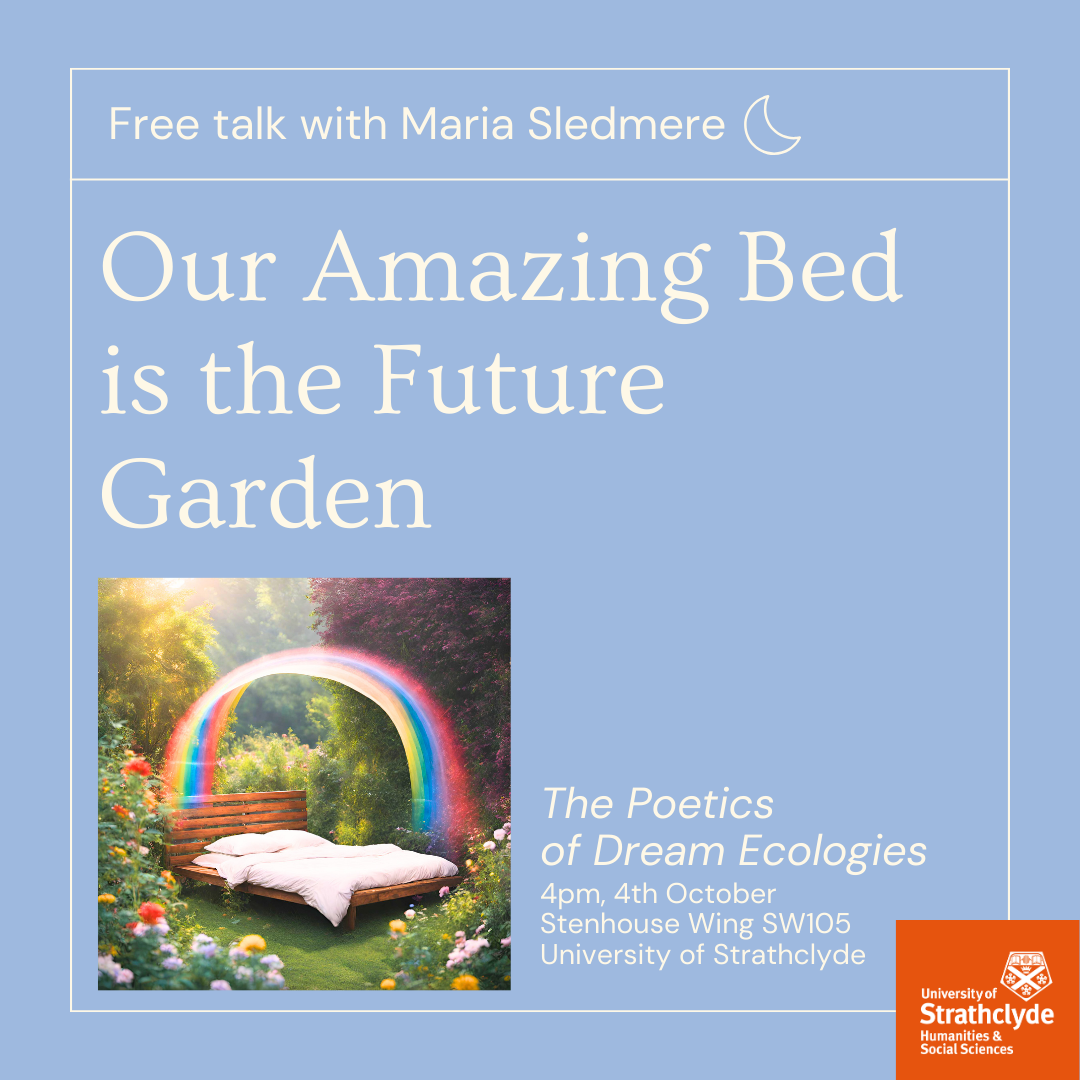
Tomorrow I’m giving a talk titled Our Amazing Bed Is the Future Garden: The Poetics of Dream Ecologies. It emerges from a chapter in my DFA thesis which will form part of a book forthcoming with NoUP Press next year. If you would like a Zoom link please drop me an email at maria.sledmere[at]strath.ac.uk.
This autumn I’ve got three upcoming workshops, two of them with the brilliant experimental composer Kevin Leomo.
Civil Twilight: Carving Dreamtime – workshop with Kevin Leomo and Maria Sledmere 14th October at 5:30pm, Civic House, Glasgow
Get your brain sticky in the pumpkin meat of the circadian and join Kevin Leomo and Maria Sledmere in carving dreamtime as an expression of creativity and low carbon pleasure. As the nights draw in and the clocks go back, we’ll be thinking about how darkness affects mood and slumber. Civil twilight is the brightest of the three twilight phases, where stars and planets might be seen in the sky as the sun dips just below the horizon. By attending to the ‘nocturne’ as a form in poetry and music, we’ll dwell in the possibilities of liminal experience for cultivating ecological imaginaries. Please bring: Preferred writing materials, If you have one, a reusable coffee cup, headphones and phone. Tickets are offered on a slide scale: £15 / £10 / £5. Part of Civic Harvest at Civic House – an Autumn themed day of family friendly activities, workshops and market stalls with lunch from Parveen’s and seasonal cocktails at Civic House Bar! Tickets
😴
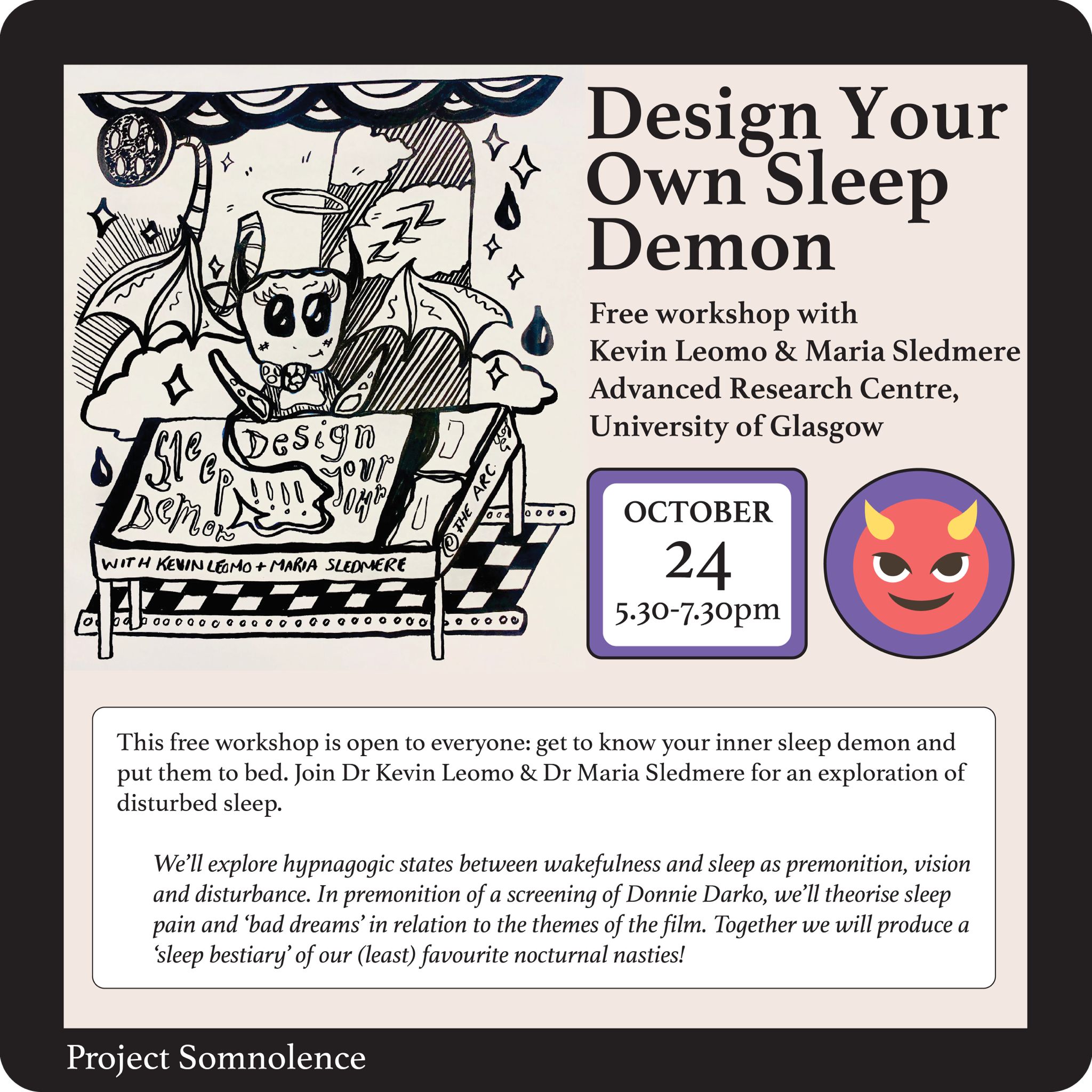
Design your own sleep demon – workshop with Kevin Leomo and Maria Sledmere 24th October at 5:30pm, Advanced Research Centre, University of Glasgow While sleep is a source of rest and recovery, many of us wrestle with disturbed sleep. If you’ve ever had nightmares or found yourself sleepwalking, you’ve encountered oneirodynia. The word comes from the Greek oneiros, meaning ‘dream’ and odyne, meaning pain. Sleep disturbance may be caused by a number of factors: from stress to stimulants, environment, illness and temperature. The eponymous protagonist of Donnie Darko is often found sleepwalking or experiencing some kind of nocturnal anguish. In this workshop, which serves as a primer for the film’s upcoming CinemARC debut, we’ll explore hypnagogic states between wakefulness and sleep as premonition, vision and disturbance. Together we will produce a ‘sleep bestiary’ of our (least) favourite nocturnal nasties, and present our findings before the screening on Friday.
The Poetry of Somnolence – weekend double workshop with Maria Sledmere and Beyond Form Creative Writing 11th and 12th November at 1-4pm (GMT), Zoom
This 2 part series of afternoon workshops prioritise the relationship between writing and sleep. Exploring cross-genre writing, visual and sonic art, we will look at how daily writing practice can recentre our circadian rhythms. From hypnagogic poetics to dream writing, nocturnal missives, dawn songs and notes on twilight, we’ll consider experimental approaches to writing somnolence. All creatives welcome.
Workshop format will combine reading, writing, listening, optional discussion and two nap breaks.
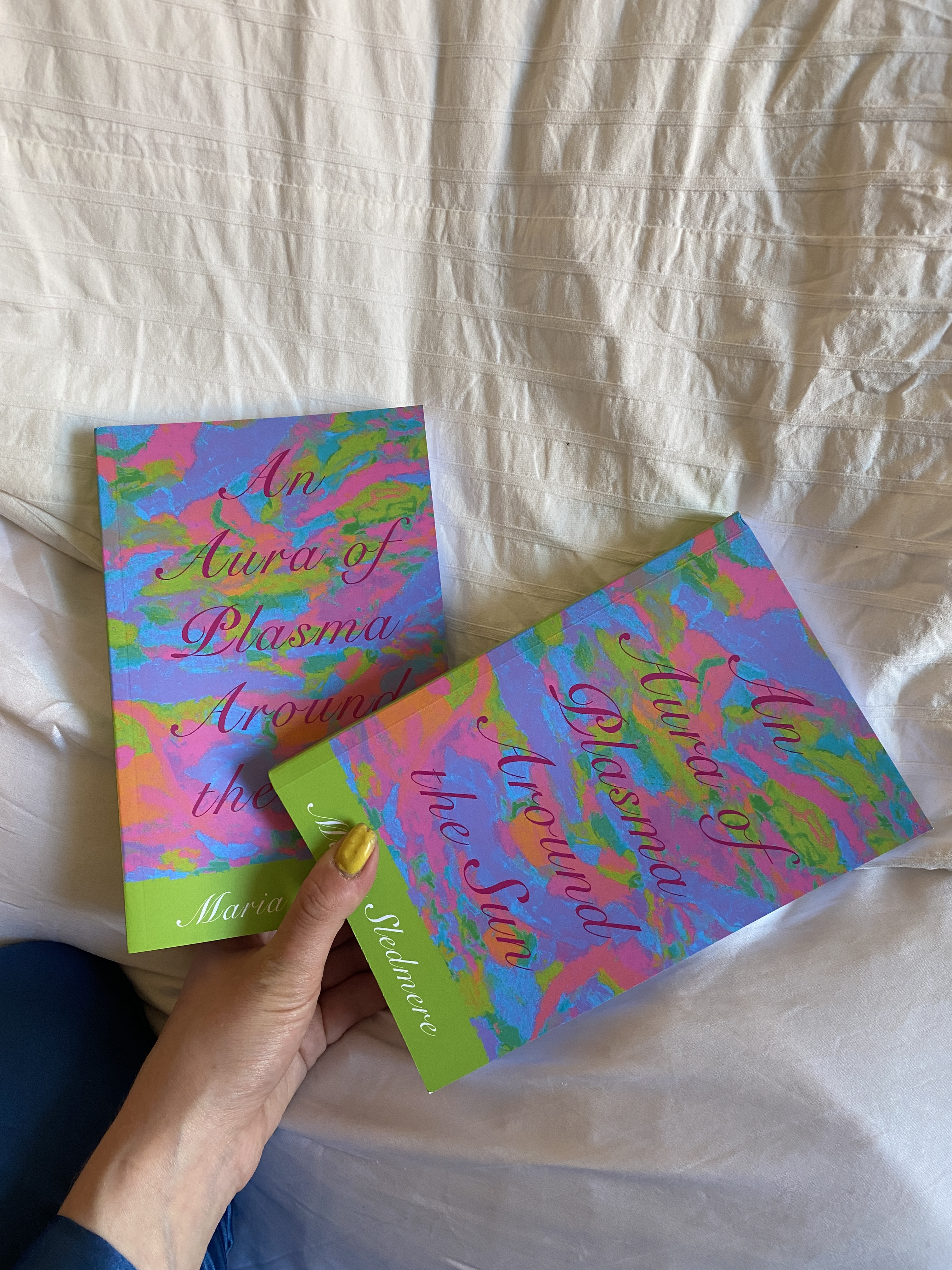
Blending oneiric memoir, experimental fiction and glitched verse, An Aura of Plasma Around the Sun swirls narratives of adolescence, occulted textual topographies and Scotland’s pandemic lockdown. Sweet, funny, heartbreaking, clever and ridiculous, often sentence-by-sentence, Maria Sledmere doesn’t guide readers through these whirlwinds so much as throw them in. Yet her spliced reveries and decadent languages are always underpinned by a celebration of community, as radiant and permeating as the sun.
198 x 129 mm / 254 pages with illustrations and photographs
That spiderwebs look like necklaces is hardly surprising. You made really good use of the cookies. They lived in your brain and measured time like a smart meter to cost more, horrible sharp smell of time, golden darling. The temperature got cold enough so that spiderwebs were necklaces encrusted with sharp frost, to unhook from trees and arabesques of gate to wear at night. The people took pictures of glaciated cities and posted them on the outer gates, with affections measured by the gram. They wore black tourmaline wolf spiderlings and blizzard stone zebras to cover their décolletage. Inside the small room, scared my hot water bottle would burst on me, I was too cold to have glamour. I looked at my golden darling coming close to coming, I could hardly wait for winter to end its solo guitar on the buttress of autumn. It wasn’t as though time snatched the web from her neck and said no more posting, no more selling yourself short as a small glass animal. Often I was a gelid cadaver, after a fuck. The man on the podcast who was a famous director said he hated to be in pain and encouraged women to stop poking their own wounds. He said to do things that made you feel better, instantly, and he put those words in the mouth of a blonde and glamorous actress. I used to buy lighthearted eyeliner and dot my face with artificial freckles to look ‘healthy’. Squinting at the sun is a personality. The moon is our universal friend. Those cookies will be hatching soon and we’ll live in the fat of their secrets. I couldn’t be alone again, especially with the gimmick machine of octovision. I had studied the web and was now found styling myself a spider matriarch, highly resistant to magic, indulged in the cannibalism of love’s imaginary, myself at the end of Verity Spott’s Hopelessness. Frost crystals glitter in the gathering wind saying people make mistakes. You can tear this from me, all of my necklacing sentence, I don’t care anymore.
Technology is harvesting our attention away from each other. We all have a “Grapevine” entwined around our past with unresolved wounds and pain.
— Natalie Mering
Of course, the flesh of the body and the flesh of the world are one.
— Catherine Malabou
Morning brings indigo gluttony of the night’s dim prizes. I remember a night in February of 2019, the brightest stars in my life we saw above a kirkyard eating chocolate for all the stars. Looking for tickets to see you again, star stuff for popcorn synecdoche of eating the bones of what you believe at the movies, infinity pool, the liminal alimony of the heart you have. I pay it all back which is why skylines exist. At this time of year, we make our own light. I text you all day and all night the text pings resonate without me, though I’m still conscious. This is how I listen to music. Harvest the ricochets until my synapse nozzles are ripe and sweet.
“It’s too difficult”
the beautiful song in my ear The Butterfly splitfin will go extinct this year
“My plastic girlhood obligatory wrote a novel you’d never know elemental love for the noise of horses”
Electra pastel of giving the lecture
Its voice never falters
Spotify should hire poets to replace the algorithm with iambs
A perfect way to respond?
The album cover of Weyes Blood’s And in the Darkness, Hearts Aglow features a glowing heart which is the idiosyncrasy of love song, gentle and melodic and good and wrong. There is something we say at breakfast about the inexplicable intimacy of an interval, this bit in the song where the chords do this or that and suddenly your heart’s aflutter. Why is that? I feel vulnerable and unclasped by music like the locket of a promise necklace snapped open, opulent. When are you gonna feel okay?
I like it best when I don’t expect it.
/
Designing the conditions for crying is easy these days. A tiny fly lands on my wet nail polish and departs as lavender.
I used to wander the abandoned golf course and around the monument to see the snowcapped hills and feel it.
Perished by screaming clouds in my brain.
I am in love with the music of Weyes Blood, we share the same birthday.
At a recent gig the singer said “thank you all for being alive”. Some people describe these songs as hymns. Last year in the climate rush of COP26 I was cycling around with my bones on fire and freezing. I would show up to the job being stared at, horrible mess of myself couldn’t hide, what do you think of this poem I said it’s a lot to unpack. Why don’t we leave those tools in the box? He says toolbox isn’t so bad. You could just improvise. I don’t look to these men to be mentors but menthols were my first cigarettes, a clothing brand called MEN is like SHEIN you could have MENOUT or menagerie, mispronounced as shine, a giraffe made of glass or a tiny glass seal with whiskers of onyx, weeping. MELATONIN or MENACING, MENDACITY / my avuncular muses of more money have outraged, they will never understand candida. A spanner in the works. No more lies. I’m most men when in lingerie maybe or styling my old surprise, the giant window in a dream wouldn’t close after I’d opened it so I had to go looking for a man to help me, high-vis or high waters our time would come to close it, not until I had escaped. Fled is that happiness. Look at it hardcore. No more lies, no more dying. Your arms in the air.
I heard catastrophe on the grapevine which was snipping guitar strings all the better to hear the lyre underneath, the union makes us strong, picket-cold and trellises our kitten hearts are growing, Natalie as in a new flower or the Minecraft roses coming up fast this year to be eaten by the dreams of spiders. Nicky Melville poem says if you’re a soft person you just get squashed, Sarah once read it aloud at the picket. I pictured a soft orange in the principal’s pocket. Roses last forever even when past their superlative. Shedding their petals to cover our eyes. Bunny put them in cubes to exhibit. Smooth wax skin.
Violet roses.
Ever since my friend with the purple aura died I’ve worn so much purple to find a flame of them, purple flame of my Raynaud’s and holy flux of traumas. What’s the point of poetry, it’s purple. I lilac therefore I lamb. I am on the lamb, I am lambing seasons, turn me into a leaf on the riptide, for I am lost. The clouds are glamorous, in pursuit of beauty’s excreta, a bad era, the best
negentropy saves us from losing everything
Secret blue note.
Wine-dark reverie of the quiet escapade, my late heart blooms for the red, the read receipt staining your tongue.
Catherine Malabou says ‘The body becomes worthy of philosophical examination when it is no longer a question of the body but of my body’. Descartes dripping wax on his robes, a lecturer pouring a pan of boiling pasta over his hand in rehearsal; the red welts between two moments, my horrible bleeding thumb. Scarlet clustering of old blood. Say it feels personal, say it is orange or purple. When it started inside me I felt the glow in my chest handed down by hyleticism of data from song: the body electric or incarnate. Menstrual tripping, I saw Kate Winslet literally on fire in fantasy after watching Romance & Cigarettes but she was invincible, what’s this script, literally the fire coming out of her in waves was my love of music. I harboured desires to stub cigarettes out on the wrists of saplings, light them and throw them barely smoked on the street; imagine my child self, scurrying around to collect them, smoking wholeheartedly the barely unsmouldered, especially rose ones. Lemonade’s infinity sunflower. I was so guilty in my treehouse for getting high, higher, highest of them all to bioluminesce in lieu of sunsets, fuck it. The cruelty displayed to our cousins was a lonesome one. What’s that word for when a word is hinged between two things, like flesh stitches that keep skin together and then dissolve inside you — a word that makes sentences make sense in this precious knitted way. What’s Latin.
Butterfly notifications in my dopamine receptors.
Coffee luxuriance and pillowslips ink-stained with diary slumbering. There are too many images trying to bed us. A stage whisper for the saints. I was born from a chrysalis of synths swaddled in melody all the better to tell you.
The discourse is banana-bruised and overly ripe in your bag.
Perfect oracle rosehip tea.
You can’t fully vanquish chaos but on the phone at a planetary scale your mouth an aquarium, spilling numbers.
It’s okay that I died, and you died a little bit that night we all did, really.
A friend is on the phone trying to renew medication. The record-breaking temperatures have lost their meaning, as in a lost glom of mercury swallowed by me. The Butterfly splitfin is in jeopardy. I have never fixed on a form for these cramps in language. The males intensify in colour when excited. The young are entirely silvery. I want to go on the profiles of the gentle ones and swim with them; you don’t need these comments, you didn’t need these things. The internship of being elegant more insect is fading. At some point
I wanted to drive. I was a girl toy and thought of many plastic cassette cases filling up the doors, the backseats with sugar. The idea of analogue as shadow, scrolling magnetic and stopping. I’m glitched by the ache which is lightening, gloss, disquietude, gelid. Girl drivers filling the roads, pouring concrete from their jars of face creams into the sea and beckoning
to make love on the white lines, almost drifting
you were there, you were swimming,
our worlds elided
I wanted to drive you to the sea cliffs of skyward to breakfast on blue.
Natalie and Lana sing of the body California incarnate, plasticity glowing emails, eyeshadow blue as in Bowie
my exospore of the hokum knowhow, excessive sentiment, hearts aglow
That house over there. That home over there. A palm. Analgesia of the sea.
Ghost for your thot
organology of a negative situationship
Catharsis polaroid still develops in my purse of us, you’re blowing out blue smoke in the dream, I’m bowing out. The eye emoji, heart stun soft mote.
And in the darkness…
It’s good to be soft when they push you down
[…]
Such a curse to be so hard
Lightning bolt award for being born at all.
I used to chew beads and often swallow them
C. said so inside you it’s like the anthropocene
many plastiglomerate organ marias
menstruating rainbows
What someone called my emotional Teflon was melted by your white-hot non-logic, almost like heroin of the pain I was in, as if to have a little blister polishing her oysters. Why is there no word for girl-come
or the tragedy of icepacks.
Kept panic-crying at the idea of sleeping
and did it until the blood vessels burst around my eyes
which are sea-coloured and colourless, unseeing.
Divine & oversized teardrop:
I bought this not on etsy but via the estuary, quartz time, I dreamt a skipped ad and heard myself in the rearview mirror bound in leather. Here is a lilac wine and the name of that bone in your chest, flagrant sternum of the lonely highway, pulling your jacket to keep warm
picking pearls off your shoulders, all the better to lick this neck
in the flesh of the road
Bernard Stiegler says the relation entropy/negentropy is really the question of life par excellence
a pair of glowing red eyes
Buying more dreams at the pharmacy
of lurid blue
your poor wee cold sore
sky porn falls into humming. It’s free, it has to be.
Anything lost at the point of service.
There’s so much I wanna say about this album
holding me tight
I wanna tie the lights
and go off to hear it shimmering beneath the moon, whose memory
bruises
rosemary
real blood from your forehead
and the shadow of the one who
was yours
a long plague
season of neutral sensation
new motor neurons at the cosmic dawn
tripping cured my parosmia somewhat I could smell sauerkraut, frying onions, coffee, kerosene my only name the body odour of the shadow you loved
I can’t tell the trees from the shape of lightning
in subtitles
spiralise my love for the seventies
in edible language
flares in the highlands
the problem is not being affectless
but totally loving too much
all the tautology of stardust
let’s take the motorway route to ride our souls
under sunblock and metal sculpture
you feel balmy here, less exposed, fear of
merging
what we are
white hot collision
emotional whiplash
Emerging triumphant the dawn is a fog machine it is only October, none of us a sweetheart neckline could finish the sentence
swishing our way to ceremony
music makes sense
instead: a down & dirty musical set in the world of italicised starlings
which are assholes
because of radiance
for the love of original mud which connotes the whole story
they had to take flight
The body of both selves is ochre like in Husserl the real world is everything
a dialectician of starlight
Morning gluttony. Grasping. A worm in your blessing
fragile apples on the counter / collect to rot.
The real era was gradient and dependent on what Merleau-Ponty calls illness, ‘a complete form of existence’. I lost a normal form but what I found was the shimmer conundrum of the shape of you, California, a rice harvest of shiny red-blue tears to grow a purple flower, you guessed it.
Possession.
Pearly beads, the slasher heartfire of a bold new vision
touching me soft jealous of cornfields
Hellbound in egress, dark glow, December’s acupuncture of clouds.
How can something so big feel so cosy?
The creature is god.
Told myself I’d scrub mould from the bathroom today. Flux glow from the dirt that is given us to know the worst.
A given thing: music is grieving.
I wrap the vine around me in the hope of fruiting, or any violet outcome is fine. You bake a good pastiche like an electric goddess, cancelling plans all the better to scream at the stars. Loop trope. Hold yourself soft or hard, by the collar or hand, by moonlight tripping in Finnieston and in Yorkhill and by the masticated night which is always online in the digest of even the worst ‘The Flower Called Nowhere’
Mothering the subgenre of oblong buildings, bliss our heart this hurt. You essay your way to music but is it not your allergies that crystallise accomplice to the throat of time? Thank you, thank you for the mystery. It’s so late.
And we love this crescent moon
for all intelligence is the art of rupture
Falling asleep at the movies
And I am choking for a sweetness that really sees me.
~
Some italics are lyrics taken from Weyes Blood’s And in the Darkness, Hearts Aglow (2022).
‘Notes on Lyric Solarity’ at Summer in the Way, Birkbeck University of London, 9th July 2022.
Video of a creative-critical paper delivered over the weekend at Birkbeck, as part of an ongoing collaboration between the87press and the Contemporary Poetics Research Centre. Below is an extract from the first half of the paper. A lot of this thinking is developed more fully in a forthcoming academic article.
As flowers turn toward the sun, by dint of a secret heliotropism the past strives to turn toward that sun which is rising in the sky of history. – Walter Benjamin, Illuminations.
Today, I’m going to move fluidly between poetry and essay to present some nascent thoughts on lyric solarity. I want to suggest lyric solarity is a poetics in which solar imaginaries are linguistically mediated and refracted through the close rhythms, affects, sensoria and arts of noticing associated with the focalised energies of lyric poetry. Lyric solarity enacts an embodied poetics of dissolve, exposure, surplus, saturation and excess/residue: it offers a way of turning towards the sun, while helping us make, in the words of Imre Szeman, ‘commitments to reshaping’ the ‘existing infrastructures’ which underpin access to and distribution of energy. While the anthropocene, a contested epoch defined by humankind’s ascendance as geological agent, is often understood as an issue of scale, attending to the solar helps us think about planetary crisis in terms of distribution and density of harm, resources and changes to climate or energy. I take energy to mean both the power derived from physical or chemical resources, the property of matter and radiation manifest as a capacity to perform work, but also in the sense of an organism’s energy – their metabolism, vitality, ongoingness within the world, and its working demands or desires. What follows is less of an argument than a set of propositions and possibilities, a selection of field notes in search of lyric solarity.
Sans Soleil
In Chris Marker’s film Sans Soleil, often translated into English as sunless, we begin with a quote from T. S. Eliot’s ‘Ash-Wednesday’: ‘Because I know that time is always time / And place is always and only place’. It begins again with an image of three children in Iceland, ‘an image of happiness’ accompanied by black film leader. The voiceover suggests that if viewers can’t find happiness in the image of the children ‘at least they’ll see the black’. The film is itself a kind of lyric documentary on human memory, how memory is fragile and so our recall of personal and political histories – especially on a global or even planetary scale – is inflected or reworked in the present. In the spring of 2020, I approached the film as a kind of memory place. I had never seen such spring sun in Glasgow, but due to Covid I was locked down inside my own sunless temple, or tenement. What follows violates, perhaps, Eliot’s insistence on the essential containment of space and time. Eliot, I guess, never used the internet.
I was messaging the poet fred spoliar, and suddenly it was the solstice and we wanted to mark it. We began this remote collaboration, not in response to Marker’s film so much as through it, or some residue within it, a blemish or shine. A bright spot, a blind spot, a kind of fleck on its vision. We wrote remotely, wrote ‘live’ and in those hours of shared writing, we existed in a solar time: where solarity was a quality of memory, its absence our absence, and yet also speculation towards something better – waiting for rays of arrival. In that sense, the poem is about the uses and abuses of pastoral; about an ‘elsewhere’ to be written around, glimpsed, squinted at, but never quite accessed. It’s also about the temporal alignment of two people writing together. Lyric as a thought device for telecommunicating something of a paraworld hidden in language. I’d fall asleep with our phrases like film credits flashing behind my eyes. We wrote between the summer and winter solstices of 2020, we split lines with sun-cloud emoji. Here’s some of the opening sequence of the poem:
Ultraviolet rose us
spilled into formless
unration of atoms
and we spend ourselves back, the day
extends pause,
folding up
in luxe ellipsis
hills and hills
of recessional cloud, cast debt
between us, rolling one-sided
to release it, all of I’m rain
cast thru fierce aureate
disquietude, to not say
hope this finds you, or
nearest the soft motif of yr hair
bright spots around the antisolar point
balayage of except champagne
never sets. In a forest image / I cannot touch you
or notify through light that drowsy reminder
we are many. Something
decorative / in the cold soak of sylvanshine
gives up its entrance, the long day
composed of such stills is lying
back from its voyage. To say
all of the land escapes / an exorbitant teardrop
a teardrop. I have these ambient hands.
I wring the leaves…
2. Solar Apocalypse
In Etel Adnan’s poetry sequence, The Arab Apocalypse (1989), the sun is variously a shapeshifting trickster, a totalising energy, an authority, a marker of time, a blinding force, a monster, a pool of blood. Here are some of Adnan’s lines taken from across the book:
I took the sun by the tail and threw it in the river. Explosion. BOOM…
the sun is contaminated by the city
the sun has eaten its children
a sun rotten and eaten by worms floats over Beirut silence is sold by the pound
eat and vomit the sun eat and vomit the war hear an angel explode
The brain is a sun STOP the sun is an eye
the sun’s atoms are incarnating in my flesh STOP STOP
The sun is a kind of virus, pulsing and multiplying, changing form and colour, nourishing and deadly, making things grow or die; a kind of white noise in the context of war, a vulnerable body, a weapon, a machine of surveillance, a carnal threat. In the American Book Review, Barbara Harlow says of Adnan’s poem that it ‘invokes a mythic past […] to presage a present that resists narration’. To presage is to be a warning sign, a prediction, typically of something unpleasant; in archaic meaning, presage is an omen, a feeling of foreboding. In The Arab Apocalypse, Adnan writes back and forward to historical crises: as Aditi Machado points out in an essay for Jacket2, the poem was begun in January 1975 in Beirut, two months before the outbreak of the Lebanese Civil War. But there is also a generalised economy of violence, exposure and replenishment which speaks to the twentieth century at large and indeed to the explosions, contaminations and environmental atrophying of the twenty-first century. As Harlow identifies, the simultaneous, coagulating, geopolitical crises of the times, what we might call the ~Anthropocene, are often resistant to narrative. The recurrent, modulating figure of the sun has more of a lyric quality, beaming and seeping, punctuated by telegraphic lines and signals of stop, break, transition. Language garners a lyric intensity which is elemental, saturating, overspilling the traditional bounds of a human ‘I’. Impressive and god-sized dramas of the stars and planets play out in a mythopoetics of Beirut, of Gilgamesh, of ‘grass snakes hiding in the texture of TIME’ (Adnan, The Arab Apocalypse).
3. More sun to consider in lyric
Julia Kristeva’s Black Sun
The music of Sun Ra
Sean Bonney’s ‘solar cop’
The shine sprites in the video game, Super Mario Sunshine
Georges Bataille’s ‘solar love’
David Schwartzmann’s ‘solar communism’
Alli Warren’s Sun Dial
The photographic process of the ‘anthotype’
Björk’s song ‘Sun in My Mouth’
Catherine Wagner’s line ‘If everything is from the Sun why praise it’
In Paul Klee’s painting, Castle and Sun (1929) the castle is line-drawn in myriad geometry: its surface is of different coloured shapes, set underneath a bright orange sun. In proximity, the colours shimmer and vibrate. If there was a patchwork made of Adnan’s poem, it might be this; or indeed one of Adnan’s own geometric, brightly-coloured abstractions. Shimmer is to shine with a soft, wavering light. It offers a coming-to-knowledge distinct from the Enlightenment regime of ‘shining a light’ on your subject; it is a way of making contact, of existing in non-linear, non-narrative – that is to say, lyric – timespace. In her 2018 book Surge, Adnan writes ‘We came to transmit the shimmering / from which we came’. In this shimmering tautology we yet cross a line, continue transmission. Shimmer is instrumental in what I call ‘hypercritique’: a poethical form of writing which orients not to the capture of time, meaning or ecological reality, but to a beyond.
Walking to the supermarket today cost wild amounts of strength and energy, for which I am grateful to have spent now that I can eat nauseating Roquefort cheese in the hope of coaxing my numbed-out tastebuds to attention (so far semi-successful) with lathering of French mustard on wholewheat bagel. Semi permasick seemingly from something in the walls in me. MOULD. Watching the Easterheads peruse giant boxes with undersized, foil-wrapped eggs inside reminds me of a lecturer I had many years ago whose primary exam advice was to study always with such an egg by your side, because curved chocolate is ‘superior’. Trying to summon childhood memories of Easter and all I get is something hardboiled and glum, rainbow-painted free-rangers being rolled down the smashed-up concrete of Minnoch Crescent estate. What were you supposed to do next? Retrieve the egg. I forget. I roll over. I have to sleep on my side or something in my organs hurts; but I believe cats have healing powers and if a cat wants to sleep right on my chest, sure, I’ll sleep on my back and wake up better.
So I’ve been enjoying The Blindboy Podcast and recently the episode where he talks about the internet before it became, well, everything. The total bombardment. Blindboy has charming tales of what cultural scarcity was like before you could just shazam the shit out of any sonic phenomenon, google every micro-thought that comes into your head or find your brain rewired around the big-ass anxiety MMORPG that is Twitter. I’m geriatric millennial enough to remember this and especially tapes. I had a thing about tapes. I wrote about this already, way back in 2014, my thing for tapes. That was kind of before the indie tape revival (is it still going on?). Seriality in writing is irresistible to me. The backwards and forwardsness of it. Krapp’s spoolish jouissance. Bernadette Mayer’s tape recordings in Piece of Cake, Memory and Midwinter Day. The glossolalic Mr Tuttle in Don DeLillo’s The Body Artist.
Recently, editor, writer and absolute king [<3] in the poetry community, Aaron Kent, published a pocket-sized pamphlet called The Rise Of… (Broken Sleep Books, 2022). The back page features the familiar anatomy of tape reels encased in clear plastic. There’s a kind of Side One/Side Two vibe: a long essay-poem, ‘The Rise Of…’, which documents the process of coming to know what happened in the wake of a sexual assault; and a poem ‘Inkmist’ dedicated to ‘CRASAC group therapy; for saving me‘. This is a breathtaking work that doesn’t so much ‘confront’ its difficult subject as enter into a kind of ‘momentum’ capable of thawing the petrification of trauma. Of central concern to the speaker is the notion of hallucination, of letter-writing, of ‘difficulty’ itself. I opened it gently from the envelope as I once would a cassette from its casing, read the whole thing in one go and found myself at this point upside down on the sofa, blood rushed to my head, kind of too stunned to even cry. The fluidity and force of Kent’s words are such that all kinds of dormant synapses in my own brain began to take flight again. This is poetry which dials up exposure not exactly to ‘tell a story’ but to disclose the whole affect-storm of a writing that could approximate a traumatised consciousness — one that is at once deeply singular, embodied but also permeable within language itself. A writing that soaks up the residues of thinking’s trillions. It’s hypnagogic, syncopated, a rush; full of swerves, stops, broken clauses, syntactic mania. Forget punctuation. This is a book about the secret. About a wild undersong of constant, yet fluctuating pain. ‘I’m like a sponge i’m always shedding and if i don’t deal with it the pain won’t go away’. Anhedonia, itching, ‘something so simple and powerful’ about a scream. ‘There must be a word for losing melody’. In a blurb for the book, Day Mattar describes this not so much as ‘a stream of consciousness’ but ‘a flood’. There’s something mesmerising and unstoppable here. ‘I am the rapture!’ Buy this book.
When I was in London I also picked up Emily Berry’s new collection, Unexhausted Time (Faber, 2022), a book I’d hotly anticipated owing to Berry’s excellent previous titles Dear Boy (2013) and Stranger, Baby (2017) but also because the book cover perfectly matched the magenta of fred’s new iets frans tracksuit. I read this last weekend in a few turbulent, food coma type nights, marvelling at how my brain could just pick up a special Berry ellipsis, steal it for a dream and then awake to another suspension in the poem. This is a book full of ghosts and twisted souls, a kind of carefulness around utterance itself; spellbinding in the sense of a spine for holding together our weathering lives. A book bound by some kind of spell. You have the sense of a secret, and a holding back:
All statements purporting to be act are true. Nothing goes away… You carry it with you, if not on your back, or in your arms, then somewhere behind your eye… So be careful… See the ghost scratching at the door frame for the note that will free her. The past is parked next to me like a dirty van with messages fingered in the grime…
(Emily Berry, Unexhausted Time)
These lines summon us but also disintegrate on the page as dust. I imagine the automatic typing of a super-intelligence gleaned from our messages. It feels intimate, uncanny. Where is this person speaking from? I want to take their advice seriously. There’s a lowkey lockdown hauntology, the house turned inside out by a kind of social toxicity. Anything natural is also sort of monstrous: ‘It always seemed to me a kind of madness, / the gardens all in flower year after year’. It’s sort of obscene to me that the blossoms are all out and I feel about as disconnected from them as if they existed purely as pixels. Is this disintegration of the senses a prefiguration to ageing? How do you stay involved with the big delicious ‘madness’ of the sensory world? The hyper-pitch of birdsong made audible by the lockdown of spring 2020 was lush, but also spooky. As if to be always in the dawn song of 5am, alone with the birdly chimeras — too piercing to surely be real? I miss it. The feeling of being wholly alive in waves. Write something to the ghost?
It always comes back. And there are new messages…
(Berry)
The digital eeriness of felt presence. New messages. Poems in their seasonal palimpsests. I want that unexhausted time, a time we haven’t yet strung out, a time to be rechilded. A time for birds.
Dearest, Happy pink moon!!!!!!!!!!!!!!!!!!
Lastly, the new Ludd Gangarrived. Mark Francis Johnson:
Those birds of passage present as fists.
I think we fauns may learn more from those birds than
half-hours by the sea teach us.
In the summer the woodcutter wanted to fell my home
and I let him.
(from The Faun Book)
You go stumbling, burned your pineal gland, phone mum. I keep the doors open in my dreams in case a deer walks in. ‘With my eye’, says Jesse Darling in the same issue, ‘I wanted to go / there, to the end of that road. With my whole body I wanted to go / there’.
Let the cold, curved chocolate fit the lip of my tongue, from the fridge.
Want also to melt.
Earlier I wrote something of our weathering lives. It’s the most beautiful and encompassing thing you can say to someone, becoming the spooky sweet hail in flux with sunbursts and mugs full of snow, a rainbow.
Something like an offering, snowballs of silver foil. Blossoms and more blossoms.
Again, from Ludd Gang (the last poem), Gloria Dawson writing for Callie Gardner:
hey, you were my weather sometimes arriving at my door
It’s been a fair while since I posted. Struggling through Covid, another supercold (emerald phlegm forever), more transitions, finishing my thesis, April snow, more streaming of the body and ache, but here we are. It’s good to get words down. I can’t smell or taste anything at all right now (coffee is just…neutral earthiness, sweet potatoes are…mush of the orange variety, bread is…send help) — so the vicarious pleasure of language is all the more heightened. Sometimes it’s a barrier: why read about anything when your senses don’t respond? I’m drawn to the elliptical which doesn’t hold me for too long. I want to be let go or dissolve a bit. Like eking my reading through a fine mesh of muslin, a semi-permeable membrane of comprehension. Or pull it over my head, this paragraph, the whole fabric of the thing. I was gonna write about a month’s worth of reading: mostly while walking west to east along the polluted, outer commuter belt of the city; on trains between Glasgow, Inverness, London, Leeds; in frail, unwaking mornings; at the park, in that golden week, sitting in the grass with salad from Juicy and daffodils. Instead I wrote about sleep.
*
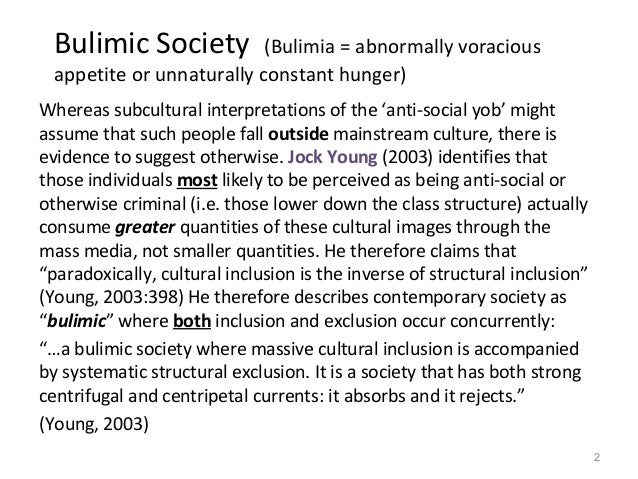
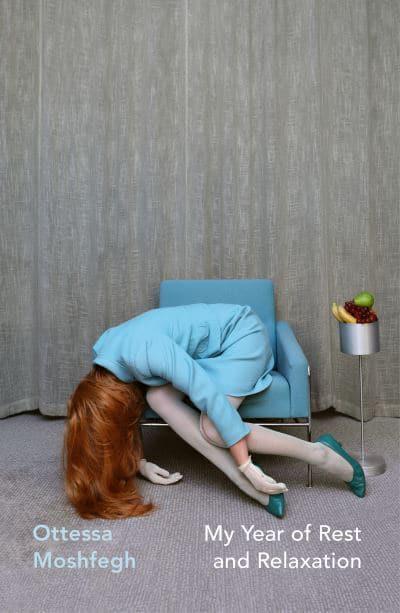
Finally I got round to reading Ottessa Moshfegh’s My Year of Rest and Relaxation (2018), a book I wanted to read especially because a trusted friend described the ending to me as ‘disappointing’. I love to glut myself on disappointment. For some reason the novel produced a similar effect on me as Tom McCarthy’s Remainder (2005), in that the pleasure was all in the premise. I would love to exist endlessly in the loop that is prolonged sleep or the reconstruction of a highly specific sensory memory. I want these novels to just go on and on like that. Of course, there has to be escalation, as per the rules of plot or ~human nature~. Is it true we can’t circle the mobius loop forever? That after a while the pleasure is desensitised, and we need to dialup on the extremity? McCarthy’s novel sort of preserves that perfect figure of eight in its set-piece ending, and you’re left with the image adrift to loop back on the primal, inciting moment of falling debris and trauma. I found the Moshfegh ending ‘cheap’ in that it seemed to cash in its bulimic character for a kind of tragedy whose fate was to fall. Bulimia, I can say, is generally an experience of permanent insolvency in the body, resulting in a loop time of binge and purge. You pay the debts of fasting by devouring; you pay the debts of eating by purging and fasting. Rinse, brush teeth, ouch, repeat. The sociologist Jock Young talks of ‘bulimic society’ as one where the poorest and most marginalised are often the most culturally enmeshed in the desperate iconography and desire economy of consumerism. The most excluded populations, according to this view, absorb images of what is apparently available under the veil of late-capitalism; but simultaneously they are rejected from accessing this culture themselves due to material inequality and class difference. As Young puts it: ‘a bulimic society where massive cultural inclusion is accompanied by systematic structural exclusion. It is a society that has both strong centrifugal and centripetal currents: it absorbs and it rejects’. But does capitalism spit us out or do we boak back? This is why I am scared to go on TikTok, like fear of lifestyle saturation to the point of nauseating breakdown.
Often powerpoint slides defining bulimia for this sociological context mention an ‘abnormally voracious appetite or unnaturally constant hunger’. In Moshfegh’s novel, the character Reva (an insurance broker) is constantly eating or constantly fasting; something our protagonist describes with pity or nonchalance. Reva is tragic because she wants too much what the protagonist effortlessly has by birth: beauty, thinness, style, money. Thinness is kind of the ur-sign for WASP privilege in the aftermath of the heroin chic fin de siècle. Reva is jealous of the protagonist’s weight loss, steals her pills. Both women are after control (or its relinquishing) in a world in freefall.
This is a period novel: set in the early 2000s, New York in the lead up to 9/11. It’s full of that inertia following the boom of the 1990s. The desire to just sleep in the unit of a single year is like a microcosm for not just an end of history, as per Fukuyama, but a refusal of history altogether as this thing that keeps growling, accumulating, disrupting sleep. I kind of buy into Reva’s bulimia as something about the consequence of being voraciously invested in a world that wants to expel you, sure. The sky’s big whitey’s the limit around Manhattan. Chewing on this feels productive. The violence of the novel is primarily in the gallery where the narrator starts out working. The gallery’s prized artist, a young man called Ping Xi, has these ‘dog pieces’: a ‘taxidermied […] variety of pure breeds’, which are rumoured to make their way into the artist’s exhibition via premature slaughter and industrial freezing. The work apparently ‘marked the end of the sacred in art’. The narrator is kind of offhand disgusted but eventually comes to identify with the young animals in the freezer, waiting to be thawed into art. Writing can be a bit like self-cannibalism; the denial of which leaves you stoked for a snack.
There are several kinds of hunger in the novel: primarily for sleep and food, but also for meaning, intimacy, loyalty. Love is a strange relation that moves uneasily between two girlfriends whose friendship is based on a premise of inequality and co-dependency. The hungers are sated by devouring emptiness. Sleep, junk food, fleeting talks. That bit in Melancholia where Justine screws her face up deliciously and says the meatloaf tastes like ashes. When I realised the same of my dinner, I didn’t even react.
We look more peaceful when sleeping. It’s worth lauding, like Lana singingPretty when I cryyyyyyyyyy………….
O, and the concept of the sad nap:
There was no work to do, nothing I had to counteract or compensate for because there was nothing at all, period. And yet I was aware of the nothingness. I was awake in the sleep somehow. I felt good. Almost happy.
But coming out of that sleep was excruciating. My entire life flashed before my eyes in the worst way possible, my mind refilling itself with all my lame memories, every little thing that had brought me to where I was.
(Moshfegh, My Year of Rest and Relaxation)
The brutal awakening cashes in on the extra expenditure of napping. I’ve written in a poem somewhere, ‘I wish I could sleep forever’. It’s different from wanting to die. It’s more like, wanting to feel aware of the nothingness and calm in its premise. Nobody needs anything from you and you can’t give anything back. It’s restful or at least prolongs the promise of rest. Stay awake super late to relish the idea that you could go to bed. I don’t remember the last time I woke up feeling energised by sleep. </3 I remember listening to an interview with the editor of Dazed where he talks about sleep being his great reset. I remember thinking wow sick cool. Whatever mental health thing he’s going through, sleep will heal it. Sleep can otherwise be a kind of emulsion of depression. You’re in the weight of it spreading right through you. I carry sleep along even when I don’t ‘have’ it.
I want you mostly in the morning when my soul is weak from dreaming (Weyes Blood, ‘Seven Words’)
I used to wake up extra early before school to steal back from sleep. I felt sleep would eat me alive. I used that time to browse the internet, write, read. Eat shitty muesli. Puke.
I’d sleep in class. Teachers would bring it up at parent’s night. I just couldn’t understand why everyone else wasn’t regularly passing out over their schoolbooks.
The perma-arousal of bulimia is a counternarrative to the inorganic sleep cycles pursued by the novel’s main character. I got a similar vibe from watching Cheryl Dunn’s Moments Like This Never Last, a documentary snapshot of the pre- and post-9/11 world of New York’s underground, showcasing Dash Snow’s graffiti and outsider art. Dash is always cheating sleep to go tag, paint, take pictures. There’s a ton of cocaine and consequence. 9/11 had toppled right through all of that leaving a wound. You know by the law of entropy that it can’t be sustained, this life, writing on the walls and all that. Maybe tagging is also about a kind of hunger-purge. Colour’s aerosol vom marking time, presence, ideas. It’s permanent, but then someone can just go clean it up; the ultimate fuck you.
Whose space does this belong to? Remainder is a novel about gentrification, the white guy’s obsessive reorganising of London spaces as precursor for the gentrification of Brixton. A novel of the zombie flaneur, fuelled on flat whites, iPad swipes and vape juice, as Omer Fast’s 2016 movie adaptation brings into focus. Moshfegh’s novel is set around the same time, but her protagonist is decidedly not a flaneur, even if she carries that vibe of the waking dead. She barely leaves her apartment to get coffees from the local bodega, and when she does venture further it has all the amnesiac disaster of a night on the NY tiles with Meg Superstar Princess, furs and all. I find this zombie existence an irresistible metaphor for the numbing effect of late-capitalism: we are overstimulated and aroused to the point of just turning off. It’s banal to say that, sure. What’s great about the Meg Superstar Princess blog girl revival is the way the writing itself is charged with like, full off-kilter zaniness. The opposite of zombie. It’s like barhopping around A Thousand Plateaus — cheap wine in one hand, vintage Android in the other —to the tune of Charli XCX and it’s absolute chaos: ‘spitting e pillz out my mouth, trying to live normal, disco n apz’. You get smashed. You’re alive! I’ll have it in writing because I can’t really have it elsewhere rn, the same way I sleep but I can’t really sleep. Apps (f)or naps?
For all this tangent on (post)pandemic hedonism (let’s say post to mean, posting and not to signal some wholescale shift in era), it’s weird how history just hits you in the face at the end of Moshfegh’s novel. Falling debris, bits of glass. Words:
On September 11, I went out and bought a new TV/VCR at Best Buy so I could record the news coverage of the planes crashing into the Twin Towers. […] I watched the videotape over and over to soothe myself that day. And I continue to watch it, usually on a lonely afternoon, or any other time I doubt that life is worth living, or when I need courage, or when I am bored.
(Moshfegh, My Year of Rest and Relaxation)
Earlier in the novel, she’s frustrated when someone replaces her VCR player with a DVD player, even though she doesn’t have any DVDs. She kind of hates the concept of the DVD. She likes the process of rewind. Video tapes, with their seriality, make you confront duration; whereas DVDs allow easy random access to specific scenes. The over and overness of Moshfegh’s careful, clean, lethargic prose is at once soothing and disturbing. When the pandemic first hit, I couldn’t stream anything because the thought of having all that content at my fingertips seemed appalling. Like accessing a trillion orderly dreams of someone else at the very moment I couldn’t even touch another person. Maybe video tapes would’ve been different. The residue of wave matter at the edge. The analogue sense of fossilised images, decaying in visible time.
In a poem called ‘Along the Strand’, Eileen Myles is like,
The times of the day, the ones with names, they are the stripes of sex unlike romance who dreamlike is a continuous walker
I love the rhythmanalysis of daily life here. VHS stripes in descending order of luminance: white, yellow, cyan, green, magenta, red, blue and black. How the speaker clings to named moments of the day as like khora: receptacles unseen for adhesive feelings. ‘Vigorous twilight’, ‘noon’ you slip into, ‘Morning’ as ‘something / I could stay with’. The times of day are lovers. If romance is continuous walking, there’s not a lot of romance in My Year of Rest and Relaxation. So after reading the novel I’m sorta stuck on wanting the romance of sleep again. Exhalations as stripes of sex. Like when you have a new partner and after a few weeks of breathless sleeplessness suddenly the first thing you realise is how well you’re sleeping, like being beside them all night just fixed your life. And so to be in love you know noon tastes different, and twilight has a lilac halo. And you’re sharing this shiny sticky static in the air like asterisks, so much more to say.
*
Sleep. After a long walk, I remember circling South Norwood Lake and humming Elliott Smith’s ‘Twilight’, because of the time. You asked me to sing it. I had a low voice, a high voice. I was just waking up; the air was all lavender, leaves in fall.






 mariaology