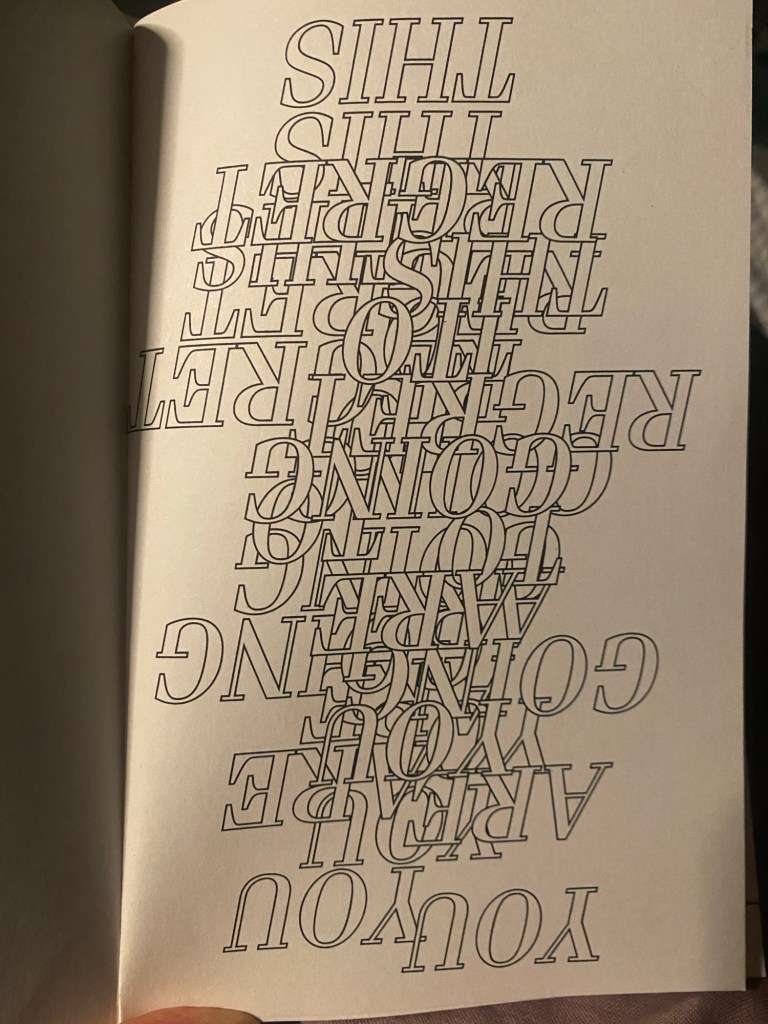
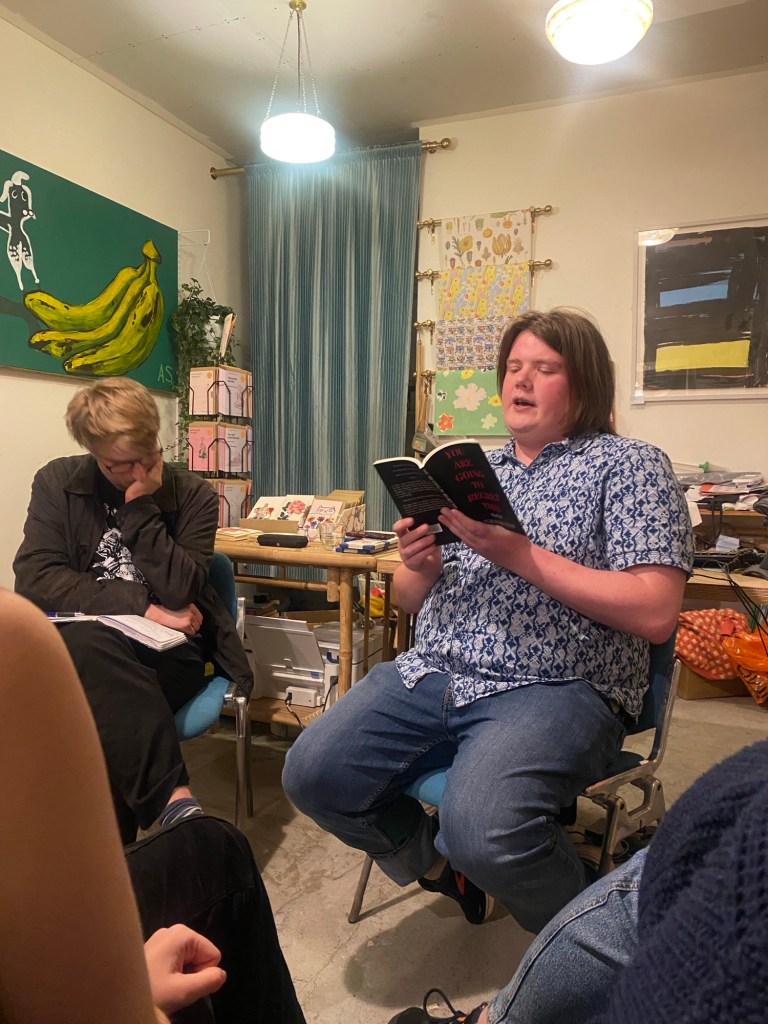
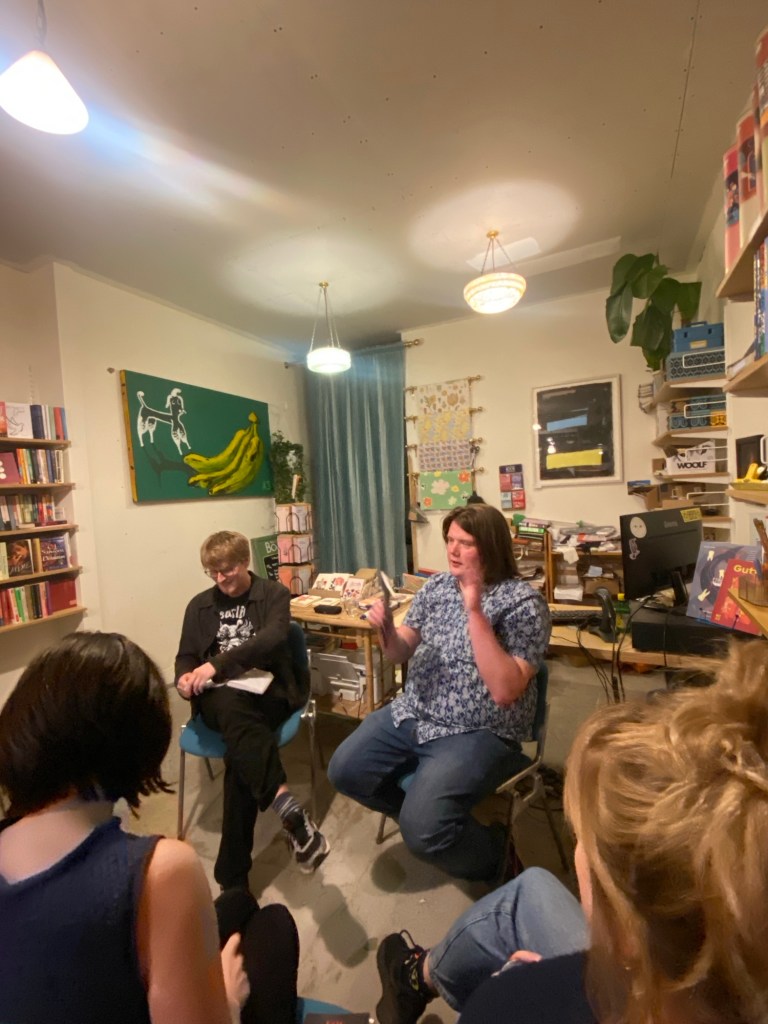
Tonight was the book launch for Tom Byam Shaw’s new short story collection, You Are Going to Regret This. Despite Storm Amy, Mount Florida Books was packed which is always so good to see (stay tuned as we’ll hopefully have another SPAM launch there before the year is out!). Tom read some pieces from the book — extracts from ‘Retail’ and ‘Arcana’. In conversation with Ian Macartney they talked about the New Weird, monstrosities and cannibalism as metaphors for capitalism, the world falling apart while people shop, continuity vs cataclysm, hauntology, real stories, Aberdeen, Glasgow, the Anderston motorway underpass (also a soft spot for me though I’m also partial to the Cowcaddens). They talked about a time when the Aberdeen open mic scene was so saturated there would be like seven different nights to choose from and regular performers would become minor local celebs. The shaping of each others’ work (both were members of the Re-Analogue art collective). At one point the word nice was said in a spiralling, elliptical comic-sweet way — I think they were reflecting on earlier days of friendship — and Katia was like this is nice ! bringing us into the present, that’s the point. The book looks great and sincere corkscrew really pulled a good number on the design. It will probably lure you into the basement which will smell of brand new trainers and you will have to confront something terrible. Everyone kept saying ‘for fans of Alison Rumfitt’. Yeah!
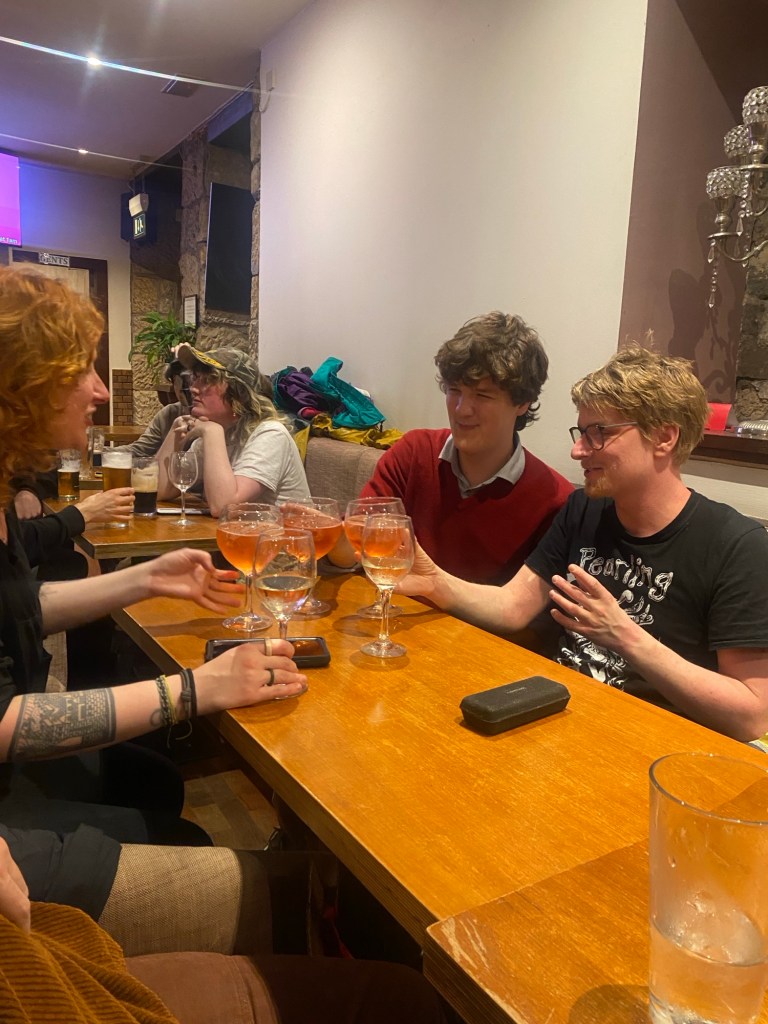
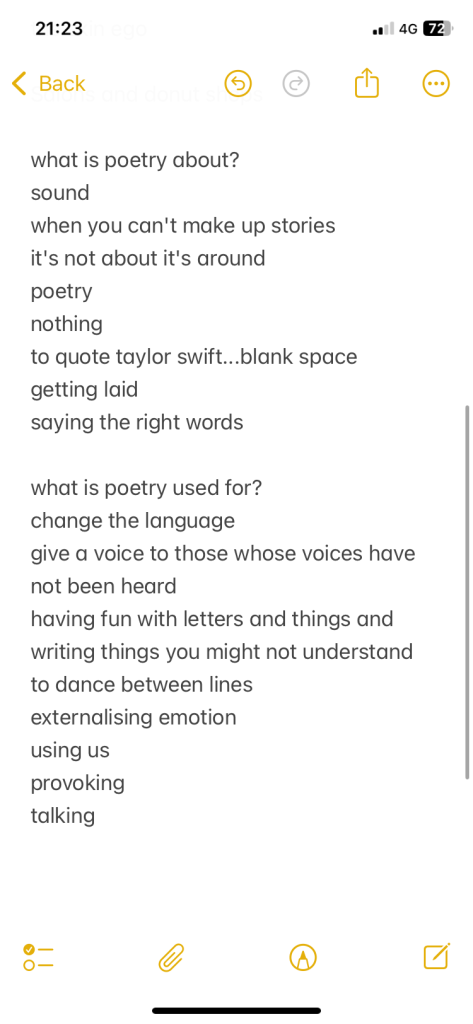
Afterwards we bandied out to The Ivory Hotel and with key questions bundled from some poetic eavesdropping of K’s café memories, I made people talk about the what and why of poetry, lifting these questions wholesale from said memories. Maybe having ‘a night off’ from poetry put me in this mood. Thanks to all who contributed. Everything was Guinness-flavoured and first thought.
J., Z. and K. shared their childhood guinea pig stories and we swapped anecdotes of encounters with rats (at home and in the workplace). The sorrow of a tiny animal curled around the absence of another.
Fans of poetry! This is an amazing, free to access archive of Bay Area audio recordings that just went live — Andrew’s been working on putting it together for a while now.
‘The Kenower series collects recordings donated by Andrew Kenower of Woolsey Heights and A Voice Box. These recordings present Bay Area readings from the aughts to the present, with a particular focus on those that receive little to no funding and run outside of institutions and commercial spaces, typically in homes, galleries, backyards, and parks, such as Artifact, Canessa Park, and The (New) Reading Series.’
Once there was an idea to make food. A pan was taken and a dark green plastic mixing bowl. Broken-up bits of cooking chocolate were added to the bowl and the pan was put on low heat. Blue flames licked the edges. What was forgotten was water. Whoever wanted water. Water to eat? No. The butter and sugar of the chocolate melted into the dark green of the plastic and that plastic became fluid and congealed into geological pools, hardened kind of bubbles in the silver pan. Black, acrid crackles. The scent was caramel and cancerous. This could not be edible.
Nor could the labour of scraping such a biohazard off the pan be edible.
The kitchen was evergreen and giving, until it couldn’t be.
There was something missing.
What was edible about listening for her car to pull up the drive, the lights to flash up, a heart leap, she’s home?
Tonight I wore what can only be described as a billowing tent and cycled in the rain to the SPAM x sincere corkscrew AFK event. Summer is over, sorry. The newish Away from Keyboard series has so far featured poets-poets-poets — local and visiting — with some exceptional forays into prose. Tonight’s affair was premised more on the prose-y variety, with flash fiction, short stories aplenty, but also music and poets reading to music. A London poet recently said all the poets are now doing ‘sonic poetics’ and this trend has made its way north. I’ve been wanting something more durational for a while. Longer readings that feel like a proper ‘set’. Having sound in the mix trains us to listen longer because we are listening beyond listening for ‘meaning’. This event was set up nicely so that the first few performers did their punchier sets and then the final two were longer. I wasn’t involved in organising this one so also quite nice to just sit back a bit.
First up was Anna Walsh. My first time seeing them read after much hype from Kirsty over the years. Their short story pamphlet Stag Do / Fantasy Hornjust came out with brand new London-based indie, Ssnake Press. Anna read a piece set in PureGym, ‘the best spin class in Shawlands’. It was funny, closely attuned, turning a sharp lens to the ennui and im/possibilities of desire, and made me think about the gym as a terrain of fantasy triangulated by disgust and expenditure. A toxic combination that is fun to sublimate through multitasking on the StairMaster, whether you are sending emails or texting e-girls. The observational plane of fiction would then cut up into self-reflexive moments of becoming-object. Here are my thighs. They are moving shapes. Sweaty hair. Here is the screen showing a beach. The pink disinfectant spray. In my notebook I wrote: What can you trust of how human relations conspire in the endorphin farm?
Sean reads with a beam of light splitting the room
Anna’s reading was short and sweet, followed by the blazing Tom Byam Shaw who delivered some hits from the cesspools of late capitalism. A disturbing anecdote featuring a licentious coworker at Footlocker. The reterritorialising of terror as gender reveal party… ‘We have a gender…it’s a war!’. A story about Chernobyl Cat Girl at the rave, ‘a party without respite or rest’. These are fictions which tremble with the hurtling premise of assured combustion. Tom’s book is coming out soon with sincere corkscrew. Launch at Mount Florida Books on the 3rd October. Following Tom was Sean Turner McLeod. Nobody knows if they have ever heard Sean read before. His author photo definitely wins best prize (if you didn’t see it, he’s standing in a picturesque river looking fierce af, exhaling dragon-quantities of vape smoke). He has been published ‘widely and discreetly’ and his work is great, witty, delivering its critique in lashes of sardonic commentary on everything from the gentrification of Glasgow to self-hating ghostwriters, poverty tourism, the Sunday night tv spectre of our Scottish childhoods, Neil Oliver, whose ‘voice made you drink’ (intone that darkly). Sean is good at verbal sparring and he essays with ease around many things vivid, for instance, the ‘controversial’ Joan Eardley painting of a male nude. Sean, I hope we will hear you read more!
Ian reading playlist poem in Xiu Xiu tee. Poets drinks of choice: IPA, tap water, whisky
After a break we had Ian Macartney, cohost of the night, deliver a virtuosic list poem about playlists. A smart, discursive cascade which was hallmark Macartney, traversing pop culture, geopolitics and counterfactual plot twists of recent Scottish history. One of the first lines was ‘The playlist is a commons’. Ian is a true lover of songs and the anguish of how much love for the playlist is distorted by the cynical, algo-ploy of subscription profiteering comes across in the poem’s argumentative rivulets and sparkle. It got me thinking to how so much of this blog used to be ‘playlist posts’ where I’d diarise lightly around a playlist, as a way of marking time. At some point, I fell out of love with the playlist form. Too long, sprawling and tantalised by algorithms, I lost the ardour for ‘looking’ that precedes any possible curation. What then soundtracked my life since I stopped making monthly playlists? An album, or a single song. So how did that transform the flow of time itself? Did I get ‘too old’ for playlists? There was a loud tone. It was found resounding in everything. Summer’s faded peach. Plaster peach. Crooning afternoons. This one plucked lyric. Is that true though? I remember having a collaborative playlist (‘E-WASTED’) for my 30th birthday party and on the night, the pub wouldn’t let us turn it up loud enough to hear it. But we played it anyway, all 24 hours and 54 minutes, knowing it was there, knowing we’d never get through it. Registering time in its variety. I wrote in my notebook: Once the modal curation of the playlist was a way into writing but then I stopped thinking of songs in their lily pad potential to cross the river of whatever mood or walk you were caught in. So what, did I wear the songs instead? I let them wear me out and I wore them to death. The songs were hot freaks! Ian’s playlist poem was a poem of nowness, enacting its ‘repetitive pattern in space’. I heard a girl downstairs shriek ‘Bye, love you!’ and thought — that’s one for the playlist. Add ‘Bye, love you!’. Midway through the reading, Ian holds up a piece of paper revealing an obscure, eleven-sided shape. I hope the mathematical reality of the poem is some kind of angel number squaring of 11 and for the playlist to transform from anaphoric placeholder to the reflexive imperative — play [the] list — as you wish. Start the poem. Perform. An eleven-sided playlist for being born again. For this to be a gesture of love, obviously. & ofc, fuck Spotify – tho I have spent over half my life listing songs on its lifeless interface.
Maddie reads!Zeo and viola!
Following Ian, Madeleine McCluskey of Big Red Cat zine read some short stories with a fairytale flair. There was an island setting, ‘spindly earrings’ and ‘menthol cigarettes’. A girl who dies. Friendship, hunger, ‘a burrow formed where lunch ought to be’. I thought about the cruelty of fiction and how we must die and plotting towards endings and hunger as a grammar of prolonging. A few performers this eve list 1999 as their d.o.b. in the author bios and it got me thinking to what a fin de siècle aesthetic might be like. I wouldn’t say anxiety was a running theme exactly. Neoliberal hell obv. But maybe an archipelagic consciousness of hopping between — something about working with what is shorn up amidst so much erosion [more thoughts needed]. Elsewhere supplants elsewhere’s interminable now. We had another break then Zeo Fawcett did a set of live viola playing with backing tracks and singing. He is so so talented and the songs were unique and compelling, shifting the tone of the evening. He had this story about missing out on hanging outside Boots being an emo because of having Gaelic singing lessons as a teenager. Sometimes I wish I’d had the Gaelic singing lessons instead of hanging outside the Odeon being an emo. There was a song called ‘Feeling really impermanent right now’. Later, I start to identify too much with a rain drop running down the window in a memory of a bus window in a 00s tv show.
Charlie & Texture Texturescattered poems & tartan carpet
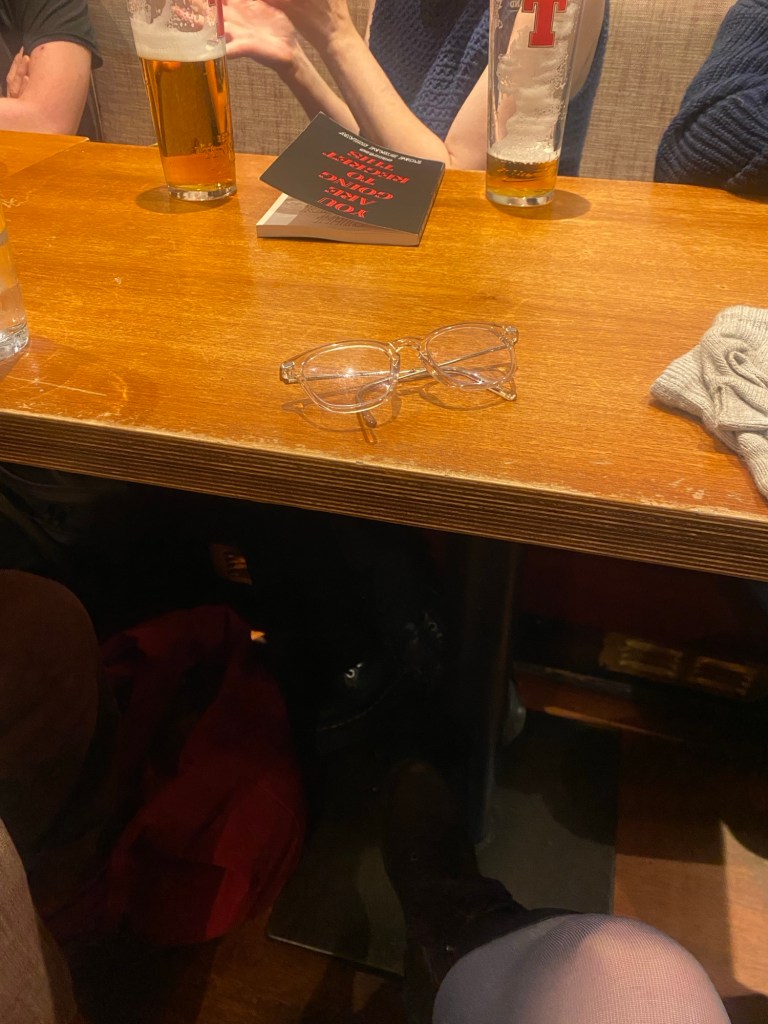
Introducing Charlie McIlwain to his Texture Texture outfit, Ian attests to the success of their connection, claiming that ’email is the way forward’. Honestly not enough people in the room questioned the boldness of this claim. I want him to be right about it though and briefly I parenthesise all communication to the epistolary promise of endless more soons like the swooning glut that would end platform capitalism and reunite us with wild cognition, in just enough time to save the world. For now, this chance pairing of Charlie and Ian will do. This is a fucking great set of surreal, whipsmart k-hole cantos delivered with register switch ups that surprised at every turn. Hilarious and devastating, with fitting improvised drone from Ian. I thought of Spicer’s radio and how there would be aliens in the ancient walls of The Doublet dictating this through the frequencies of wave machine. One regular punter from downstairs popped in by accident and stood in mesmerised bewilderment (nah, rly he was just giving glaikit) before turning back and losing the opportunity to have his head blown off by poetry. We had ‘white fire violetted daddy’, we had ‘sleep is just cloth’, ‘you can use your ass like an appliance’, we had literally two pairs of glasses, ‘stop killing Lorca’, imploring ‘the language is in trouble’ folded into ponderings borrowed from W.S. Graham, we had ‘Hegel ate a crow’, ‘the furniture will not endure perception’, we had Brian Wilson and John Clare ‘and shall I know that sleep again’. Listening was like trying to trip talk with someone who is not tripping and in the duration of that performance (idk 30 mins or so?) I let myself (what comprises brain matter of synapse and syntax) be scrambled by signifying mayhem and enjoyed every minute. Go buy Charlie’s Elegy [Model Interaction Trend] now you fools!
When I found the remnants of some kind of pop-up carnival show on Kelvin Way, cycling home, dis-articulated along the road in luminous obstacle, I knew I was still riding through Charlie’s poem.
~
Thank you for reading! This write-up is for K. and anyone else who couldn’t make it – plus I forgot to record the audio for this one sorry! but one day we will upload the mp3s from AFKs of yore…and this one will be remembered in the hearts & minds of all who attended… xx
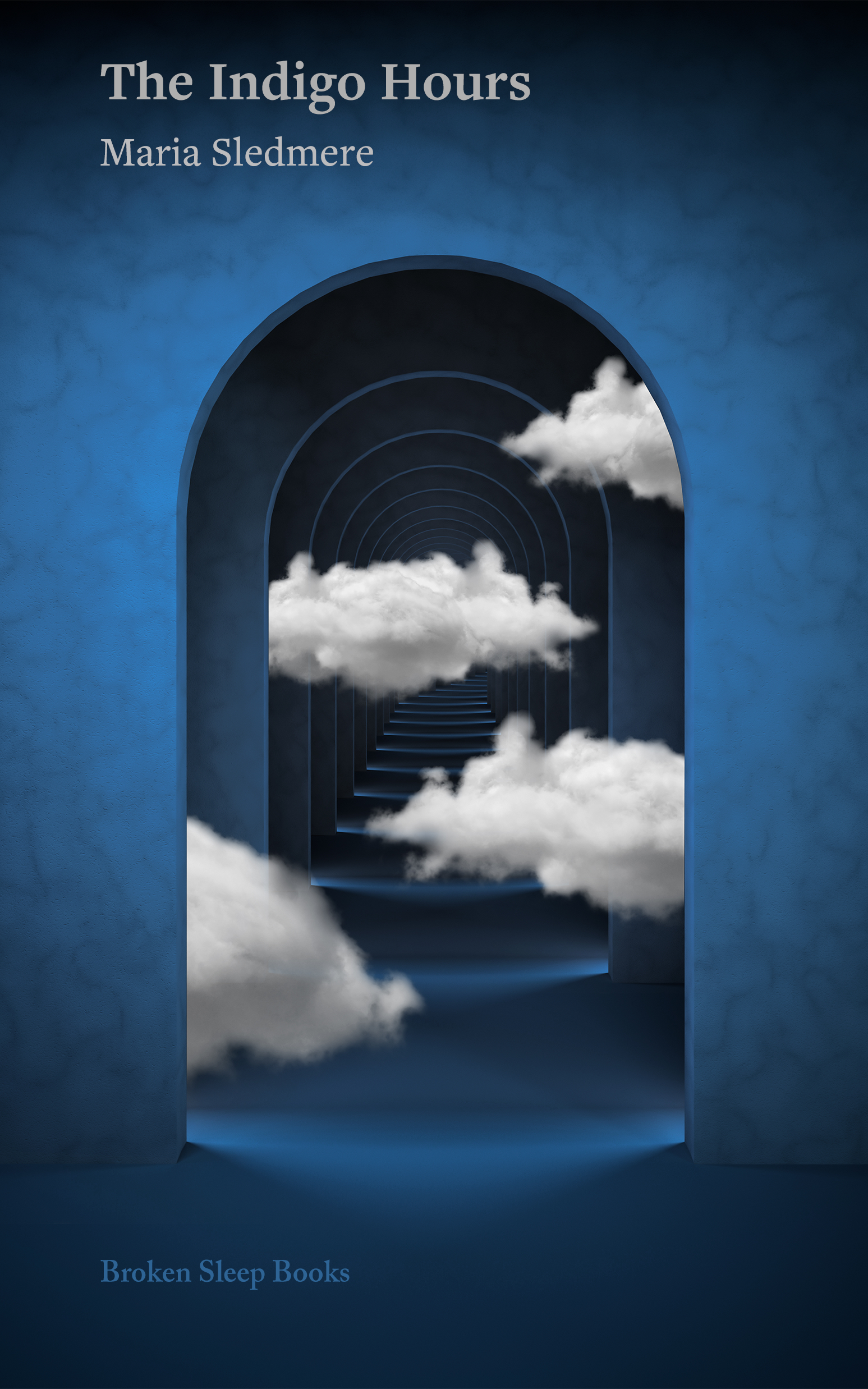
🦋🌫️🍋🟩The Indigo Hours…forthcoming with Broken Sleep Books
In 2018, I wrote a novella about erratic romance/Romance and the lyrical space-times of its (im)possibility. The fictional ~situationship at the heart of this work is stretched into, over and through various places — real and imagined — which the narrator digs into as pockets of presence and meaning. With its wandering, non-linear plot, I’d describe The Indigo Hours as ambient fiction. It’s a little eclipse of a book. It was ambiently written (leisurely, over one summer, as a dare) and may invite ambient reading. Which is to say, a textual experience more inclined to ‘going round’ a thing, attuning to its surrounds, getting lost, adjusting the frequency of (dis)interest. This is like dating a semi-transparent person. To adore the ghosts of both of you. How might love halo or envelope one’s personhood? How might love’s presence be felt ambiently in the objects and subjects of everyday life? The work tests love against memory, song, travel and friendship. I was interested in the phenomenon of blue — specifically indigo — as a desiring filter. Indigo as a singularity. Indigo as language of variable opacity. Denim wash (to go someplace). The supernatural inflection of indigo children (as a vocalised attempt at performing divergence of attention, durée and feeling). The book is full of aura, fleeting connections, music, art, intimacy and loss. It will be out on Hallowe’en, 31st October 2025.
Some nice things people have said:
The Indigo Hours’ lyrical prose, daubed from a free-associating palette of sensory psychedelia, becomes a portal into a ‘blossomy blossomy realm of the possible,’ where sadness is a sexuality, jealousies cause for celebration, and love a drunken texture. Painterly, tender, and spatially generous, this affecting novella rewards re-reading, like a magic eye that reveals a new image, and perhaps new self, with every glance.
— Poppy Cockburn
The Indigo Hours is watery fortification. Beneath li’l triads of asterisk constellations, Maria Sledmere tells a post-Romantic tale of moonlit precarity and passion among pools & thunderstorms & prairies & airports, where feeling wretched wandering midnight miles is a complex freedom, as exposure on cobalt-lit webcams, dozing/dosing to dub deep trap techno, bruises so Blühen. Yet under cosmic circumstances that augur heartbreak, Maria gifts us the deep assurance of ancient-blue auras and a languageful love pulsing constant. For insomniacs-or-otherwise against analgesia’s ‘“who cares”’, a most vital and tender-prone tonic.
‘In A Thousand Plateaus, Deleuze and Guattari talk about a child walking through darkness who ‘comforts himself by singing under his breath’: ‘Lost, he takes shelter, or orients himself with his little song’. The song ‘is like a rough sketch of a calming and stabilising, calm and stable, centre in the heart of chaos’. Despite this centring effect, ‘the song itself is already a skip’: something on the brink of ‘breaking apart’. I take this to mean something akin to what you say about ‘the way poems know things’ through ‘co-ordinates of sound’. Like their navigational function. So often, reading poetry, I have felt like that child in the dark.’
Thanks to editor Tom Bailey at And Other Poems for inviting this conversation to happen! Always a delight to talk with Oli Hazzard about all things poetry, telepathy & dreams.
I don’t know if it’s summer or just plain warm for walking around in search of dark-bitter reprieve pulled the Ace of Pentacles in Maureen’s the pledge of a seed planted in manifest pasture walking up the Grand Parade to have Mau grab my arm and pull me into due embrace since they were just getting breakfast, sloshing oysters with Dom I keep saying it’s good to be with everyone the neighbours are rehearsing a play I sit on the floor and arrange paperwork phoning it all back like I failed to see the love in front of me fertile and with selenium
wishing I could have bottled the birdsong of Brace Cove so much to trap myself in notes also reeling around the English Market with poets wishing we were Irish ordering whisky with Luce if you ever want to talk, we say if you ever need whatever
the Beamish flows easily it is less than five euros. I have yet to burn my fingers on ice, to go home into caring situations with dutiful infinite replenishment of ice instead I run up Shandon arriving late for Maggie O’Sullivan, early enough to catch her words as Eden-variety everafters flying around our garden of poetry I was locked from initially, outside in the street awaiting my call
that poem about a mother opening her belly that poem incants a fact, you are present sometimes being born you will always be able to talk to me I weep through the reading, it’s easy to constellate far away suffering in greener syntax just across the sea to afterwards hug Maggie, thank you we have no idea how powerful words are to leap, mutate and glow in defiance of the law how hard it was for all of us just to get here
everything we’ve been through will be again but I don’t have a generation we see wagtails on the lawn sonograms of gathering voice what is it to be intimidatingly full of life Gloria singing of sailing Carl making faces at the baby making faces at poetry as we remember Callie being smart and funny and so singular as to outlast all of it eating dosa while watching Ellen Dillon’s killer reading then a cuckoo went off on someone’s phone, hello pastoral
those oysters were universal tell me about your shoes
guess I will inherit my father’s spiral cutlery
all the better to eat what cannot be stomached of home-cooked nowheres rich in cortisol
what I want is raw and clear
saw a little grey dog at my feet during Keith Tuma’s performance not a real dog, offhand come to comfort me because dogs smell cancer even when someone else’s lives like a phantom accord on your aura and in the forever ward of poetry who will get away with autumn
my life is a spatiotemporal displacement filtering love’s dimensionality
I want to go back to Dogtown rose petals steeped in promises
‘You may be weaker than the whole world but you are always stronger than yourself. Let me send my power against my power. So what if I die. Let me discover what it is that I want and fear from love. Power and love, might and grace. That I might desire again’ (Gillian Rose, Love’s Work, pp. 74-75).
Institute for Advanced Studies in the Humanities, 2 Hope Park Square Edinburgh EH8 9NW
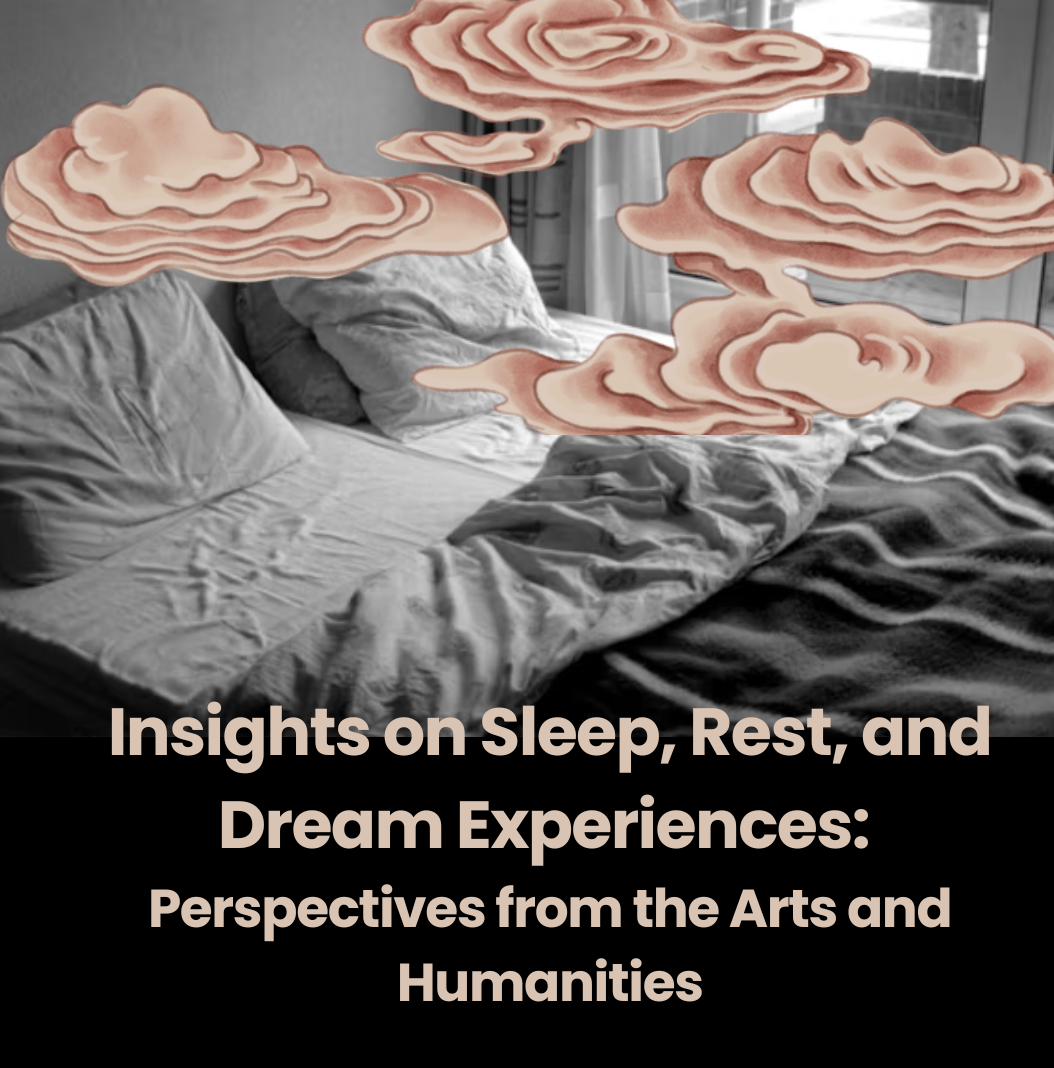
Broadly, our societal response towards sleep and rest is one of downgrading and devaluation. In our current capitalist society, sleep and rest are conceptualised as a time of passivity and inaction, and thus, as a period in which we are not producing or accomplishing. We tend to be jealous of those who can go about their days with fewer hours of sleep than ours, or praise those who can maximise their schedules, crammed with an endless series of activities and tasks. However, lack of sleep and rest time can lead to poorer health, both physical and mental. A good night of sleep can be one of our most restorative activities, and despite this fact, it tends to be neglected. Similarly, sleep and resting states allow for the occurrence of experiences that, if carefully attended, can provide us with a tool for self-exploration, such as dreaming and daydreaming.
The workshop intends to explore how these and related issues to our relationship to sleep and rest can be approached from the methods and perspectives of different disciplines within the arts and humanities. To that end, the workshop will consist of short presentations, panel discussions, and collaborative sessions for active participation. The workshop will be hosted both in-person and online.
DrMaria Sledmere(English & Creative Writing, University of Strathclyde)
Preliminary schedule:
11-11.25: Introduction and reflective activities:In this initial session, participants will be encouraged to share and write down their thoughts about their relationship to sleep and rest.
11.30-13: “Topics on dreaming, sleep experiences and transitory states” (Dr. Alcaraz-Sánchez, Dr. Bernini and Dr. Cowan). Short talks followed by a Q&A.
· Dr Marco Bernini (Durham University): “Dreams and Heightened Narrowed Immersivity: Combining Saturation, Permeability, Presentationality and Presence”.Are dreams (narrative) worlds? What similarities and differences are in play between our waking consciousness of the perceptual world and dream consciousness as quasi-perception? This paper posits that dreams exhibit a unique experiential mode called ‘Heightened Narrowed Immersivity’ (HNI)—a state characterized by intense presentational immediacy and severely restricted informational context. Combining frameworks and concepts from narrative theory and cognitive science while looking at dream reports, literature, lyrics, and movies, the paper shows how dreams and their artistic mediations reveal unstable ontological environments—low saturation in time, causality, identity, and space—while maintaining a high degree of immersive presence.
· Dr Robert Cowan (University of Glasgow). “Exotic and Ordinary Dreaming”.In this talk I consider two kinds of ‘exotic’ dreams. First, those that occur during episodes of REM sleep behaviour disorder where subjects allegedly ‘act out’ their dreams. Second, lucid dreams wherein subjects are apparently aware that they are dreaming while dreaming. My question: what do these exotic cases tell us about the nature of ordinary dreaming? My answer: very little and certainly less than others have thought.
· Dr Adriana Alcaraz Sánchez (University of Glasgow). Hacking the sleeping mind: the exploitation of the dreamspace.In dream research, the term ‘dream engineering’ has been adopted to describe techniques that manipulate, record and affect our dreams. Within the research context, dream engineering has become a useful tool for exploring the nature of dreaming as well as its potential for enhancing our waking lives. Yet, a couple of examples taken from outside scientific research might make us worry about the extent dream engineering practices should be conducted, especially when those are applied widely to the general public. Here, I consider some of the ethical implications of those practices outside the research realm, some of which put into question the value we attribute to sleep and dreaming.
13-14: Lunch Break:Vegetarian and Vegan catering for all participants
14-15: Panel discussion: Working title “The need for rest”(Dr Reeder, Dr Jones, and Dr Callard and Dr Sledmere): Our panellists will give a flash/provocation followed by a chaired discussion with questions from the audience.
15-15.15: Short break:Tea and coffee for all participants
15.15-17.00: Creative session.In this facilitated session, we will explore the role of dreaming/liminal states for creative purposes.
· Poetry reading and discussion by Dr Sledmere and Dr Hazzard.
· Haiku writing and Deep Listening activities
17.00-17.30: Discussion back to the rest of the workshop/final thoughts
From 17.30: Wine reception at IASH (Open to all participants)
This event is organised byAdriana Alcaraz-Sánchez(Postdoctoral Fellow in Philosophy, IASH, University of Edinburgh), Maria Sledmere (Artist and Lecturer in English & Creative Writing, University of Strathclyde) and Kevin Leomo (Artist and Community and Engagement Manager, University of Glasgow).
Accessibility: This event will take place at IASH, 2 Hope Park Square, Edinburgh, EH8 9NW. Please see a map here: https://www.iash.ed.ac.uk/location
The Seminar Room is on the first floor, and unfortunately IASH does not have a lift. If you have mobility issues and would like to discuss access, please contact iash@ed.ac.uk as soon as possible. Next to the Seminar Room, there are a couple of rooms that can be freely used in between the sessions/break time. If you require a quieter space at any point during the duration of the workshop, do reach out to the lead organiser (contact below) or let any of the organisers know on the day of the event. There’s also access to a microwave/small kitchen space if you require it.
Note to online participants: All sessions will be streamed, and online participants will be able to ask questions. However, note that due to the engaging nature of some of the sessions (i.e. creative session), we will not be able to provide tailored support or feedback to online participants. The sessions (including the talks) will not be recorded.
Note to in-person participants: Unfortunately, we are unable to cover travel and/or accommodation expenses for participants. Catering (including lunch and refreshments) will be provided to all.
Contact: For any questions or enquiries regarding the event, please get in touch with the lead organiser Adriana at Adriana.alcaraz.sa@gmail.com
The event is supported by the Susan Manning Workshop Fund from the Institute for Advanced Studies in the Humanities (IASH) and is jointly hosted by IASH and Project Somnolence.



 mariaology