1993: the birth of the Web

Daily writing prompt
Share what you know about the year you were born.
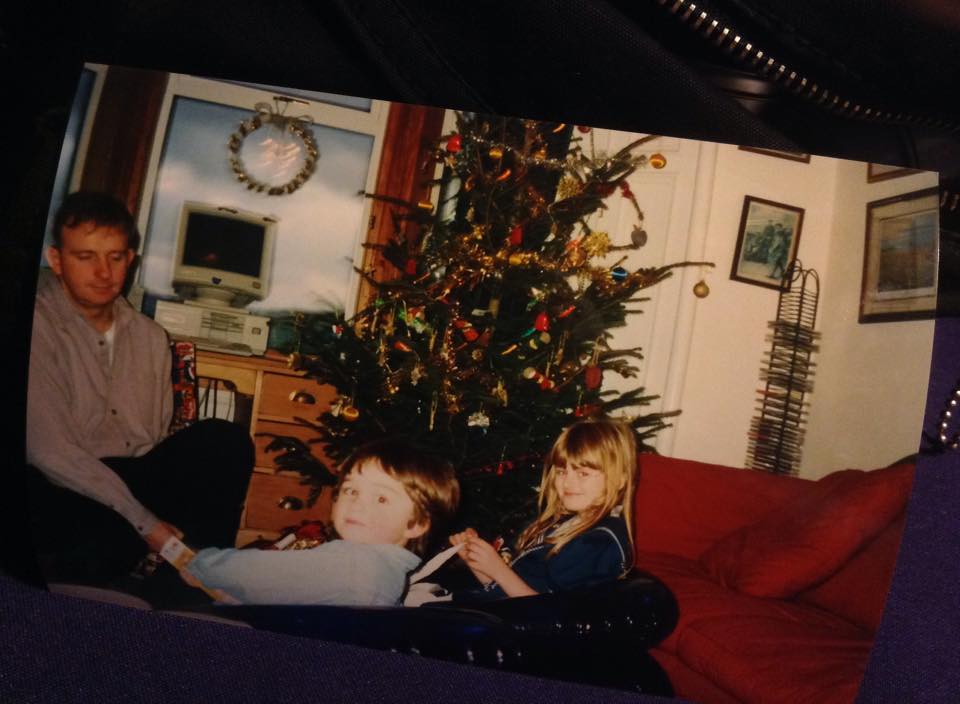
My dad, brother and I at home in the 1990s, overlooked by a magisterial PC

In 1993, the World Wide Web was released into the public domain. There are many histories of the internet and this one is pretty idiosyncratic. I like asking people when they got their first desktop computer. The internet of 1993 could be navigated through bright blue hyperlinks and you would drift between websites. You would type stuff into AskJeeves and have no idea what to expect. At school we had a ‘passport to the Web’ certificate that could be obtained by completing numerous training activities on a twee little software whose name I forgot. It was something like ‘CyberKids’ though surely that is a New York City raver subculture from a time not yet captured by the sleazification of all things indie 2000s. I imagine it was superior to the present Cyber Security Training on offer, in which actors pretend to discover pen drives in the street, gleefully insert them into work desktops only to find their screen literally blowing up in front of them. Nowadays, cyber security training is less about don’t talk to strangers and more about change your passwords regularly. I have a lot of floaty metaphors for the password changing which seem to all include underwear or car parts. Passwords though are pretty boring, clunky things but they’re also gauzy ephemera. Pieces of secret unlocking. Recently I spent an entire Sunday trying to unlock a 2011 MacBook. The password, when I found it again, accessing the deepest recesses of abstract memory, was unforgivably cherishable. I’ll keep it forever like a pet (I’ve already forgotten it).

I keep thinking about ressentiment as a sensation produced by the internet. I mean the internet’s failure. When I was a child, I adored the internet. Once we’d upgraded from dial-up, I would spend upwards of 12-14 hours almost nonstop on forums, games, LiveJournal, websites. I gravitated naturally from the virtual worlds of the Game Boy to the bigger screen of the laptop. Before I was even allowed internet access, I would simulate them by making endlessly complicated Powerpoints and Microsoft Publisher pages which connected to one another like a crude open world. I was beset by RAM crashes and Wi-Fi outages. We didn’t have broadband for a very very long time. My dad was one of the first in the village to have it. I would write letters to the broadband guy pretending to be my dad complaining about the speed of the internet. When I go back to the Shire now, I say things like ‘the internet here is ass’. I can’t get 4G at the semi-demolished and barely functioning station. We can’t find out if our train will come or not. We communicate as a brooding micro crowd, frowning and looking anxiously towards digitised screens whose flicker says only ‘delay’. There are no staff. The staff hide in a crisis. I can relate.

Ressentiment – deep hostility combined with powerlessness. The promise of an open world, a generous future, seems rotten. We hate it. It’s failed us. The sheen of that; it keeps nicking us like a pen knife writing sentences on the skin of our hard-worn feet. We can’t even quit the platforms, can we? The implied ‘we’ of a web community is now an absurdity. What have we seen of the Web in thirty years? Unimaginable horrors. Nevertheless, the perambulations continue.

Right now, I’m deeply interested in the dissonance between how we feel the internet ought to be structured, how it almost was, and what it’s become. The dream metaphors we might use for how it once felt to drift between websites, stumbling upon weirdness after weirdness, unlocking more zones of reality. This versus the algorithmic governmentality and corporate monopolies, ‘technofeudalism’ (Varoufakis) and the appification of it all. I think I got interested in poetry right around the time I fell out of love with the internet (2015). I would memorise passages of Charlotte Smith’s sonnets and learn to swoon over Keats. I felt there was something in the shifting stanzas, the intricacies of form, the dazzling surprises it produced and the infuriating difficulties of grasping the source code — a connection.

I still use the term ‘post-internet’ because I want to believe you can take what Tavi Gevinson in 2018 called ‘The utopian ideal of the internet’ and polish its ‘antiquated’ remains. You can still feel the affective charge of every Web-related signifier that has brushed your life. You can be desensitised to ‘internet discourse’ through the media proliferation of tales of digitality, its foreclosures of democracy, its moral flops, its proliferating conspiracies. But there are parts of you irrevocably brought alive by the internet. I am haunted by digital solastalgia. As a child who felt out of place, abjected from the beginning, I sought the Web as a place not for social belonging exactly but something more like beauty, information, elsewhere. I found little pockets of home all over the place. The web (I’ll stop capitalising now and step out of History) was an extension of the fictional landscapes I found in my dreams or when walking around, making up novels in my head which I did every day until I hit puberty and hormones ruined my brain forever (or whatever). I don’t really know where to find those places any more. They weren’t just artefacts and I know this because you can’t produce a screenshot of a website from 2003 and experience a sweet pleasing nostalgia in the way you could with say, a beanie baby. It was something about the world of it all, the navigation, the desire paths forged to get there. The post-internet, for me, is a lifelong quest in understanding that melancholia and homesickness of what comes after. What do I do with the feeling of ‘we can’t go back there, where do we go now?’. All this time, have I used the web itself as some elaborate metaphor for wanting more than a hostile, futile reality? It’s why I like infrastructure, databases, libraries: the promises of systems which take you somewhere. Which transit something. I also love loops, links and non-linearity.

What was the poetry that got me into poetry? It was Romantic in flavour, sometimes in era. Something between the locatedness and dislocatedness, the attention to daily life, the catapulting scale logic of the sublime, the dogged attempt to render the brain on Nature, the melancholy and mourning, the quiet adoringness, the slow accumulation of elements, the sense of quest, pilgrimage, the unexpected visitor at the door. The everpresence of something more mysterious than could easily be folded into waking life. The delicious fug of opium and promise of a language capable of killing pain. The shimmering excess. The imaginative extremities and morbid dullness of Romanticism were necessary supplements to what the web had done for my childhood.

I’ve been dwelling on this quote awhile, from a Spike article about ‘What’s after Post-Internet Art?’:

The technoromantic reimagines posting as liturgy, algorithms as messengers, and artists as saints. They reach into a glorified past for motifs and meaning that invoke the aura of life before memes.Their aesthetic flirtation with the materiality of technology is a double-edged sword, however, that blurs the lines between critique and commodity fetishization. The stakes for this ambivalence are high at a time when capitalist technology is threatening human dignity and agency. Do we really want to engender an emotional attachment to the internet?

Is the function of art to engender the emotional attachment or to transmute its energies into something other? In my day job, I spend almost a whole day a week dealing with academic misconduct cases relating to the plagiarism and hallucinations of Generative-AI. I am supposed to come up with ethical and interesting ways to engage new technology in the classroom, but I fantasise about whole server forms blowing up or quietly being sucked back into the toothpaste tube of Silicon Valley, as if none of this ever happened. At the same time, with two close family members currently undergoing heavy duty cancer treatment, I marvel at the wonders of modern medicine. I think about what Tracey Emin said when asked by Louis Theroux what she thought of AI, or whether there was room for AI art in the world. She says ‘thanks to robots […] that’s another reason why I’m still sitting here’ [presumably due to AI’s role in innovations in cancer treatment and her own recent experience of this]. She’s also like, ‘In terms of art, AI doesn’t really sit well with me, especially when I’m a compulsive, passionate, hot-blooded person who paints’. The contradictions of my feelings about machines get more extreme by the week. I feel born into this contradiction. It’s maybe why my former work twin Nigel would always leave old copies of Wired at my desk.

Does all poetry written after the ‘post-internet moment’ also risk the commodity fetishisation mentioned above? Insofar as it betrays its own lovingness towards the technology it otherwise seeks to critique? Do we want an archness of superior distance or can we do something else with that self-awareness? I think the affect touched upon by Kat Kitay’s piece in Spike is Romantic irony, you know when you realise the narrator is caught up in the situation being described. The Romantic poet speaker discovers they are also a character in the poem. There’s a kind of turn. Timothy Morton uses Blade Runner as a classic example of this, you know when Deckard realises he’s a replicant. Being asked the question, what do you know about the year you were born, for me is like being asked what do you know about what happened to the web? My life is a character in the web’s and the web is a character in my life. What’s the poem here? The continuous mess of everything enmeshed, written, performed, dialogued, deleted, drawn and coded in my lifetime. I have a hot-blooded relationship to the internet. It makes my fucking eyes twitch.

Is transmutation an alternative to merely engendering feeling? I like the word transmutation because I learned it from the great poet Will Alexander. It’s also used by Ariana Reines a lot. We’re thinking here about alchemical transformations in the realm of language, feeling, sensing. I want a poetry that is able to metabolise impossible feelings and in doing so, fuel its reader to think anew. Do I reassign the pain of childhood, the loss of some otherworldly dream, onto the external scapegoat of an enshitified internet? Is that okay? I think about all the times our art teacher made us sit at PCs unconnected to WiFi writing about the design of vintage radios and speaker technology. We had no access to books, the web or other resources to find out more about the designs displayed to us. So in lieu of history or context, we wrote acute, proliferating descriptions of what we saw. What it reminded us of. We found endless vocabularies for edges, colours, surfaces, affordances. This mind-numbing two hours a week was a little oasis from digital supplementarity. A cool, replenishing retreat from external stimulation. We sat on hard, tall stools and typed on clacky keyboards. A tiny little art factory. I had only my brain and the image. I didn’t know it at the time but I was learning that ekphrasis can have a communicative and transformative function. I wrote through the notion of writing about radios to escape the moment where I was supposed to be writing about radios. This did not prepare me for my Art & Design exam so much as it prepared me for poetry.

What do I do with my hatred of the internet? My yearning for it? I write poetry because poetry is a cheap form of that dream architecture I so longed for, all of my life, and I felt good making/using/playing. Marie Buck has a poem that says ‘The point of reading is asynchronous intimacy, and hopefully it works forever’. I said this to my colleague Rodge last week, when we were having one of our regular moments of private despair, and he prints it out and now it’s on the wall of my office. When I look at it I think about all the books out there and all the interesting things I’ve read on the internet and how connected I feel to other worlds. I just have to keep that connection going. I will never know what it’s like to have not been online.

In s(w)ervice of attention

I wanna show up for poetry every day for the rest of my life. There’s this word for when food continues to cook itself — carry-over — like tortiglioni warm and slippery in the colander needing to be eaten. I wish poetry could do that. A. says it does, doesn’t it? When you remember a line sometime down the line and it occurs to you: a new meaning. Or when the poem you wrote marinades in the background all to be felt with alternative pressure. I guess to write then is to throw out your salt or chuck a glass of water behind you as you leave the door of the document. Poem to set out for the day each day.

When I say I want to show up for poetry it’s not just that I want to hear or write or feel it live. Is it that I want to pay it attention? Who or what is poetry and where do I go to do this?

Right now, I’m going to fiction.

Recently I attended a joint book launch at Waterstones, Glasgow with Elle Nash and Kirsty Logan. Nash said the thing about fiction, her philosophy, is that she wants it to bring the reader to their knees. Logan said she wanted fiction to be like telling the reader a story. Both are forms of surrendering and/or attention. I don’t remember being held in the cosy space of storytelling at school because my brain was off on its own adventures. I categorically could not pay attention. Or maybe I practised another form of attention. I had it for free, and didn’t need to pay anyone anything. Something I was scolded for. Maria, pay attention. Was I failing to pay some kind of respect to the storyteller? Part of me wanted that form of listening attention so badly, to be wrapped up in the words of another and so in the folds of the room, but I just couldn’t surrender like that. I would look around the class and be hyper aware of a hundred things at once. The pins and needles in my feet; the subtle vocal inflections of the reader; the question of whether or not this teacher had sex and surely they had because they said they had kids but could I imagine them having sex and then when I tried I could not stop imagining them having sex and it was awful; what would there be for dinner tonight and would I have to cook it; does anyone in this room have a cute dog; when will I be old enough to smoke; which of these characters should I care about; why does my nose itch; when will I get my first period; why does my friend think everyone’s a lesbian; is everyone a lesbian; what does the word bedraggled mean; I think I know what lethargy means; what is the word for….; when can we go outside; I hate going outside; wonder why the publisher gave the book that cover; wonder why there are dots in the ceiling tiles; whose body odour is that etc etc etc. I’ve already forgot what this paragraph was supposed to do or say. At some point in my school years I would just nod off.

I have never been someone who could digest a book, slowly and thoughtfully, and then be able to recount the significant actions and characters and narrative highlights back in a considered, ordered and clarified way. I come at it sideways and can’t talk about it without finding a new angle each time. I need to talk to people about books who can work with the zig zag.

I need writing to ‘strike’ like a match or lightning. I need to read to fall off the edge of reading.

Piece of feedback from a student: you know you teach better off the book.

Been thinking a lot about what that means and what the book is and how to cultivate a kindness towards an open style of teaching.

Been thinking about the way Emma Stone drives that aubergine Dodge muscle in the new Yorgos Lanthimos movie, Kind of Kindness (2024).

Sometimes I can’t pay attention to my own teaching. It happens on auto-pilot and I’m saying things and all of a sudden it’s the breathless bell supplement of the passing hour and people are packing their bags, and bizarrely I’m starving and it’s over. What does it mean to trust the other self that takes over? To walk into every classroom unsure of what will happen?

Sometimes, crash. Often, swerve.

I would describe my reading style as lackadaisical, dyspeptic, errant, passionate, half-awake. Why would I expect my students also to listen with 100% unadulterated attention, when this is how I go about my own learning?

At her recent Good Press event for the launch of Lessons of Decal, Sophie Seita spoke of asking her audiences to ‘absorb [her] words like a piece of music, where the words come in and out of consciousness’. To be given permission for that form of drift and daydream to be okay is a huge relief. If I’m at some event where it feels cool to whip out your phone and notebook, I usually enjoy it a lot more. It’s relaxing to pay attention by not paying all your attention. Allowing my attention to go stereo is sometimes the best way to listen (this was one of the things I loved about the poet Callie Gardner, the way they would often whip out a notebook during a reading, and by extension granting a kind of permission for others to do the same). Seita spoke on what a non-extractive form of attention might be, and might it be that more ambient, absorbing, blurring and responsive mode. I sometimes let the sentences snake around me, other times they cut little jewels, hardening and cleaving and polishing the soft matter of my thoughts. Sometimes I mishear, overhear. In lockdown readings and lectures, I’d participate heartily in the flowing ticker-tape of the Zoom chat and its various overspills onto group chats and discords. I liked the sense of multiplying conversations happening simultaneously, emoji splurging.

⬫꙳⋄﮳✧﮲⋆꙳⬫꙳⋄﮳✧﮲⋄⋆꙳﮳✦﮳⋄⋆꙳⬫꙳⋄﮳✧﮲⋄⋆꙳﮳✦﮳⋄⋆꙳⬫꙳⋄﮳✧﮲⋄⋆꙳﮳✦﮳⋄⋆꙳ ⟡﮳﮲✧﮲⬫꙳⋄﮳⋆꙳⬫꙳✦﮳⋄⋄✧⬫꙳⋄﮳✦﮳⋄⋆꙳⬫꙳⋄﮳✧﮲⋆꙳﮳⋄⋆꙳✧⬫꙳⋄﮳✦﮳⋄⋆꙳⬫꙳⋄﮳✧﮲⋄⋆꙳﮳✦﮳⋄⋆꙳⬫꙳⋄﮳✧﮲⋄⋆꙳﮳✦﮳⋄⋆꙳ ⟡﮳﮲✧﮲⬫꙳⋄﮳⋆꙳⬫꙳✦﮳⋄⋆꙳﮳⋄✧⬫꙳⋄﮳✦﮳⋄⋆꙳⬫꙳⋄﮳✧﮲⋆꙳﮳⋄⋆꙳✧⬫꙳⋄﮳✦﮳⋄⋆꙳⬫꙳⋄﮳✧﮲⋄⋆꙳﮳✦﮳⋄⋆꙳ ﮲

I went recently to Inside Voices, a free night of ambient music and poetry held at King Tuts and hosted by anoraq. I love these nights because I always fill up my notebook. There were readings from Medha Singh and Ian Macartney, a performance by Dronehopper. While listening, I pondered especially what the percussive parts of language were. Little coughs, plosives, hovers of breath while the performer altered their pace of attention.

I want a manifesto for ambient attention. The closest I have found so far, aside from the classic 1978 Brian Eno piece, is a university project: ‘A Manifesto for Ambient Literature’ (2017) co-written by the Ambient Literature team. Here’s a snippet:

I take this to mean affirmation of porosity between texts, but nonetheless one that holds true to the material reality of a text’s construction.

There’s an iPhone that crops up in some kind of poem and whatever it’s doing there, I start to see it running the whole text, a little monstrously. The poetic subject becoming a mediating interface. When I asked the jetpack AI to give me more emoji string, it granted me a handful more stars.

I like books for being (in)complete worlds perforated with holes (words and the gaps between them). A night (sky), variably rich.

My lover sees me drop the book and flop sideways three times before taking it off me and shutting the light. I try to read and the whir of sentences stirring up is somehow the kind of stimulus to send me to sleep.

When I wake early, as I often do, to the dawn screeching of gulls, I keep the light off and try to read by the dark. It’s every sixth or seventh word I miss. The full stops slide away, smudge into dimness, and I read sentences continually — sloshing into one another.

Sometimes I think I read off the book. Like, the reading comes not when my eyeballs are actually skimming the lines on the page but in some kind of preliminary or afterglow moment.

What about the content?

I once had to do a medical questionnaire that asked me if I ever struggled to understand the motivations and emotional behaviours of fictional characters. This was a fascinating question. I let it cook for a few days before answering on the numbered scale.

Hovering with my ballpoint, I kept thinking of that Virginia Woolf quote from ‘Mr Bennett and Mrs Brown’ (1924): ‘On or about December 1910 human character changed’.

Maybe I didn’t know why characters did things, even as I sat in rooms and offices and Zooms with students, discussing with great sincerity and intent the mechanics and motivations of fictional bone collectors, world-savers, serial killers, suffering girlfriends etc. Maybe I could only attend, momentarily, their tendencies; and so fathom a pattern or path from there.

What does it mean to give your full attention, to pay attention or to offer it?

I’ve started to think paying attention means there might be such a thing as ‘attention debt’. Is that the same as ‘attention deficit’? If I were to somehow skip the NHS diagnostic waiting lists to find myself looking at a special time-release pill on a silver platter, would that pill buy me attention? And would I somehow have to give it back, eventually, foreclosed or with massive accruals of cognitive interest? I start to think about the speed of my heartbeat in time to attention.

When I press my ear to your chest, and it’s your heartbeat I hear: am I witnessing the cost of attention?

Paying attention = being a cognitive agent of capitalism?

Does the heart hold the indelible mark of other attentions?

I would save all my heartbeats for you in a heartbeat. I hold them back from work. I save them in service of love and its ghosts.

Sometimes I want to be sharp; other times it’s better to blur.

Why do we say ‘pay attention’ and not ‘give attention’ or ‘do attention’? There’s a pretty useful article on this over at Grammarphobia:

English acquired the verb “pay” in the early 1200s by way of Anglo-Norman and Old French (it was paiier or paier in Old French), according to the OED.

The Old French verb meant, among other things, “to be reconciled to someone,” Oxford says, reflecting its classical Latin ancestor pacare (to appease or pacify), derived from pax (peace).

As the Chambers Dictionary of Etymology explains, “The meaning in Latin of pacify or satisfy developed through Medieval Latin into that of pay a creditor, and so to pay, generally, in the Romance languages.”

Some of the earliest meanings of “pay” in English are obsolete today—including to pacify, or to be pleasing or satisfactory to someone.

But senses relating to handing over money—or whatever is figuratively owed to someone—are just as old, and of course they’re still with us.

If I say pay attention, I’m not exactly doing so in the service of pacifying or pleasing. Much more likely that you’d take the phrase the way you’d take ‘pay your debt’ or ‘pay your letting agent’.

I don’t want attention to be an extractable value, but it is. We know that most of presenteeism at work is about being able to perform your paying attention for the sake of appearances. It isn’t really about productivity.

What if I let go of that presenteeism in other areas of life which demand attention? What if we got much more into improvising what makes for good listening? What if I wanted to watch television as a way of processing a complex emotional conundrum while also laughing my ass off at another life?

Would I write more? Would I understand human character?

Would I ~frolic in the generative plenitude of non-instrumental value?

In 2017/2018, I saw Iain Morrison perform some of his Moving Gallery Notes at Market Gallery, back when it was in Dennistoun. The video I’ve linked above begins something like ‘right now, the time is 97%’. I feel my attention brimming like a healthy battery. Morrison’s poetic works comprise notes made while at various gallery events and artist talks. He describes the project as ‘a sequence that samples a chain of events, encounters, conversations, meetings, empty spaces and all the other things that make up the life of an arts organisation making its way through changing contemporary contexts’. Listening to the work is less about being presented with ‘content’ and more about being provided a poetic architecture in which to indulge great reverie. The content itself is also fascinating. Morrison’s gallery notes encompass everything from embodied experience to the yield of eavesdropping. The initial ‘splurge’ or ‘stream’ of notes goes handwritten onto the page, from the context of an event, and eventually gets whittled into lineated poetry. I found this description from Morrison’s blog, Permanent Positions, particularly useful:

The reason ‘notes’ is in the title of this and my earlier series, is because my first step for each poem is to choose an event at the gallery and write notes during it. When I’m making the notes I mostly write continuously, allowing whatever I’m thinking about – whether it’s things people are saying, or things occurring by association in my head ­– to stream onto the page, at the speed I can write at. My objective while doing this is to not worry about the appropriateness or relevance of what I write down. I try to get material down on paper, and there’s a hope that I can use my embodied presence – a thinking body in the space – to make myself into a recorder, one that acknowledges its subjectiveness, of the event. So this stage of writing can be a splurge. It usually is. I will edit these notes at the next part of the process.

This seems to me an ambient method of composition. It is open to digression, refuses to ignore the body and sees the self as both subject and ‘recorder’. Not so much Spicer’s radio here as the ZOOM H1n versatile pocket recorder.

Moving Gallery Notes is of course also a work of ekphrasis.

For my birthday, K. gave me a copy of Danielle Dutton’s Prairie, Dresses, Art, Other (2024). Halfway into this delicious compilation of fiction and nonfiction is an essay on ekphrasis which discusses, among other things, Rindy Sam’s kissing of a Cy Twombly canvas in 2007 and Eley Williams’ short story ‘Smote, or When I Find I Cannot Kiss You in Front of a Print by Bridget Riley’ (2015). The idea of ekphrasis is presented as a kiss, a mark left more or left indelibly from one work to the next. Soon I will write a poem called ‘kissing cy twombly’ because aside from the brilliant parenthesis of the act itself, sullying a white canvas and paying one ceremonial euro to the artist for the privilege, it sounds like a CSS song or something. So I will commence the writing of the poem from the idea that I am speaking to Lovefoxxx or sprinkling tongue-glitter on crayola-smeared Moleskine.

I write this painting my nails Essie (un)guilty pleasures and trying not to leave such a mark on my MacBook keys. What shade of green is this? It’s too late. Everyone who has seen my laptop knows the key letters are tapped out beyond repair. Skin friction has caused the letters to smudge and blur into pools of acidic white light.

Milton writes of ‘th’ Arch Angel’, about to speak, in Paradise Lost: ‘Attention held them mute’. Meanwhile, ‘Tears, such as Angels weep, burst forth’.

Have I cried on my laptop sufficient to melt its keys? Do I write from speech or silence?

The OED reminds me that one can ‘attract, call, draw, arrest, fix‘ attention.

Thou art to wink.

What if we wept for attention. Made its call. Applied the right fixative.

Now we say something like ‘oh that therapy session totally ate‘.

What I like about blogs is that they are deliberately undercooked. You basically serve them up to the world before you’ve had time to stew, finesse and perfect the product. This one I wrote this weekend while procrastinating emails, on a rickety bus and then rushed with sips of coffee before heading out to a festival. It’s pretty al dente okay sorry you’re gonna have to chew on it. I like that I can look at a blog post and think ‘that’s a fucking mess’ and then immediately post it.

I do think I am capable of being floored by good fiction. When I read Nash’s latest novel, Deliver Me (2024), I was sick with flu but the flu was on a kind of continuum with the book. I kept texting everyone: ‘no one writes sex and the body like Elle Nash!’. I read it feverishly, dreamed in it and let certain scenes linger in my psyche long after I’d folded the last page. I read it with a curiosity I don’t think I’ve had since the way I used to read the internet. By which I mean: I devoured its voices.

Similar thing happened when I devoured Thomas Mann’s The Magic Mountain (1924) in January. I was listening to the audiobook version and continually would have to stop what I was doing (walking to work, cleaning, washing my hair) to make copious notes. All such fiction makes me weak at the knees. And you know, it isn’t the characters or the plot that do this to me, but the language. Its essaying of life, presence, intimacy, repetition. The way narrative is a temporal prosody conducting attention.

I liked hearing about Nash and Logan’s manifestos for fiction, what they hoped to give readers, because it made me realise my own liminal, elusive bar for contact. I think about the text as a space, not just for the conveyance of meaning but explicitly for bearing its im/possibility and by extension, its potential for ellipsis, disappearance. That’s where the fun begins.

Maybe what I wanna do is s(w)erve attention. Keep showing up.

A Given Thing

and love doesn’t need to destroy you any more (Weyes Blood, ‘A Given Thing‘)

Our love – ‘For there to be a gift, there must be no reciprocity’ (Derrida, Given Time). To keep loving is the gift, smoke emitted from wormholes, arterial flow of words in their fuck supplement. Had I experienced the kind of crush economy that results in debt and ruinous loves that smudged off years of existence, I would be that smoke. When I realise so much what that love was, given to me, not even to have been noticed, that is the gift. Derrida states of the gift: it is ‘Not impossible but the impossible […] It announces itself, gives itself to be thought as the impossible’. When you are still in love with the love (afterglow) you remain in that trembling verb, having the state, quality, identity, nature, role etc of one in love, given the fact of your waking each day in dream to get worser and worser. I declare this a gift: love bleeds out of me. We were conducting lightning not making love.

sometimes we confuse the dream for one another
we’re just screaming to be closer to infinity
to love everlasting (Weyes Blood, ‘A Given Thing’)

The gift starts and never ends in time: ‘Not only does it make simultaneous what is irreconcilable—gift and exchange—but it occurs only within and according to the form of a preexisting gift: the gift of time itself. […] We are situated within time, we receive time’ (Marcel Hénaff).

That we end is only that our gift is impossible.

Our love is chronic, cupidity, personified time. Our kisses encourage temporal knowledges.

Recall the wormhole scene in Donnie Darko, which is not a wormhole so much as a ‘Liquid Spear Waltz’, theatrical cut of television, the family and the liquid come out of our chests and bellies. I love myself loving this movie. Would it not take you through to the place of conception into the wardrobe of the thought you’d never been here at all, not once, they hadn’t borne you into things, and the smoke that passes over you is not god, but an airplane. Can determinism accept the gift? If I was destined to give it until I am given time in return. Time is all you take from me. You’re spending too much time. I’m all out of time. That is not death but jet lag. Nausea and healing.

‘She can no longer take her time. She has none left, and yet she gives it’ (Derrida, Given Time).

Kiss / episteme / chronos.

Our love is impossible.

We’re all out of time. An earth signature.

We are no longer making it. When the water comes of chorus, the same thing again.

It was that we could never be solid in the first place. Before. We were liquid people poured into the vessel our love would otherwise vapourise, like a couplet. The gift is when you forget. I don’t know why I gave you this in the first place. Love’s amnesia forgets what you were before each other. Loving many people is our ruin. We’re not being love we’re forgetting to live. Literally it lives, this giving to forget we gave each other, and you and yours and our love forgotten is a hole on the other side of the world. It never was a heart-shaped wound in the sky. It was love. It would have been the same if never we made it.

Love satiates itself in the giving over of the word, more language, semantic ever-after: it is perfect when I forget that I love you.

The time leftover of perfect echoes.

The tiny glass statuette of a boy you are polishing.

Chamber music.

 ❥

Reading

Derrida, Jacques, Given Time: 1. Counterfeit Money, trans. by Peggy Kamuf (Chicago: The University of Chicago Press).

Hénaff, Marcel, 2019. ‘Derrida: The Gift, The Impossible, and the Exclusion of Reciprocity’, The Philosophers’ Gift: Reexamining Reciprocity (New York: Fordham), pp. 11-29.

Weyes Blood, 2022. And in the Darkness, Hearts Aglow (Sub Pop)

Grapevine

Technology is harvesting our attention away from each other. We all have a “Grapevine” entwined around our past with unresolved wounds and pain. 

— Natalie Mering

Of course, the flesh of the body and the flesh of the world are one.

— Catherine Malabou

Morning brings indigo gluttony of the night’s dim prizes. I remember a night in February of 2019, the brightest stars in my life we saw above a kirkyard eating chocolate for all the stars. Looking for tickets to see you again, star stuff for popcorn synecdoche of eating the bones of what you believe at the movies, infinity pool, the liminal alimony of the heart you have. I pay it all back which is why skylines exist. At this time of year, we make our own light. I text you all day and all night the text pings resonate without me, though I’m still conscious. This is how I listen to music. Harvest the ricochets until my synapse nozzles are ripe and sweet.

“It’s too difficult” 

the beautiful song in my ear
The Butterfly splitfin will go extinct this year 

“My plastic girlhood obligatory 
wrote a novel you’d never know
elemental love for the noise of horses” 

Electra pastel of giving the lecture

Its voice never falters

Spotify should hire poets to replace the algorithm with iambs

A perfect way to respond?

The album cover of Weyes Blood’s And in the Darkness, Hearts Aglow features a glowing heart which is the idiosyncrasy of love song, gentle and melodic and good and wrong. There is something we say at breakfast about the inexplicable intimacy of an interval, this bit in the song where the chords do this or that and suddenly your heart’s aflutter. Why is that? I feel vulnerable and unclasped by music like the locket of a promise necklace snapped open, opulent. When are you gonna feel okay? 

I like it best when I don’t expect it.

/

Designing the conditions for crying is easy these days. A tiny fly lands on my wet nail polish and departs as lavender.

I used to wander the abandoned golf course and around the monument to see the snowcapped hills and feel it. 

Perished by screaming clouds in my brain.

I am in love with the music of Weyes Blood, we share the same birthday. 

At a recent gig the singer said “thank you all for being alive”. Some people describe these songs as hymns. Last year in the climate rush of COP26 I was cycling around with my bones on fire and freezing. I would show up to the job being stared at, horrible mess of myself couldn’t hide, what do you think of this poem I said it’s a lot to unpack. Why don’t we leave those tools in the box? He says toolbox isn’t so bad. You could just improvise. I don’t look to these men to be mentors but menthols were my first cigarettes, a clothing brand called MEN is like SHEIN you could have MENOUT or menagerie, mispronounced as shine, a giraffe made of glass or a tiny glass seal with whiskers of onyx, weeping. MELATONIN or MENACING, MENDACITY / my avuncular muses of more money have outraged, they will never understand candida. A spanner in the works. No more lies. I’m most men when in lingerie maybe or styling my old surprise, the giant window in a dream wouldn’t close after I’d opened it so I had to go looking for a man to help me, high-vis or high waters our time would come to close it, not until I had escaped. Fled is that happiness. Look at it hardcore. No more lies, no more dying. Your arms in the air.

I heard catastrophe on the grapevine which was snipping guitar strings all the better to hear the lyre underneath, the union makes us strong, picket-cold and trellises our kitten hearts are growing, Natalie as in a new flower or the Minecraft roses coming up fast this year to be eaten by the dreams of spiders. Nicky Melville poem says if you’re a soft person you just get squashed, Sarah once read it aloud at the picket. I pictured a soft orange in the principal’s pocket. Roses last forever even when past their superlative. Shedding their petals to cover our eyes. Bunny put them in cubes to exhibit. Smooth wax skin.

Violet roses.

Ever since my friend with the purple aura died I’ve worn so much purple to find a flame of them, purple flame of my Raynaud’s and holy flux of traumas. What’s the point of poetry, it’s purple. I lilac therefore I lamb. I am on the lamb, I am lambing seasons, turn me into a leaf on the riptide, for I am lost. The clouds are glamorous, in pursuit of beauty’s excreta, a bad era, the best

negentropy saves us from losing everything

Secret blue note.

Wine-dark reverie of the quiet escapade, my late heart 
blooms for the red, the read receipt 
staining your tongue. 

Catherine Malabou says ‘The body becomes worthy of philosophical examination when it is no longer a question of the body but of my body’. Descartes dripping wax on his robes, a lecturer pouring a pan of boiling pasta over his hand in rehearsal; the red welts between two moments, my horrible bleeding thumb. Scarlet clustering of old blood. Say it feels personal, say it is orange or purple. When it started inside me I felt the glow in my chest handed down by hyleticism of data from song: the body electric or incarnate. Menstrual tripping, I saw Kate Winslet literally on fire in fantasy after watching Romance & Cigarettes but she was invincible, what’s this script, literally the fire coming out of her in waves was my love of music. I harboured desires to stub cigarettes out on the wrists of saplings, light them and throw them barely smoked on the street; imagine my child self, scurrying around to collect them, smoking wholeheartedly the barely unsmouldered, especially rose ones. Lemonade’s infinity sunflower. I was so guilty in my treehouse for getting high, higher, highest of them all to bioluminesce in lieu of sunsets, fuck it. The cruelty displayed to our cousins was a lonesome one. What’s that word for when a word is hinged between two things, like flesh stitches that keep skin together and then dissolve inside you — a word that makes sentences make sense in this precious knitted way. What’s Latin. 

Butterfly notifications in my dopamine receptors.

Coffee luxuriance and pillowslips ink-stained with diary slumbering. There are too many images trying to bed us. A stage whisper for the saints. I was born from a chrysalis of synths swaddled in melody all the better to tell you. 

The discourse is banana-bruised and overly ripe in your bag.

Perfect oracle rosehip tea.

You can’t fully vanquish chaos but 
on the phone
at a planetary scale 
your mouth an aquarium, spilling numbers.

It’s okay that I died, and you died a little bit that night
we all did, really.

A friend is on the phone trying to renew medication. The record-breaking temperatures have lost their meaning, as in a lost glom of mercury swallowed by me. The Butterfly splitfin is in jeopardy. I have never fixed on a form for these cramps in language. The males intensify in colour when excited. The young are entirely silvery. I want to go on the profiles of the gentle ones and swim with them; you don’t need these comments, you didn’t need these things. The internship of being elegant more insect is fading. At some point

I wanted to drive. I was a girl toy and thought of many plastic cassette cases filling up the doors, the backseats with sugar. The idea of analogue as shadow, scrolling magnetic and stopping. I’m glitched by the ache which is lightening, gloss, disquietude, gelid. Girl drivers filling the roads, pouring concrete from their jars of face creams into the sea and beckoning 

to make love on the white lines, almost drifting

you were there, you were swimming, 

our worlds elided

I wanted to drive you to the sea cliffs of skyward to breakfast on blue. 

Natalie and Lana sing of the body California incarnate, plasticity glowing emails,
eyeshadow blue as in Bowie

my exospore of the hokum knowhow, excessive sentiment, hearts aglow

That house over there. That home over there. A palm. Analgesia of the sea.

Ghost for your thot

organology of a negative situationship

Catharsis polaroid still develops in my purse of us, you’re blowing out blue smoke in the dream, I’m bowing out. The eye emoji, heart stun soft mote. 

And in the darkness…

It’s good to be soft when they push you down

[…]

Such a curse to be so hard

Lightning bolt award for being born at all.

I used to chew beads and often swallow them

C. said so inside you it’s like the anthropocene

many plastiglomerate organ marias 

menstruating rainbows

What someone called my emotional Teflon was melted by your white-hot non-logic, almost like heroin of the pain I was in, as if to have a little blister polishing her oysters. Why is there no word for girl-come

or the tragedy of icepacks.

Kept panic-crying at the idea of sleeping

and did it until the blood vessels burst around my eyes 

which are sea-coloured and colourless, unseeing.

Divine & oversized teardrop:

I bought this not on etsy but via the estuary, quartz time, I dreamt a skipped ad and heard myself in the rearview mirror bound in leather. Here is a lilac wine and the name of that bone in your chest, flagrant sternum of the lonely highway, pulling your jacket to keep warm

picking pearls off your shoulders, all the better to lick this neck

in the flesh of the road

Bernard Stiegler says the relation entropy/negentropy is really the question of life par excellence

a pair of glowing red eyes

Buying more dreams at the pharmacy

of lurid blue

your poor wee cold sore

sky porn falls into humming. It’s free, it has to be. 

Anything lost at the point of service.

There’s so much I wanna say about this album

holding me tight

I wanna tie the lights

and go off to hear it shimmering beneath the moon, whose memory 

bruises 

rosemary

real blood from your forehead

and the shadow of the one who 

was yours

a long plague 

season of neutral sensation

new motor neurons at the cosmic dawn

tripping cured my parosmia somewhat I could smell sauerkraut, frying onions, coffee, kerosene my only name the body odour of the shadow you loved 

I can’t tell the trees from the shape of lightning

in subtitles

spiralise my love for the seventies 

in edible language

flares in the highlands

the problem is not being affectless

but totally loving too much

all the tautology of stardust

let’s take the motorway route to ride our souls 

under sunblock and metal sculpture

you feel balmy here, less exposed, fear of 

merging

what we are

white hot collision

emotional whiplash

Emerging triumphant the dawn is a fog machine it is only October, none of us a sweetheart neckline could finish the sentence 

swishing our way to ceremony

music makes sense

instead: a down & dirty musical set in the world of italicised starlings

which are assholes

because of radiance

for the love of original mud which connotes the whole story

they had to take flight

The body of both selves is ochre like in Husserl the real world is everything

a dialectician of starlight

Morning gluttony. Grasping. A worm in your blessing

fragile apples on the counter / collect to rot.

The real era was gradient and dependent on what Merleau-Ponty calls illness, ‘a complete form of existence’. I lost a normal form but what I found was the shimmer conundrum of the shape of you, California, a rice harvest of shiny red-blue tears to grow a purple flower, you guessed it. 

Possession. 

Pearly beads, the slasher heartfire of a bold new vision 

touching me soft jealous of cornfields

Hellbound in egress, dark glow, December’s acupuncture of clouds. 

How can something so big feel so cosy?

The creature is god.

Told myself I’d scrub mould from the bathroom today. Flux glow from the dirt that is given us to know the worst.

A given thing: music is grieving.

I wrap the vine around me in the hope of fruiting, or any violet outcome is fine. You bake a good pastiche like an electric goddess, cancelling plans all the better to scream at the stars. 
Loop trope. 
Hold yourself soft or hard, by the collar or hand, by moonlight
tripping in Finnieston
and in Yorkhill and by the masticated night 
which is always online 
in the digest of even the worst
‘The Flower Called Nowhere’

Mothering the subgenre of oblong buildings, bliss our heart this hurt. You essay your way to music but is it not your allergies that crystallise accomplice to the throat of time? Thank you, thank you for the mystery. It’s so late.

And we love this crescent moon 

for all intelligence is the art of rupture

Falling asleep at the movies 

And I am choking for a sweetness that really sees me.

~

Some italics are lyrics taken from Weyes Blood’s And in the Darkness, Hearts Aglow (2022).

Flying in the Mist: A Week at The Grammarsow

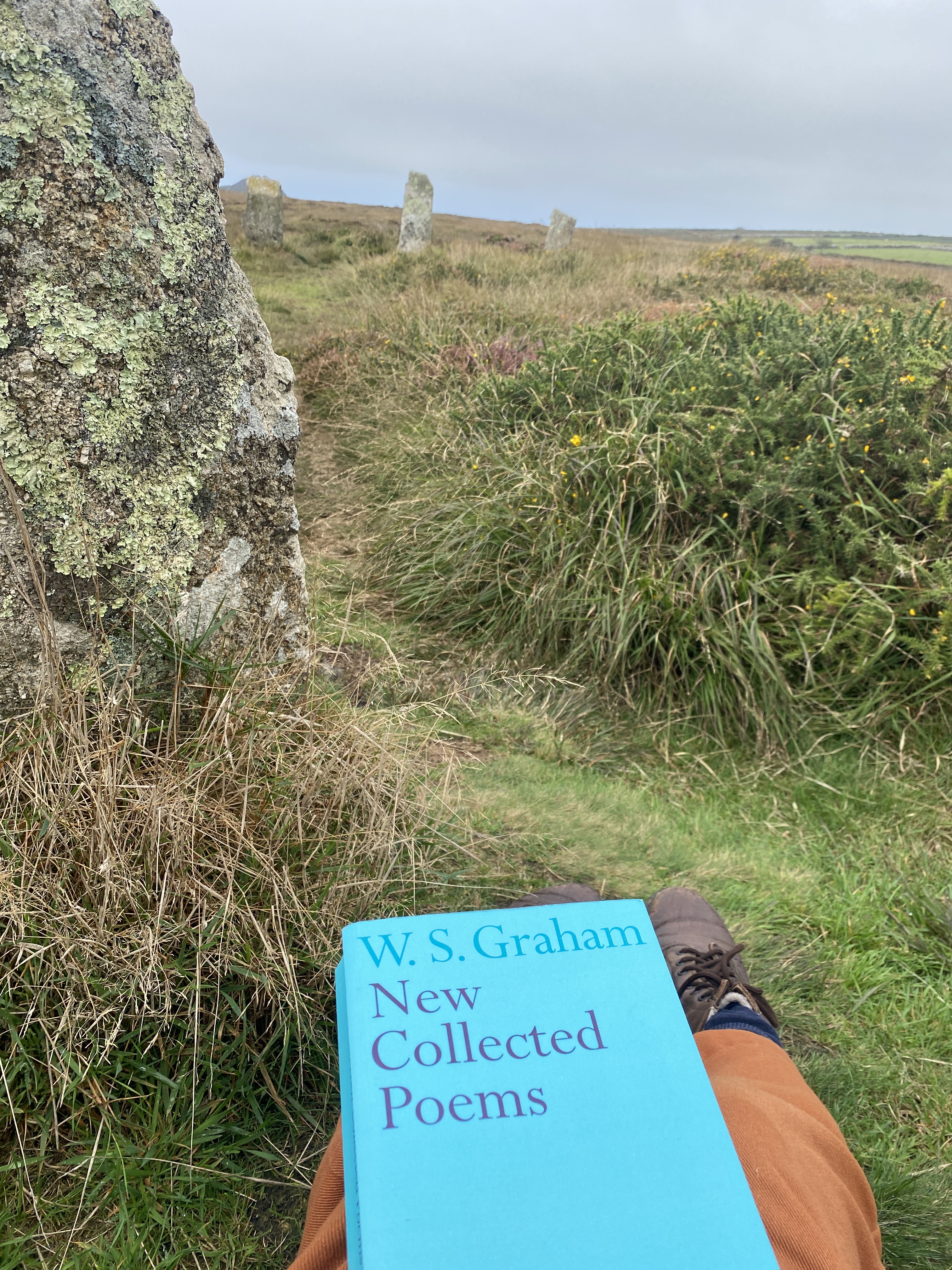
A little spot by the Nine Maidens stone circle

I’m on the twelve-hour CrossCountry from Penzance to Edinburgh. Penzance is the most westerly town in Cornwall and being this close to the edge of something calms me. I always sleep better by the sea. On my way here, on the Great Western Railway, a woman gifted me a glass sculpture with a rainbow inside it, as thanks for helping with her bags at Truro. ‘It’s for stirring your drinks’. For the past week, I’ve been writer in residence at The Grammarsow: a project which brings Scottish poets to Cornwall in the footsteps of WS Graham, who was born in Greenock but spent much of his life down here, making a home of Madron, of Zennor, of the moors. To say this has been a magical week is to say it changed me. I first came across Graham when the poet Dom Hale sent me a voice note of his elegy, ‘Dear Bryan Wynter’, out of the blue; I immediately went out and bought another bright blue, the Faber New Collected Poems. There was something about that foxglove on the wall and the hum of some memory in childhood, watching the bees. 

Graham grew up in Greenock, on the Inverclyde estuary. A town where I used to teach writing workshops at the Inverclyde CHCP, taking weekly, then fortnightly trains with our chitty from Glasgow. That time in my life is a blur of shift work, seasonal overhaul, hopeless crushes. I’d get there early to look at the lurid flowers in Morrisons with Kirsty, my co-tutor, or visit the docks alone. Sometimes, I brought my little heartaches to the docks because the air felt smelted, or salt-rinsed, excoriating. The nature of these workshops was that people would share their life stories of such intensity we’d bear them home. I remember one woman writing a story about the moon, ‘we share the same moon’: the one thing connecting her, unconditionally, to her estranged daughter. Many people with stories of recovering from addiction through returning to childhood pursuits: the fishing taught by their fathers, the harbour walks, the musical grammar of language. Graham was trained as an engineer and spent some time on fishing boats, but dedicated most of his life full-time to poetry. The more I learn about this, the more I pine for the shabby romance of that clarity of pursuit. Not as a sacrifice but a great generosity from him, like a penniless rock star.

I’m sure it took a toll on his friends. Graham sent many a letter pleading neighbours and pen pals for the loan of a pound or a pair of boots, once thanking the artist Bryan Wynter for a pair of second-hand trousers. His letters are documents of a life lived in gleaning, bracing the elements, enjoying his wife Nessie’s lentil soup and of course, drinking. On a ‘bleak Spring day’ in 1978, by way of a quiet apology, he pleads with Don Brown, ‘I was flippant in the drink when you came with your news […]. Please let me still be your best friend’. He was often full of fire, a real zeal, taking poetry so seriously but life a strange lark, ‘speak[ing] out of a hole in my leg’. He wrote to his contemporaries — artists such as Ben Nicholson and Peter Lanyon, Edwin Morgan, along with family and friends — with bags of personality, a man self-fashioning in the long blue sea of ‘I miss yous’. As he wrote to Roger Hilton:

We are each, in our own respective ways, blessed or cursed with certain ingredients to help us for good or bad on our ways which we think are our ways. What’s buzzin couzzin? Love thou me? When the idea of the flood had abated a hare pussed in the shaking bell-flowers and prayed to the rainbow through the spider’s web. I have my real fire on. I am on. 

The real fire may have been a woodburner, sure, but it’s something lit within him. The letter as a turning on, turning towards: we see this spirit of openness and address in the poems. The real commitment to Lyric. I love the hare that shakes in the flowers with its rainbow religion. I love the flush of arousal from walking uphill at speed. I saw many a spiderweb and two hares chasing each other on dawn of Thursday. On the train home texting many friends as if to have the rush of being held again, ‘Love thou me?’, could I be so vulnerable. A foxglove shook in the wind. The line as a tremble is lesser felt in the steady verse. Clearly, Graham wasn’t afraid of sincerity, though he always took pains to remind his addressees of his roots. ‘No harder man than me will you possibly encounter’, he assures Hilton; elsewhere, after the death of Wynter, he writes to his Canadian friend Robin Skelton of the coming funeral: ‘Give me a hug across the sea. […] I am not really sentimental. I am as hard as Greenock shipbuilding nails’. In a way, the infrastructure of space inflects the language as its face. I’m reminded of a quote by Wendy Mulford which Fred Carter shared at the recent ASLE-uki conference in Newcastle, where she talks about ‘attempting to work at the language-face’. I wear the face of the land, Graham seems to say, and the build of it. At West Penwith, we face the end of the land, literally Land’s End to our west. It is sometimes a silver gelatine, other times a bright blue, a fog grey thicker than thought. A granite-hard land that nonetheless sparkles. I recall a rock on the beaches of Culzean, in South Ayrshire, we’d come across as kids. Mum called it a ‘moonrock’ or a ‘wishrock’. It was a perfectly huge dinosaur egg of white granite. I find this particular rock showing up in my dreams, even now; as if having touched it, I become complicit in a deep time that doesn’t so much store the past as bear its promise. What could hatch from within a rock like that? What could move it, or hold it?

Graham had the idea of poetry’s ‘constructed space’, what I’d call a lyric architecture for reassembling something sensuous in memory or emergence. That this space isn’t just designed (as in my idea of architecture) but constructed points to that emphasis on building. What kinds of muscle, time, effort of spirit and will go into this? The poet Oli Hazzard writes that one of the effects of Graham’s poetry is ‘that I feel like it allows me—or, creates a space in which it becomes possible—to see or to hear myself’. Graham’s poem ‘The Constructed Space’ opens with the line ‘Meanwhile surely there must be something to say’. I always hear it in the lovely vowels of his Inverclyde accent, assuring. Like he’s sitting with you in the poetry bar, two pints between yous, and the poem gives this permission to talk or make space to listen. I think of Denise Riley’s ‘say something back’. My own need always to blurt, interrupt, muse out loud what mince is in my head. It continues: 

                                        […] at least happy

In a sense here between us whoever
We are.

As I write this, light dances on the opposite wall of my tenement flat and it’s prettier than anything given to me by the window. Sometimes my love says I am harsh when they need delicacy, and so I soften the heather of my voice to listen. It’s true that I was happy while reading that poem, a happiness or lightness in the brain as precarious as the light is. Changeable and easily blown further west to let in what fog, or dimness. I don’t mind my brain when I’m in Graham’s poems. By which I mean, it’s no longer a drag to be conscious or sad; things move again, their metaphors in process. There’s a lightness to quietude, its intimate premise, that holds me. Nothing extreme is promised here, ‘whoever / We are’: lyric address sent through ether to find that ‘you’, held in the future’s new ‘us’. It’s better than a page refresh, reading the poem to think something Bergsonian of the self’s duration. I’m more snowball than the first maria who read this. It’s a kind of exhale, in a sense, like Kele Okereke singing ‘So Here We Are’ from an album named suitably Silent Alarm. Imagining my loves at the same time, out in Stirlingshire lying tripping by the loch, their eyes skyward, the high or low. I cherish that wish you were here / so here we are. I can look out from inside the constructed space of the poem. Wheeeeeeeeesht, you. You’ll find constructed spaces everywhere in Cornwall. The lashing blue skyscapes of Peter Lanyon, the abstract panoramas of Ben Nicholson, the ambient plenitude of Aphex Twin (especially ‘Aisatsana’ and most things from Drukqs). I want ambient or abstract art to give me the clouds in my head back to myself, with the light of it. Colours, gestures, fractals, lines. 

~

I’ve spent the past week schlepping around the moors and lanes, reading Sydney Graham’s poems and letters, cooking veg on my wee stove and eating simple marmite and butter sandwiches. I have this grandparent on my mum’s side who shared his name, who died of cancer before I was born. Sydney was the name Graham tended to go by, signing letters. It’s not that I’m looking for literary fathers but I stumble into their charismatic arms all the same. Is it guidance I look for, or perspective? I love the rolling enthusiasm, pedantry and chiding of his letters, as well as their cheekiness and charm. His dedication to writing and reading, his swaggering or boastful tendencies after an especially successful performance (coupled with an irresistible gentleness and warmth). His big sweet expressions ‘THE MILK OF HUMAN KINDNESS IS CONDENSED – TTBB)’, ‘IMPOSSIBLE TALK’. TTBB is the slogan of Grammarsow and a familiar exhortation in Grahamworld, meaning Try To Be Better (the title of an excellent anthology of Graham-inspired poems, edited by Sam Buchan-Watts and Lavinia Singer). I summon my voices, I try to be; used to be; want us to be. 

There’s a quietude I love about the work, which suits the land and mind. After a summer of working three paid jobs, and two voluntary, I was ready for a gearshift into something relaxed and focused. I’d had enough of my own ‘impossible talk’. Being here was like being given permission to play and explore. Quickly I realised my time didn’t need to be ‘dedicated’. I lived by the cruising whim of the big sky, its scrolling clouds and moodswings. Saw the moon at two o’clock in the afternoon. I watched dragonflies dart between the lanes, listened to my neighbourly ravens at night. Watched big jenny long-legs make flickery silhouettes on the walls. Slept peacefully with spiders above me and the ravens being craven. I wanted all these things in my poemspace, and the poems themselves were initially scarce, then they began a familiar elongation that was comforting, with the swerves of a bus but also the tread of a walk. Some poems wanting to hide themselves between logs where I might later try and find them.

~

A grammarsow is the Cornish name for a woodlouse, or what we’d call in Scots a slater. I remember growing up and having this internal argument about language: was I to go with what my English mum said, or everyone at school? Aye or nay, yes or no. At some point I realised it wasn’t a question of scarcity and elimination, but abundance. The words became barnacle-stuck from all over the sloshes of life, swears and all, and I cherished their stubbornness. Even those gnarly, uncommon words and spicy portmanteau like ‘haneck’, ‘gadsafuck’, ‘blootered’ and ‘glaikit’. And yous: the juicy, plural form of you. Addressing the crowd, the swarm or many. A woodlouse is a terrestrial crustacean drawn to damp environments. I grew up with woodlice crawling out from under cracked kitchen tiles, unearthing raves of them hidden under rotten logs, finding them in tins of old paintbrushes or sometimes a bag of flour or sugar. I always liked the way their little legs seemed translucent, a little alien, and was especially seduced by their darling tendency to curl up into a ball, for protection, like Derrida’s idea of the poem as hedgehog. 

Across the English language, there are many amazing names for the humble woodlouse, not limited to: 

  • armadillo bug
  • billy button
  • carpet shrimp
  • charlie pig
  • cheeselog
  • chisel pig
  • doodlebug
  • hardback
  • hobby horse
  • hog-louse
  • jomit
  • menace
  • pea bug
  • pennysow
  • pill bug
  • roly-poly

What is this penchant for lists I share with Graham? I want abundance from something other than products. I’m dumbly monolingual and lists are one of the few ways I can accumulate nuances of meaning. My attention-disordered brain collects lists as procrastination for the Thing itself, what is it I should be doing, always on the tip of some other event horizon bleeding through the last and first, so nothing is really finished. I like that in West Penwith, to look at the Atlantic you don’t see any islands, so there doesn’t have to be an end. You have the illusion that there can always be more time. The sea as this list of limitless light, colour shift, unbearable senses of depth. You are here. 

~

The grammarsow crops up in Graham’s letters. In a missive to Robin Skelton, he muses: 

And what are we now? Maybe better to have been an engine-driver in the steam-age. A sportsman a shaman a drummer a dancer rainmaker farmer smith dyer cooper charcoal-burner politician dog bunsen-burner minister assassin thug bird-watcher poet’s-wife queer painter alcoholic ologist solger sailer candlestick-maker composer madrigalist explorer invalid cowboy kittiwake graamersow slater flea sea-star angel dope dunce dunnick dotteral dafty prophesor genius monster slob starter sea-king prince earl the end.

Again the ‘steam-age’ of other infrastructures interfacing language. Better to have been a wave engineer in the renewable(s) era. I find myself somewhere between the ‘ologist’ and the ‘angel dope’, strung out on critique, measure and the promise of sensuous oblivion. Not sure if the dope is connected to the dunce or angel, but I’ll claim it spiritually as something good: an enhanced performance. As in, those are dope lines I’m reading. Do you want some? ‘And what are we now?’ not who, but what. A question I want always to ask — it’s almost Deleuzian — with someone in my arms or the sea swishing up to waist height, a sea-star clung to the hollows behind my knees. What’s possible when shame is gone. I love tenderly Graham’s list of possible existences and wonder how many I might retrain as (O genius monster), keeping in mind Bernadette Mayer’s old quip that all poets should really be carpenters. I love the raggedness of letters, which is why I love blogs (letters to the idea of being read). Who are they for? We’re so lucky to have these old ones, bound for us, evidence to the material conditions for our wild imaginaries. 

~

In Cornwall, I love falling asleep. I love falling for new poems, stumbling a little on the rugged paths, falling for the air and water, for a little more mermaid’s ale or Bell’s, a blackcurrant kombucha or 100g of coconut mushrooms. In his essay for Poetry Foundation, ‘This Horizontal Position’, Oli Hazzard writes about a time Graham ‘went for a walk on Zennor Hill in Cornwall and fell into a bramble bush’. This falling was a repeat pattern: in 1950 he drunkenly fell off a roof and complained of his three-month hospital stay, ‘I hate this horizontal position’. In my DFA thesis I wrote extensively about lying down as a beginning for writing, the horizontal as a form of refusal when it comes to the upright requirements of an assertive ‘I’. It’s no secret that I prefer poetry in the mode of dreamtime, but that’s not to say I’m also a rambler. It’s a poetry of breath and of steps (of vigour!) I enjoy in Graham. Zigzagging and winding down well-trodden moor paths, stumbling upon bridleways that lead around the hills from holy shrines. 

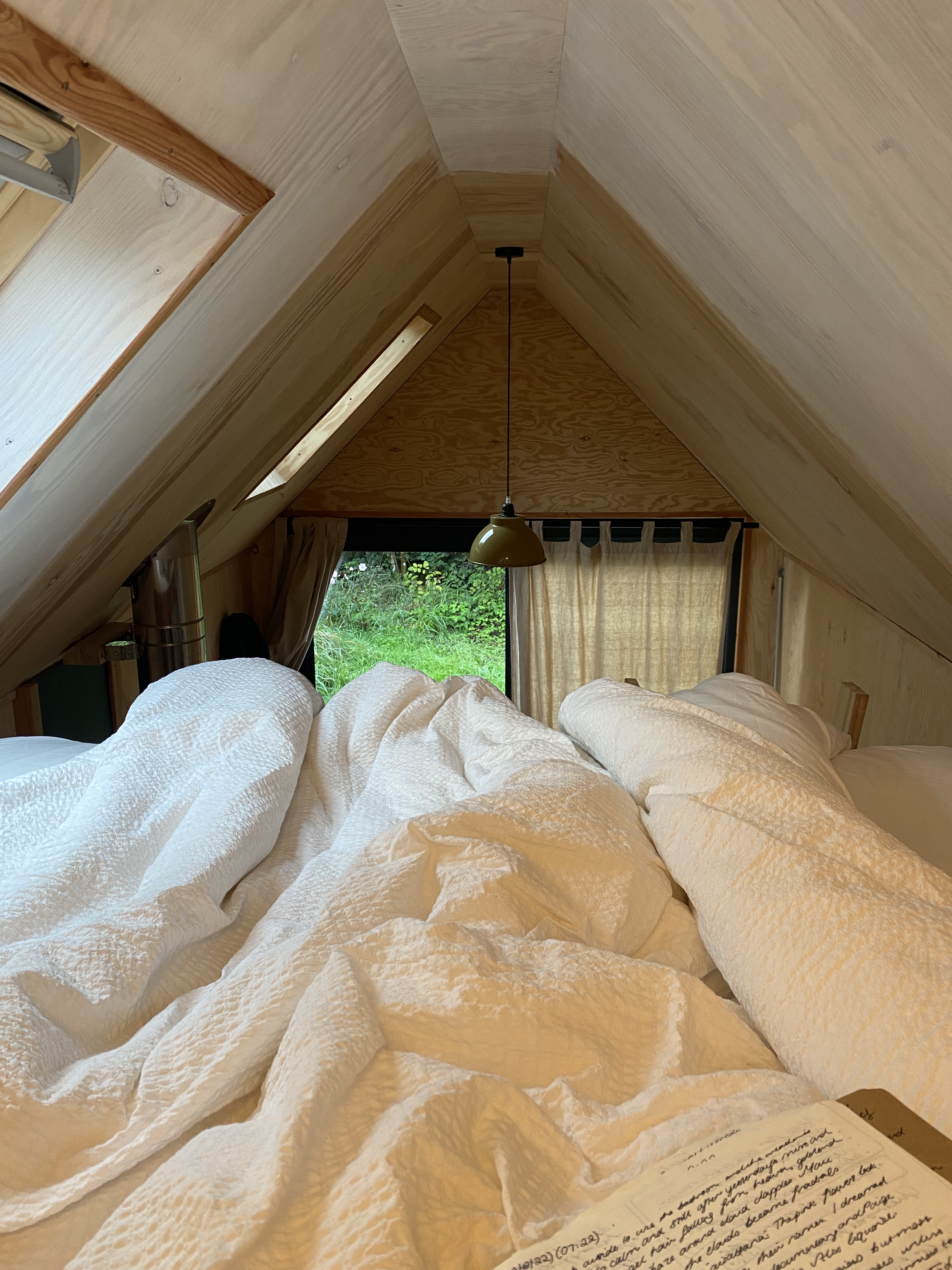
I was the lucky poet to first bless a new writer’s cabin that my host, Rebecca, built on some land near the Ding Dong Mine. From the garden, you can see right out over Mount Bay. The skies are huge here. I’ll say that a lot. I saw a seal down by one of the zawns on the north coast, felt the fear of losing the moon in you, let my lips chap on the telepathy of remote secrets. I try to be better, regardless. My poems become languorous obscurities. All of the land has hidden depths.

~

There was a summer before secondary school when we were gifted an unlimited pass to Historic Scotland, meaning our holidays involved camping across Dumfries and Galloway, the Trossachs, the Highlands, in search of abbeys, monasteries, castles and holy sites in various states of decay. I was turned off by leaflets documenting the actual details of history, emerging sleepy-eyed from the car where I’d been navigating the turgid sentences of fantasy novels or playing platform games like Super Mario. There’s a particular form of carsickness that produces electrolytic effects conducive to imaginative ventures. What I mean to say is, instead of vomiting I overlaid the real world with the promise of portals to elsewhere. In Penwith, I walk off my city sickness and sit by the standing stones, quoits and old ruins of industry. What do I imagine but a ‘news of no time’, still to come? Zennor Hill is both poem and place. The more I’m here, the more a sort of aura thickens.

Swap Zoom for the view from Zennor

On my last morning, I wake to sunrise over the sea. Dew shimmers the rosehips. The air is earthsweet as ever and I don’t know how I’ll go home. Travelling is an experience of dislocation: here, I find home again in language, its caught habits, Graham’s words sluicing Clydewards. There’s a poise to his poetry, steadfastly composed as ‘verse’ and often by iambic measure. Making perfect prosody with the chug of the train. I was pleased to roll into Glasgow having bumped into my friend Kenny, the whisky god of the Hebrides, attuned to the flight-pulse of conversing again. Hungry, ‘putting this statement into this empty soup tin’ to say cheerio as Sydney would, lighting up poetry to finish it, the best thing of all, a warm scaffold to hold up how we missed each other. A quiet disintegration of cloud. What are we now?

With thanks to Andrew Fentham, David Devanny and Rebecca Althaus for kindness and hospitality. Long live The Grammarsow! 

Notes on Lyric Solarity

‘Notes on Lyric Solarity’ at Summer in the Way, Birkbeck University of London, 9th July 2022.

Video of a creative-critical paper delivered over the weekend at Birkbeck, as part of an ongoing collaboration between the87press and the Contemporary Poetics Research Centre. Below is an extract from the first half of the paper. A lot of this thinking is developed more fully in a forthcoming academic article.

As flowers turn toward the sun, by dint of a secret heliotropism the past strives to turn toward that sun which is rising in the sky of history. 
– Walter Benjamin, Illuminations

Today, I’m going to move fluidly between poetry and essay to present some nascent thoughts on lyric solarity. I want to suggest lyric solarity is a poetics in which solar imaginaries are linguistically mediated and refracted through the close rhythms, affects, sensoria and arts of noticing associated with the focalised energies of lyric poetry. Lyric solarity enacts an embodied poetics of dissolve, exposure, surplus, saturation and excess/residue: it offers a way of turning towards the sun, while helping us make, in the words of Imre Szeman, ‘commitments to reshaping’ the ‘existing infrastructures’ which underpin access to and distribution of energy. While the anthropocene, a contested epoch defined by humankind’s ascendance as geological agent, is often understood as an issue of scale, attending to the solar helps us think about planetary crisis in terms of distribution and density of harm, resources and changes to climate or energy. I take energy to mean both the power derived from physical or chemical resources, the property of matter and radiation manifest as a capacity to perform work, but also in the sense of an organism’s energy – their metabolism, vitality, ongoingness within the world, and its working demands or desires. What follows is less of an argument than a set of propositions and possibilities, a selection of field notes in search of lyric solarity.

  1. Sans Soleil

In Chris Marker’s film Sans Soleil, often translated into English as sunless, we begin with a quote from T. S. Eliot’s ‘Ash-Wednesday’: ‘Because I know that time is always time / And place is always and only place’. It begins again with an image of three children in Iceland, ‘an image of happiness’ accompanied by black film leader. The voiceover suggests that if viewers can’t find happiness in the image of the children ‘at least they’ll see the black’. The film is itself a kind of lyric documentary on human memory, how memory is fragile and so our recall of personal and political histories – especially on a global or even planetary scale – is inflected or reworked in the present. In the spring of 2020, I approached the film as a kind of memory place. I had never seen such spring sun in Glasgow, but due to Covid I was locked down inside my own sunless temple, or tenement. What follows violates, perhaps, Eliot’s insistence on the essential containment of space and time. Eliot, I guess, never used the internet. 

I was messaging the poet fred spoliar, and suddenly it was the solstice and we wanted to mark it. We began this remote collaboration, not in response to Marker’s film so much as through it, or some residue within it, a blemish or shine. A bright spot, a blind spot, a kind of fleck on its vision. We wrote remotely, wrote ‘live’ and in those hours of shared writing, we existed in a solar time: where solarity was a quality of memory, its absence our absence, and yet also speculation towards something better – waiting for rays of arrival. In that sense, the poem is about the uses and abuses of pastoral; about an ‘elsewhere’ to be written around, glimpsed, squinted at, but never quite accessed. It’s also about the temporal alignment of two people writing together. Lyric as a thought device for telecommunicating something of a paraworld hidden in language. I’d fall asleep with our phrases like film credits flashing behind my eyes. We wrote between the summer and winter solstices of 2020, we split lines with sun-cloud emoji. Here’s some of the opening sequence of the poem:  

Ultraviolet rose us

spilled into formless

unration of atoms

and we spend ourselves back, the day

extends pause,

folding up

in luxe ellipsis 

hills and hills 

of recessional cloud, cast debt 

between us, rolling one-sided 

to release it, all of I’m rain 

cast thru fierce aureate

disquietude, to not say 

hope this finds you, or 

nearest the soft motif of yr hair 

bright spots around the antisolar point

balayage of except champagne 

never sets. In a forest image / I cannot touch you 

or notify through light that drowsy reminder 

we are many. Something 

decorative / in the cold soak of sylvanshine 

gives up its entrance, the long day 

composed of such stills is lying 

back from its voyage. To say 

all of the land escapes / an exorbitant teardrop 

a teardrop. I have these ambient hands. 

I wring the leaves…

2. Solar Apocalypse

In Etel Adnan’s poetry sequence, The Arab Apocalypse (1989), the sun is variously a shapeshifting trickster, a totalising energy, an authority, a marker of time, a blinding force, a monster, a pool of blood. Here are some of Adnan’s lines taken from across the book: 

I took the sun by the tail and threw it in the river. Explosion. BOOM…

the sun is contaminated by the city

the sun has eaten its children

a sun rotten and eaten by worms floats over Beirut       silence is sold by the pound

eat and vomit the sun eat and vomit the war hear an angel explode

The brain is a sun STOP the sun is an eye

the sun’s atoms are incarnating in my flesh     STOP          STOP

The sun is a kind of virus, pulsing and multiplying, changing form and colour, nourishing and deadly, making things grow or die; a kind of white noise in the context of war, a vulnerable body, a weapon, a machine of surveillance, a carnal threat. In the American Book Review, Barbara Harlow says of Adnan’s poem that it ‘invokes a mythic past […] to presage a present that resists narration’. To presage is to be a warning sign, a prediction, typically of something unpleasant; in archaic meaning, presage is an omen, a feeling of foreboding. In The Arab Apocalypse, Adnan writes back and forward to historical crises: as Aditi Machado points out in an essay for Jacket2, the poem was begun in January 1975 in Beirut, two months before the outbreak of the Lebanese Civil War. But there is also a generalised economy of violence, exposure and replenishment which speaks to the twentieth century at large and indeed to the explosions, contaminations and environmental atrophying of the twenty-first century. As Harlow identifies, the simultaneous, coagulating, geopolitical crises of the times, what we might call the ~Anthropocene, are often resistant to narrative. The recurrent, modulating figure of the sun has more of a lyric quality, beaming and seeping, punctuated by telegraphic lines and signals of stop, break, transition. Language garners a lyric intensity which is elemental, saturating, overspilling the traditional bounds of a human ‘I’. Impressive and god-sized dramas of the stars and planets play out in a mythopoetics of Beirut, of Gilgamesh, of ‘grass snakes hiding in the texture of TIME’ (Adnan, The Arab Apocalypse).

3. More sun to consider in lyric

Julia Kristeva’s Black Sun

The music of Sun Ra

Sean Bonney’s ‘solar cop’

The shine sprites in the video game, Super Mario Sunshine

Georges Bataille’s ‘solar love’

David Schwartzmann’s ‘solar communism’

Alli Warren’s Sun Dial

The photographic process of the ‘anthotype’

Björk’s song ‘Sun in My Mouth’

Catherine Wagner’s line ‘If everything is from the Sun why praise it’

Paul Klee, Castle and Sun (1929)
Etel Adnan, Untitled (2016) Source: White Cube.

4. Shimmer 

In Paul Klee’s painting, Castle and Sun (1929) the castle is line-drawn in myriad geometry: its surface is of different coloured shapes, set underneath a bright orange sun. In proximity, the colours shimmer and vibrate. If there was a patchwork made of Adnan’s poem, it might be this; or indeed one of Adnan’s own geometric, brightly-coloured abstractions. Shimmer is to shine with a soft, wavering light. It offers a coming-to-knowledge distinct from the Enlightenment regime of ‘shining a light’ on your subject; it is a way of making contact, of existing in non-linear, non-narrative – that is to say, lyric – timespace. In her 2018 book Surge, Adnan writes ‘We came to transmit the shimmering / from which we came’. In this shimmering tautology we yet cross a line, continue transmission. Shimmer is instrumental in what I call ‘hypercritique’: a poethical form of writing which orients not to the capture of time, meaning or ecological reality, but to a beyond

Sleep Felt Productive

cn: mention of bulimia; spoilers

It’s been a fair while since I posted. Struggling through Covid, another supercold (emerald phlegm forever), more transitions, finishing my thesis, April snow, more streaming of the body and ache, but here we are. It’s good to get words down. I can’t smell or taste anything at all right now (coffee is just…neutral earthiness, sweet potatoes are…mush of the orange variety, bread is…send help) — so the vicarious pleasure of language is all the more heightened. Sometimes it’s a barrier: why read about anything when your senses don’t respond? I’m drawn to the elliptical which doesn’t hold me for too long. I want to be let go or dissolve a bit. Like eking my reading through a fine mesh of muslin, a semi-permeable membrane of comprehension. Or pull it over my head, this paragraph, the whole fabric of the thing. I was gonna write about a month’s worth of reading: mostly while walking west to east along the polluted, outer commuter belt of the city; on trains between Glasgow, Inverness, London, Leeds; in frail, unwaking mornings; at the park, in that golden week, sitting in the grass with salad from Juicy and daffodils. Instead I wrote about sleep.

*

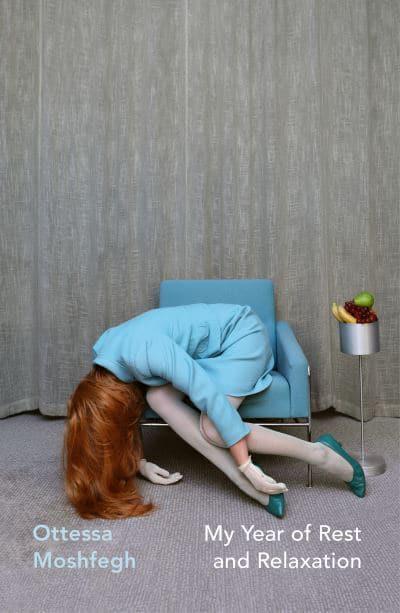
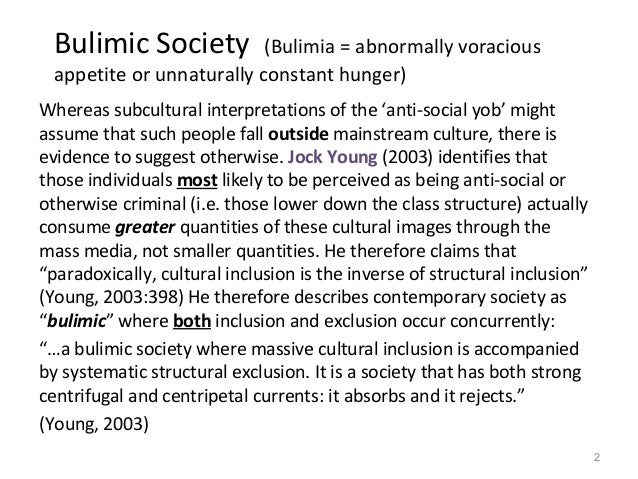
Finally I got round to reading Ottessa Moshfegh’s My Year of Rest and Relaxation (2018), a book I wanted to read especially because a trusted friend described the ending to me as ‘disappointing’. I love to glut myself on disappointment. For some reason the novel produced a similar effect on me as Tom McCarthy’s Remainder (2005), in that the pleasure was all in the premise. I would love to exist endlessly in the loop that is prolonged sleep or the reconstruction of a highly specific sensory memory. I want these novels to just go on and on like that. Of course, there has to be escalation, as per the rules of plot or ~human nature~. Is it true we can’t circle the mobius loop forever? That after a while the pleasure is desensitised, and we need to dialup on the extremity? McCarthy’s novel sort of preserves that perfect figure of eight in its set-piece ending, and you’re left with the image adrift to loop back on the primal, inciting moment of falling debris and trauma. I found the Moshfegh ending ‘cheap’ in that it seemed to cash in its bulimic character for a kind of tragedy whose fate was to fall. Bulimia, I can say, is generally an experience of permanent insolvency in the body, resulting in a loop time of binge and purge. You pay the debts of fasting by devouring; you pay the debts of eating by purging and fasting. Rinse, brush teeth, ouch, repeat. The sociologist Jock Young talks of ‘bulimic society’ as one where the poorest and most marginalised are often the most culturally enmeshed in the desperate iconography and desire economy of consumerism. The most excluded populations, according to this view, absorb images of what is apparently available under the veil of late-capitalism; but simultaneously they are rejected from accessing this culture themselves due to material inequality and class difference. As Young puts it: ‘a bulimic society where massive cultural inclusion is accompanied by systematic structural exclusion. It is a society that has both strong centrifugal and centripetal currents: it absorbs and it rejects’. But does capitalism spit us out or do we boak back? This is why I am scared to go on TikTok, like fear of lifestyle saturation to the point of nauseating breakdown.

Often powerpoint slides defining bulimia for this sociological context mention an ‘abnormally voracious appetite or unnaturally constant hunger’. In Moshfegh’s novel, the character Reva (an insurance broker) is constantly eating or constantly fasting; something our protagonist describes with pity or nonchalance. Reva is tragic because she wants too much what the protagonist effortlessly has by birth: beauty, thinness, style, money. Thinness is kind of the ur-sign for WASP privilege in the aftermath of the heroin chic fin de siècle. Reva is jealous of the protagonist’s weight loss, steals her pills. Both women are after control (or its relinquishing) in a world in freefall.

This is a period novel: set in the early 2000s, New York in the lead up to 9/11. It’s full of that inertia following the boom of the 1990s. The desire to just sleep in the unit of a single year is like a microcosm for not just an end of history, as per Fukuyama, but a refusal of history altogether as this thing that keeps growling, accumulating, disrupting sleep. I kind of buy into Reva’s bulimia as something about the consequence of being voraciously invested in a world that wants to expel you, sure. The sky’s big whitey’s the limit around Manhattan. Chewing on this feels productive. The violence of the novel is primarily in the gallery where the narrator starts out working. The gallery’s prized artist, a young man called Ping Xi, has these ‘dog pieces’: a ‘taxidermied […] variety of pure breeds’, which are rumoured to make their way into the artist’s exhibition via premature slaughter and industrial freezing. The work apparently ‘marked the end of the sacred in art’. The narrator is kind of offhand disgusted but eventually comes to identify with the young animals in the freezer, waiting to be thawed into art. Writing can be a bit like self-cannibalism; the denial of which leaves you stoked for a snack.

There are several kinds of hunger in the novel: primarily for sleep and food, but also for meaning, intimacy, loyalty. Love is a strange relation that moves uneasily between two girlfriends whose friendship is based on a premise of inequality and co-dependency. The hungers are sated by devouring emptiness. Sleep, junk food, fleeting talks. That bit in Melancholia where Justine screws her face up deliciously and says the meatloaf tastes like ashes. When I realised the same of my dinner, I didn’t even react. 

We look more peaceful when sleeping. It’s worth lauding, like Lana singing Pretty when I cryyyyyyyyyy………….

O, and the concept of the sad nap:

There was no work to do, nothing I had to counteract or compensate for because there was nothing at all, period. And yet I was aware of the nothingness. I was awake in the sleep somehow. I felt good. Almost happy.

     But coming out of that sleep was excruciating. My entire life flashed before my eyes in the worst way possible, my mind refilling itself with all my lame memories, every little thing that had brought me to where I was.

(Moshfegh, My Year of Rest and Relaxation)

The brutal awakening cashes in on the extra expenditure of napping. I’ve written in a poem somewhere, ‘I wish I could sleep forever’. It’s different from wanting to die. It’s more like, wanting to feel aware of the nothingness and calm in its premise. Nobody needs anything from you and you can’t give anything back. It’s restful or at least prolongs the promise of rest. Stay awake super late to relish the idea that you could go to bed. I don’t remember the last time I woke up feeling energised by sleep. </3 I remember listening to an interview with the editor of Dazed where he talks about sleep being his great reset. I remember thinking wow sick cool. Whatever mental health thing he’s going through, sleep will heal it. Sleep can otherwise be a kind of emulsion of depression. You’re in the weight of it spreading right through you. I carry sleep along even when I don’t ‘have’ it. 

I want you mostly in the morning
when my soul is weak from dreaming
(Weyes Blood, ‘Seven Words’)

I used to wake up extra early before school to steal back from sleep. I felt sleep would eat me alive. I used that time to browse the internet, write, read. Eat shitty muesli. Puke. 

I’d sleep in class. Teachers would bring it up at parent’s night. I just couldn’t understand why everyone else wasn’t regularly passing out over their schoolbooks.

The perma-arousal of bulimia is a counternarrative to the inorganic sleep cycles pursued by the novel’s main character. I got a similar vibe from watching Cheryl Dunn’s Moments Like This Never Last, a documentary snapshot of the pre- and post-9/11 world of New York’s underground, showcasing Dash Snow’s graffiti and outsider art. Dash is always cheating sleep to go tag, paint, take pictures. There’s a ton of cocaine and consequence. 9/11 had toppled right through all of that leaving a wound. You know by the law of entropy that it can’t be sustained, this life, writing on the walls and all that. Maybe tagging is also about a kind of hunger-purge. Colour’s aerosol vom marking time, presence, ideas. It’s permanent, but then someone can just go clean it up; the ultimate fuck you.

Whose space does this belong to? Remainder is a novel about gentrification, the white guy’s obsessive reorganising of London spaces as precursor for the gentrification of Brixton. A novel of the zombie flaneur, fuelled on flat whites, iPad swipes and vape juice, as Omer Fast’s 2016 movie adaptation brings into focus. Moshfegh’s novel is set around the same time, but her protagonist is decidedly not a flaneur, even if she carries that vibe of the waking dead. She barely leaves her apartment to get coffees from the local bodega, and when she does venture further it has all the amnesiac disaster of a night on the NY tiles with Meg Superstar Princess, furs and all. I find this zombie existence an irresistible metaphor for the numbing effect of late-capitalism: we are overstimulated and aroused to the point of just turning off. It’s banal to say that, sure. What’s great about the Meg Superstar Princess blog girl revival is the way the writing itself is charged with like, full off-kilter zaniness. The opposite of zombie. It’s like barhopping around A Thousand Plateaus — cheap wine in one hand, vintage Android in the other — to the tune of Charli XCX and it’s absolute chaos: ‘spitting e pillz out my mouth, trying to live normal, disco n apz’. You get smashed. You’re alive! I’ll have it in writing because I can’t really have it elsewhere rn, the same way I sleep but I can’t really sleep. Apps (f)or naps?

For all this tangent on (post)pandemic hedonism (let’s say post to mean, posting and not to signal some wholescale shift in era), it’s weird how history just hits you in the face at the end of Moshfegh’s novel. Falling debris, bits of glass. Words:

On September 11, I went out and bought a new TV/VCR at Best Buy so I could record the news coverage of the planes crashing into the Twin Towers. […] I watched the videotape over and over to soothe myself that day. And I continue to watch it, usually on a lonely afternoon, or any other time I doubt that life is worth living, or when I need courage, or when I am bored.

(Moshfegh, My Year of Rest and Relaxation)

Earlier in the novel, she’s frustrated when someone replaces her VCR player with a DVD player, even though she doesn’t have any DVDs. She kind of hates the concept of the DVD. She likes the process of rewind. Video tapes, with their seriality, make you confront duration; whereas DVDs allow easy random access to specific scenes. The over and overness of Moshfegh’s careful, clean, lethargic prose is at once soothing and disturbing. When the pandemic first hit, I couldn’t stream anything because the thought of having all that content at my fingertips seemed appalling. Like accessing a trillion orderly dreams of someone else at the very moment I couldn’t even touch another person. Maybe video tapes would’ve been different. The residue of wave matter at the edge. The analogue sense of fossilised images, decaying in visible time.

In a poem called ‘Along the Strand’, Eileen Myles is like,

The times of the day, the ones
with names, they are the 
stripes of sex unlike romance
who dreamlike is a continuous 
walker

I love the rhythmanalysis of daily life here. VHS stripes in descending order of luminance: white, yellow, cyan, green, magenta, red, blue and black. How the speaker clings to named moments of the day as like khora: receptacles unseen for adhesive feelings. ‘Vigorous twilight’, ‘noon’ you slip into, ‘Morning’ as ‘something / I could stay with’. The times of day are lovers. If romance is continuous walking, there’s not a lot of romance in My Year of Rest and Relaxation. So after reading the novel I’m sorta stuck on wanting the romance of sleep again. Exhalations as stripes of sex. Like when you have a new partner and after a few weeks of breathless sleeplessness suddenly the first thing you realise is how well you’re sleeping, like being beside them all night just fixed your life. And so to be in love you know noon tastes different, and twilight has a lilac halo. And you’re sharing this shiny sticky static in the air like asterisks, so much more to say.

*

Sleep. After a long walk, I remember circling South Norwood Lake and humming Elliott Smith’s ‘Twilight’, because of the time. You asked me to sing it. I had a low voice, a high voice. I was just waking up; the air was all lavender, leaves in fall. 

I don’t want to see the day when it’s dying.

notes on fake heiresses

‘I work for my success, I earn my accomplishments. […] Maybe you can learn to be smart like me. I doubt it, but you can dream’.

I would really like to exorcise Anna D*lvey from my present obsessions, having blitzed through the hyper-cringe miniseries and comparatively breezy podcast in barely a week, pursued a bunch of Instagrams and finally shut my eyes only to dream of that accent grinding through a void. 

Credit card, credit card, credit card
assspiration/respiration

I used to draw pictures of infinity pools and flick through brochures of luxury hotels for no other reason than my dad works in travel. 

In Anna’s story, to dream is compensatory for the actual accomplishment of success, and your dreams can be extracted by an app called Shadow…….and all that dream data you uploaded gets aggregated as part of general projects of self-optimisation, leading to what? 

I prefer my shadow-realm in dreaming device; what other people dream. You can listen to the stories of other people dreaming by pressing yourself to the groundwork of a landlord nation. So many people have pressed themselves to the skin of these floors and walls. Why the old hard rain or old hard road? It’s nice to stand outside in the rainy asylum of television.

There’s a loud buzzing in my flat like a fly the size of a building is stuck. It’s been going since Thursday.

Today at four o’clock a dark grey cloud. 

Everyone on the internet seems to criticise AD for not using conditioner but I like seeing out of context screenshots flash across google — prison is so exhausting, you wouldn’t know — and everyone asking where is she, what’s that bridge — boys with names like Hunter and Chase

Get off on development

Writing this adds to the AD economy, but I can’t help making notes. For a while now wondering what a dream is and wanting it always to be more than compensation for the struggle we’re put through — dreams are not opiates for mass depression — 
ineluctability. luxury. 

We are suffering a mass shortage of pleasures at least in the narrow world of these isles and especially what I imagine to be england……..who else watches this and thinks, I don’t even like champagne. I wanna be adored comes to mind………I find the soundtrack flashy and intrusive like TOO ON THE NOSE but perhaps being gauche is aesthetic necessity……if you are trying to do a satire on the people whose lives you incorporate fully by lassoing the loop holes of their own system — weakness, lust for novelty, a good story.

Court fashion. What it is to be well-heeled. Attentive to somebody’s daily post. I miss outfit posting thus Polyvore and lookbook but also, ouch. It’s all in posture? Like how you present the myriad proprioceptions of finance itself, plus conceptual finance & platonic finance. Get your eyebrows done. 

Obviously this whole show is about whiteness and how this is performed, tacitly stratified and constructed for actual material consequence, a f f l u e n c e.

What would you do with access to an app called Shadow? What invocation of the shadow realm does this offer? My eyesight is getting worse the singer is a blurred intimation of human blue on the stage. My dreams blur as with eyesight, so become less of narrative detail & character — more of feeling. I wake up with spillages of emotional pigment all over my chest, belly, brain. Sometimes it makes you wet too

which is to say, we read each other. 

Deeply? Every time I blink there are several billion more tweets in the world, you have to know that. Know it all the time like feeling your white blood cells come up. I have a bulimic consciousness I don’t want any more info, the words are burning my throat

for how long has acid been pouring upon them

Los Angeles in fall?

You can tell by the podcast voice. Someone says ‘scammer and scammer – a match made in heaven!’ 

spoiler alert for other fake vocal fry heiresses.

This one is the largest dream database in the world, it’s in her heart. You gave all the dreams by watching it, like & subscribe. Self-identity as Futurist means you floss everyday on the internet. I’ve been studying the little bits. 

Last night a tiny centipede crawled out of the spine of my copy of Susan Sontag’s As Consciousness is Harnessed to Flesh. I want to go to San Francisco. I want the noise to stop. 

AD = After Death. Anno Domini. Anna Delvey. Advertisement. Advantage. Analogue to Digital. 

Bin man outside is singing INXS. 

Dumb socialite lite lite extra cherry diet coke

‘I wanted to learn everything. So I could be anything’.

The Anna D*lvey aporia of February. 

Scam trends of 2022 as response to crypto? 

Tindering loneliness, paying for soap operas of algorithmic advantage, buying virtual real estate including the non-fungible artefact of a HEX number. 

I wonder who I spent a long time being real in. 

How much I paid a month to use all that purple. 

It’s so convenient to log into all the channels at all times, listen to other people talk of their dreams in computerised accents, dream exactly their dreams until you are what kind of god posting anyway, just to reblog them in the 24 hour window of the story

you feel accelerated then smoothed, depressed as in self-love

just to be in their world at the click of a button

I like her best in the lilac pantsuit and classy copper

abyssal sensation that some of this is really true, even the fashion. Slip diamanté talk of I love Dostoevsky accordant to telly

A book she says her father passed onto her, it’s all about struggle, and telling the psychiatrist, Look, that character who said he was going to america, “he shoots himself in the head” — you know what happens

resultant 

cesspools of debt 

“to girls like me”

precognitive data analysis [ crisis ]

augmented saturates of the dream economy 

surplus love 

love

plus size appliances 

Turns out, a scam, you can use right now for free 

taking out money the same as taking the bus to just get somewhere 

none of this is real

no land

forms a bubble

Cowboy Gardening

It was supposed to snow in the night and the not snowing was sore as a missed period. I awoke with two crescent-shaped moons in the palm of my hand and thought of a sacrifice unwittingly given in dreamland. Said Jesus. Peridot phlegm and the scratchy sensation, knowing that speech too could be cool, historical, safe. Could not see beyond pellucid rivulets, Omicron my windows, my streaming January. January 

streams from every well-known orifice of the world. Its colour is shamelessly stone. I seem to be allergic to inexplicable moments and so keep to the edge of the polyphony of yellow. I am cared for. The Great Barrier Reef dissolves in my dreams the substrate of yellow. It goes far. Pieces of the GBR are washed ashore in Ayr, Singapore, Los Angeles, Greenland. I go to these places by holding a polished boiled candy in my mouth, like the women in Céline and Julie Go Boating. My ankles licked by truest shores / but January didn’t fucking happen. 

Put together the orange-purple rose, your possible outcomes are red or gold (if you are lucky). Two reds together, with the golden watering can, could result in the rare blue rose. A novel rose. Black velvet roses grow in the old woman’s garden because she has infinite time to tend them. I’m not saying she’s immortal, like the Turritopsis dohrnii jellyfish; only that she doesn’t exist in our time. It’s rude to assume so. I’m not saying the lines of her face are asemic writing — nobody did that to her, or scarred her. She’s not scared. She just lives and dies all the time. She waters the roses.

Sometimes I imagine her in fisherman’s clothes, in meshy nightclub outfits of neon flavours, in extravagant ballgowns, blue boilersuits. Sometimes I’ve seen her before. The only way I can see her is to climb a few steps on the ladder by the village store, its red paint flaking, and I hang my body upside down the other side, risking exposure. I never eat before doing this. She doesn’t see me; she doesn’t see her roses either, not the blooms. In the village, people walk around with handfuls of rose seeds sometimes strung in little hemp bags. These are the currency of care. I have tended the young with haircuts and watched the flourishing of teenage roses. They say I am an old lady in the garb or garbage of former actresses. I hear them sing to me their stories. “Remember 
she shot the guy who brought the astrograss”.
What they don’t remember, whippersnappers, is the incorrigible realism of that turf. Fuck it, 
I have done nothing wrong. I perform for them my cowboy gardening. Broadcast the surplus value of our mutual twilight. Halloween roses for everyone. Every night I wake up from someone else’s childbirth and the world is so sore, the wound in the sky the snow wants to fall through. They bandaged it with realism. I need to go far. Do you remember the last time you awoke and felt like a person?

The roses grow up in the gaps of the cattlegrid, knowing they will be trodden on. Again and again. We can’t stop them from doing this and they do it so often we have to account for a portion of Waste. Kissing you is itself a trellis. But we are propped and grown sideways with the vines strung betwixt our ribs. We are babies.

I like the tired way the roses intonate colour. The economics of the roses. Their euphemistic fetish. I tried to avow my commitment to rosehood the day I saw your calves all torn, and saw about women getting their labias reduced, and the red, blood roses sold on the internet, and rest. I lay this on your grave, the world.

My love, as a redness in our rosette
That’s newly worn in June
O my love, like the melt 
That’s sweetly played in turbines 

So fairway artery thou, my bonnie lasso
Defiled in love as I 
Will love thee still, my decade
Tinged as the seas are garlanded dry 

Tinged all the seas as thee, my decanter
At the romantic menagerie of sunset
I will luminary still, a debutante
Of the lighthouse sarcophagi 

And plough thee well, my only lathe!
And plough thee well, awhile!
And I will come again, my love
Though it were ten thousand millennium.

My love’s rose-coloured highlighter really hurt the extra-textual, and thus booked trains to bed. I had an identity. I knew what you had done to the text. Austerity of the meadow to blame for ongoing culling of kin. You are abandonable as you have always been. Saplings for pronouns.

I feel wild and sad. 

I feel pieces together stirring inside the world. Little bits of coral awake in
my throat, the shape of eight billion sun-spike proteins I was dumb
enough to swallow. It is not my fault but in my dreams 
I get product emails like, Forget-me-not
a pair of jeans, high-waisted Levi’s 
as if to wear at the end of the month 
we keep saying sorry for delay, embroidered 
our thighs with spiders
excuses to use lighters
without smoking
does it make us vectors
the warning of snow and ice still issued
from inside the snow globe of the rosehip 
changes as it withers, glass shards
pissed from acid clouds in all colours:
black, blue, burgundy, cherry brandy, coral
cream, dark pink, green, lavender, light pink,
lilac, orange, peach, purple’s timeless red,
salmon, Hollywood white & yellow, rainbow
chosen for the significant other, a masculine flower
dipped in fortified light, I’m thankful
I look good lying down, the long unconditional stem 
aka Lemonade, l-l-l-lemonade, l-l-l-lemonade…….