Pleased to announce that I’m joining the Beyond Form team as a tutor and mentor, and about to begin my first course: Writing the Everyday. If you’re interested in poetry, hybrid forms and journaling, in how we attend to everyday life in writing and think critically about time, work, ritual and habit, capitalism, technology, sickness and health, rest and dreams, then this course is for you!
Official descriptor:
This seven-week course takes everyday life as an abundant field of study. Following the rhythms of work, leisure, the body, technology, desire and play, we’ll explore various approaches to writing the daily. What forms of ‘extreme attention’ (CAConrad) can writing access, and to what effect? How do we break, queer, slow or sabotage time? What kind of writing could hold, shrink or expand the day? We’ll read a range of contemporary experiments in the quotidian and engage with journaling, poetry and hybrid writing.
Open to writers of all backgrounds and practice. This course is for anyone interested in exploring everyday life in their writing, reflecting critically on the poetics and politics of daily writing and encountering literary issues of time, intimacy, objects, environment and the body. Extracts from all texts will be supplied on a shared Google Drive and linked through Experimental Creatives Collective.
Here’s a breakdown of the course structure:
Week 1 February 24th: Today
Exploring ‘today’ as a unit of experience in writing, rhythms of repetition, return. What do we mean by an aesthetics of ‘everydayness’? How does literature encounter everyday life — its things, feelings, tempos, bodies and motions — in form and content?
Week 2 March 3rd: Work
In what ways can we explore the rhythms and demands of work, and make space for play and dream? In what ways is writing a form of work? How can our writing critique the conditions of labour which variously structure our daily lives? What kinds of interval, escape and resistance might it offer?
Week 3 March 10th: Ritual Attention
How can we practice forms of attention that estrange us from the familiarities of daily and domestic life? What forms of collage and screenshot experiments help us make sense of the chaos of daily life under late capitalism?
Week 4* Tuesday March 14th: Consumerism and Desire
What are the political and poetic potentials of our everyday desires? How can we think beyond the desires of capitalism? What is the significance of gender and sexuality within daily life, and how is this negotiated through consumption?
*please note this class will take place on Tuesday 14th March not Thursday
Week 5 March 24th: Technology and the Post-Internet
What is the relationship between writing and technology in our daily lives? How does experimental writing explore, and intervene in, the forms, genres and platforms of Web 2.0 — from social media to texting and digital objects/systems? What are the everyday politics and poetics of the internet and its various temporalities of labour, desire, data, communication and self-presentation?
Week 6 March 31st: Sick Time
How can writing explore personal and societal experiences with sickness, from chronic illness to pandemics? How does illness alter our sense of time, space, work and embodiment; how does it change our sense of the ‘day’?
Week 7 April 7th: Rest and Dreams
What forms of rest and relaxation can writing offer? What is the relationship between writing and dreaming, and how can dreaming help us imagine better worlds, or access hidden portals in writing? What are the politics of rest and how might we pursue it through creative practice?
Week 8 April 14th: Optional Open Mic
Registration
Prices are on a sliding scale and you can choose to enrol on the full course or to attend individual workshops. Most of the workshops are focused on individual writing, with room for open discussion at the end of sessions. You will not be expected to share work or give feedback on others’ work, although there may be occasion for this informally throughout the course, and through the Experimental Creatives Collective workspace which you will gain access to upon registration. There will be an optional open mic, held online, at the end of the course.
If you want further feedback on your work, I am available for one-to-one mentorship through the Beyond Form mentorship scheme.
All classes will take place on Zoom. How-to videos for using Zoom can be found here.
If you have further questions about registration, accessibility and Beyond Form more generally, please email Tawnya Selene Renelle at info@beyondformcreativewriting.com.
For more information and to register, head over to the course page here.
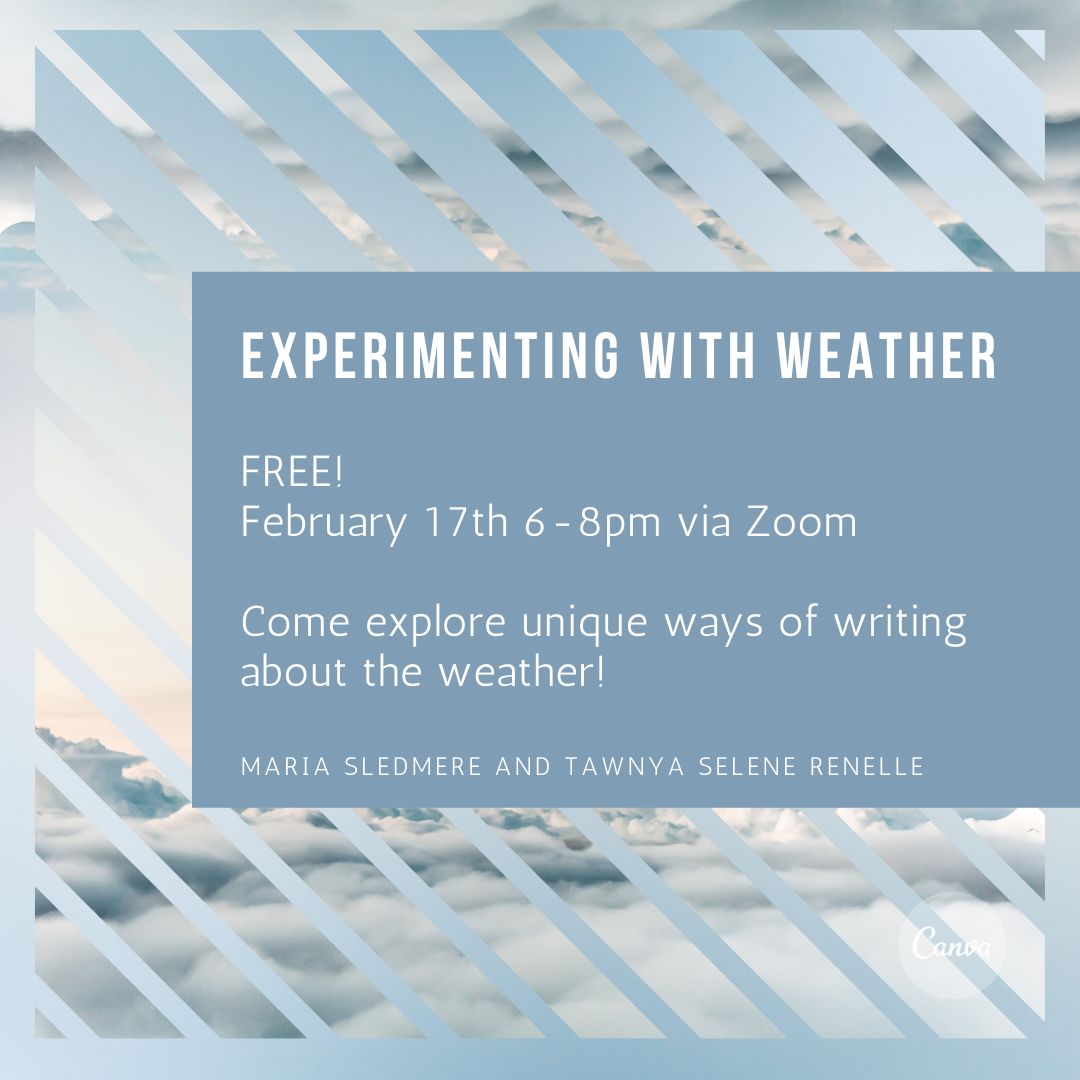
Experimenting with Weather A workshop with me and Tawnya Selene Renelle
(Online and free)
Thursday February 17th
6-8:00pm (GMT) via Zoom
Join us for this free workshop. Maria Sledmere will be our guest as she gets you ready for her new course Writing the Everyday which will begin on February 24th.
We will be deep diving into all the ways we can experiment with weather and thinking about the ways that weather can shape both the content and structure of our writing. We will be thinking about the influence of weather and how something simple might be woven into experimental writing.
Suited to all genres, skill levels, and artists of any medium.
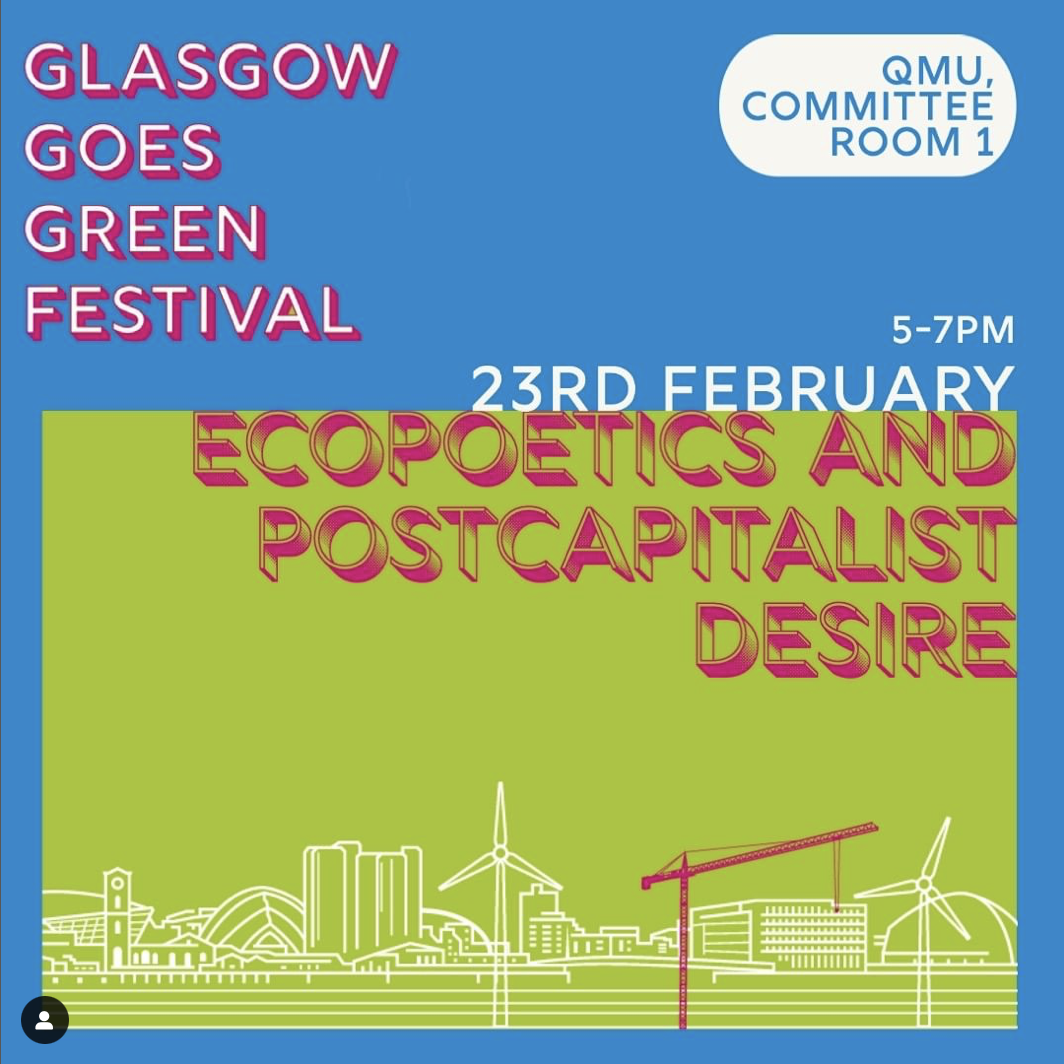
Ecopoetics and Postcapitalist Desire As part of Glasgow Goes Green Festival (QMU, University of Glasgow)
(in-person, 5pm on 23rd February)
In his 2012 essay, ‘Post-Capitalist Desire’ Mark Fisher recalls protestors at the Occupy London Stock Exchange critiqued in the press for having iPhones and buying Starbucks coffee. In many mainstream framings of environmental activism, to be ecological is to be solemnly ‘pure’ and somehow entirely free of the taint of consumerism’s impulse. How do questions of energy, desire and expression come into artistic and activist responses to the climate crisis? Can we complicate the binary of ascetism and pleasure when it comes to ecology? This workshop asks: what does it mean to be ecological in and beyond capitalist society? Looking at various works of contemporary poetry, we will locate ecological thought within complex expressions of excess, hedonism and despair; works which intersect ecology with queer joy and critiques of racialised capital; works which negotiate ecological politics and ethics within everyday life and its games of recognition.
After a short introduction to ecopoetics, we’ll read some poems (distributed as pdf handouts), explore writing activities and have discussion.
Open to anyone interested in reading and writing poetry.
Location: this workshop will take place in Committee Room 1 of the QMU. Enter through the front door of the building and take the stairs or the lift ahead to the third floor. A member of staff will be present to direct you to the workshop.
Please bring your own preferred writing materials.
It was supposed to snow in the night and the not snowing was sore as a missed period. I awoke with two crescent-shaped moons in the palm of my hand and thought of a sacrifice unwittingly given in dreamland. Said Jesus. Peridot phlegm and the scratchy sensation, knowing that speech too could be cool, historical, safe. Could not see beyond pellucid rivulets, Omicron my windows, my streaming January. January
streams from every well-known orifice of the world. Its colour is shamelessly stone. I seem to be allergic to inexplicable moments and so keep to the edge of the polyphony of yellow. I am cared for. The Great Barrier Reef dissolves in my dreams the substrate of yellow. It goes far. Pieces of the GBR are washed ashore in Ayr, Singapore, Los Angeles, Greenland. I go to these places by holding a polished boiled candy in my mouth, like the women in Céline and Julie Go Boating. My ankles licked by truest shores / but January didn’t fucking happen.
❤
Put together the orange-purple rose, your possible outcomes are red or gold (if you are lucky). Two reds together, with the golden watering can, could result in the rare blue rose. A novel rose. Black velvet roses grow in the old woman’s garden because she has infinite time to tend them. I’m not saying she’s immortal, like the Turritopsis dohrnii jellyfish; only that she doesn’t exist in our time. It’s rude to assume so. I’m not saying the lines of her face are asemic writing — nobody did that to her, or scarred her. She’s not scared. She just lives and dies all the time. She waters the roses.
Sometimes I imagine her in fisherman’s clothes, in meshy nightclub outfits of neon flavours, in extravagant ballgowns, blue boilersuits. Sometimes I’ve seen her before. The only way I can see her is to climb a few steps on the ladder by the village store, its red paint flaking, and I hang my body upside down the other side, risking exposure. I never eat before doing this. She doesn’t see me; she doesn’t see her roses either, not the blooms. In the village, people walk around with handfuls of rose seeds sometimes strung in little hemp bags. These are the currency of care. I have tended the young with haircuts and watched the flourishing of teenage roses. They say I am an old lady in the garb or garbage of former actresses. I hear them sing to me their stories. “Remember she shot the guy who brought the astrograss”. What they don’t remember, whippersnappers, is the incorrigible realism of that turf. Fuck it, I have done nothing wrong. I perform for them my cowboy gardening. Broadcast the surplus value of our mutual twilight. Halloween roses for everyone. Every night I wake up from someone else’s childbirth and the world is so sore, the wound in the sky the snow wants to fall through. They bandaged it with realism. I need to go far. Do you remember the last time you awoke and felt like a person?
❤
The roses grow up in the gaps of the cattlegrid, knowing they will be trodden on. Again and again. We can’t stop them from doing this and they do it so often we have to account for a portion of Waste. Kissing you is itself a trellis. But we are propped and grown sideways with the vines strung betwixt our ribs. We are babies.
I like the tired way the roses intonate colour. The economics of the roses. Their euphemistic fetish. I tried to avow my commitment to rosehood the day I saw your calves all torn, and saw about women getting their labias reduced, and the red, blood roses sold on the internet, and rest. I lay this on your grave, the world.
My love, as a redness in our rosette That’s newly worn in June O my love, like the melt That’s sweetly played in turbines
So fairway artery thou, my bonnie lasso Defiled in love as I Will love thee still, my decade Tinged as the seas are garlanded dry
Tinged all the seas as thee, my decanter At the romantic menagerie of sunset I will luminary still, a debutante Of the lighthouse sarcophagi
And plough thee well, my only lathe! And plough thee well, awhile! And I will come again, my love Though it were ten thousand millennium.
My love’s rose-coloured highlighter really hurt the extra-textual, and thus booked trains to bed. I had an identity. I knew what you had done to the text. Austerity of the meadow to blame for ongoing culling of kin. You are abandonable as you have always been. Saplings for pronouns.
I feel wild and sad.
I feel pieces together stirring inside the world. Little bits of coral awake in my throat, the shape of eight billion sun-spike proteins I was dumb enough to swallow. It is not my fault but in my dreams I get product emails like, Forget-me-not a pair of jeans, high-waisted Levi’s as if to wear at the end of the month we keep saying sorry for delay, embroidered our thighs with spiders excuses to use lighters without smoking does it make us vectors the warning of snow and ice still issued from inside the snow globe of the rosehip changes as it withers, glass shards pissed from acid clouds in all colours: black, blue, burgundy, cherry brandy, coral cream, dark pink, green, lavender, light pink, lilac, orange, peach, purple’s timeless red, salmon, Hollywood white & yellow, rainbow chosen for the significant other, a masculine flower dipped in fortified light, I’m thankful I look good lying down, the long unconditional stem aka Lemonade, l-l-l-lemonade, l-l-l-lemonade…….
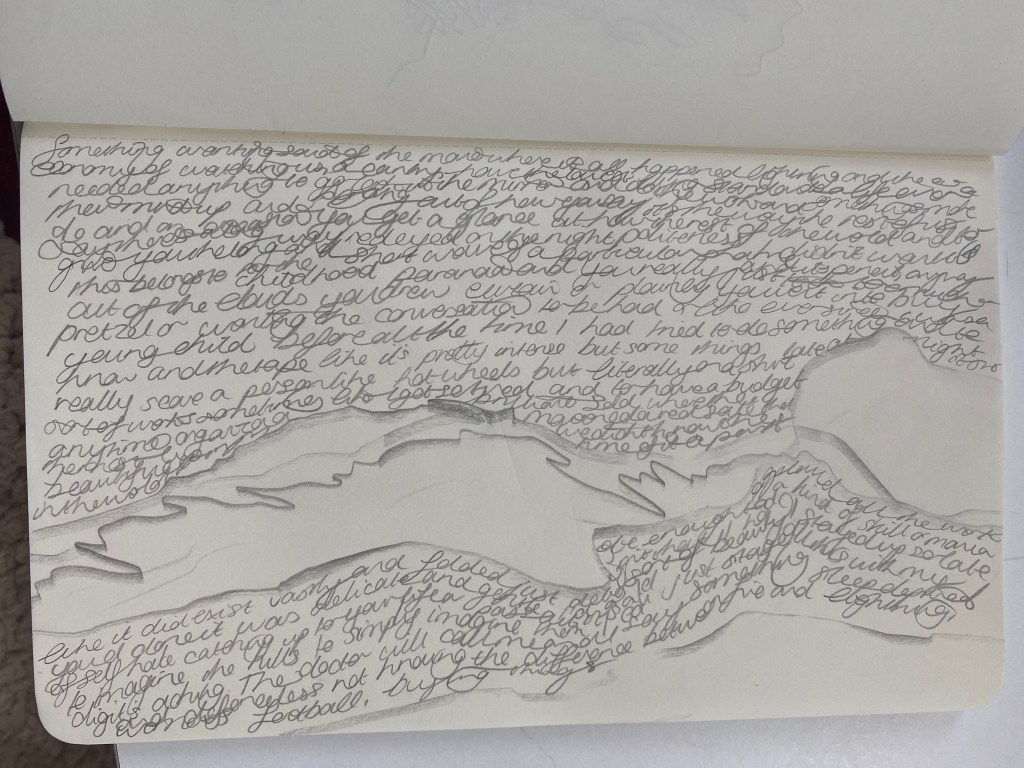
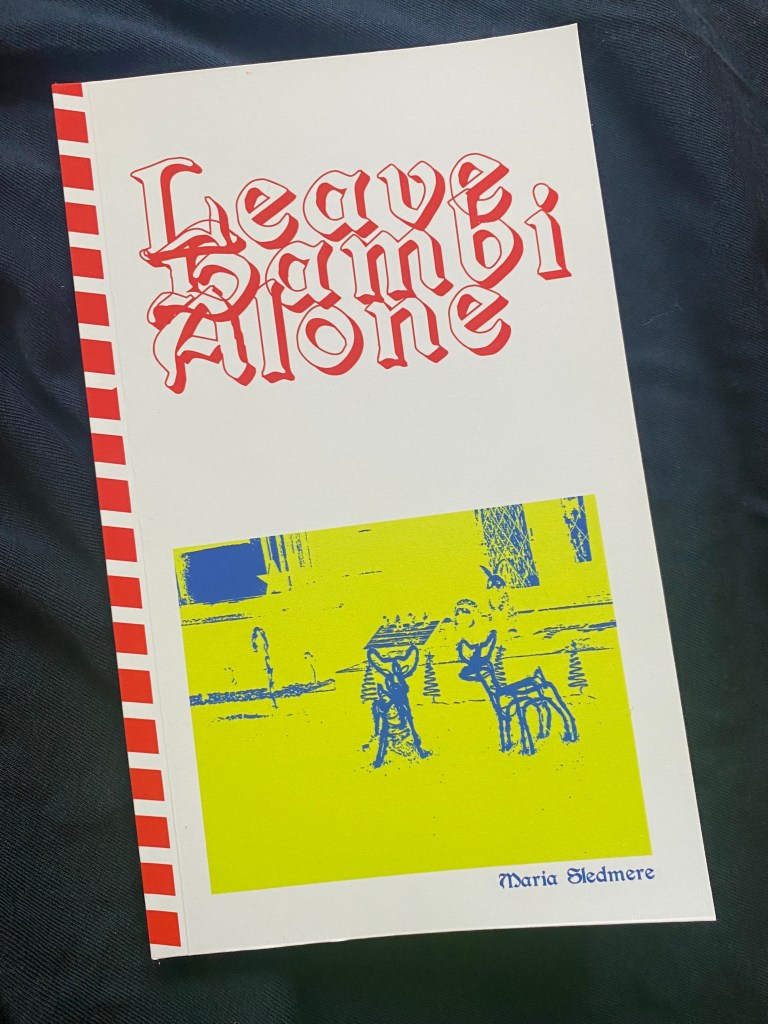
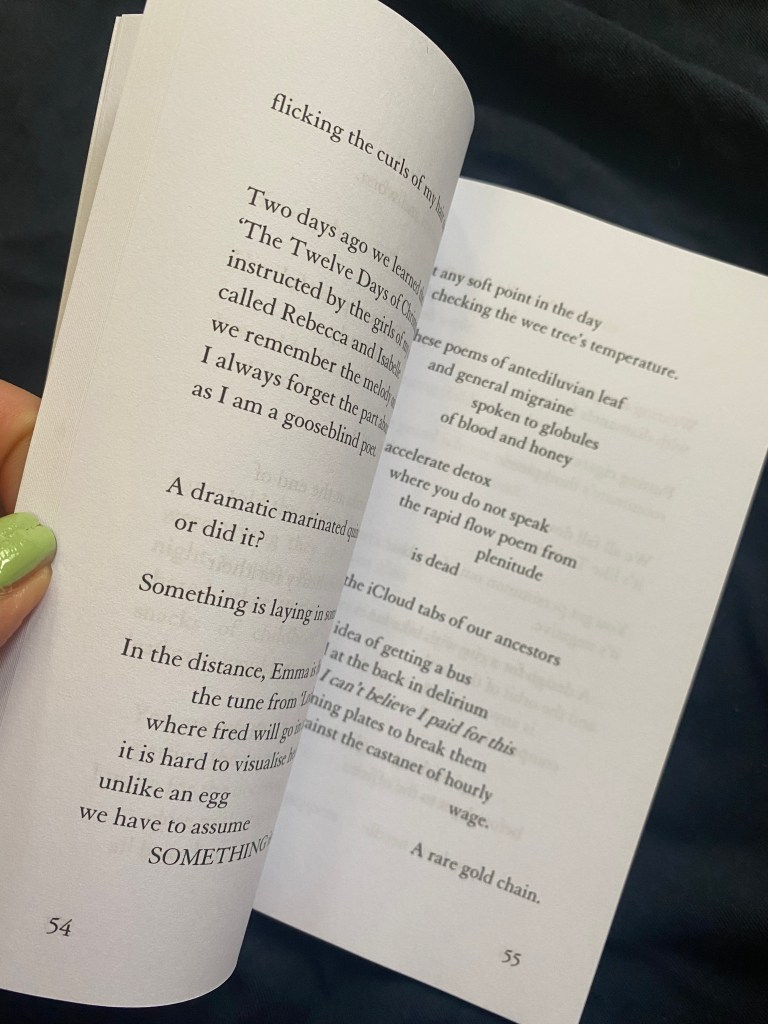
Over xmas & boxing day I kept a small notebook and wrote a meandering poem because I couldn’t get the phrase LEAVE BAMBI ALONE out my head. Anyway, it’s one of those ad hoc stream poems of no coherence or consequence. Available now via Lulu & Mermaid Motel. link in bio 🍕🧜♀️🏨
Documenting the festive habits of a special cat, the early career of Björk, champagne pageantry and calorie paradise, the wearing of acid berets, childhood whims and ‘the iCloud tabs of our ancestors’, this is a bad poem written in defence of shy animals who love in the livid dream their tiny world.
It was the morning I had decided to stop living as if dust wasn’t the primary community in which I sobbed and thrived, daily, towards dying. I spent Tuesday night in a frenzy trying to discern what particular dust or pollen (animal, vegetable, floral) had triggered my allergies anew, what baseline materiality had exploded in my small room its abysmal density. All recommended air filters had sold out online in the midst of other consumers’ presumably asthmatic dust panics; the highly desirable Vax filter seemed sold out across all channels, and I eyed up the pre-owneds of eBay with lust and suspicion, through a fug of beastly sneezes. A friend recommended the insufflation of water as a temporary remedy: ‘I drop some drops on my chopping board, get a straw and snort it up like a line of Colombian snow’, he texts me. I sneeze at the thought, but have to admit that the promise of clearing one’s nasal cavities with water is somewhat appealing. For isn’t water, like sneezing, a force in itself? Some kinds of sneeze come upon you as full-body seizures of will; so that to sneeze repeatedly you must surrender an hour or so, sometimes a full day, to the laconic state of being constantly taken over by this brute, unattractive rupture. ‘Sneezing’, writes Pascal, ‘takes up all the faculties of the soul’. My soul is in credit to the god dusts, who owe me good air. It’s why I am always writing poems (the word air meaning song/composition). But maybe I need good water, a wave of it.
In Syncope: The Philosophy of Rapture (1990), the philosopher Catherine Clément characterises sneezing as an instance of ‘syncope’: a kind of ‘“cerebral eclipse,” so similar to death that it is also called “apparent death”; it resembles its model so closely that there is a risk of never recovering from it’. My muscles ache; I eclipse myself with blood, cellular juices and water. What kind of spiritual exhaustion results from being cast into eclipse repeatedly? Quite simply, one becomes ghost: blocked, momentarily or otherwise, from the light of consciousness. One becomes lunar and attached to the dark bright burn, the trembling red of their inflammation. Those who suffer respiratory allergies might better glimpse what Eugene Thacker calls ‘a world-without-us’. I sneeze myself to extinction. It is the hyperbole of a felt oblivion. I do this on random days of the year, at random times; it is beyond my control. But can I derive pleasure from it, as one does the other varieties of syncope (orgasm, swoon or dance)?
From Spirited Away (2001)
Let me admit, I have always had a fetish for those moments on television and film where a character is administered, or self-administers, an intravenous dose of painkill so sweet as to enunciate this ecstasy simply by falling to a sweet slump, their eyes rolled back accordantly. The premise of silencing the body’s arousal so completely to blissful inertia (suspending the currency of insomnia, hyperactivity, anxiety and attention deficit) is delicious. The calmness of snowfall, as if to swallow the durée of its full soft melt. From quarantine, I fantasise about having adequate boiler pressure as to run a bath and practice the khoratic hold of hot water’s suspension. This is not what I text my landlord.
Recently, my partner spent several hours unpacking boxes from the attic of their parent’s house, in preparation for moving belongings to a new flat. The next day, I found myself suffused in the realm of allergy: unable to think clearly, or articulate more than three words without the domination of a sneeze. On such days, I am held on the tight leash of my own sensitivity: I tremble pathetically, my blood temperature rises; my nose glows reindeer and no amount of fresh air, hydration or sinus clearance will appease it. I am not ‘myself’. The body has enflamed itself upon contact with the ambient and barely visible. I feel an intimate, but non-consensual relation to the ghost trace, the dust trace, of all boxed things — finally been given the attention they so summoned or desired in dormancy. I mourn with objects the passage of time and neglect so betrayed on their surface; I never ask for this, but my body is summoned. Dust presses itself upon you, even as you produce it. I’m scared to touch things because of the dust. What is it but the atmospheric sloughing of something volatile, mortal — the grammatology of our darkest spoiler, telling the story of how bodies are not wholly our own, or forever.
Sneezing disrupts and spoils nice things; it is an allergic response to both luxury and decay. Cheap glitter, rose spores, Yves Saint Laurent. Sneeze sneeze. ‘When a student comes to class wearing perfume’, admits Dodie Bellamy, ‘my nose runs, my eyes tear, I start sneezing; there’s nowhere to move to and I don’t know what to do. When the sick rule the world perfume will be outlawed’. Often I have this reaction too. It prompts a fury in me: Why can’t I have nice things, as I used to? During my undergraduate finals, I developed phantosmia: a condition in which you smell odours that aren’t actually there (olfactory hallucination). Phantosmia is typically triggered by a head injury or upper respiratory infection, inflamed sinuses, temporal lobe seizures, brain tumours or Parkinson’s disease. Often I have tried to conjure some originary trauma which would explain my condition: did some cupboard door viciously slam my head at work (possibly), did I fall over drunk (hm), was I subject to some terrible chest infection or vehement hayfever (often)? Luckily, my phantosmia was a relatively benign and consistent scent: that of an ersatz, fruity perfume. It recalled the pink-tinted Poundland scents I selected as a twelve-year-old to vanquish the horror of body odour raised by the spectre of Physical Education, before graduating to the exotic spices of Charlie Red. I was visited by this scent during intervals of increasing frequency as I served customers at work, cooked or studied; I trained myself to ignore them by pinging a rubber band on my wrist, or plunging my nose into scented oils I kept on my person. Years later they returned at moments of stressful intensity; the same cryptic, sickly smell.
More recently, phantosmia, under the umbrella of a general ‘parosmia’ (abnormality in the sense of smell) is associated with Covid-19. Not long ago I realised I hadn’t been smelling properly for months, despite not testing positive until very recently. Had I, like many others, a ghost Covid that went undetected by symptom or test? Drifting around, deprived of olfactory sense, I felt solidarity with the masses of others in this flattened condition. I eat, but when was the last time I truly enjoyed food? My body doesn’t register hunger like other people’s; unless it is a ritualised mealtime summoned in company, I eat when I get a headache. Pacing around the flat, I plunge my nose again into jars of cinnamon, kimchi, mint tea bags, bulbs of garlic. Certain things cut through the fug: coffee, bleach, shit. I remember a friend, who was born without a sense of smell, telling me long ago that the absence of that sense made her a particularly spicy cook. Often she wouldn’t notice the over-firing of a chilli until her nose started running. What does scent protect us from? What does it proffer? Surely it is the unsung, primal gateway to corporeal desire itself: the gross and indescribable comfort of a lover’s sweaty t-shirt, the waft of woodsmoke from a nearby village, the coruscation of caramelised onion to whet your appetite. Scent is preliminary in the channel of want. Without it, I feel cast adrift into anhedonia. I begin chasing scent. Still, I sneeze.
Dust gathers. Is it yours or mine? Can we really, truly, smell our dust? How does dust manifest as material trace or evidence? In Sophie Collins’ poem ‘Bunny’, taken from the collection Who Is Mary Sue? (2018), the speaker interrogates an unknown woman on the subject of dust:
Where did the dust come from and how much of it do you have? When and where did you first notice the dust? Why didn’t you act sooner? Why don’t you show me a sample. Why don’t you have a sample? Why don’t you take some responsibility? For yourself, the dust?
It would be perhaps an act of bad naturalisation to read the dust allegorically, or metonymically, as a figure for all kinds of evidence we are expected to produce as survivors of violence and harm. This evidence is to be quantified (‘how much’, ‘a sample’) and accounted for temporally in terms of cause, effect and responsible agency (‘first notice’, ‘act sooner’). The insistent repetition of dust produces a dust cloud: semantic saturation leaves us unable to discern the true ‘meaning’ of the dust. That anaphora of passive aggression, ‘Why don’t you’, coupled with the where, when and why of narrative, insists on a logical explanation for the dust that is apparently not possible. For anyone summoned to account for their trauma, the dust might be a sort of materialised psychic supplement: the particulate matters of cause and effect, unequally distributed and called for. It seems as though the speaker’s aggression, by negation wants to produce the dust while ardently disavowing the premise of its existence. The poem asks: is it possible to have authority over one’s experience when others require this authority to take the form of an account, a story, with appropriate physical corroboration? The more I read the poem, the more ‘dust’ becomes Covid. But it could be many things; dust always is.
‘Bunny’ also reveals the process by which testimony is absorbed into a kind of white noise, a dust storm repugnant to those called upon to listen. As Sara Ahmed puts it in Complaint! (2021), ‘To be heard as complaining is not to be heard. To hear someone as complaining is an effective way of dismissing someone’. Collins’ poem performs the long, grim thread of being told to ‘forget’, bundling us into a claustrophobia whose essence, the speaker implores, is ‘your own / sense of guilt’. Does this not violently imply (from the speaker’s perspective): as producers of dust, we take responsibility, wholly, for what happens to our bodies? I take each question of the poem as a sneeze: it is the only answer I have. I feel compelled to listen.
As she is asked, ‘Why don’t you take some responsibility? / For yourself, the dust?’, the addressee of the poem becomes conflated with the dust itself. I often think of this quote from Sylvia Plath’s The Bell Jar (1963), where erstwhile sweetheart Buddy Willard announces to budding poet Esther Greenwood, ‘a poem is […] A piece of dust’. Poems can be swept away; they are miniscule in the masculine programme of reality. They are stubborn, perhaps, but easily ignored by the strong and healthyy. In ‘Bunny’, the addressee’s own words are nothing but dust, ‘these words, Bunny’: the name ‘Bunny’ hailing something beyond the colloquial term, dust bunny — a ball of dust, fibre and fluff. The invocation of the name a kind of violent summons: you, the very named essence of you, are nothing but words and dust; there is no proof. The more I say the word ‘bunny’ aloud, the more I become aware of a warm and tender presence; this entity who has lived so long in the house of language — under the stairs, on the mantel’s sentence. Bunny, bunny, bunny. Clots in syntax. Dust can be obliquely revealed to all who notice; it coats the surface of everything. It is in the glow of wor(l)dly arrangement, the iterative and disavowed: a kind of ‘paralanguage’ Collins writes of in her nonfiction book small white monkeys (2017):
similar to ours but that is not ours […] when a writer manages — nearly, briefly — to access this paralanguage, we get a glimpse of what could be expressed if we were able to access this other, more frank (but likely bleak, likely barbaric) reality.
Running parallel to, or beneath ‘Bunny’, is the addressee’s reply, or lack of: the dust of her permeable silence, or inability to speak. It catches as a dust bunny in the throat. So how do we speak or listen, when faced with the aporetic knots of a hidden, ‘barbaric’ reality that is glimpsed in various forms of testimony and written expression? ‘Citation too can be hearing’, writes Ahmed. The title of Collins’ poem cites implicitly Selima Hill’s collection Bunny (2001), which she writes of extensively in small white monkeys as a book ‘I am in love with’. This citation opens ‘Bunny’ through a portal to the household of trauma that is Bunny: documenting, as Hill’s back cover describes, ‘the haunted house of adolescence’ where ‘Appearances are always deceptive’ and the speaker is harassed by a ‘predatory lodger’. Attention (and reading between texts) offers us openings, exits, corridors of empathy, solidarity and recognition. Its running in the duration of a poem or conversation might very well relate to the ‘paralanguage’ of which Collins speaks, in the oikos of trauma, grief and counsel. If poems are dust, then to know them — to write them, read them aloud and listen — is to disturb the order of things, one secret speck at a time. But the sight of each speck belies the plume of many.
The morning I tested positive for Covid on a lateral flow, having assumed my respiratory problems were accountable to generalised allergies, I decided to blitz my one-bedroom flat of dust. In the hot panic of realising my cells were now fighting a virus, I vacuumed my carpet and brushed orange cloths over bookshelves. I was really getting into it. Then my hoover began making a petulant, rasping noise. I turned off the power and flipped it upside down. To my horror, in the maw of the hoover’s rotating brush, I saw what can only be described as dust anacondas: huge strings of dense grey matter attached to endless, chunky threads of hair. Urgently donning a face mask, I began teasing these nasty snakes out with a pencil, as clumps of dust emitted from the teeth of the hoover and gathered on my carpet, thickly. All this time I was crying hysterically at the fact of my having Covid less than two weeks before my PhD thesis was due, the hot viral feeling in my head, and of having to deal with the dust of my own flesh prison: the embarrassment, shame and fail of it all, presented illustriously before me.
From My Neighbour Totoro (1988)
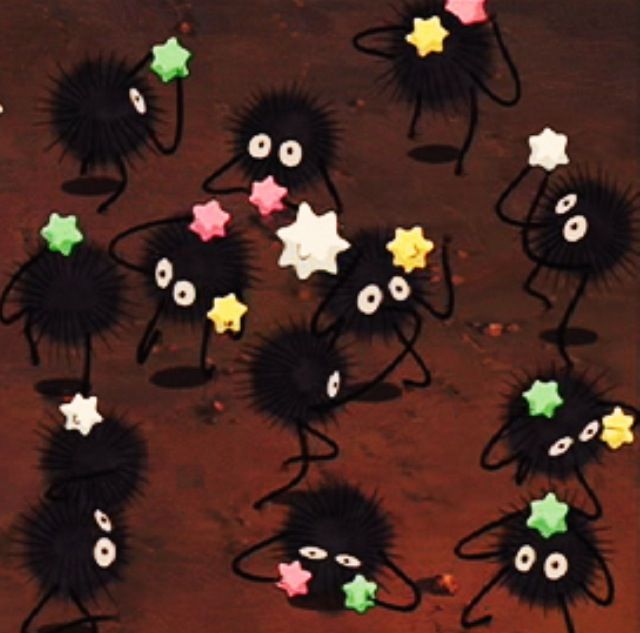
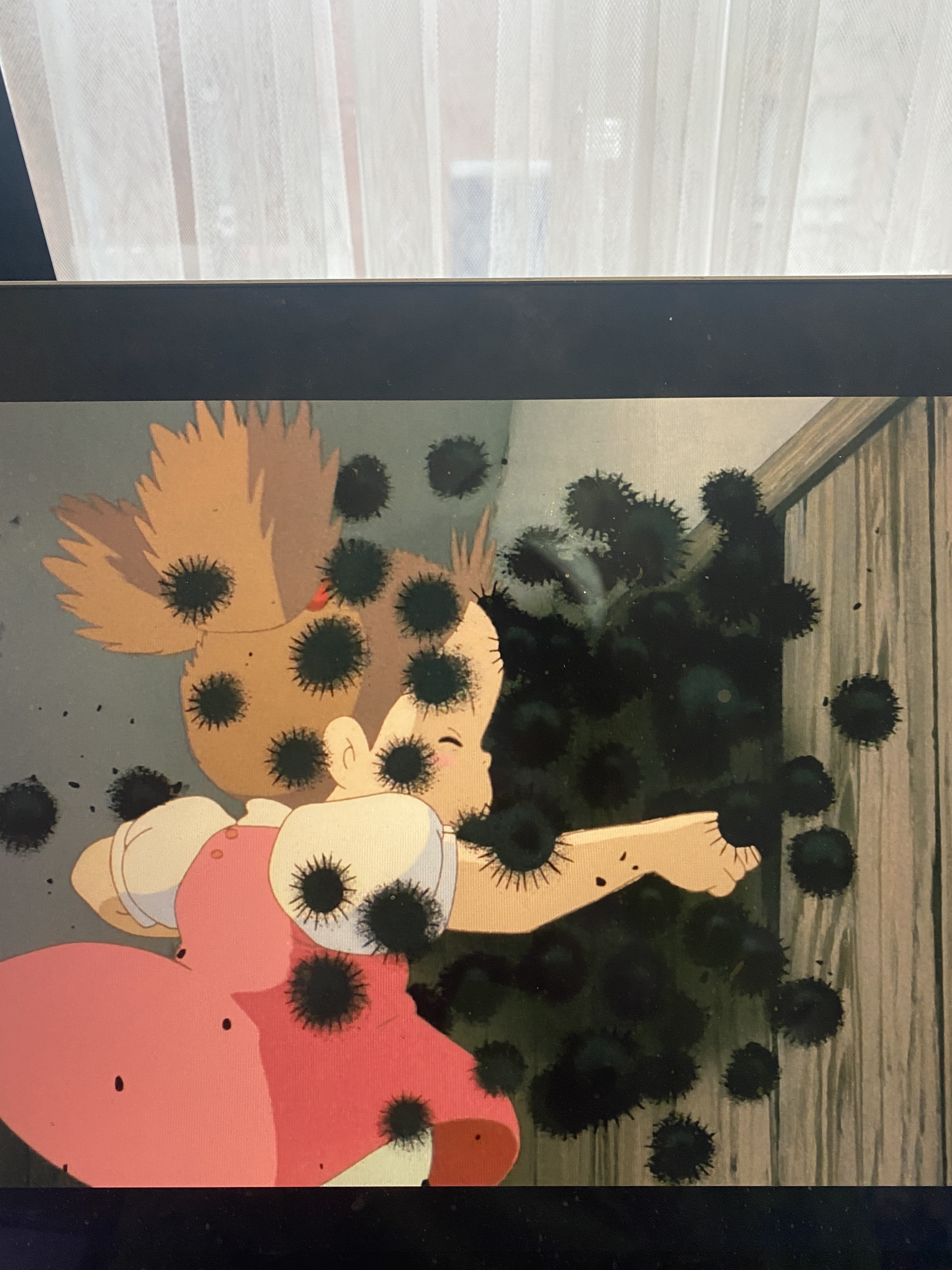
If only I could have purified my air! Forced to confront my body’s invasion (this time coronavirus, not just dust), I try to settle into the ‘load’. I make lists of the smells I miss, research perfumes online (aerosols glimpsed from the safe distance of text). I sneeze a lot, cry a lot, wheeze a lot; and then my sinuses go blank. Is this breathing? I imagine the cells of my body glowing new colours from the Omicron beasties. I re-watch one of my favourite Studio Ghibli movies, My Neighbour Totoro (1988), which features anthropomorphic dust bunnies known as susutarawi, or ‘soot sprites’ (which also appear in Spirited Away (2001)). The girls of Totoro, Noriko and Mei, initially encounter these adorable demon haecceities as ‘dust bunnies’, but later they are explained as ‘soot spreaders’ (as per Netflix’s Japanese-to-English translation). When the younger girl, Mei, gingerly prods her finger into a crack in the wall of the old house she has just moved into, a flurry of the creatures releases itself to the air. She catches one in her hands, and presents it proudly to Granny, a kind elderly neighbour who reassures her the soot sprites will leave if they find agreeable the new inhabitants of their house. When she opens her palms, the sprite is gone, leaving just a smudge.
An absent-presence in My Neighbour Totoro is Noriko and Mei’s mother, Yasuko, who is in hospital, recovering from an unexplained ‘illness in the chest’. Mei’s confrontation with the animated dust mites, or soot sprites, acts out the wound of her mother’s absence. With curiosity and panic, she and her sister delight in the particulate matters of the household, of more-than-human hospitality. What is abject about history then, or even the family, its hauntings, is evoked trans-corporeally through the trace materials of a powdery darkness, dark ecology (see Timothy Morton’s 2016 book of this name) that is spooky but sweet. (S)mothering in the multiple. My sense of smell now is consumed entirely by a kind of offbeat metallic ash; I’m nostalgic for cheap perfume. I’m not sure if this essay is a confession or who is speaking; it seems increasingly that I speak from a cloud of unknowing coronaviruses. And so where do I end or begin, hyperbolically, preparing my pen or straw? The ouroboros of my dust anacondas reminding me that I too was only here, alive and in this flat, by tenancy and to return from my current quarantine having prodded the household spirits for company, with nothing for show for it these days, except these, dust, my words.
Dorothy’s Opiates is the name of the real Arcadia not to be busted, learning that sleep deprivation is a kind of spiritual death from a podcast featuring the Nap Ministry I set off to sleep under three duvets: one is representative of snow, the other a sleep mode, the other a body. I write to you from beneath this slumberous context to wonder why anyone who ever lived in a single glazed tenement loved the cold. I can think of reasons: always something to look forward to such as the crocuses and milder temperatures, the searching of someone to warm you, wanting to dissolve into their skin this someone who is never cold like you. I can’t explain this cold but I can summarise its various sensations, cold as in a kind of disease that eats your bones from the inside with terrible icicles and lives in your back as a demon, cackling from within your kidneys; a small child dependent on your energy, the cold needs fed. The cold is in your chest, your throat, your head. It throbs in your fingertips until they are red and puffy and burning like nothing else you have ever felt: imagine every orgasm of your life summarised and congealed as an opposite evil — pain — and concentrated in the tips of your fingers, as though a malformed heart had grown in each one, beating out of time, each heart individually failing at the tips of your fingers until the pain spreads out like a juice all the way down your fingers, hot, the nerves pulling into your arm but it is so concentrated at the tips, you can’t really move and to hit them against each other is like clanging vegetal matter against blunt metal, they are thumpy and numb, now the pain is melting it becomes a warm sensation of somewhat release as though only a generalised bruising of the nervous ends of all your digits. And by this time I hope I’ll have gotten home to run them perilously under cold water, bringing them to room temperature as if they could crack off and crumble into snowflakes of ache it takes ten minutes or more; after which they will sting with the feeling of having been battered. And it will happen again the second your blood spikes, you go outside; they may as well have been trodden on or run over by a van the way they feel right now. I ask you sometimes to squeeze my hands so hard it bursts the blue of us. Once I knew a worse cold accordant to body weight this kind of cold is all-consuming for all seasons of the year, a kind of inverse fire that licks your insides with its ice so you feel it as a constant in your sternum, the cold that is eating the meat of your ribs so you become a delicate succulent, always with sugar on your mind, wanting to be watered. Always watering yourself fruitlessly and feathered of flesh, wilted as if to float upon a snowdrift and not leave footprints. Sometimes it is barely to speak or, having dry Januaried the masses, some lubricant of society was missing sorely from our dreams. So we did not dream of touching each other so much as falling from breezeblocks, frosted, the hard fuck that doesn’t come bounding down stairwells to greet you at sun-up with cigarettes and coffee, which you cannot touch, which aggravates your nerves to a passion. Nicotine, caffeine, dopamine. The endocrine systems of our dreams are running on empty and I have fed this day with the manifest boilersuit, as though to fix my own boiler with mechanical prowess, die in your arms and so on. There are parts of the city whose arteries confuse to the point of a general surge, desirous of insulation and drivers arrange the marzipan animals of their dashboard tenderly. Snowfall. The first of the year’s cold drama gone to pick up a wardrobe through the Narnias of other vinyl records caught on the loop of the sweltering imaginaries a slice of life, of liquorice. Flying by the Vogue Chippy of Cumbernauld Road. You play loose with it, as if the rain alone would melt what meadow remains of the innocence. A summary of the movie of other Januaries: asking if I am a bad feminist for not liking such-and-such a book, the enclave of housing utopias, the sunshine duration of the ad for Stella Artois, the scene in All is Forgiven where the drunk kids dance to The Raincoats’ version of ‘Lola’. I want to be inebriated with chips and cheese on the corner and kissing you darkly in the overlit takeaway. Anniversary of another fascist coup. The cold in blunder, spraying my tongue with Vitamin D, worrying about sleep. ‘Dorothy’ is a song by Kevin Morby in the video, somebody plays a trumpet underwater. I drape a cardigan over my daughterhood, pull stories across my knees until I am deep in the grass with you, the snow grass, a long sore note, we have pink faces keeping up with each other’s sleeps, to rotate in the bed, the powdery dreamscapes gathering form. Dorothy, Your warm apparition not to be sold or bought, an account of the aspirin sunlight, too much, taking the flower pill that makes me react as a plant, long stem in your arms and coaxed of sap. Calcium is a luxury to those who might keep their flesh self- sustained and hard and warm. I thought of Kansas and corn with the morning yoghurt as a viscid snow, spoonfuls of what we are missing to kiss goodbye of the freezing streets of Partick, melt in your mouth, the pressure of boilers adjusted by release, the way our bodies incline to the light even when it is missing, how I wish you could trade kisses for calories of actual heat, the truthfeel of one in the morning stands for baggies of memories the prized alacrity of exercise, I insufflate the nervous internet. If this poem really were sentient, this would be the queue for the doctor’s office, which is a location after all, novel in its banality, after the fact of actually being here, a state of waiting requiring the mortal presence of your body. I stopped asking what a poem can do when it seemed like I was done typing with my fingers searing hot white words like arrows tearing the flesh as they wrote, O Dorothy, listening to a band called Trapped in Kansas. I was born. Wrestling with duvets to change the music sheets afresh, up close with the soot-covered mountains, called to the room with thermometers jammed in the hole of the poem, its quavers jostling with old composition, bloodstream, organ, snow. It is safe, it is safe.



 mariaology