viscous tendencies
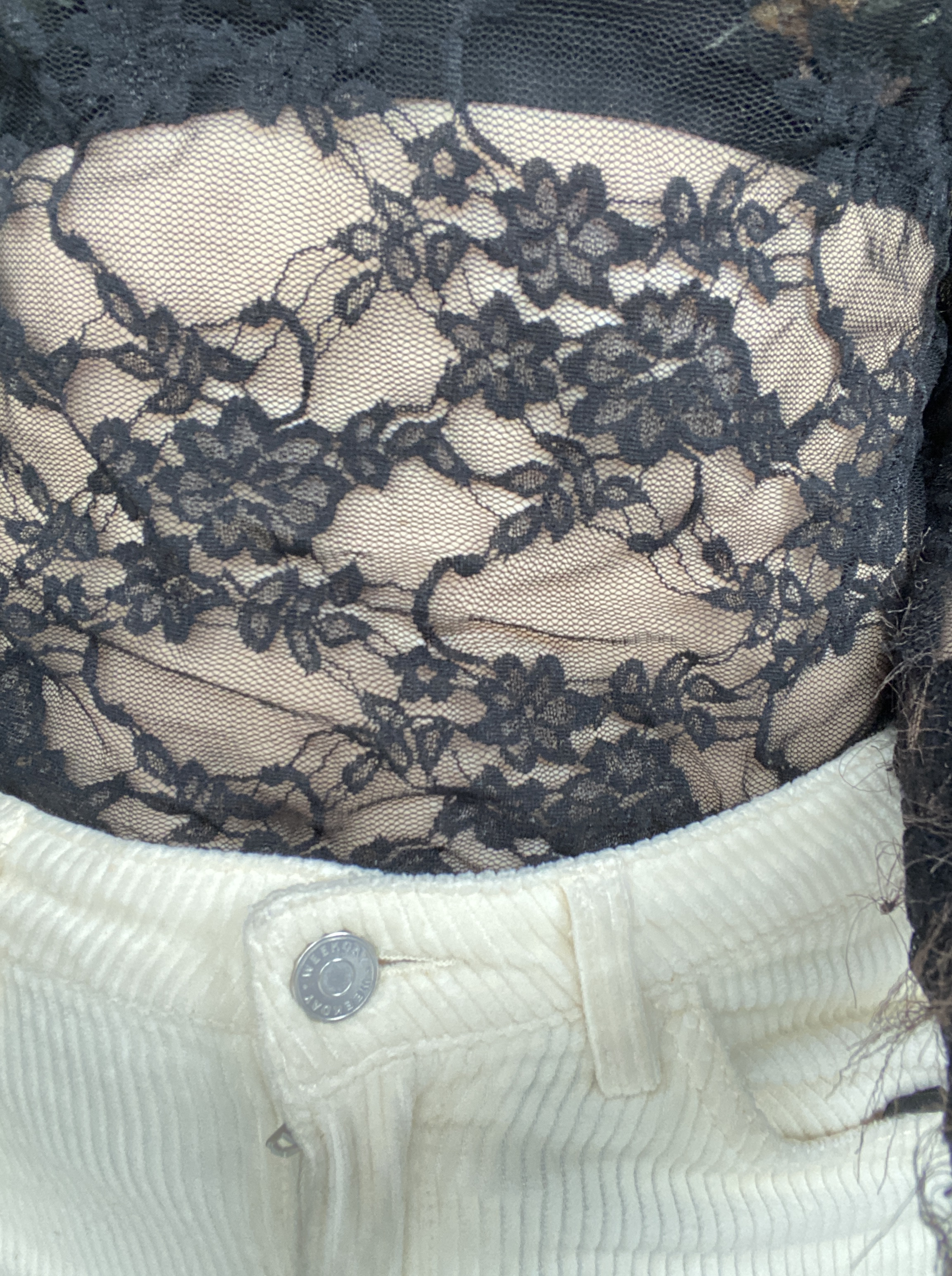

It’s almost autumn and I can’t stop listening to The Corrs. Something ringing in the falling rain a leaf-lorn runaway, never gonna stop falling, wish I could play the strings and not cry over a snapped shoelace that Saturday, wish I could never need name this. A fresh nostalgia for Flash player, a bad new year, kneeling in the car dirt of roadsides to fix my bike, the air all gone out of each tyre it’s tiring to be here / wish I could change. Not into other people but into the person I was, rosy-fingered sleepless rolling cinnamon skins and talking on the internet while in the other town this guy throws a mattress out of a window. If memory serves to fall out with it. Black lace and white corduroy out to the woods I’m happiest on the hill where I see this deer, evidently a teenage stag and I’m calling angel androgynies the very next stray. Fucked up salads of affect, afraid to go outside. Emma says everyone’s a poet. You just go.
Crying in the cobblers for other omens.
Girls in the nineties with strands of dark hair, box-dyed. The electricity all gone out. I was supposed to be planning a workshop, writing a lecture. The universe owns me, doesn’t owe me.
Across oceans of static, watching you typing…
I cycled past the cathedral and saw the sycamores blush orange as if in real-time metabolising their chlorophyll before me. I google the phrase ‘fall splendour’ in guilty luxuriance. A man on my street pisses against the wall, daylight screams; he pisses for so long I think he will disintegrate in dumb liquid gold. Can’t concentrate on this Zoom call. I’m missing something real of the days before me. Girl in old man bar is singing a ballad. Can you drink a black hole if you can’t drink a Guinness? Colin says Brian says you’d have to suck through a straw at the speed of light. Girl in old man bar is wearing tartan, a velvet headband, recently expired lipstick. I like her.
Singing Eliza Carthy, singing Amen Dunes…
I always want autumn too early and pine for spring. Trillions of magazines tell me it’s not cool having holes in my tights. It’s not cool having ragged cuticles.
Ten years of sleazy beauty.
A paintbrush yellowing in sordid water.
Forever down Cathcart Road.
Incurable bed mornings of limb ache and long illness, it’s fine like to say it’s totes, bring myself coffee in bed and emails filling me with autumn leaves and the fly infestation fed upon fruit and air…a red car rolling backwards up the street…
It used to be so easy to write these like it never mattered to write at all. The sky is still whey and there are new routes to get to the same old temples. I swirl my tongue in the google doc long enough to know how I’d touch you; the hopescape bristles with city pollution. My friends have been to Greece and Bali, the Hebrides. I have been to Edinburgh for work. Come down the wrong side of the hill among gorse and scramble, the rocks coming loose and my heart gone trash-eating in the nights of bad sleep again, all again, falling awake with the light on, spilled ink in my sheets. I met the same America on Netflix checking my brain, my gag reflex.
I heard the blood blister in that guitar riff and it was like vomiting behind the shopping mall in Kilmarnock, drunk on bus wine and the Alice in Chains of my arteries…you awake, say the word clavicle, touch my spine…
The Corrs – Breathless
Alice in Chains – Tears
Hand Habits – No Difference
Beth Orton – Weather Alive
Belle & Sebastian – Working Boy in New York City
Sharon Van Etten – Darkness Fades
Baths – Tropical Laurel
Doja Cat – Love to Dream
Adios Nervosa – cloudcover
Drugdealer – Madison
Thee Oh Sees – Chem-Farmer
The 1975 – Part of the Band
June11 – Who is Still Dreaming?
Regina Spektor – Loveology
Thrilled to announce I’ll be working with Beyond Form Creative Writing again this autumn to offer two new workshops. The first, Epistolary Experiments, begins on 28th September and is a monthly, four-part series designed to explore the arts of letter writing and correspondence across different forms. We’ll be thinking about how the work of address, posting, description and all its intimacy and triangulation can tell a story, evoke fantasy scenarios or perform an expansive, relational lyric. The second, Pop Matters: Our Songs, is a one-off workshop on 23rd November and offers a warm and upbeat ‘studio’ for musing on the relationship between creative practice and pop music. How do we write through and towards pop with all our devotion or ambient dwelling in its neon glow? Both workshops will involve a mix of reading other work, discussion and structured individual writing activities. There will never be any pressure to share work, although you will have access to the workshop threads on Experimental Creatives Collective, a closed forum space where further discussion and sharing can take place if anyone wishes.
For both workshops, there is both a full price and two concession rates.
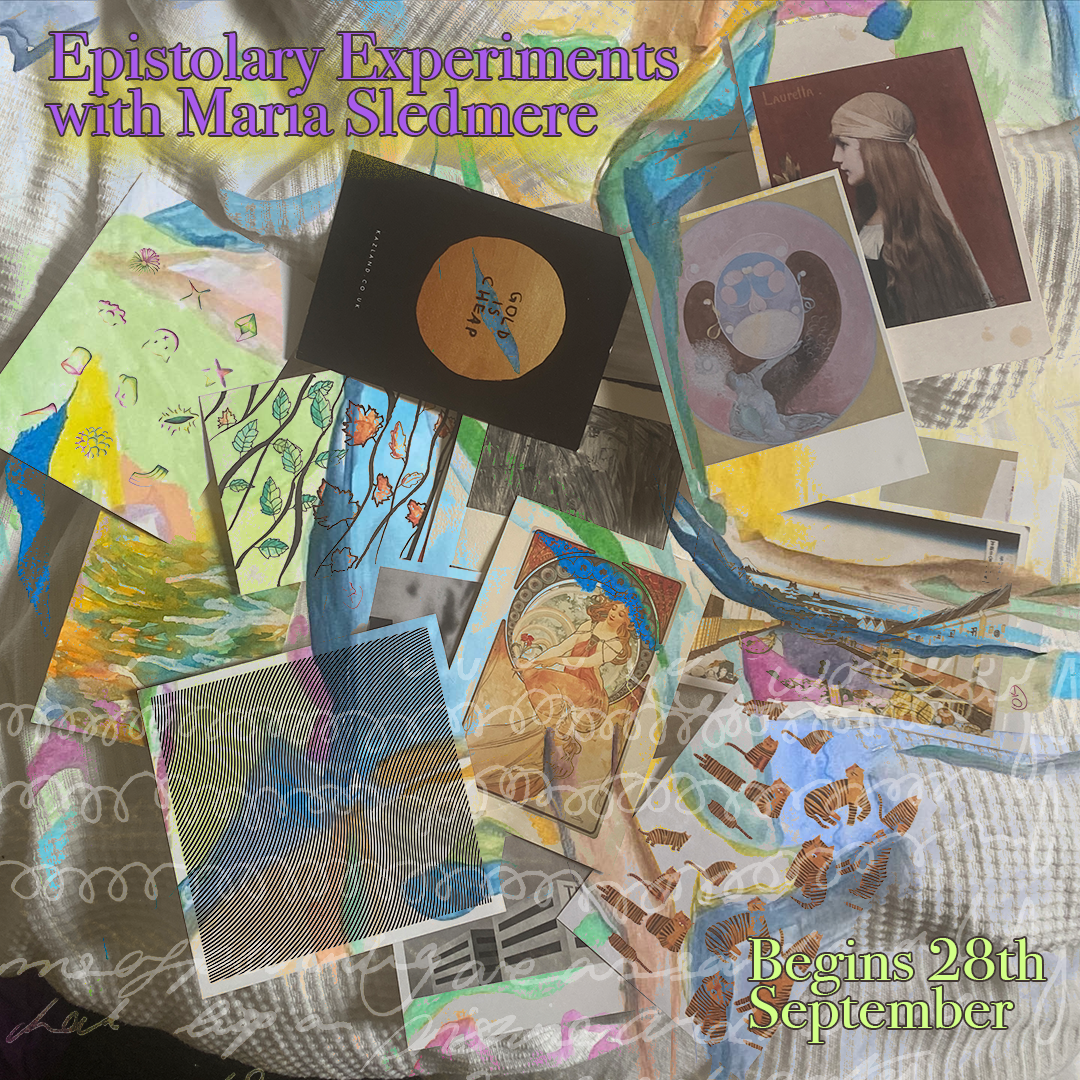
Epistolary Experiments
4 Sessions Starting Wednesday September 28th
6-8:00pm (GMT) via Zoom
‘I write you a letter to make eyes at a reader I don’t know from Adam’ (Kay Gabriel). From Samuel Richardson’s Pamela (1740) to Sean Bonney’s incendiary Letters Against the Firmament (2015), letter-writing or ‘the epistolary’ has inflected all kinds of writing, including novels, poetry and manifestos. Taking cue from Kay Gabriel’s ‘The Purloined Lyric’, we’ll explore the possibilities of letters, address and communication in all kinds of writing, practice and performance. While the literary letter has an established tradition, we’ll look at contemporary artists/authors who shake up the form of correspondence and in turn reframe desire, play, identity, sex, intimacy, domesticity and the political.
In this four-part, monthly series, we’ll look at several key areas: the love letter, the political letter, the fantasy letter and the postcard. A letter can triangulate writer, addressee and reader in endlessly generative ways, not to mention the origami of folds between art, life and writing, and this series is designed for creatives of all kinds to think about the epistolary genre in their own practice. Whether you want to incorporate the letter form directly into your work as source material/form, or simply use it as an extra tool in your research, reflection and development process, this series offers a generative starting point. Workshops will combine reading and reflection with individual writing activities, with some opportunities for collaboration including optional pairing of participants as ‘pen-pals’ for the duration of the course.
Open to all skill levels and writers and creatives of all mediums. You can sign up for all or just some of the weeks!
♡
Session 1 September 28th: The Love Letter
An iconic motif in the history of film and literature, the love letter conveys acts of noticing, clandestine reflections, confessions, embarrassment and desire. The love letter might be a plot device, a poetic ode, a pop song, a frank or coded material expression. The love letter tells a story, obscures a truth, embodies connection; it might concern romantic, platonic or comradely love. Sometimes a love letter goes beyond the intended beloved and forges all sorts of new energies and worlds. We’ll write into all these intimacies and frictions.
Key writers include John Keats, Jane Campion, Kay Gabriel, Jo Barchi, Diana Hamilton, Frank Ocean
Session 2 October 26th: The Political Letter
By reading unsent letters, letters to everyone, letters to no one, we’ll consider how the art of writing letters is a radically social form. Playing with the art of address and description, this workshop explores how the letter form can explode and disseminate ideas of presence, identity, desire and political (im)possibility.
Key writers include Bernadette Mayer, Fred Moten and Sean Bonney
Session 3 November 30th: The Fantasy Letter
Sometimes we write to someone who might never read our letters. We write to fictional characters, other writers or artists — some of them lost to time. These epistles might take the form of fan letters, speculative letters, epistolary letters or fantasy missives — defying the limits of time, space, the living and dead. In this workshop we’ll engage with such letters to consider voice, the intimate arts of reading, communication between forms, the body and queer temporalities.
Key writers include Dodie Bellamy, Vahni (Anthony Ezekiel) Capildeo, Jack Spicer
Session 4 December 14th: The Postcard
‘A giving which gives only its gift, but in the giving holds itself back and withdraws, such a giving we call sending’ (Derrida, The Post Card). What does it mean to send, or be sent? This final workshop takes the pithy form of the postcard as a figure for the literary possibilities of posting. What temporality does a postcard hold? What happens in the relationship between word and image, expression and constraint, public and private? Could we write postcards to the past or future, to the more-than-human? Can thinking postcard help us rethink other kinds of ‘posting’ and (un)delivery in our daily and writerly lives?
Key writers include: Postcards from the Anthropocene project, Jacques Derrida, Kiraṇ Kumār
Pop Matters: Our Songs
Wednesday November 23rd
6-8:00pm (GMT) via Zoom
Building on the success of the 2020 Pop Matters series, this workshop offers a warm and upbeat ‘studio’ for musing on the relationship between creative practice and pop music. We’ll focus mostly on pop music and love/devotion, making space for writing which borrows from the form of pop music or writes to specific pop artists. We’ll consider how pop can offer the emotional and structural inspiration for other kinds of creative output, the role of pop in everyday life/life-writing and the mythologies we give to pop icons in writing. Designed for anyone who wants to flirt with a bit of pop in their practice, this workshop will feature music, free association, reading and stimulating activities for writing.
Key writers include: Kevin Killian, Dana Ward, Anne Boyer, Ian Macartney

Source: Yugipedia
A few weekends ago marked a whole year since my exhibition with Jack O’Flynn, The Palace of Humming Trees, curated by Katie O’Grady. It was the height of summer, electrified by lightning storms and rain showers which sent the city streets flooding my ankle boots. I sat in the exhibition watching the auras of animals, drifting in and out of presence, doodling, planning short fiction I’d never write. The rain came down through the ceiling, just a little, and caught in a bucket. I texted in streams.
Something of the exhibition magicked itself into existence. We were all ’93 babies. Making things happen felt so easy. There were synchronicities and invincibilities. When Katie and I hung out at Phillies, we won the quiz. Jack and I wove this hyperplane of fantasy from the gestures of clay and line, whittling and glitter cast wide across floorboard and spiderweb. It was a strange time, the summer of 2021. I was also partially in the numb haze of grief. There was a delta wave but not like the deep sleep of the sea. People brought champagne and flowers to the opening. I wore a long white dress and wished the days were as long as they used to be. The Earth spins too fast.
Partly I wanted to write in the choral voice of many creatures speaking to one another. The process felt like a lyric surrender to this collective, their hyperintelligence of humming and stammer that spoke through pores, chitin, liquid. I don’t know where they learned all this. There was a sun virus in the emails we sent the summer before it. Time freckled on my arms. I could draw out the muscle ache from cycling more. It was possible then.
Anyway, about this experience of writing. A porous voice. Here’s an artist’s talk from a recent conference.
First delivered at Hear them speak: Voice in literature, culture, and the arts
10th June 2022

Who might be the ‘they’ in K Allado-McDowell’s statement? Taken from Pharmako-AI, published in 2021 and the first book to be co-authored with the neural network GPT-3, a system trained on extensive web data (from Google Books to Wikipedia), the quote suggests voice, presence and identity are questions of patterning, replication, weaving, plurality. Recurrent in Allado-McDowell’s book is the figure of the spider and its web, in a kind of constant movement like thought itself.
I was travelling north on a train when I began writing The Palace of Humming Trees, a book-length exhibition poem which forges energy fields of dreamy relation between many species of animal, mineral and element. Late spring and the fields I could forget about, texting myself more poem. The motion of the train according inverse to the downward scroll of the document. All the while seeing spiders in the corner of my vision, emitting great clots of silk. Commissioned by curator Katie O’Grady and made in collaboration with the artist Jack O’Flynn (both from Cork, Ireland), the exhibition was to offer something of a ‘hyperspace’ to its viewers: somewhere in which voices coalesced, formed new modalities of being and relation, new webs. In a Tank Magazine interview with K Allado-McDowell, Nora N. Khan notes that hyperspace ‘is an abstract space in which we perceive patterns of information and then shape them in language in order to communicate’. Having a big, serial and open field poem adjacent to visual work premised on bold, ecstatic colour and texture was to perform multiplicities of voice within an otherwise abstracted work. Inspired by Timothy Morton’s ideas of ‘dark ecology’, adrienne maree brown’s ‘pleasure activism’ and Ursula Le Guin’s ‘carrier bag theory of fiction’, I wanted to think about that communication as a form of attunement through which we gather, desire and coexist as ecological beings.
In The Palace of Humming Trees, the lyric voice is taken as that trembling spider silk assembling worlds. Spider silk is a protein fibre which embodies the inside of the spider woven on the outside for shelter, cocoon, courtship or the trapping of prey. It’s five times stronger than steel and is now being synthesised to make everything from body armour to surgical thread and parachutes. I began imagining the twangling of droplets on silk strands as the visualisation of a deep vibration, perhaps the wood wide web – something humming in and between trees. The world of the exhibition was inspired by the Irish folktale, The Hostel of the Rowan Trees, also known as Fairy Palace of the Quicken Trees. In the story, trees of scarlet fruit provide refuge, but the fruit itself (the quicken berries) are highly desirable to the point of despair. The rowan was brought from the land of promise, and its berries offer rejuvenation. With these symbolic undertones of danger and desire in mind, we wanted to explore a mythic ‘palace’ which merged the digitality of hyperspace with the organic textures of woodland and the chromatic intensity of dream, fantasy and ethical relation.
At the heart of our project was a notion of infinity. Hyperspace suggests that our ecological sense of world, surrounds, habitat, umwelt is always being reassembled. I wondered if infinity could somehow be voiced in a way that wasn’t just postmodern recursion or echo. What does it mean to be open to a state of infinity? To let many worlds pass through you all at once, making diamond-like instants and gossamer patterns of prosody?
Infinity became our figure for ambience. As spider silk is densely structured, and the neural net densely layered, so the notion of ambience captures, in Brian Eno’s words ‘many levels of listening attention’. To walk through the door of The Palace of Humming Trees was to enter a portal of multiplicity. You could take any route you liked around the room, moving between sculptures of hyperfoxes and sparklehorses, lichenous forms, ceramic butterflies of psychedelic hue and illustrated groves where trees shimmered green, orange, purple and blue. You could also scan a QR code and choose to listen to a recording of the poem, voiced by Jack, Katie and I and accompanied by Dalian Rynne’s sonic dreamscapes. To hear something ‘humming’ is to sense its presence, even if you can’t wholly understand it; humming implies electromagnetic vibration, birds and bees, a weather event or tectonic movement. We weren’t interested in translating the more-than-human voice so much as bringing it into the forcefield of lyric poetry, and through that expansive patterning achieve ‘infinity states’ of reassembled meaning, of felt experience that could not be crystallised into singularities of being. Visitors took pictures, sketched Jack’s sculptures, ran their fingers through the luminous plaster dust, placed to highlight the debris or excess of our clay animals. Something always in the process of creation or decay, incomplete. Corporeal, yet infinite.
One of the many voicings of this project was Letters from a Sun Virus, a correspondence between Jack and I that occurred over the first Covid lockdown, documented at the back of the exhibition book. While the email exchange had distinct senders and receivers, the you and I, over time in collaborating and sharing work between the visual and textual, our voices were beginning to mingle. Sometimes this co-voicing was painterly; other times musical, inflected with the characteristic intonation and energy of our respective speech patterns, moods, expressions. An entry from April 2020 reads: ‘…the wateriness of the poem. I had completely forgotten about all that blur. It’s like all the brush of the ocean and one which seems the idea to spill that way. Almost like a pressure, lines that go on and hair turning into the sea, each one of kinetic energy then finds all these points’. To assemble the correspondence for publication, I plugged it through text remixers, copying, pasting and rearranging phrases to enhance that sense of two voices repatterning one another. A ceaseless quest for points; for elements acting upon objects, emotions. Denise Riley has written of ‘inner speech’ as a strange oxymoron, where one hears voice at the moment of issuing voice inside us – a kind of running commentary that hums without actually humming. The letters suggest a kind of inner voice infected by the anticipated response of the other, rendering intimacies of collaboration which form a sticky substance, sentences and mobius formations holding time’s play and repeat – ‘Unending loop of my dream resins / not to complete the palace infinity of these trees’. Imagining the many of them speaking.
In Texts for Nothing, Samuel Beckett writes:
Whose voice, no one’s, there is no one, there’s a voice without a mouth, and somewhere a kind of hearing, something compelled to hear, and somewhere a hand, it calls that a hand, it wants to make a hand, or if not a hand something somewhere that can leave a trace, of what is made, of what is said, you can’t do with less, no, that’s romancing, more romancing, there is nothing but a voice murmuring a trace.
To ask whose voice in The Palace of Humming Trees is to hear sound bouncing as light, romancing, refracting in what Katie, the curator, calls a many-panelled ‘vivarium of humming thought’. To say ‘there is no one’ is to declare at once absence and the impossibility of presence as a singularity, there is no ONE. What if voice was infectious, modular, sporous, erotically charged, in common? Early in the project, I had this conversation with Jack where he told me that sometimes in the process of sculpture, he’ll try turning something upside down, or inside out, to revitalise the work. Make it strange or more-than. To sculpt by hand is to ‘leave a trace, of what is made’, and to write is to leave a trace ‘of what is said’. I wondered if the inner speech of the lyric ‘I’ could be turned inside out, to be exposed to the grain, the noise, the weather. A voice that touches is and is being touched, traced, smudged. I imagine this book as a glasshouse, somewhere between inside and outside, shelter and exposure; a chamber music of alchemical voicings, always repatterning, transforming each other. Sound and light. A place of invitation, ritual attention, metamorphosis. Many selves stuck to the web of a visual, expansive language.

Video of a creative-critical paper delivered over the weekend at Birkbeck, as part of an ongoing collaboration between the87press and the Contemporary Poetics Research Centre. Below is an extract from the first half of the paper. A lot of this thinking is developed more fully in a forthcoming academic article.
As flowers turn toward the sun, by dint of a secret heliotropism the past strives to turn toward that sun which is rising in the sky of history.
– Walter Benjamin, Illuminations.
Today, I’m going to move fluidly between poetry and essay to present some nascent thoughts on lyric solarity. I want to suggest lyric solarity is a poetics in which solar imaginaries are linguistically mediated and refracted through the close rhythms, affects, sensoria and arts of noticing associated with the focalised energies of lyric poetry. Lyric solarity enacts an embodied poetics of dissolve, exposure, surplus, saturation and excess/residue: it offers a way of turning towards the sun, while helping us make, in the words of Imre Szeman, ‘commitments to reshaping’ the ‘existing infrastructures’ which underpin access to and distribution of energy. While the anthropocene, a contested epoch defined by humankind’s ascendance as geological agent, is often understood as an issue of scale, attending to the solar helps us think about planetary crisis in terms of distribution and density of harm, resources and changes to climate or energy. I take energy to mean both the power derived from physical or chemical resources, the property of matter and radiation manifest as a capacity to perform work, but also in the sense of an organism’s energy – their metabolism, vitality, ongoingness within the world, and its working demands or desires. What follows is less of an argument than a set of propositions and possibilities, a selection of field notes in search of lyric solarity.
In Chris Marker’s film Sans Soleil, often translated into English as sunless, we begin with a quote from T. S. Eliot’s ‘Ash-Wednesday’: ‘Because I know that time is always time / And place is always and only place’. It begins again with an image of three children in Iceland, ‘an image of happiness’ accompanied by black film leader. The voiceover suggests that if viewers can’t find happiness in the image of the children ‘at least they’ll see the black’. The film is itself a kind of lyric documentary on human memory, how memory is fragile and so our recall of personal and political histories – especially on a global or even planetary scale – is inflected or reworked in the present. In the spring of 2020, I approached the film as a kind of memory place. I had never seen such spring sun in Glasgow, but due to Covid I was locked down inside my own sunless temple, or tenement. What follows violates, perhaps, Eliot’s insistence on the essential containment of space and time. Eliot, I guess, never used the internet.
I was messaging the poet fred spoliar, and suddenly it was the solstice and we wanted to mark it. We began this remote collaboration, not in response to Marker’s film so much as through it, or some residue within it, a blemish or shine. A bright spot, a blind spot, a kind of fleck on its vision. We wrote remotely, wrote ‘live’ and in those hours of shared writing, we existed in a solar time: where solarity was a quality of memory, its absence our absence, and yet also speculation towards something better – waiting for rays of arrival. In that sense, the poem is about the uses and abuses of pastoral; about an ‘elsewhere’ to be written around, glimpsed, squinted at, but never quite accessed. It’s also about the temporal alignment of two people writing together. Lyric as a thought device for telecommunicating something of a paraworld hidden in language. I’d fall asleep with our phrases like film credits flashing behind my eyes. We wrote between the summer and winter solstices of 2020, we split lines with sun-cloud emoji. Here’s some of the opening sequence of the poem:
Ultraviolet rose us
spilled into formless
unration of atoms
and we spend ourselves back, the day
extends pause,
folding up
in luxe ellipsis
hills and hills
of recessional cloud, cast debt
between us, rolling one-sided
to release it, all of I’m rain
cast thru fierce aureate
disquietude, to not say
hope this finds you, or
nearest the soft motif of yr hair
bright spots around the antisolar point
balayage of except champagne
never sets. In a forest image / I cannot touch you
or notify through light that drowsy reminder
we are many. Something
decorative / in the cold soak of sylvanshine
gives up its entrance, the long day
composed of such stills is lying
back from its voyage. To say
all of the land escapes / an exorbitant teardrop
a teardrop. I have these ambient hands.
I wring the leaves…
2. Solar Apocalypse
In Etel Adnan’s poetry sequence, The Arab Apocalypse (1989), the sun is variously a shapeshifting trickster, a totalising energy, an authority, a marker of time, a blinding force, a monster, a pool of blood. Here are some of Adnan’s lines taken from across the book:
I took the sun by the tail and threw it in the river. Explosion. BOOM…
the sun is contaminated by the city
the sun has eaten its children
a sun rotten and eaten by worms floats over Beirut silence is sold by the pound
eat and vomit the sun eat and vomit the war hear an angel explode
The brain is a sun STOP the sun is an eye
the sun’s atoms are incarnating in my flesh STOP STOP
The sun is a kind of virus, pulsing and multiplying, changing form and colour, nourishing and deadly, making things grow or die; a kind of white noise in the context of war, a vulnerable body, a weapon, a machine of surveillance, a carnal threat. In the American Book Review, Barbara Harlow says of Adnan’s poem that it ‘invokes a mythic past […] to presage a present that resists narration’. To presage is to be a warning sign, a prediction, typically of something unpleasant; in archaic meaning, presage is an omen, a feeling of foreboding. In The Arab Apocalypse, Adnan writes back and forward to historical crises: as Aditi Machado points out in an essay for Jacket2, the poem was begun in January 1975 in Beirut, two months before the outbreak of the Lebanese Civil War. But there is also a generalised economy of violence, exposure and replenishment which speaks to the twentieth century at large and indeed to the explosions, contaminations and environmental atrophying of the twenty-first century. As Harlow identifies, the simultaneous, coagulating, geopolitical crises of the times, what we might call the ~Anthropocene, are often resistant to narrative. The recurrent, modulating figure of the sun has more of a lyric quality, beaming and seeping, punctuated by telegraphic lines and signals of stop, break, transition. Language garners a lyric intensity which is elemental, saturating, overspilling the traditional bounds of a human ‘I’. Impressive and god-sized dramas of the stars and planets play out in a mythopoetics of Beirut, of Gilgamesh, of ‘grass snakes hiding in the texture of TIME’ (Adnan, The Arab Apocalypse).
3. More sun to consider in lyric
Julia Kristeva’s Black Sun
The music of Sun Ra
Sean Bonney’s ‘solar cop’
The shine sprites in the video game, Super Mario Sunshine
Georges Bataille’s ‘solar love’
David Schwartzmann’s ‘solar communism’
Alli Warren’s Sun Dial
The photographic process of the ‘anthotype’
Björk’s song ‘Sun in My Mouth’
Catherine Wagner’s line ‘If everything is from the Sun why praise it’


4. Shimmer
In Paul Klee’s painting, Castle and Sun (1929) the castle is line-drawn in myriad geometry: its surface is of different coloured shapes, set underneath a bright orange sun. In proximity, the colours shimmer and vibrate. If there was a patchwork made of Adnan’s poem, it might be this; or indeed one of Adnan’s own geometric, brightly-coloured abstractions. Shimmer is to shine with a soft, wavering light. It offers a coming-to-knowledge distinct from the Enlightenment regime of ‘shining a light’ on your subject; it is a way of making contact, of existing in non-linear, non-narrative – that is to say, lyric – timespace. In her 2018 book Surge, Adnan writes ‘We came to transmit the shimmering / from which we came’. In this shimmering tautology we yet cross a line, continue transmission. Shimmer is instrumental in what I call ‘hypercritique’: a poethical form of writing which orients not to the capture of time, meaning or ecological reality, but to a beyond.
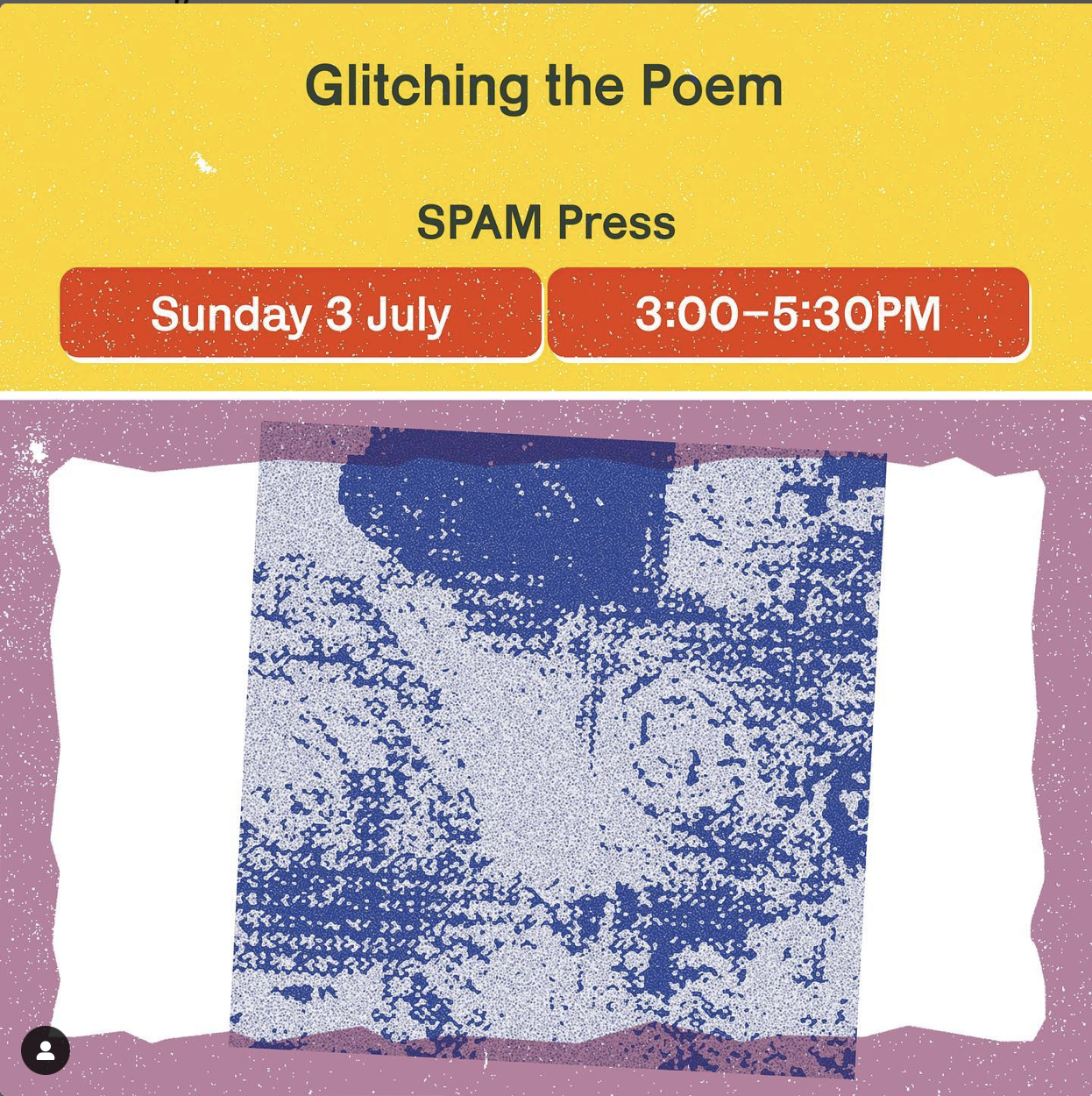
This event is part of the Glasgow Zine Fest 2022 Programme
Location: CCA Glasgow, 350 Sauchiehall St, Glasgow G2 3JD
Room: Creative Lab
Who: Maria Sledmere & Kirsty Dunlop from SPAM Press
Tickets: Pay-What-You-Can (find out more here!)
In Glitch Feminism (2020), Legacy Russell hones in on the sudden error of the glitch as ‘a form of refusal’. As our social, intimate and professional lives become increasingly directed by the commercial algorithms of everyday media platforms, how can poetry intervene in the cognitive minefield of Web 2.0? Playing with text-mixing, collage and procedural forms, we’ll consider ways of glitching between interfaces of browsing/writing in virtual space and print, with time for questions and discussion.
Through cookies, advertisements and terms and conditions, digital capitalism constantly demands that we affirm the ‘yes’ of its systems. In this workshop, poetry will offer something alternative. We’ll break through the junk space of virtual realms and create innovative works within and beyond them, while exploring the world of SPAM Press. Asking what it means to be post-internet, to write from error, to envision the poem as an interactive environment. Let’s glitch!
This event will include: group discussions, reading out loud, reading alone, writing, sharing work that has been created in the workshop.
Visit me: mariasledmere.com 🌐
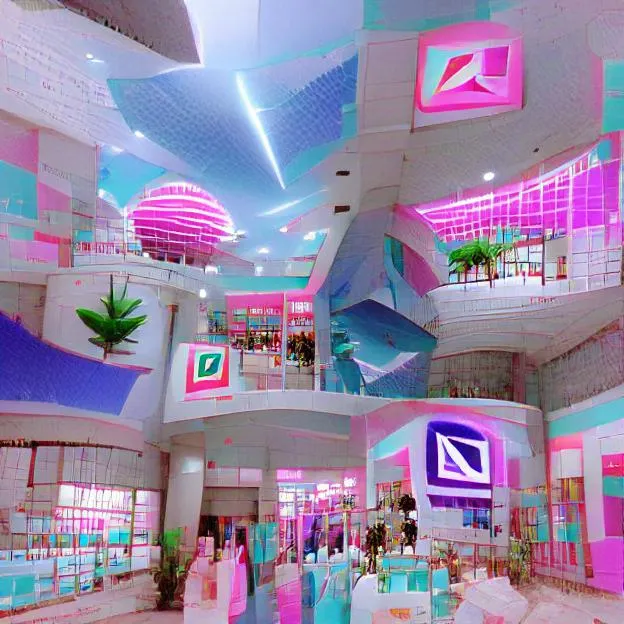
Last week I taught a seminar and workshop at the University of Glasgow’s Summer School: Urban Arcadia: Mythologies of the Mall. We explored how malls represent liminal spaces of urbanism and suburbia, public and private, the civic and surveillance. We reflected on the decline of malls in recent years, on the deadmalls archive project, on malls as institutions, infrastructures and emblematic locales of capitalism. I once wrote a phenomenology of my local mall, a shopping centre in Ayr, the site of teenage loitering, toil and trouble. I asked the students to write manifestos or plans towards new malls: public sites built into or out of a failing mall building. The more I write mall, the more I fall into it. The idea of plenitude. One student said malls are so prevalent in post-apocalyptic fiction because that’s where the resources are pooled. It’s only natural that when capital eats itself we go back to its crumbling temples to eat. Malls are for raiding, free-running, skating, squatting, paying disrespect to statuesque disgrace of billionaires, wishing in fountains, abolishing, raving, growing plants in greenhouses. Malls with solar panels, malls with turbines, malls with open canteens, malls where you take what you like. I want malls to metabolise the brilliance of dreaming the billioning of a generous elsewhere that yes could be ours, not like in adverts but actually in our hands, sticky with bricks and mortar and molten pennies the fountains spat back as lithium rainbows in the battery acid of plurality, nothing pristine, our shattering. It’s so infinitely worthless, warm and deplorable. The lyric I is a mallwalker. All of them. Open doors.
I’ve written about malls before in fiction and poetry. See ‘Mallwalkers’ and Rainbow Arcadia.
Suggested exercise:
Mall Regeneration
You have been tasked with reviving a so-called dead mall in your local town or city. The budget is limitless! In pairs, come up with a manifesto for how you would rebuild the mall or put it to new uses. You might want to share the different contexts of how retail works in your local area and think about a ‘solution’ that works for both of you. What values do you find important in urban architecture? How should public space be used in the twenty-first century and beyond? Is this mall just for human people or other creatures? What would the mall need to serve, withstand or endure?
You can write this as a list or mini essay.

