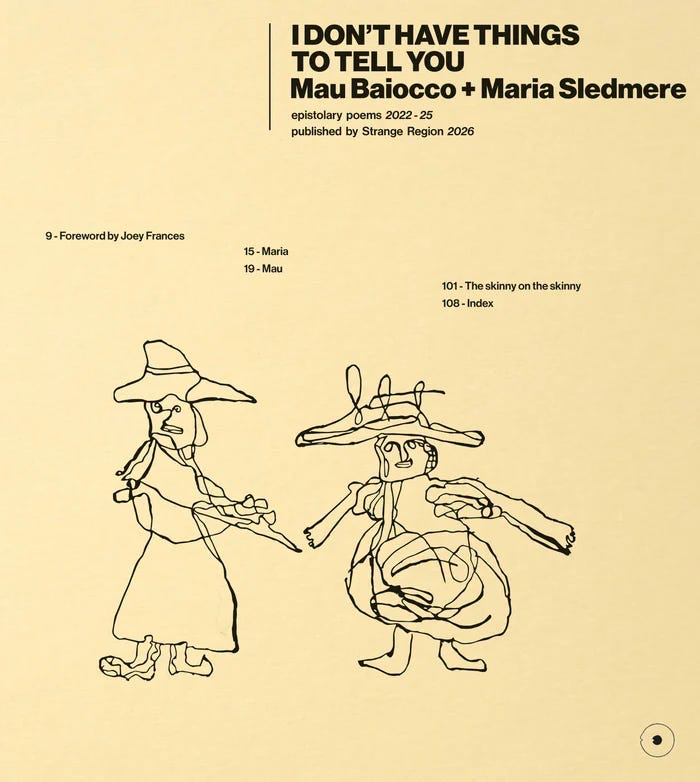
I don’t have things to tell you

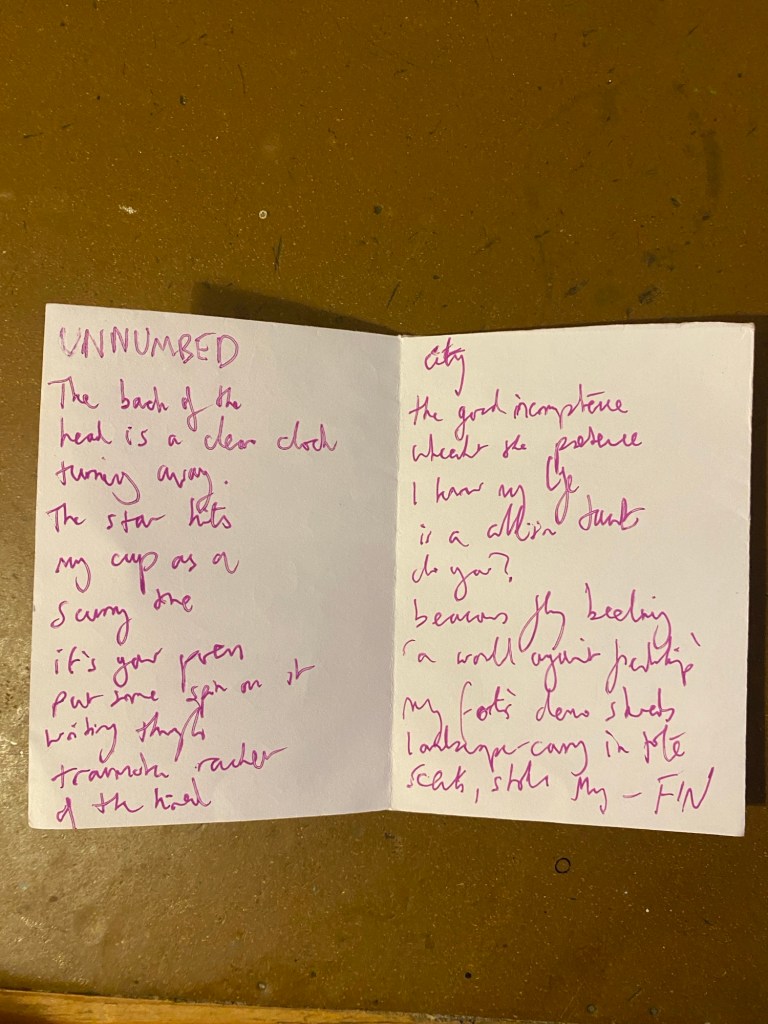
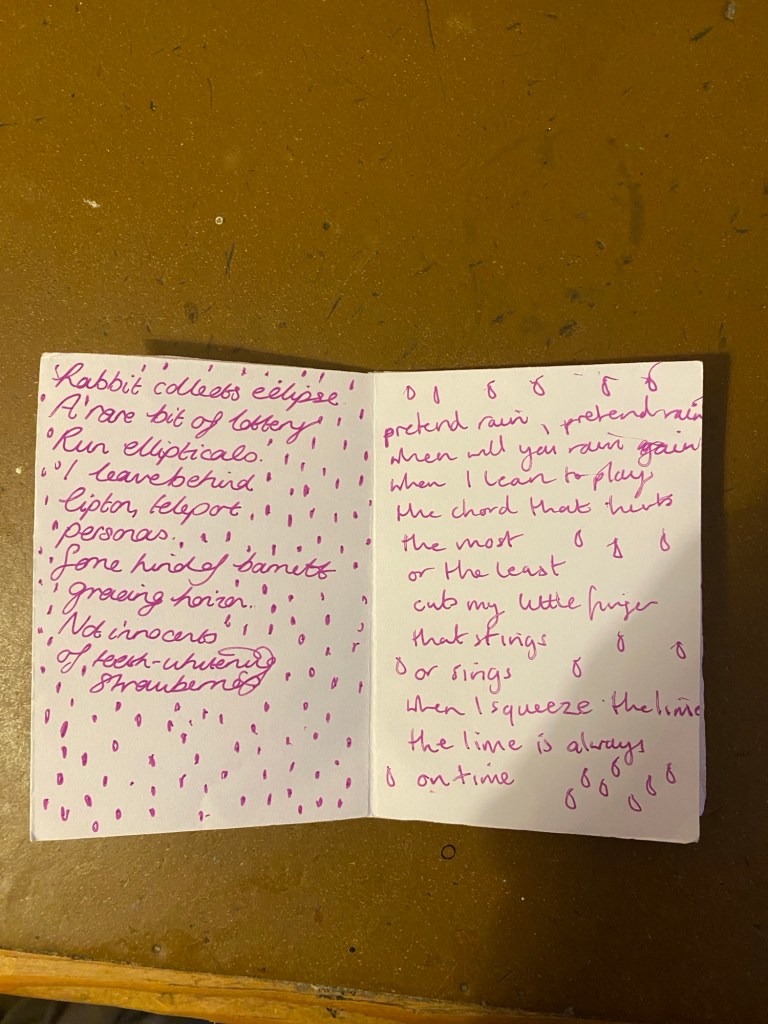
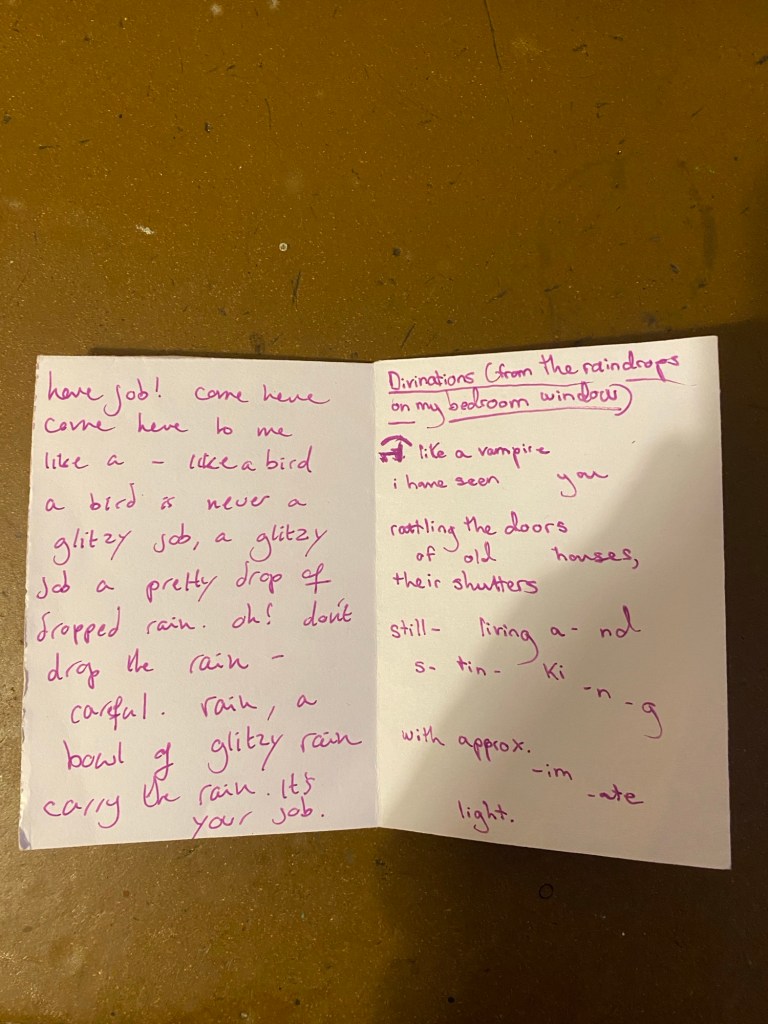
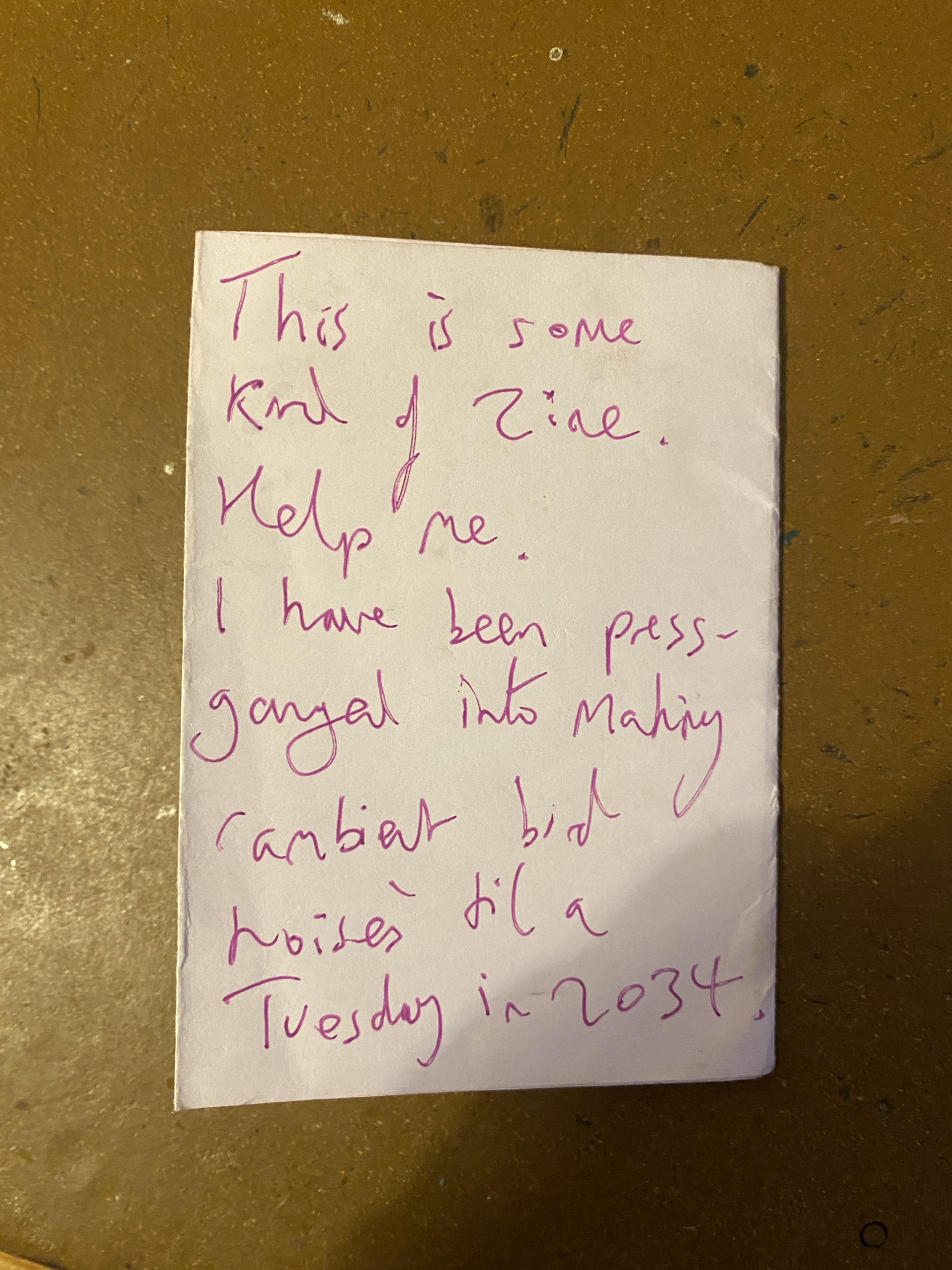
There’s a new book coming out. Ribbons of collaborative epistolaries with Mau Baiocco, presented in skinny columns, writ between 2022-2025, the years of emergence from lockdown and still in the viral fug of Covid, its long durée and continuous shaping of economic, social and poetic relations. On the 23rd March 2022, Mau writes to me: ‘I don’t have / things to / tell you but / to run along / it’. The shaky glitter of that ‘it’ can be traced across the whole collection, morphing in what it refers to — a French horn, an original thought, a flower painted by Degas. It’s a bit like a syntactical kaleidoscope where the grammar changes according to voice, something to look through, the long telescopic look in (to another’s brain) that’s poetry. Blink and you’ll miss it. We wrote to each other with the initial burst of correspondent excitement: back when I was a graduate teaching assistant working in one university and a part-time, fixed term lecturer in another, striking intermittently at both as part of a long campaign that began before lockdown; back when Mau was working in a gallery in Leeds and metabolising observational extremes into playful meditations on value, art and human behaviour. In the course of the book we get sick, have birthdays, fly transatlantic, witness resigning cabinets, respond to so much art and music, write of many friends and loves, muse on various colours and substances. We run along.

To run along the length of a fabric is to cut, move, align parallel to the selvage, the warp yarns of the textile’s spine, along the grainline, running parallel, threads with the least amount of stretch, the highest strength — could this be our poetics? In the book, I write about a task I was given at primary school: to untangle the long streamer ribbons or dance wands we were given to play with at breaktime, in an effort to curb presumably our violent outbursts and bullying. O how we loved our e-numbers! And how we loved colours! These streamers were thick, luxurious, brightly coloured: red, green, yellow or blue. We would wave them around like it was May Day, loving the euphoria of colour until it got boring and then we’d joust with them, whacking the long plastic sticks against each other like swords. Why am I telling you this? For to write one another yielding the giant streamer pen would always result in a sort of euphoria, now to bounce into jousting, pretending that we were on ponies. As I write this, people are jousting on Lime bikes in London Fields and once again medievalism is trending.

However, there is or was no fight in us. Only energy of neon, some knots, a sing-along strong or louche. Our jousting wands become streaming rivers in möbius formation. Mau and I are gemini twins, having nurtured a sort of telepathy from years of exchanging gossip and poetry (including, with Luce Lovell, our sonnets for hooch), from years of standing in front of art, finding our painterly doubles, eating curry at the indoor market, flicking through chapbooks, reading Lee Harwood in the rain. The fight was to have this space to think, it slivered into the work of email, analogue in a perverse way to have this medium which didn’t expect an instant response. We found energy from what was around us. The little things to notice, plus: all of our friends. This was a book co-written in a way by a whole collective, wayward and not nameable. Joey Frances writes of this so well in his foreword to the book, ‘the conditions that mediate the possibilities of writing’, ‘comparing notes on all the shit we did and all the shit we could yet do’. Yes — I love the provisional curve of the ‘yet’, how future possibility spirals outwards in these poems because we needed to write with dream all the time, daydream and nocturnal slumbercore of the narrative variety, episodic flashes of light that tell us dull life could be otherwise. Our ribbons fray into threads of everyone.
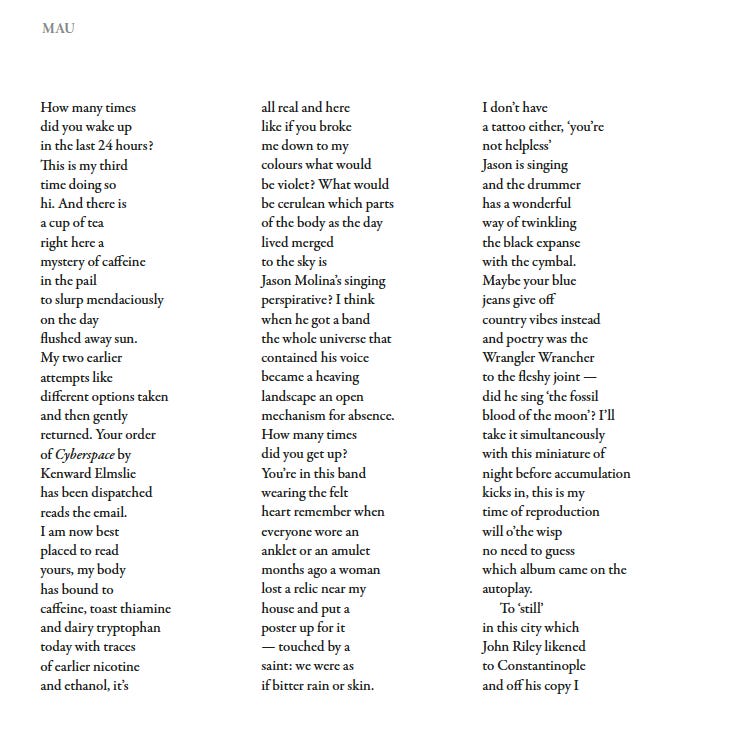
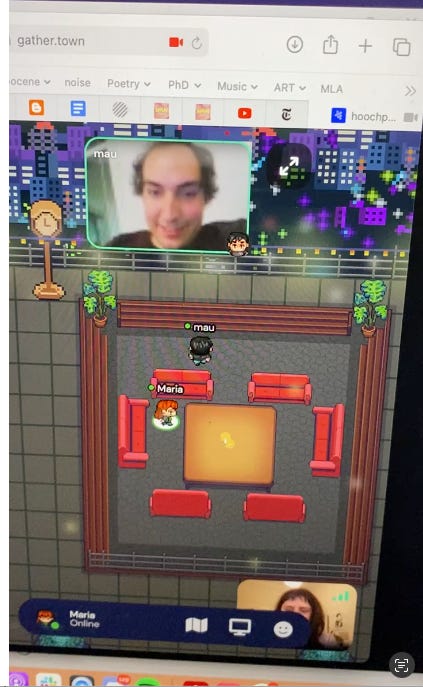
We connect via the internet constantly, something worth saying and saying again. In lockdown, Mau and I would show up as wide-eyed UK poets in various international poetry Zooms — readings in New York most often, dreaming from face-tiles a city of stoners and sleepless lights. We kept a sidebar discussion going on a secret poetry Discord, blue-dark-deck that became the afterparty, the dingy bar. Mau would go to two events simultaneously on different computers. Now we would call that poetrymaxxing. I write of feeling ‘like the goddess modem / of puerile form’, somehow fused electrical to a higher grace via the tenement broadband that served my days. I am childishly silly and yet talking to gods, poets we love so much, the domestic dreameries of Bernadette Mayer, the ‘singing / perspirative’ of Jason Molina. Asking Peter Gizzi a question about light and speed via ~the chat, nervously in 2020. Our poetry metabolises that experience not as diaristic self-reflection but as chatty missive, epistemic flirtation. I like that now I know what you know, as you know I for I.

This book tries to pull everything in and yet still maintains the feeling of attempt, desirous of almost; a kind of delirious voice note written down, not quite getting to the point. A poetics of incomplete documentation and utopian meta-commentary on what we would need to fulfil our commitment to this undefined Project. A chemical obsession with what would be the right conditions to read each other, how to curate the perfect take, correspondence — a word that means to pledge, promise or to answer, with prefix of together, with, together-with-this-promise was to write a skinny poem. ‘I do not always understand what you say. / Once, when you said, across, you meant along. / What is, is by its nature, on display’ (Schuyler). Oh how we love James Schuyler. This poet at the window, embraced in the mortal combat of syntax, to paraphrase something Stephen Yenser wrote of Schuyler’s line breaks. We wanted the skinny, the crop of the day, for someone to bring us the lilies; we broke lines because to do so offered a sense of autonomy, almost like eating.

The first phase of the book has the heightened bubbling of new correspondence, moving quickly along, the feeling of having found a form. Curious and exploratory, performatives of witness and ‘psychological androgyny’ borrowed from the Romantics. The second phase of the book occurs when time jumps across from 16th July 2022 to 23rd April 2024. I’m back into Mau’s inbox with tales of the softest breakup. We ask if it’s worth trying again, we indulge into a leisurely to and fro, the poems feel different, there’s a shift in the language and from Saturn’s return, so much has changed and now we are both teaching, feeling out ‘life in the ashes’ and ‘the starry shared / humiliation of reading’. Is there a new self-consciousness in the form? Now it is something we move across…

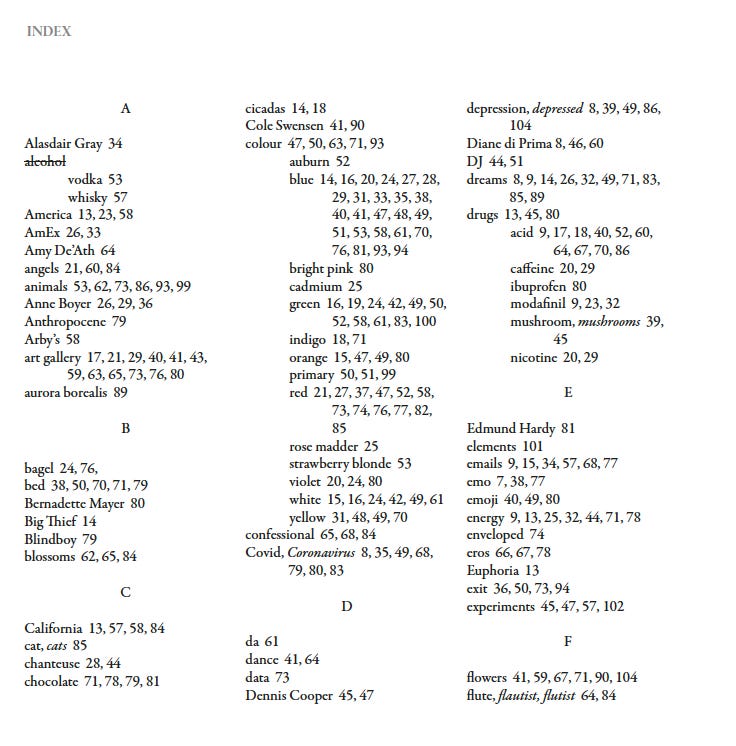
…and we shape it into a book: I don’t have things to tell you, a title whose premise is refusal. Like the gemini tendency to answer the phone in burnout, saying I’ve got nothing and then launching into love’s digressive everything. The poems are presented mostly chronologically, excepting a centrefold poem of sorts, Mau’s poem on the occasion of visiting California, the aforementioned foreword by Joey Frances and a closing essay by me, ‘The skinny on the skinny’, followed by an index which collects the book’s referential whimsies.
We have continued the emails since finishing this manuscript, something submitted to the Strange Region open call at the start of the year and now being graciously published by Joe in Bristol. Joe has been amazing. He’s typeset the thing beautifully in triple columns, taken our linguistical quirks as a necessary poetics to preserve, found us a cover image of illustrated Martians worthy of the aspiring Spicerean forms within. In the book where the cover images originally hail from, Psychical Research and the Resurrection (1908), James H. Hyslop writes: ‘We went all around. The people are different in different places’. Yes, the kaleidoscope changes. That’s this book. The two of us swapping hats and cities.
You can preorder it now from the publisher, or catch us at our Glasgow launch on 21st November at MF Books. More dates to be announced soon. Please invite us to your city!
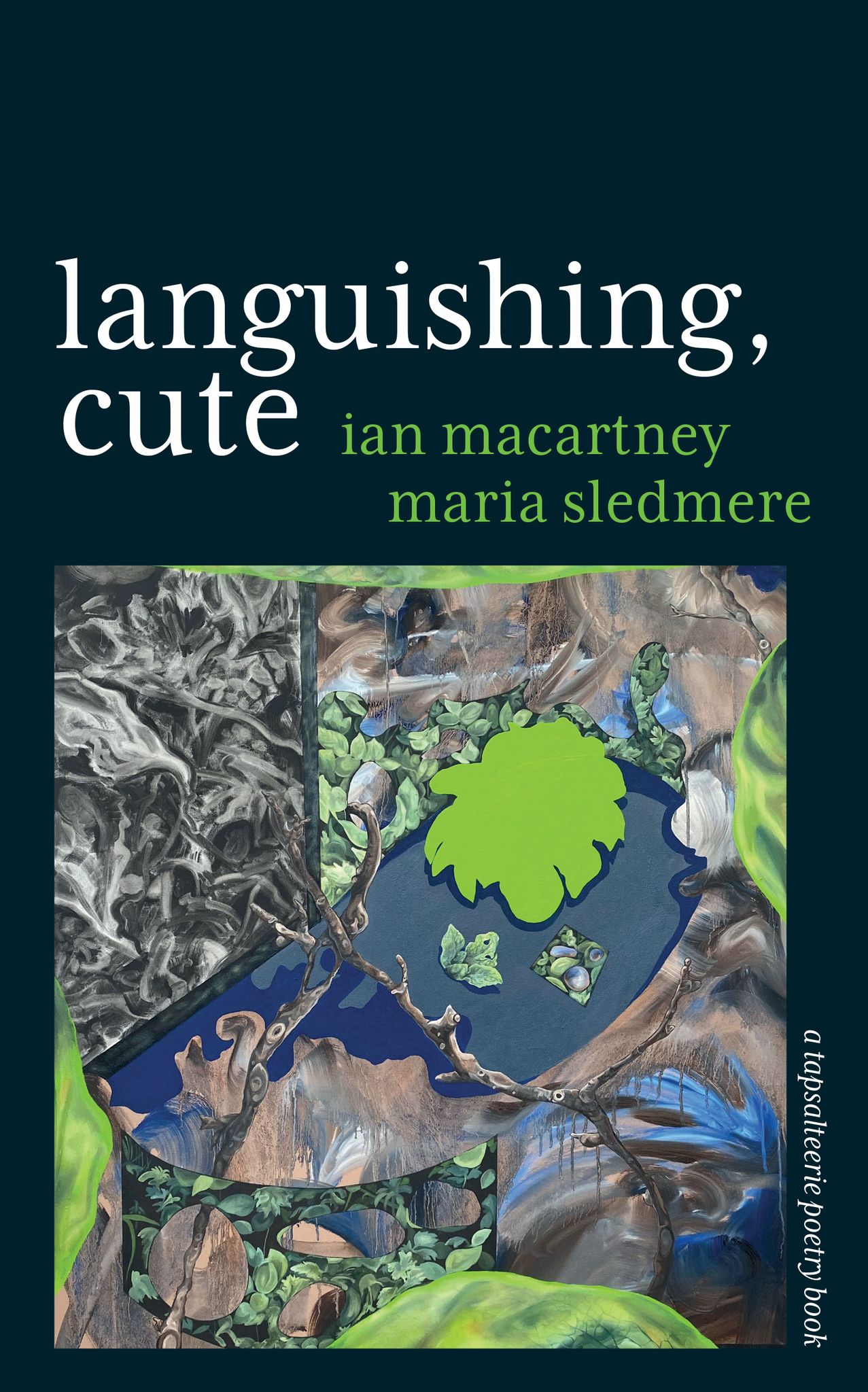
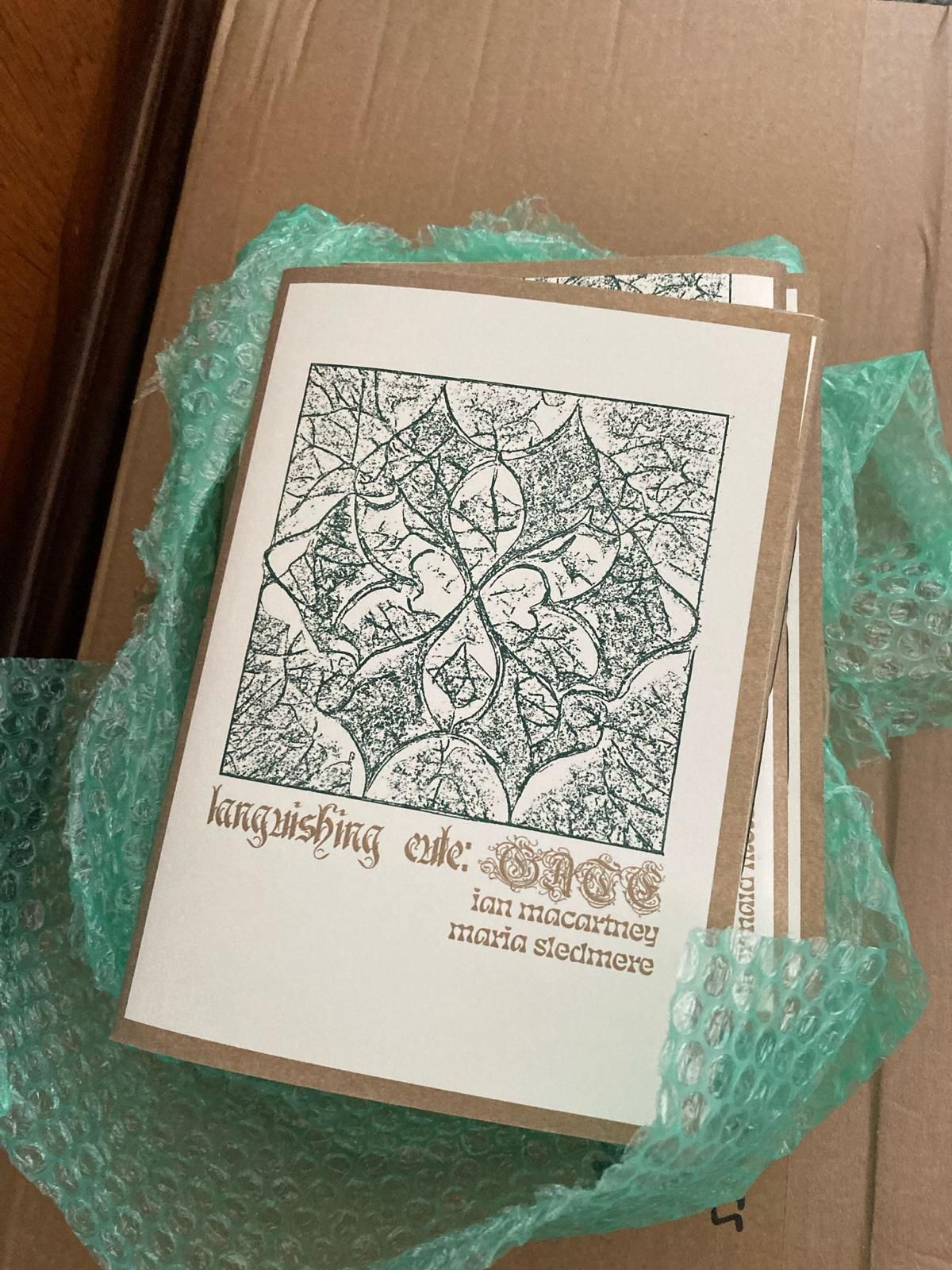
Languishing, cute is in the world!

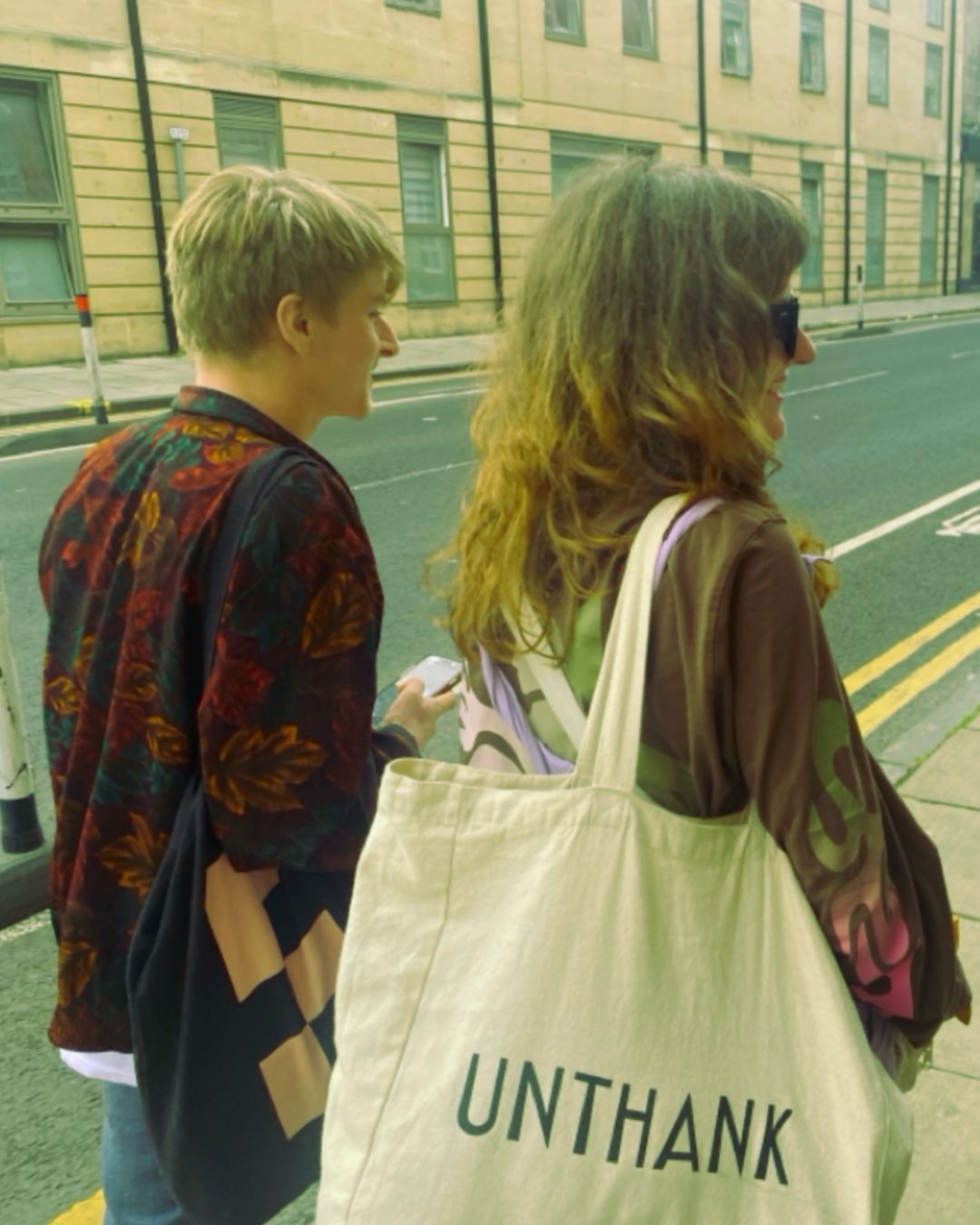
In August 2022, which legitimately feels a whole fat wormhole ago, Ian Macartney and I found ourselves working in Edinburgh for part of the summer. We met up at after-hours cafes (more prevalent in the capital, what you playing at Glasgow?) and walked around the Botanical Gardens where the staff promised ~*’Instagram flowers’*~ and we talked about our hopes and dreams and struggles as booksellers and teachers. Part of the emergent narrative concerned utopian ideals of Scottish infrastructure, where one could zip to Lerwick in a hyperloop heartbeat (all élan, not El*n) or at the very least catch a local bus on time, or unlock a hidden realm below the loch of Linlithg(l)ow. Part of it was about friendship, love and pop music. We were listening nonstop to Caroline Polachek and feeling okay about it. Pretty good actually. There was her vocal flipping over the crags, at sunset. I remember purifying my heart with orange liquor. Wearing a lot of lilac. Bleeding ink into industrial bedsheets. We were thinking about pivotal points where our childhoods overlapped with culture. We wrote things in documents and met in the months ahead. I did a lot of chaos cycles, late, trying to meet Ian at say, the Mitchell Library to go over some edits. A lot of awful things happened in the months intervening but there was this document we could splash land into and like turn on the light. Poetry’s coy ambience zonked up to warp speed. I liked doing this project a lot. I’m glad it’s in the world.

I think it’s in the same universe as say, An Aura of Plasma Around the Sun and Ian’s 2024 essay for Futch Journal, ‘solarity, reclaimed’.

We’re publishing the full collection, Languishing, cute with the wonderful Tapsalteerie, an indie press based in rural Aberdeenshire. Ian’s worked with them before via their pamphlet imprint Stewed Rhubarb Press and they published some of my poems in the 2019 anthology, edited by Calum Rodger, titled makar/unmakar: twelve contemporary poets in Scotland. We’re big fans of Duncan Lockerbie, Tapsalteerie’s founder and editor, who does so much for Scottish poetry and beyond.

We’re also publishing, thanks to the exquisite printing of Earthbound Press, a separate riso pamphlet of b-sides titled The Gate. Look out for that at our launch events…

From the publisher

languishing, cute presents a collection of jittery missives that propels the speculative Scottish canon of Morgan, Gray and Mitchison into a maximalist ‘high femme goth surrealism’ via hyperpop, Celtic futurism and digital culture. Here the poets tend towards e-pistolary contemplations of retro-adolescence, fizzy ecology and mercurial slippy gurlhood to complicate notions of Scottish identity, nationhood, ecology, nostalgia and more.

Nice things people have said:

languishing, cute is the opposite of a flyting — that traditional bare-knuckles fight between two poets. Rather, the two poets here offer their worlds to each other in the gift of friendship and they listen back: it’s not a duel, it’s a jewel. Where they meet is in a place of Anglophone avant-garde stimulants — locating codes include Francesca Lisette’s Teens, Edwin Morgan, Tim Atkins and Peter Manson — and the dancefloor has Bunny Is A Rider pumping out in up-melancholy and autotune. At times this is glitch-poetry, funny, para-kitsch and mesmeric. At other times there are the amplitudes of tenderness and self-effacement in a palette of citrus and greenest day-glo. What’s also fascinating is the pressing together of the virtual and its tics with its mineral and viscose underpin, all via the very human. It’s a leap from body/mind to capital/digital and back again, flickering, a visit to Silicon Brig-a-Doon you’ll want to be the first to Insta.

– Richard Price

[…] Messy as a teenage tumblr, flashy as a strobe light, this is two exceptionally generous poets bouncing off the walls of the backrooms with the energy of a thousand monster energies… here ~The Glitch~ is not a glitch but a stitch between windows, the glue between a b2b set, the rhythmic green hills of algorithmic infinity … and yet these re-mixes and e-mails traverse an internet of metal and cable, the business of poetry is conducted by staples through sheets of reconstituted tree::: there’s something old-school, decidedly analogue about all this. It feels like you could feel it. It feels like the push of a button, the caress of a bright cool screen. Actually no it feels warm and coarse, a cosy transmission rumbling, re-tuning itself like you’re flicking from station to radio station, flickering between noise & dialectical noise, patterns emerging in the static as the ether unknots itself, and the stuff of life comes spilling out […]

– Dan Power

Endless aureate refreshment from Maria Sledmere and Ian Macartney, languishing, cute is a collection with all its push notifications turned on that still finds headspace to pay attention on the DL to form and poetic inheritance. There’s Sledmere’s elliptical take on William Carlos Williams’ fridge raid (with Kylie Minogue R osé instead of plums), the odd sestina, and plentiful nods to that Scottish experimentalist Edwin Morgan range from embedded songs of the Loch Nes[s]presso Monster to Macartney’s predictive geographies in time-travelling poems indebted to Morgan’s Sonnets from Scotland.

With spins to further Scottish topographies from Maybole to Lerwick, Sledmere and Macartney are often found shuttling east and west ‘w/ eloquent glitches’ across Scotland’s central belt, heading increasingly into CAPITALS when Macartney’s voice announces us into Superedinburgh Vaporwaverley/Edenbruh/the London of Scotland.

The internet’s vertigo is never far away from poems presenting like listicles. Sadly for any wannabe monetised content, in languishing, cute these poets may be trading futures, but their hacked hypernature is funding nobody’s wellness retreat.

– Iain Morrison 


ORDER HERE FROM THE PUBLISHER


LAUNCH EVENTS

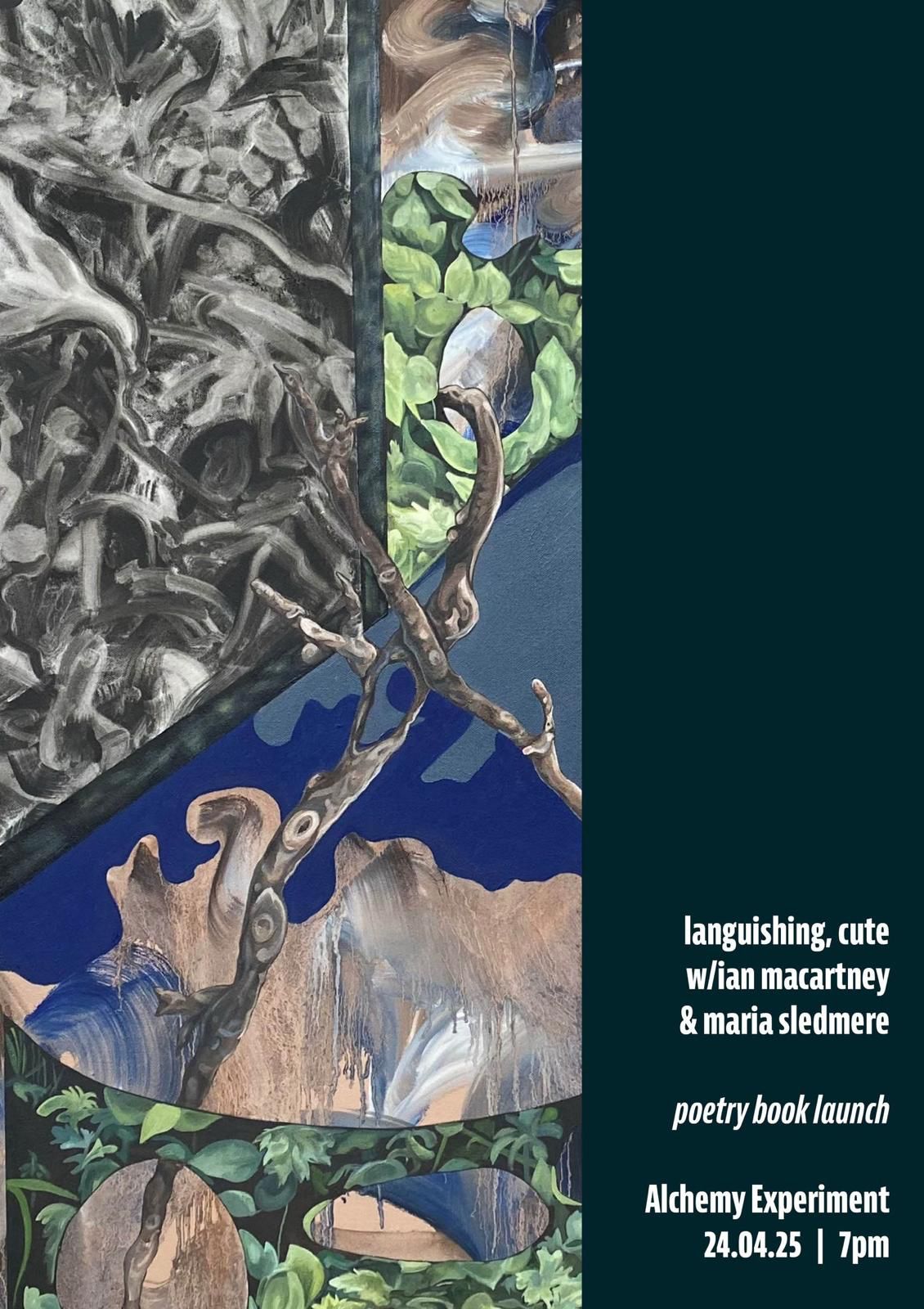
24th April, 7pm — The Alchemy Experiment, Glasgow (free entry – details)

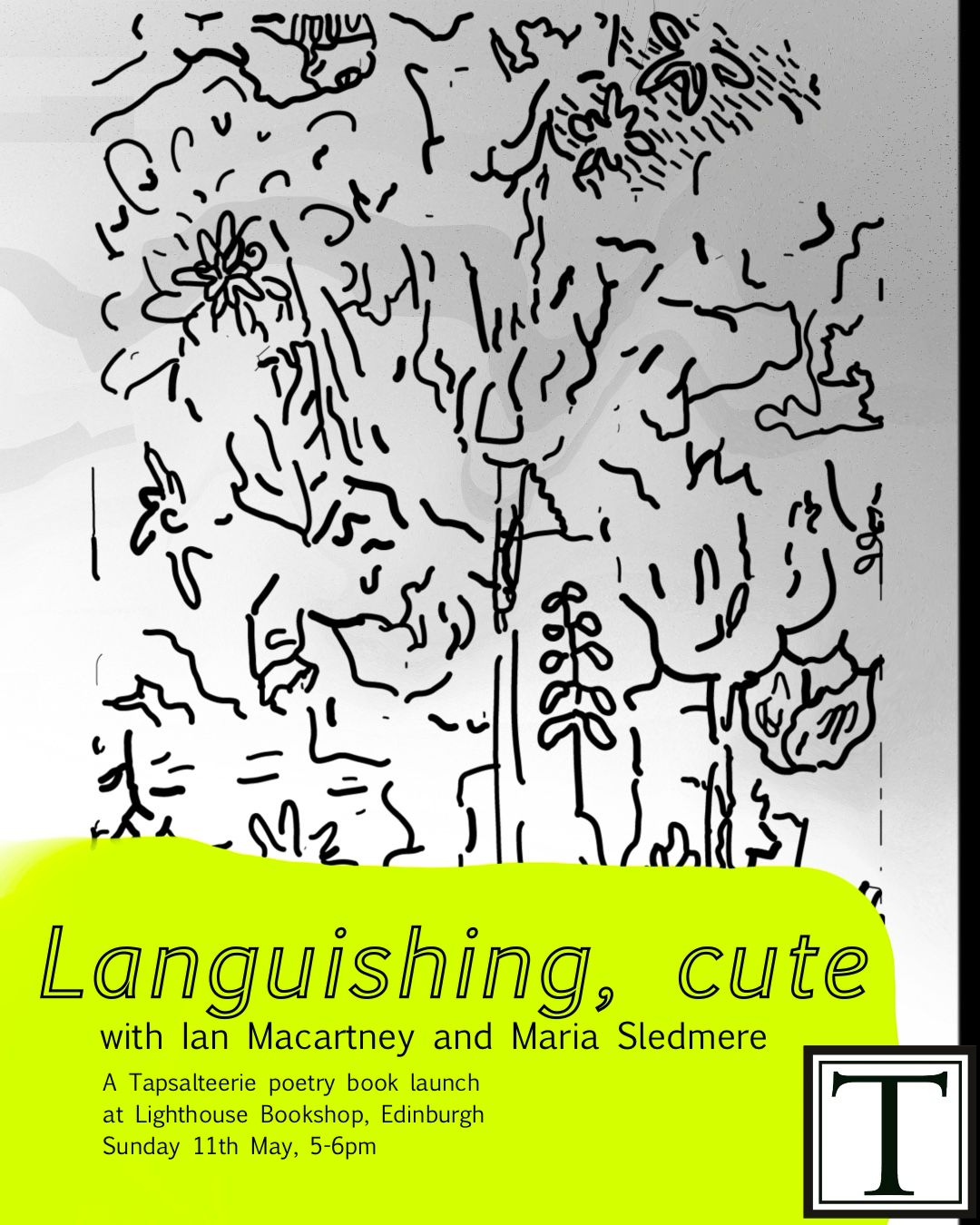
11th May, 5pm — Lighthouse Books, Edinburgh (arrive promptly! – details)

Thirteen Morisettes

One of the exciting things about running a small press publisher is discovering new forms of poetry at the same time as totally falling in love with them. Like finding a long, lustrous hair at the end of the pencil and falling in love with it so much to spiralise your day around its protein. Like hearing a song on the radio first thing in the morning brain. What I mean to say is, poets are shedding all the time and sometimes you really want to be there, hospitably, in the moment of language leaving itself beautifully there.

Growing, shedding.

On 31st January, SPAM are releasing Thirteen Morisettes, a transatlantic communion between Courtney Bush and Jack Underwood, a 60-page book of lyrics and epistles which centre around the poets’ love of Alanis Morisette. Our eponymous chanteuse haunts the lyrical plazas of Woolwich Market, university corridors and Starbucks. It’s great to have a collaboration which feels like a true collaboration: the interweaving of voices, in-jokes, playful telepathy.

The Morisette itself is a new form developed by Jack and Courtney. The authors define it as:

The primary constraint of the Morisette is that its lines are formed out of the deliberate mis-transcribing of Alanis Morisette lyrics. The Morisette is (usually) comprised of two mis-transcribed verses, followed by a mis-transcribed chorus to end the poem.

The epistolary, then, is not just a mode of transmission but of listening. At the light speed of however many G’s we wish to bestow upon the airwaves, Jack and Courtney have made an ambience of their poetic communiqué and like the desire for better worlds we sublimate in the village of our most familiar coffee chains, typing away into elsewhere, they form a sort of pop-chorus-corridor across the Atlantic. I fucking love it. I hope you will too.

The book is available to preorder for £8 now.

SPAM TOUR:

Courtney and Jack will be reading on the following dates:

6th February – Instagram Live (@spamzine)

13th February – Glasgow (venue tbc)

15th February – Peckham Pelican, London (along with Eve Esfandiari-Denney, Karólína Rós Ólafsdóttir, Jack Young

16th February – Bookhaus, Bristol (Courtney only – along with Jack Young, me and Karólína Rós Ólafsdóttir)

2021 in review

From this year in-between brushing my teeth:

BOOKS AND PAMPHLETS

Miss Anthropocene (Mermaid Motel)
a selection of short lyric, ‘ethereal nu metal’ poems responding to the Elon Musk/Grimes complex.

Sonnets for Hooch – with Mau Baiocco and Kyle Lovell (Fathomsun Press)
An ongoing pamphlet series of sonnets attuned to the weirding seasons: what started as an internet joke about alcopops and longing as a keystone for exploring adolescent malaise, nostalgia and resilience thru civic space and Friendship. Current editions available are Lemon Bloom Season and Summertime Social. Two more instalments are forthcoming in association with Rat Press and Mermaid Motel.

Polychromatics (Legitimate Snack)
A pamphlet-length poem about colour, cetaceans and cosmic twilight, inspired by Walter Benjamin and a sculptural and textile works by the artist Anna Winberg.

Soft Friction – with Kirsty Dunlop (Mermaid Motel)
Soft Friction is an intimate gathering of dreams from 2018, written during a summer of ‘existential soup’, fainting at gigs, pulling all-nighters and panic surrealism. Extracted from a longer diary, these fragments wear the sensuality and sass of an active dream life shared between two people getting high on each others’ brains.

The Palace of Humming Trees (Sundays)
Edited and typeset by Katie O’Grady with visual identity by Paul Smith, this book-length poem features illustrations by Jack O’Flynn plus a curator’s word from Katie O’Grady and collaborative mixtapes. Set in the speculative locale of The Palace of Humming Trees, the poem is a jaunt through weird nature’s arc of glass, following the desire lines of hyperfoxes, sunburst melancholia and corona correspondence. Also available as a free pdf.

The Luna Erratum (Dostoyevsky Wannabe)
The Luna Erratum, Maria Sledmere’s debut poetry collection, roams between celestial and terrestrial realms where we find ourselves both the hunter and hunted, the wounded and wounding. Through elemental dream logics of colour, luminosity and lagging broadband, this is a post-internet poetics which swerves towards the ‘Other Side’: a vivid elsewhere of multispecies relation, of error and love, loss and nourishment.

ARTIST COLLABORATIONS

‘The Rosarium’ for Zoee’s album, Flaw Flower (Illegal Data)
A lyric sequence responding to the glistening pop garden of Zoee’s debut record Flaw Flower. Available as an A6 booklet as part of the limited edition album bundle.

The Palace of Humming Trees with Jack O’Flynn and Katie O’Grady (French Street Studios)
A collaborative project with artist Jack O’Flynn and curator Katie O’Grady which took place April to August 2021 and was showcased at French Street Studios in Glasgow. Featuring new works of poetry, sculpture, illustration and multisensory dreamscapes (from mixtapes to Tarot readings), we offered a ‘tenderly crumbling foliage’ of visual and sonic otherworlding.

The Dream Turbine with A+E Collective and The NewBridge Project
This online installation explores the relationship between sustainability and dreaming, offering a space to collectively share dreams and promote discussions surrounding these broader topics. The Dream Turbine was conceived by A+E Collective in collaboration with Niomi Fairweather and Jessica Bennett, as part of the Overmorrow Festival. I contributed to a preparatory DreamPak of resources and the curation of a Dream Vault and associated ‘Lost in the Dreamhouse’ workshop on Zoom.

Cauliflower Love Bike Episode 1: Play with A+E Collective
While play might be co-opted for capitalism, true play is that which exceeds instrumentalism and commodification. This episode reclaims play from its dialectical relation with work, exploring play as a practice and thought-mode that is capable of radical sensing, temporal sabotage, tenderness, sociality and a joyous excess that is also low-carbon. The podcast series was launched at COP26 in the Rachel Carson Centre’s pop-up exhibition at New Glasgow Society.

ACADEMIC ARTICLES

Article: ‘Hypercritique: A Sequence of Dreams for the Anthropocene’ in Coils of the Serpent Issue 8
An in-depth venturing through the possibilities of hypercritique, featuring readings of Billie Eilish, Sophia Al-Maria, Ariana Reines and more; plunging through dream, fire and the heartwood of anthropocene imaginaries.

“Just to distract you like the inside”: a correspondence wrapped up in Bernadette Mayer’s poetry, in post45, Bernadette Mayer cluster (with Colin Herd)
An epistolary collaboration which wraps and unwraps itself in and around the poetry of Bernadette Mayer, as part of a special cluster issue on Bernadette’s work.

‘I, Cloud: Staging Atmospheric Imaginaries in Anthropocene Lyric’, Moveable Type, Issue 13
Tracing the possibilities of ‘cloud writing’ in anthropocene lyric by way of Brian Eno, Mary Ruefle, Anna Gurton Wachter and more, asking what kinds of reading are possible or desirable in a medial world of thick atmospheres.

POEMS

ESSAYS AND OTHER ERRATA

‘On Foam’ for Futch Press

Feature: Some Letters – a correspondence with Joe Luna

Review: Cloud Cover, by Greg Thomas

Feature: “It’s pretty utopian!” A conversation with Marie Buck, Mau Baiocco and Maria Sledmere pt.1, pt. 2

SPAM Cut: ‘I RESEARCH THE ORIGINS OF THE MODERN ROSE AND DISCOVER’ by Sarala Estruch

Feature: Some Notes on Muss Sill by Candace Hill

Feature: A conversation with Kinbrae and Clare Archibald ‘Tangents: letters on Etel Adnan’: a correspondence with Katy Lewis Hood in MAP Magazine (part 1) (part 2) (part 3)

‘‘Now now is everything’: Maria Sledmere on two maximalist poets of the Anthropocene’, Poetry London issue 99

‘Cloud Shifts’ BlueHouse Journal

Anam Creative Launch for MAP Magazine

DESIGN

Cover for Katy Lewis Hood’s Bugbear (Veer2)

Cover for fred spoliar’s With the Boys (SPAM Press)

Cover for SPAM Press Season 5 Pamphlet series

Meadow Fractals for A Soft Landing

Sam Williams’ project, A Soft Landing, is ‘an online resource inspired by the activity of communal gardens and city allotments. It is a space where volunteers are invited to share, learn, contribute and care for themselves and others, through the sharing of material that could be used for nourishment, growth, pleasure, education or healing’.

I like this website because it’s what I want from the internet, a place to share and graft and cut and paste, to nourish and discover something unexpected. You tend a little plot and see what grows from it. I used to live near Woodlands Community Garden and loved seeing the flora and fauna change throughout the seasons, people volunteering, pulling out weeds and planting. Something of A Soft Landing is in this spirit: you might get asked to respond or contribute, you might volunteer yourself. You never really know what might crop up in the meantime, which is why there’s a satisfying ethic to ‘checking back’.

I’m happy to find a home for an ongoing and incomplete series, Meadow Fractals, among the leaf matter and stems of other makers. It features a sestina after Kevin Killian (and isn’t the sestina the most fractal traditional form?), plus some weird and tessellating meadow illustrations done on an MS Paint simulator. Long live Paint. You can find the full selection at a-soft-landing.com (look for the dark grey tendrils).

In recent months, I’ve also been reading Sean Roy Parker’s Fermental Health substack, which has got me excited about blogging, and even food again. Do have a read! 🌱

The Palace of Humming Trees

Excited to announce a collaborative exhibition with artist Jack O’Flynn and curator Katie O’Grady, happening until 8th August at French Street Studios in Glasgow.

~

The Palace of Humming Trees is a collaborative project between artist Jack O’Flynn, writer Maria Sledmere and curator Katie O’Grady which took place from April to August 2021. This collaboration will be showcased in an exhibition at French Street Studios, Glasgow, featuring new works from O’Flynn and Sledmere which travel through poetry, sculptural entities and dreams of impossible possibilities.

This project was formed in a concert – along mixtapes, Tarot readings, zoom calls and shared research. We present it here as multiple sensual journeys; to an exhibition of hyper-foxes and tenderly crumbling foliage, through a publication of lichenous illusions and rummaging thought and in a selection of music and voices which trailed our imaginings. 

Intertwining themes of ecological thought, world building and re-enchantment we sought to un-ravel the question: how can we act and think in this present moment to ensure positive change to our relationship with the world around us? The action and thinking which we wandered became located in small and monumental formats – enacted in the everyday and in how we create and build the future. We were enveloped by uncertain certainty, whether apparent through non-human thought, the possibilities of visual art and poetry or the endorsement of magic. Living in a world brimming with unease by climate crisis and extreme inequality – brought upon by extractive capital, far-right strategies and carceral logics – we wished to communicate a different model of awareness that could refuse these structures and re-imagine being a Being. 

Exploring this sentiment O’Flynn and Sledmere have created a body of work that opens a portal to a forest of vibrating thought. One of galloping states, lockdown meanderings and a lyrical suffusion through language and art that prompts how we can think and imagine differently. 

Please enjoy this digital showcase of The Palace of Huming Trees and, if you can, come to visit its physical iteration at French Street Studios, 103 – 109 French Street, Glasgow. Open July 30th to August 8th 11 AM to 5 PM (closed Monday and Tuesday) with a preview on July 29th 6 PM – 9 PM. Book to attend exhibition via Eventbrite here and to attend preview here.

More info at the exhibition website.

The exhibition also comes with a book of poetry, illustration and essaying, The Palace of Humming Trees.

Available to order for £12.99 – Contact details for ordering available on the website above.

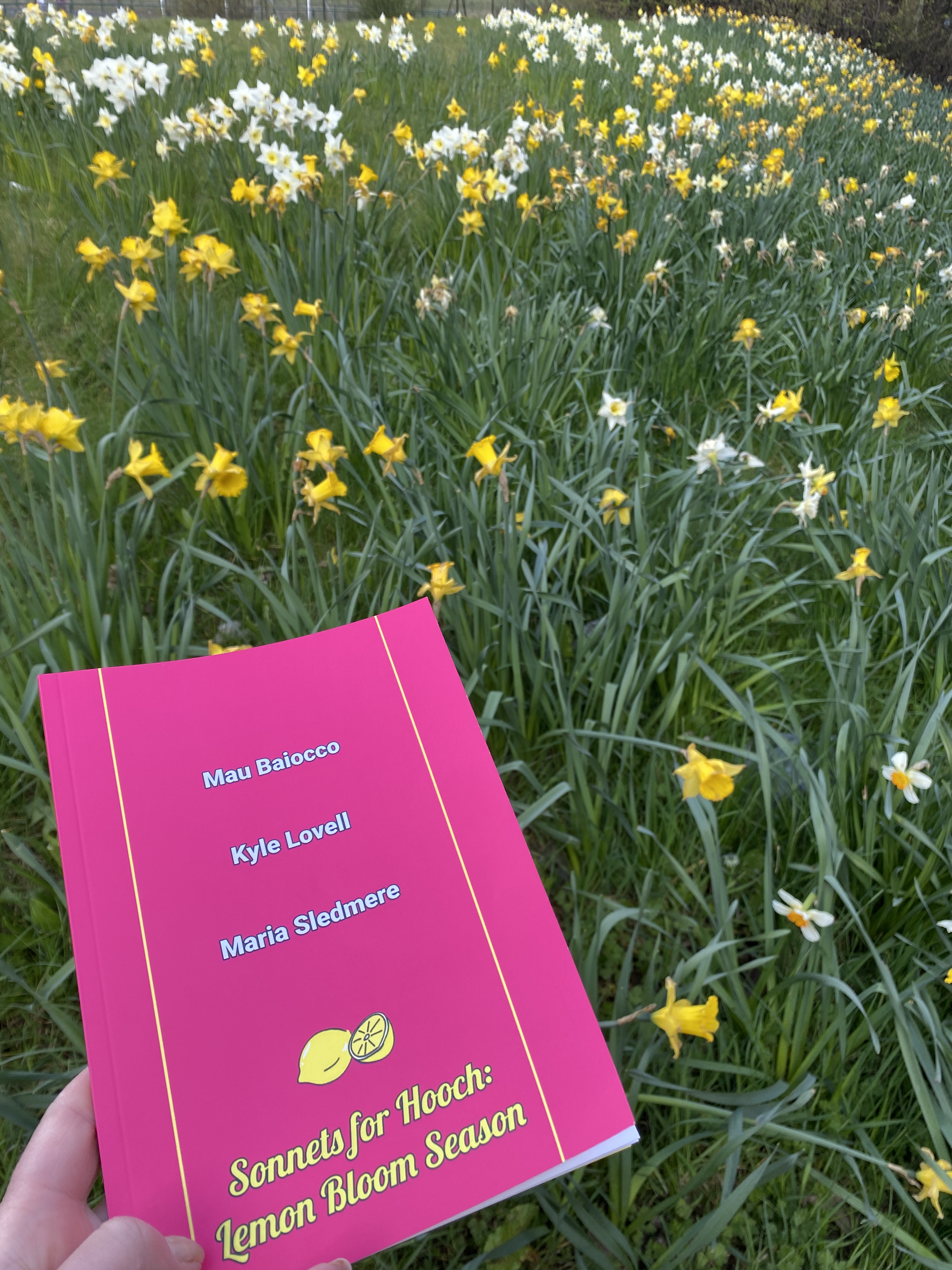
(NEW BOOK) Sonnets for Hooch: Lemon Bloom Season

Sonnets for Hooch: Lemon Bloom Season
Mau Baiocco // Kyle Lovell // Maria Sledmere
[56 pp.  //  A5 // Perfect-bound  // Run of 100 // 17/04/2021]

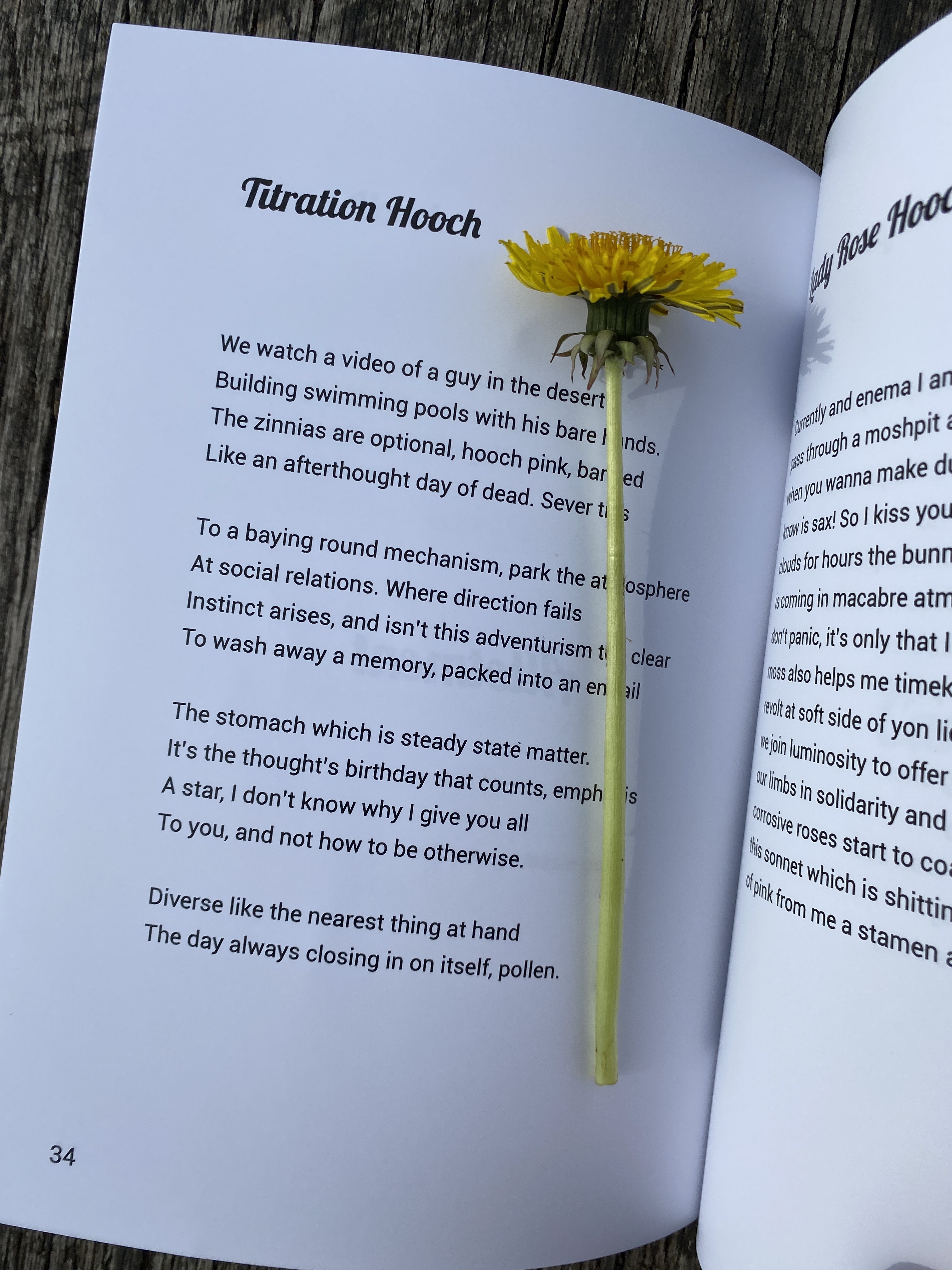
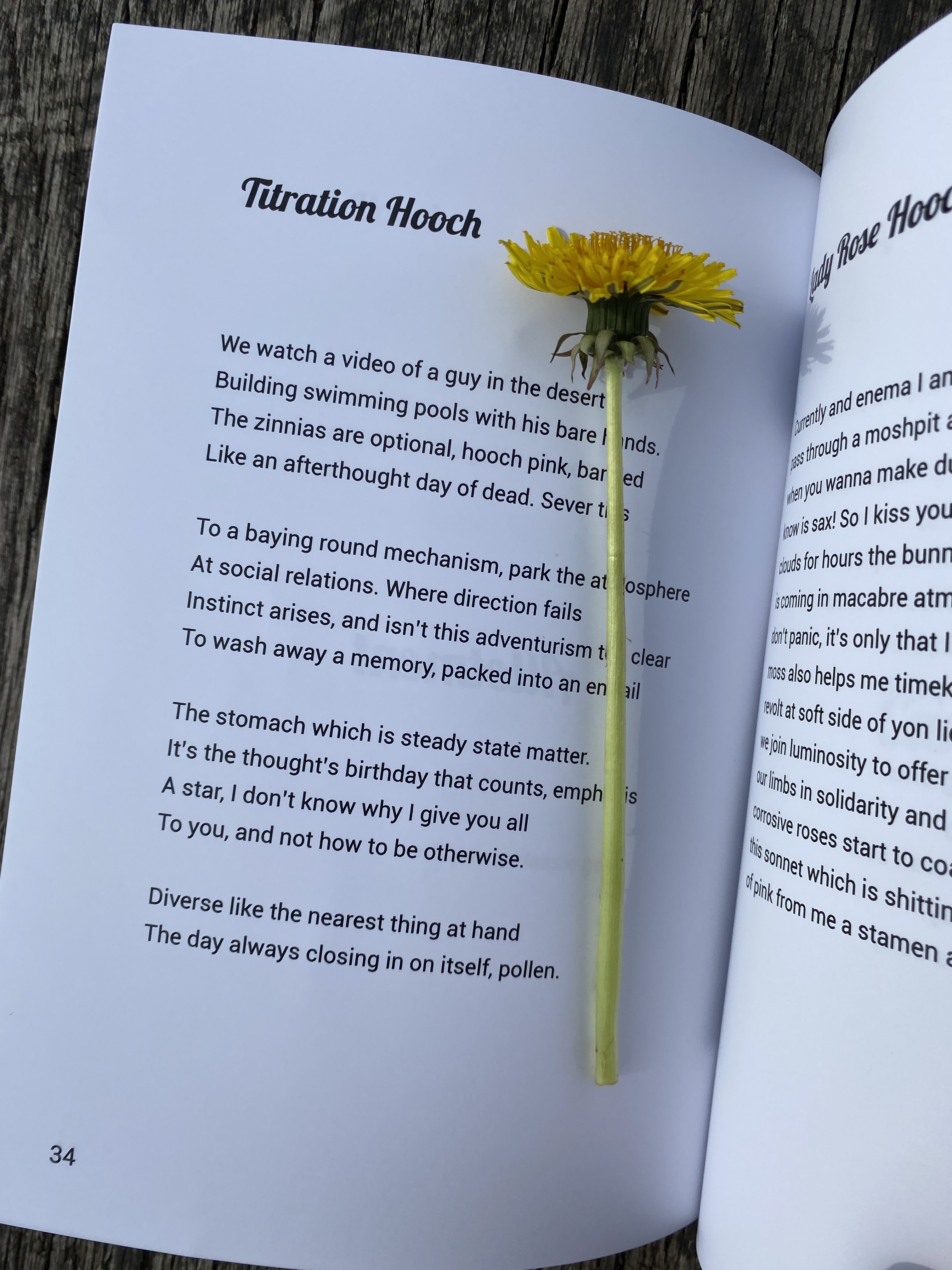
Announcing the first of four seasonal pamphlets of sonnets, written in collaboration with Mau Baiocco and Kyle Lovell.

Available to order now at £6 inc. UK P&P.

~

Praise for Lemon Bloom Season

Like a liquid prisoner pent in glass, I once thought the sum total of human ingenuity was Fanta Grape. And then I read this collection, the perfect expression of what it means to write your poems in the mouths of your friends (as I think Derrida said). You know the part of a poem that stays at the bottom of the bottle, collects as crystallising residue? If you read these poems out loud for long enough, the sounds train your tongue to flicker in there like a lizard and the why of the world just fizzes and melts.

– Colin Herd, author of You Name It (Dostoyevsky Wannabe, 2019)

Of all sciences, is our Hooch poet found at the highest. For they doth not only show the way, but giveth so sweet a prospect into the way as will entice any person to enter into it; nay, they doth as if your journey should lie through a fair orchard—at the very first give you a cluster of lemons that, full of that taste, you may long to pass further.

– Sir Philip Sidney, author of An Apology for Poetry 

When put to our focus group, seven out of nine consumers agreed that the tasting notes for Lemon Bloom Season were long, smooth, and ‘distinctively yellow in its language’. One consumer attempted to quote Roland Barthes. Another consumer attempted to put forward a new theory of ‘Bitter Poetics’, before being given some more Lemon Bloom Season sonnets. Everyone was glad.

– Philomena Zest, SMOOCH™ CEO

Playlist from Hooch Launch Party

Sample Poems