A second smaller heart: on writing The Indigo Hours

The first song I was ever obsessed with was Suzanne Vega’s ‘Marlene on the Wall’. It was on a compilation CD called Simply Acoustic that I’d found somewhere in the house. I’d listen to it over and over again on the CD player in my room. What I loved about this song was its narrative possibility. The protagonist triangulates her love affairs under the watchful eye of ‘Marlene’ looking down at her from the wall. My child’s mind made up all kinds of stories about this. Marlene could be an older sister, a mentor, maybe the lover of one of the men that passed through the life of her. Marlene seemed cold. She was not a jealous lover, she didn’t act out. Anything advised by Marlene is provisional, ‘what she might have told me’. I imagined her having very thick eyeliner.

For a long while, Marlene was a kind of angel to me. I saw her wherever I saw people on the wall. A Picasso print of a woman drinking coffee on a balcony. I haven’t been able to source this painting except to remember there was long dark wavy hair, the colours purple and yellow, coffee. I remember thinking it looked a little like my mother. It’s not something we kept when we had to clear her flat this summer. Maybe I took a picture, but I don’t want to look for it. Marlene showed up in my dreams. Marlene was there in my imaginary stories. I could never tell if she was the protagonist of a life or someone to whom things were done. She seemed to encapsulate a distant sexual maturity while also representing ‘the impossible’ and so, the untouchable.

*

I see 2018 as an apex year in my life. I remember dazzling summer nights, two kingfishers, kissing in the midst of cinders, hiding, my phone pinging constantly, no homework, sparkle emoji. This was the year I wrote the novella that Broken Sleep are publishing next week. I started writing The Indigo Hours partly in solidarity with a close friend who was writing a novella for her Masters degree. I was a year out from my MLitt and waiting to start a PhD. I don’t think we shared any work in progress; we just swapped manuscripts when we’d got to the end. I don’t remember writing this book. I don’t remember if I wrote it on my phone, a library computer, the Chromebook in the restaurant I worked at. Maybe it bounced between these locales. Maybe the bouncing was painful. It involved data loss. When I meditated today the AI-generated female voice said ‘find a point in your breath and this will be your anchor’. The point in my breath is a ‘flashing’ spot in my chest. It is an anxiety motor. It cannot be my heart because it is too centred. But of course it is my heart. Sometimes I think I have a second smaller heart lodged in my sternum, where I used to get an ache from purging. This heart is blue, a mottled and gold-streaked blue, and it is rare like the blue version of the rose, my middle name. Semi-precious.

I wanted to tell this story about two people kissing illicitly in a garden, surrounded by white poppies and mystery. I wanted to write about the indigo hour of midsummer dawn, when you are up all night with someone, the breath before a comedown, before it’s all over. I wanted to write about a relationship that felt like that and whose dramaturgy was always the dawn. I wanted to write about something that was ending over and over again, and the ending wasn’t the point. There was a life and people drifted in and out of it. I wanted to write about arousal and attention, sentiment and giving up.

The summer before The Indigo Hours took shape, I was writing a thesis about the curatorial novel, about object-oriented ontology. I was interested in what Ben Lerner says about fiction staging encounters with other art forms. For that to be embodied and taking place in a credible present. I was interested in the refrain of unseasonable warmth that haunts his novel 10:04, the way the narrator might have these hotspots of medial feeling owing to places in New York City where he received such and such a text. I was reading a lot of books that take place in the disintegration of some kind of love affair — Joanna Walsh’s Break.up and Lydia Davis’ The End of the Story (also loaned by the novella-writing friend). I don’t remember the plots of these books at all but I see them essentially as ‘novels that walk around, receiving and metabolising messages’.

Turning to write myself, I wanted to create a fictional world in the aperture of indigo, the special hours of Scottish nights in June and July where it never really gets dark — there remains this blueish glow to the sky. I knew these hours to be indigo because I didn’t really know what indigo looked like, only that it was some kind of shade of blue and everyone seemed to disagree about how light or dark it was. A morning and eveningness, a not quite. More like a mineral or texture.

How deep in the woods to go to get this indigo. How deep in love did we go, or in druggy reverie. It all felt so subjective, translucent. The love I was writing about was already belated, collaged and distributed unevenly through various places, fantasies and timelines. What could I say about it? This love that made an ‘I’ into both subject and object. That distorted the closure we had been raised on to believe was love’s destiny. It was an ambient intimacy, then. It was in medias res, ongoing. The midtone of indigo. In the process of editing the raggedy manuscript (what I referred to, in an email to the poet Callie Gardner, as ‘the trashy wee thing’) a couple years later, I discovered the phenomenon of indigo children. Since then I have learned more about what it means to be an indigo from the writer Laynie Browne. I relate this to a phenomenon of emotional & intellectual hyper-attentiveness my ex and I used to refer to as ‘shine’, also to a feeling of hyper-empathy and sensitivity not just to the mood of a room but to the mood of anything more-than-human. If you are capable of shine, if you are inclined to indigo, your presence might follow a gradient opacity. In Committed: On Meaning and Madwomen, Suzanne Scanlon has a chapter ‘Melting’ which talks about what it feels like to have ‘no glue’ and no security: ‘You could melt into another person, or melt into a place like this [a psychiatric hospital]’. This melting is akin to what Stephen King calls ‘the shining’ or what others call ‘sensitivity, insecurity, shyness. Fragility’ (Scanlon). I’m interested in how to put that kind of melting character on the page. What would her voice sound like?

A vessel, a leaky container…a watercolour palette smudging ceaselessly in stroke after stroke…Being an indigo is a lonely experience but one that lights up at the world. Pure indigo has a high melting point; when heated, it will eventually decompose or sublimate. For some people, reading indigo must surely be excruciating. For others, it is true. I think indigos come from elsewhere, they remember other times, their memories mutate and take form in their dreams, they bear an awful gift, they don’t belong to any fixed thing. What could be their future, is it possible. It doesn’t have to be something that makes you special. There is a kind of love that makes you indigo, opens you. For a lot of my life and even now, I walk around like an animal or an open wound. These are cheap metaphors. It is more that I walk around like the weather. No, I walk around like indigo. I freeze-dry experiences into crystals and exhale them on the page. I can’t say whether this produces realism; it’s very smudged.

Trying to put Marlene on the page was an act of transmutation. I read Timothy Morton on beauty’s perception as an act of ‘attunement’. I wondered if my attempt at fiction was really just an attempt at sensing beauty. But there is a lot of horrible stuff in this book. A lot takes place in the shadows. A lot of the scenes are decontextualised and in a sense ‘free-floating’. We don’t get heightened climaxes and denouements so much as vignettes melting into one another. In Reading Machines: Ambient Writing and the Poetics of Atmospheric Media, Alec Mapes-Frances talks about the ambient poetics of Lisa Robertson and Tan Lin as a ‘vaporisation of the lyric subject or self’. I saw Marlene as a soluble force more than as a coherent character, a stable subject. Marlene was a problem to be solved; she was able to be dissolved. I needed the temporal mode of fiction to play this out over time, place and encounter. Ambience refers to the surroundings of something, the environment, a kind of base existence (there is light, it is blue; there is this mood; the room is cool) tinted with some accompaniment, encompassing. Can we plot ambience the way we might plot time? This was something I was concerned with when writing the book.

My friend Stuart read an early version of the manuscript and said something about it being constructed around several pillars or towers. I think he was referring to place, as it stands in the story. The central (unnamed) city, Berlin and the prairie. I imagined these towers as constructed of fragile pixels. A little data moshed and crumbling. The movement through the story might be closer to a dérive or distracted wandering (I imagine readers skipping over, revisiting, forging microloops as I did in the writing). Insofar as I can remember writing the book (which I cannot) I was doing so in order to ‘read’ a relationship. This took place in a series of loops and compressions. Similar things said, the same mistakes, rotations of closeness and distance. My towers were constructed to make something semi-permanent of a very dissolving time. Aaron Kent’s cover for the book invites you to choose from various alcoves and passageways, or drift onwards into mise-en-abyme. All the while, in the company of clouds. I recently rewatched season 2 of Twin Peaks and the finale, in which Agent Cooper slips in and out of red curtains while seeking Annie, or answers, resonates. Disorientation. Passing through thresholds. Trying to save your love from evil. And what if it was not one love, but a concatenation of shadows?

Evil was also the ravages of shame and depression, the doubling of seeing the dark in yourself. Or, depression was a particularly sensitivity to evil. I get into these loops about it. There is so much evil in the world. For much of my life, I have not felt like a person. There are clouds drifting in that part of my soul that is supposed to feel warm and full. “I am okay” etc. I am like a child, lily-padding over the clouds. The same child that needed Marlene to guide me. I experienced love as something annihilating and so bright. The blue-heart anchoring pain in my chest. Hawk tells Cooper that if you go into the Black Lodge ‘with imperfect courage, it will utterly annihilate your soul’. What does it mean to give your narrator courage? I wanted her to have the courage of suffering and to see that in others. To suffer what would never work out. A constellation of burst blood vessels around the eyes. To have the strength to look in them, for that look to be a holding place, then a continental shelf, then nothing.

A foothold, even. For someone climbing the tower, trying to get to the kissable moment again and again. For the tower to be a text. I go to the tower, I spiral in stairwells, I see a prairie stretching farther and farther, I get so thirsty.

*

Are such towers architectures of refuge or incarceration? Here’s a passage from Hélène Cixous’ Hyperdream, a novel about grief, love, friendships, telephones and mother-daughter relationships (I will never not be obsessed with):

We don’t stop killing ourselves. We die one another here and there my beloved and I, it’s an obsession, it’s an exorcism, it’s a feint, what we are feigning I have no idea is it a sin a maneuver a vaccination the taming of a python the fixing-up of the cage, it’s an inclination, we don’t stop rubbing up against our towers touching our lips to them

Haunting the novel is this allusion to 9/11, but the towers as totems seem also to be something else, much more imaginary: ‘I saw it shimmer in my thoughts’, Cixous says of her ‘dearly beloved originary tower’. In an early document for The Indigo Hours I had this epigraph I haven’t since been able to locate from Morton, something about beauty being a homeopathic dose of death. I see my love go out the wrong door, I see a certain look, a turning back. Towers of collapsing sand. I see Marlene on the wall. Marlene from a tower. Marlene as the mother-tower, no, the sister. All my life I have said, who is she? She whose name means ‘star of the sea’. I rap at the door of Montaigne’s library tower. It survived a fire.

The homeopathic dose of beauty, like Cixous’ vaccination, prepares us for exquisite loss (and so soaring, to tower over). In a way, The Indigo Hours quite simply plots the disintegration of a what is now called a situationship. But really it is a book about everything happening in one plane, each shifting tense another groove of growing older. Growing into the old you were before. Essaying through this experience via encounters with art — everything from installations to Lana Del Rey (on whose early albums the narrator delivers protracted sermons — this being a book loosely about finding meaning in the spiritual emptiness of the 2010s). No, it is a book about things and time and pleasure.

Only recently did I look up the meaning of the song ‘Marlene on the Wall’. Apparently Marlene was the German actress, Marlene Dietrich, whose heavy gaze looks down from a poster. Maybe this is why my protagonist so frequently visits Berlin. Vega talks about writing the song for Dietrich after turning on the TV one night, her ‘beautiful face in close-up’. ‘Marlene on the Wall’ is a coming-of-age song, it’s also about power and violence, beauty and changing. There’s a butchershop but also a rose tattoo. I saw the song as an eternal love story with destruction as its anchor point. ‘Even if I am in love with you’ being the parenthesis through which to begin the working backwards of what Joanna Walsh calls the ‘fresh and terrible’. If I carried around that song I also carried the ghost-image of Marlene’s televised face in monochrome. How alien those brows, the beauty of another time. When I read fiction, when I edit fiction, when I approach a story, so often my question is ‘so what?’ I am looking not for answers, but for experience. Fingerprints.

Vega’s opening: ‘Even if I am in love with you / All this to say, what’s it to you?’ could be the central premise of The Indigo Hours. So for this book to be ambient is to be deeply interested in the ‘it’. Of love, of the being-in, of melting into the world, being washed continuously in its blood, its indigo, its chlorinated swimming pools. To look for explanation is one of many reasons for fiction. If Marlene peeled off the wall, I saw her growing along some trellis as a rare blue flower, a wallflower but livid and shedding, changing. I would write to water her, I would coax my clouds for a little rain.

Blurbing The Indigo HoursAmy Grandvoinet (brilliant critic of Surrealist & avant-garde psychogeographies) writes generously of ‘a languageful love pulsing constant’. A blue heart plucked and buried in the book, behind some cloudy curtain. This heart is sequined to the rhythm of life. If there is a cadence to the book it is love and love’s chaos sewn into patchwork. Marlene returns to Berlin to see her friend. She sees an old friend and cannot bear to reach him because there is this substance between them. She paraphrases T. S. Eliot’s ‘Burnt Norton’, she almost leaps the mirror fence. There are indigo seeds in these stories. I hope whoever reads it finds their own pulsing constant.

You can order the book from the publisher here. It is out on the 31st October.
Grand Parade (SoundEye, 2025)

Grand Parade (SoundEye, 2025)

I don’t know if it’s summer or just plain warm
for walking around in search of dark-bitter
reprieve
pulled the Ace of Pentacles
in Maureen’s
the pledge of a seed
planted in manifest pasture
walking up the Grand Parade to have Mau
grab my arm and pull me into due embrace
since they were just getting breakfast, sloshing
                                                         oysters with Dom
I keep saying it’s good to be with everyone
the neighbours are rehearsing a play
I sit on the floor and arrange paperwork
phoning it all back like
I failed to see the love in front of me
fertile and with selenium

wishing I could have bottled
the birdsong of Brace Cove
so much to trap myself in notes also
reeling around the English Market with poets
wishing we were Irish
ordering whisky with Luce
if you ever want to talk, we say
if you ever need whatever

the Beamish flows easily
it is less than five euros. I have yet
to burn my fingers on ice, to go home
into caring situations with dutiful infinite
replenishment of ice
instead I run up Shandon
arriving late for Maggie O’Sullivan, early enough
to catch her words as Eden-variety everafters
flying around our garden of poetry
I was locked from initially, outside
in the street awaiting my call

that poem about a mother opening her belly
that poem
incants a fact, you are present
sometimes being born
you will always be able to talk to me
I weep through the reading, it’s easy
to constellate far away suffering
in greener syntax
just across the sea
to afterwards hug Maggie, thank you
we have no idea how powerful words are
to leap, mutate and glow
in defiance of the law
how hard it was for all of us
just to get here

everything we’ve been through will be again
but I don’t have a generation
we see wagtails on the lawn
sonograms of gathering voice
what is it
to be intimidatingly full of life
Gloria singing of sailing
Carl making faces at the baby
making faces at poetry
as we remember Callie
being smart and funny and so singular
as to outlast all of it
eating dosa while watching
Ellen Dillon’s killer reading
then a cuckoo went off on
someone’s phone, hello pastoral

those oysters were universal
tell me about your shoes

guess I will inherit
my father’s spiral cutlery

all the better to eat what
cannot be stomached
of home-cooked nowheres
rich in cortisol

what I want is raw
and clear

saw a little grey dog
at my feet
during Keith Tuma’s performance
not a real dog, offhand
come to comfort me because
dogs smell cancer
even when someone else’s lives
like a phantom accord on your aura
and in the forever ward of poetry
who will get away with autumn

my life is a spatiotemporal displacement
filtering love’s dimensionality

I want to go back to Dogtown
rose petals steeped in promises

Ordinary Water

Curious in the cartoon litany of lying underneath the song is Sylvester the main antagonist out of touch with the show girls who nourish ducklings with a fractal hush that something connects and is like done, the texture of communication bristles against the cat’s tuxedo and beautifully undiminished and slow I go into the lair of the wholesome embodiment, holding up glove puppets of my favourite characters — Melancholy, Sanguine, Cholic and Phlegm — asking will you be west on the day of this shimmering announcement, new protections and crystals, slamming on the bed of our lungs it was gorgeous; I was sick for a month in the cold, moist aporia of not getting it done, my fingers in the cleft of the being held sideways and what is called dyscrasia was thought to be the underpinning of all disease including the disorderly eating with which I bring to you my body, its folds and anthropomorphic sinews, the double blush of my hipbones — and even if Sylvester comes bounding along with impossible feline precision, smacking his chops, and even if temperament is a psychologically damaging aspiration, I aspire to a joy that would swallow, susceptible, the violation — and if that be spirit, Sophia, spiritedness, the cellar door opens on its own to reveal a vital wine whose bold adoration unmerited is only a thrifted, fruity red that is lightly tattooed on your ankle and if you dance with your dear antagonist there’s no stopping, my dear one, stopped, I do not try to bend down the pain tree my spine’s impression remembers the dance of the dream in which I was willowy, carefree without keys and spiralling through the gardens of the queerest princes their sensuous lips are peonies the cognitive vacillation of anyone’s truth claim a clause unlocks and is perilous, like a thirst 

Neoliberal hubris and Dionysius on the news escapes immunity, the wilder instinct of the puppet in me and the me in the glove is like holding a hand but who’s anyway, we are going into the structure of witnessing where to hand a soft hypocrisy to the beach is only placating the burning palms, or how it feels to hold you; every little habit or thing in continuum to compulsively repeat the lossy compression of origins every time simple, night time, the song of the puppetshow of the vegetables and a drone in humour — looping whose function — in play’s decentred exigency we are unthinking the shadowplay of having said CHILD YOU ARE IN HOT WATER to a crumbling earth in our green plaster-cast sandpit at the art school tending towards minerals and diacritics, to blush soot from your lashes and the cartoon voice of the angelheaded baristas where the faucet is switched off from redacted 

Prometheas all you could want buffet of fire, deep in life’s interior is the dream or the drama — if I am a conduit for being punched in meatspace to say every person is already in the poem saying ‘I’ for ‘aw’ say hello online in a burst of tiny energies, swift changes, inserts an otherworldliness within the world banality of movement; can a person really be a spider or a cyclone, like jouissance to speak of the symbiotic ana-cartharsis, triangulates how honey I shrunk the president is wanting to move in with you / how it is too much to meet this lyric transfer, taut love’s blank dream to be twisting and safe, people in the street have been multiplied lately like kissing, we are here, a sad reprisal

(2019)

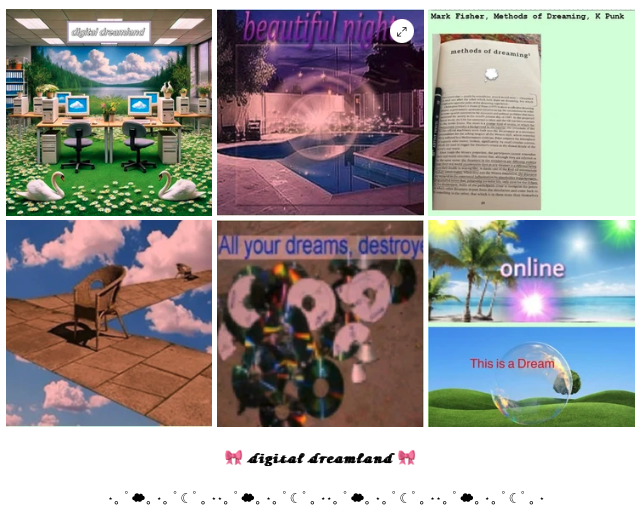
Submissions open: Digital Dreamland

So excited to co-edit this new series with Maisie Florence Post!

SPAM Plaza is reopening submissions for Digital Dreamland. 

Ever had déjà vu, not knowing if something happened IRL, online or in your dreams? As screentime and sleep time increasingly clock similar hours of the day, we’re turning our attention to the acute relationship between dreams and the internet. 

We invite critical work inspired by, but not limited to, any of the following topics: 

☁︎ sleep procrastination and social media

☁︎ cloud hoarding 

☁︎ the return of the (digital) repressed

☁︎ the memetic unconscious

☁︎ distraction as dream economy 

☁︎ ghosting (and the metaphysics of digital presence)  

☁︎ sleep texting 

☁︎ hyperreal environments & nonspaces as dreamscapes 

☁︎ online dream journaling communities 

☁︎ targeted ads as unconscious desires 

☁︎ chaos edits as dream realism

☁︎ artificial intelligence and dreaming

☁︎ interactive & lucid dreaming

☁︎ digitally-induced parasomnias 

☁︎ dream imaginaries and political im/possibility

☁︎ neural net neurosis

☁︎ image spam and cyber garbage as psychic discharge 

☁︎ oceanic feeling online 

☁︎ dreams in augmented and virtual realities

☁︎ video game realities and dream framing

☁︎ online shopping and astral projection

☁︎ cognitive timelapse and digital intimacies

☁︎ corecore and collaging the cultural unconscious

☁︎ dream scanning as the next cyber frontier

☁︎ avatars, dreams and shadow selves 

☁︎ (rip) twitter dream sharing

☁︎ movie and/or fictional representations of dreams and the internet 

☁︎ typographic parapraxis (poetics of the typo as freudian slip)

☁︎ affective ecologies of the comment section

☁︎ recalibrating platforms/digital detournement

☁︎ dead internet theory as dreamscape

☁︎ online dream interpretation communities 

☁︎ folk hauntology and web 1.0, 2.0 or 3.0 

☁︎ somnambulist clickholes 

☁︎ liminal spaces and spaciality of dreams

☁︎ surrealist aesthetics

☁︎ online collective memories 

☁︎ posting as automatic writing 

☁︎ psychosomatics of the meta-nightmare 

☁︎ dreaming in digital interfaces 

☁︎ dream prophecies and crypto 

☁︎ virality as bottleneck alter-consciousness

☁︎ glitch feminism

☁︎ screen-induced hallucinations (shared hallucinations)

☁︎ I lost a piece of my psyche in geocities

☁︎ hyperconnectivity and dream symbolism

☁︎ we are (always already) living in a simulation

☁︎ rest vs attention online

☁︎ internet temporalities/(a)synchronicities

☁︎ social dreams as cyber commoning 

For more inspiration, read the inaugural editorial for this series written by Maisie Florence Post. We always love to see work which engages these themes specifically in relation to poetry, but are open to work that touches on any aspect of texts, media and internet culture. 

Submission guidelines:

We will be open for submissions between 15th January and 12th March 2025. 

All submissions should be sent to spamzine.editors@gmail.com with subject line SUBMISSION: DIGITAL DREAMLAND.

Please add a brief note to your email explaining how your work fits into our theme.

We aim to respond to all submissions within four weeks and some people will hear back before the submission window closes as we will be publishing pieces on a rolling basis throughout 2025. 

This is an open call for critical work. While we appreciate the line between creative and critical can be fluid, we are looking for work that fits overall a more critical angle. 

Unfortunately neither the editors or contributors of this series will receive remuneration. Copyright remains with the author. 

We don’t have capacity to give feedback on unsuccessful submissions and the editors’ decision remains final. 

Please send submissions that are previously unpublished.

You can submit up to TWO pieces in any of the following categories:

  • Flash essays – 400-1000 words
  • Full essays – 1000-2500 words
  • Theory fictions – up to 2000 words
  • Verse essays – up to 100 lines (we have very limited formatting options however, so please get in touch if you’re not sure your work will be suitable)
  • Visual essays (photography, memes, illustrations etc – max limit of 15 images)
  • Audio or video essays (with text transcript provided – you must already have the link hosted elsewhere rather than send it as a file – we need to be able to embed it via a link)

ʚɞ

You can read the SPAM Plaza archive for free to get a feel for the stuff we like to publish.  

Phantom Architecture

the stillness of the painting has a kind of speech to it
the sustaining restless grammar of poetry
is that how good poets defy things with their heart
the sun on the tongue is a kind of living
the poem seems to fill up with this
a panic, just in the peripheral vision
a mode that can maintain the day
something of Schuyler in the act of saying
how it allows the people to enter the self
we are not complete
when I’m writing, I’m the right size
I’m not bigger or smaller than anything
kindle’s like etch a sketch
one of the issues of elegy is not being able to let go
the Orphic is endless
we’re all here because we’ve been taken captive by our reading practice
a text of dubious origin which is a great analogy for poetry
trick us into thinking these are finished propositions
the only authority is the sound itself
foregrounding the process of echoing
the lyric utterance as operating system in the present moment
humour my error
invent my own invisible poem behind the invisible poem
beginnings are always about nothingness
meaninglessness makes meaning
a horizon or atmosphere that I can continue to write into
I am always beginning…
I literally don’t know how to write a poem
phantom architecture of a poem
the complexity of getting from one line to another
a properly honest relation to our temporality 
the poem that doesn’t know it’s good is usually good 
you can’t find anything if you’re not lost
making nothing as a suspension of labour
marking the duration of a symptom
speculative topos for tracing affinities
there is no better time than the present when we have lost everything
a generative uprooting of one’s identity or biography to do the work
incantation to wrestle the poem from its enclosure 
to project in divine sublimity
hoping poetry might come back 

*

All of these lines are quotations of things said by panellists and contributors at the Peter Gizzi Colloquium at St Andrews University on 18th October 2024: Anne Boyer, Luke Roberts, Oli Hazzard, Honor Hamlet, Colin Herd, Jacob Bard-Rosenberg, Rosa Campbell, David Herd, Caspar Bryant, Daisy Lafarge, Anthony Caleshu, Peter Gizzi.

Midsummer Song (Hypercritique)

In 2018, I started a Doctorate of Fine Arts in Creative Writing at the University of Glasgow. I also started a new diary. In October, the month it all started, I wrote about duplicate footsteps and permanent landfills. I wrote of lacking the energy to dance, being lost in the forest, looking for safety among swirling leaves. Can’t remember if the forest was real or metaphorical. I wrote seemingly in lieu of being able to actually venture beyond the confines of my working life. Over three years and three months, I went through multiple iterations of research focus. I looked at foam, clouds, technicity, glitter, quotidian measures, fire and cinders. I fell asleep on coaches circling lochan sunsets. I produced a list of figures for how we might conceptualise this project. It was a sort of Escherian dollshouse, a self-deconstruction of building this place to think. I thought about Bhanu Kapil dropping her book in the river. I thought about doing a writer’s residency within the confines of a square-shaped digital platform. I wrote of ‘An angel tossing her gunpowder sequins’ and ethical eating, ‘how so often you are so paralysed between two choices that you just don’t eat at all’. I wondered what kind of home this work would make for me. This was a material question: thanks to the Scottish Graduate School of Arts & Humanities, it was a funded period. It paid me through Covid-19.

These were my original research questions:

  • How can creative and critical writing interrogate and depict the apparent tensions between the Anthropocene’s deep-time and the quotidian context of our ecological orientations?
  • What hybrid critical-creative forms might open up possibilities for a future ecological art, one which builds productive ways of ‘tuning in’ to a non-anthropocentric experience, with reflexive attention to the artistic and technological media involved in this process?
  • How might ‘the everyday’ provide a temporal and formal mode through which to develop a critical, interdisciplinary Anthropocene aesthetics, negotiating ecological questions of affect, sensory relations, ethics and responsibility at scales both macro and micro, human and nonhuman?

It is up to the reader to decide how far the end result fulfilled or strayed from these lines of enquiry.

Six years on, having graduated from being a baby scholar-poet, I am really thrilled this project has found a dream home with No University Press, a new imprint from Tenement Press. The ‘no’ of refusal feels appropriate to this project, which very much concerns the affordances and limits of an academic and institutional mode when thinking through (im)possible questions of ecological thought and living on. Working with Benjamin Pickford and Dominic Jaeckle, editors at Tenement, I was able to bring the project’s creative detours and modalities to life in its final book form: Midsummer Song (Hypercritique). This is definitely the most ambitious work of my life. It’s 469 pages of critique, poetics, meadow work, illustration and elegy. I see the whole book as a big song, a study, an architectural attempt at making an ecological home in lyric.

Somewhere between an academic monograph and performative dreamwork, poetry and poetics, conceptualism and the commonplace.

You can order the book direct from Tenement here or from Asterism here.

You can read a full description of the book and access endorsements, sample poems and other materials here.

I will be touring the book at some upcoming dates in Glasgow, Edinburgh, Manchester and London:

09.11.24                      Peter Barlow’s Cigarette /
                                        with Maria Sledmere,
                                        Harriet Tarlo & Lucy Wilkinson
                                        The Carlton Club, Whalley Range
                                        Manchester
                                        See here.

05.11.24                      Midsummer Song / Readings & Discussion
                                        Maria Sledmere,
                                        David Farrier
                                        & Colin Herd
                                        Fruitmarket Gallery, Edinburgh
                                        See here.

26.10.24                      Midsummer Song / Readings & Discussion
                                        Maria Sledmere,
                                        Chris McCabe
                                        Small Publishers Fair
                                        Conway Hall, London
                                        See here.

22.10.24                     Midsummer Song / Readings & Discussion
                                        Maria Sledmere,
                                        Carl Lavery
                                        & Colin Herd
                                        Advanced Research Centre,
                                        University of Glasgow / (Online via Zoom)
                                        See here.

In s(w)ervice of attention

I wanna show up for poetry every day for the rest of my life. There’s this word for when food continues to cook itself — carry-over — like tortiglioni warm and slippery in the colander needing to be eaten. I wish poetry could do that. A. says it does, doesn’t it? When you remember a line sometime down the line and it occurs to you: a new meaning. Or when the poem you wrote marinades in the background all to be felt with alternative pressure. I guess to write then is to throw out your salt or chuck a glass of water behind you as you leave the door of the document. Poem to set out for the day each day.

When I say I want to show up for poetry it’s not just that I want to hear or write or feel it live. Is it that I want to pay it attention? Who or what is poetry and where do I go to do this?

Right now, I’m going to fiction.

Recently I attended a joint book launch at Waterstones, Glasgow with Elle Nash and Kirsty Logan. Nash said the thing about fiction, her philosophy, is that she wants it to bring the reader to their knees. Logan said she wanted fiction to be like telling the reader a story. Both are forms of surrendering and/or attention. I don’t remember being held in the cosy space of storytelling at school because my brain was off on its own adventures. I categorically could not pay attention. Or maybe I practised another form of attention. I had it for free, and didn’t need to pay anyone anything. Something I was scolded for. Maria, pay attention. Was I failing to pay some kind of respect to the storyteller? Part of me wanted that form of listening attention so badly, to be wrapped up in the words of another and so in the folds of the room, but I just couldn’t surrender like that. I would look around the class and be hyper aware of a hundred things at once. The pins and needles in my feet; the subtle vocal inflections of the reader; the question of whether or not this teacher had sex and surely they had because they said they had kids but could I imagine them having sex and then when I tried I could not stop imagining them having sex and it was awful; what would there be for dinner tonight and would I have to cook it; does anyone in this room have a cute dog; when will I be old enough to smoke; which of these characters should I care about; why does my nose itch; when will I get my first period; why does my friend think everyone’s a lesbian; is everyone a lesbian; what does the word bedraggled mean; I think I know what lethargy means; what is the word for….; when can we go outside; I hate going outside; wonder why the publisher gave the book that cover; wonder why there are dots in the ceiling tiles; whose body odour is that etc etc etc. I’ve already forgot what this paragraph was supposed to do or say. At some point in my school years I would just nod off.

I have never been someone who could digest a book, slowly and thoughtfully, and then be able to recount the significant actions and characters and narrative highlights back in a considered, ordered and clarified way. I come at it sideways and can’t talk about it without finding a new angle each time. I need to talk to people about books who can work with the zig zag.

I need writing to ‘strike’ like a match or lightning. I need to read to fall off the edge of reading.

Piece of feedback from a student: you know you teach better off the book.

Been thinking a lot about what that means and what the book is and how to cultivate a kindness towards an open style of teaching.

Been thinking about the way Emma Stone drives that aubergine Dodge muscle in the new Yorgos Lanthimos movie, Kind of Kindness (2024).

Sometimes I can’t pay attention to my own teaching. It happens on auto-pilot and I’m saying things and all of a sudden it’s the breathless bell supplement of the passing hour and people are packing their bags, and bizarrely I’m starving and it’s over. What does it mean to trust the other self that takes over? To walk into every classroom unsure of what will happen?

Sometimes, crash. Often, swerve.

I would describe my reading style as lackadaisical, dyspeptic, errant, passionate, half-awake. Why would I expect my students also to listen with 100% unadulterated attention, when this is how I go about my own learning?

At her recent Good Press event for the launch of Lessons of Decal, Sophie Seita spoke of asking her audiences to ‘absorb [her] words like a piece of music, where the words come in and out of consciousness’. To be given permission for that form of drift and daydream to be okay is a huge relief. If I’m at some event where it feels cool to whip out your phone and notebook, I usually enjoy it a lot more. It’s relaxing to pay attention by not paying all your attention. Allowing my attention to go stereo is sometimes the best way to listen (this was one of the things I loved about the poet Callie Gardner, the way they would often whip out a notebook during a reading, and by extension granting a kind of permission for others to do the same). Seita spoke on what a non-extractive form of attention might be, and might it be that more ambient, absorbing, blurring and responsive mode. I sometimes let the sentences snake around me, other times they cut little jewels, hardening and cleaving and polishing the soft matter of my thoughts. Sometimes I mishear, overhear. In lockdown readings and lectures, I’d participate heartily in the flowing ticker-tape of the Zoom chat and its various overspills onto group chats and discords. I liked the sense of multiplying conversations happening simultaneously, emoji splurging.

⬫꙳⋄﮳✧﮲⋆꙳⬫꙳⋄﮳✧﮲⋄⋆꙳﮳✦﮳⋄⋆꙳⬫꙳⋄﮳✧﮲⋄⋆꙳﮳✦﮳⋄⋆꙳⬫꙳⋄﮳✧﮲⋄⋆꙳﮳✦﮳⋄⋆꙳ ⟡﮳﮲✧﮲⬫꙳⋄﮳⋆꙳⬫꙳✦﮳⋄⋄✧⬫꙳⋄﮳✦﮳⋄⋆꙳⬫꙳⋄﮳✧﮲⋆꙳﮳⋄⋆꙳✧⬫꙳⋄﮳✦﮳⋄⋆꙳⬫꙳⋄﮳✧﮲⋄⋆꙳﮳✦﮳⋄⋆꙳⬫꙳⋄﮳✧﮲⋄⋆꙳﮳✦﮳⋄⋆꙳ ⟡﮳﮲✧﮲⬫꙳⋄﮳⋆꙳⬫꙳✦﮳⋄⋆꙳﮳⋄✧⬫꙳⋄﮳✦﮳⋄⋆꙳⬫꙳⋄﮳✧﮲⋆꙳﮳⋄⋆꙳✧⬫꙳⋄﮳✦﮳⋄⋆꙳⬫꙳⋄﮳✧﮲⋄⋆꙳﮳✦﮳⋄⋆꙳ ﮲

I went recently to Inside Voices, a free night of ambient music and poetry held at King Tuts and hosted by anoraq. I love these nights because I always fill up my notebook. There were readings from Medha Singh and Ian Macartney, a performance by Dronehopper. While listening, I pondered especially what the percussive parts of language were. Little coughs, plosives, hovers of breath while the performer altered their pace of attention.

I want a manifesto for ambient attention. The closest I have found so far, aside from the classic 1978 Brian Eno piece, is a university project: ‘A Manifesto for Ambient Literature’ (2017) co-written by the Ambient Literature team. Here’s a snippet:

I take this to mean affirmation of porosity between texts, but nonetheless one that holds true to the material reality of a text’s construction.

There’s an iPhone that crops up in some kind of poem and whatever it’s doing there, I start to see it running the whole text, a little monstrously. The poetic subject becoming a mediating interface. When I asked the jetpack AI to give me more emoji string, it granted me a handful more stars.

I like books for being (in)complete worlds perforated with holes (words and the gaps between them). A night (sky), variably rich.

My lover sees me drop the book and flop sideways three times before taking it off me and shutting the light. I try to read and the whir of sentences stirring up is somehow the kind of stimulus to send me to sleep.

When I wake early, as I often do, to the dawn screeching of gulls, I keep the light off and try to read by the dark. It’s every sixth or seventh word I miss. The full stops slide away, smudge into dimness, and I read sentences continually — sloshing into one another.

Sometimes I think I read off the book. Like, the reading comes not when my eyeballs are actually skimming the lines on the page but in some kind of preliminary or afterglow moment.

What about the content?

I once had to do a medical questionnaire that asked me if I ever struggled to understand the motivations and emotional behaviours of fictional characters. This was a fascinating question. I let it cook for a few days before answering on the numbered scale.

Hovering with my ballpoint, I kept thinking of that Virginia Woolf quote from ‘Mr Bennett and Mrs Brown’ (1924): ‘On or about December 1910 human character changed’.

Maybe I didn’t know why characters did things, even as I sat in rooms and offices and Zooms with students, discussing with great sincerity and intent the mechanics and motivations of fictional bone collectors, world-savers, serial killers, suffering girlfriends etc. Maybe I could only attend, momentarily, their tendencies; and so fathom a pattern or path from there.

What does it mean to give your full attention, to pay attention or to offer it?

I’ve started to think paying attention means there might be such a thing as ‘attention debt’. Is that the same as ‘attention deficit’? If I were to somehow skip the NHS diagnostic waiting lists to find myself looking at a special time-release pill on a silver platter, would that pill buy me attention? And would I somehow have to give it back, eventually, foreclosed or with massive accruals of cognitive interest? I start to think about the speed of my heartbeat in time to attention.

When I press my ear to your chest, and it’s your heartbeat I hear: am I witnessing the cost of attention?

Paying attention = being a cognitive agent of capitalism?

Does the heart hold the indelible mark of other attentions?

I would save all my heartbeats for you in a heartbeat. I hold them back from work. I save them in service of love and its ghosts.

Sometimes I want to be sharp; other times it’s better to blur.

Why do we say ‘pay attention’ and not ‘give attention’ or ‘do attention’? There’s a pretty useful article on this over at Grammarphobia:

English acquired the verb “pay” in the early 1200s by way of Anglo-Norman and Old French (it was paiier or paier in Old French), according to the OED.

The Old French verb meant, among other things, “to be reconciled to someone,” Oxford says, reflecting its classical Latin ancestor pacare (to appease or pacify), derived from pax (peace).

As the Chambers Dictionary of Etymology explains, “The meaning in Latin of pacify or satisfy developed through Medieval Latin into that of pay a creditor, and so to pay, generally, in the Romance languages.”

Some of the earliest meanings of “pay” in English are obsolete today—including to pacify, or to be pleasing or satisfactory to someone.

But senses relating to handing over money—or whatever is figuratively owed to someone—are just as old, and of course they’re still with us.

If I say pay attention, I’m not exactly doing so in the service of pacifying or pleasing. Much more likely that you’d take the phrase the way you’d take ‘pay your debt’ or ‘pay your letting agent’.

I don’t want attention to be an extractable value, but it is. We know that most of presenteeism at work is about being able to perform your paying attention for the sake of appearances. It isn’t really about productivity.

What if I let go of that presenteeism in other areas of life which demand attention? What if we got much more into improvising what makes for good listening? What if I wanted to watch television as a way of processing a complex emotional conundrum while also laughing my ass off at another life?

Would I write more? Would I understand human character?

Would I ~frolic in the generative plenitude of non-instrumental value?

In 2017/2018, I saw Iain Morrison perform some of his Moving Gallery Notes at Market Gallery, back when it was in Dennistoun. The video I’ve linked above begins something like ‘right now, the time is 97%’. I feel my attention brimming like a healthy battery. Morrison’s poetic works comprise notes made while at various gallery events and artist talks. He describes the project as ‘a sequence that samples a chain of events, encounters, conversations, meetings, empty spaces and all the other things that make up the life of an arts organisation making its way through changing contemporary contexts’. Listening to the work is less about being presented with ‘content’ and more about being provided a poetic architecture in which to indulge great reverie. The content itself is also fascinating. Morrison’s gallery notes encompass everything from embodied experience to the yield of eavesdropping. The initial ‘splurge’ or ‘stream’ of notes goes handwritten onto the page, from the context of an event, and eventually gets whittled into lineated poetry. I found this description from Morrison’s blog, Permanent Positions, particularly useful:

The reason ‘notes’ is in the title of this and my earlier series, is because my first step for each poem is to choose an event at the gallery and write notes during it. When I’m making the notes I mostly write continuously, allowing whatever I’m thinking about – whether it’s things people are saying, or things occurring by association in my head ­– to stream onto the page, at the speed I can write at. My objective while doing this is to not worry about the appropriateness or relevance of what I write down. I try to get material down on paper, and there’s a hope that I can use my embodied presence – a thinking body in the space – to make myself into a recorder, one that acknowledges its subjectiveness, of the event. So this stage of writing can be a splurge. It usually is. I will edit these notes at the next part of the process.

This seems to me an ambient method of composition. It is open to digression, refuses to ignore the body and sees the self as both subject and ‘recorder’. Not so much Spicer’s radio here as the ZOOM H1n versatile pocket recorder.

Moving Gallery Notes is of course also a work of ekphrasis.

For my birthday, K. gave me a copy of Danielle Dutton’s Prairie, Dresses, Art, Other (2024). Halfway into this delicious compilation of fiction and nonfiction is an essay on ekphrasis which discusses, among other things, Rindy Sam’s kissing of a Cy Twombly canvas in 2007 and Eley Williams’ short story ‘Smote, or When I Find I Cannot Kiss You in Front of a Print by Bridget Riley’ (2015). The idea of ekphrasis is presented as a kiss, a mark left more or left indelibly from one work to the next. Soon I will write a poem called ‘kissing cy twombly’ because aside from the brilliant parenthesis of the act itself, sullying a white canvas and paying one ceremonial euro to the artist for the privilege, it sounds like a CSS song or something. So I will commence the writing of the poem from the idea that I am speaking to Lovefoxxx or sprinkling tongue-glitter on crayola-smeared Moleskine.

I write this painting my nails Essie (un)guilty pleasures and trying not to leave such a mark on my MacBook keys. What shade of green is this? It’s too late. Everyone who has seen my laptop knows the key letters are tapped out beyond repair. Skin friction has caused the letters to smudge and blur into pools of acidic white light.

Milton writes of ‘th’ Arch Angel’, about to speak, in Paradise Lost: ‘Attention held them mute’. Meanwhile, ‘Tears, such as Angels weep, burst forth’.

Have I cried on my laptop sufficient to melt its keys? Do I write from speech or silence?

The OED reminds me that one can ‘attract, call, draw, arrest, fix‘ attention.

Thou art to wink.

What if we wept for attention. Made its call. Applied the right fixative.

Now we say something like ‘oh that therapy session totally ate‘.

What I like about blogs is that they are deliberately undercooked. You basically serve them up to the world before you’ve had time to stew, finesse and perfect the product. This one I wrote this weekend while procrastinating emails, on a rickety bus and then rushed with sips of coffee before heading out to a festival. It’s pretty al dente okay sorry you’re gonna have to chew on it. I like that I can look at a blog post and think ‘that’s a fucking mess’ and then immediately post it.

I do think I am capable of being floored by good fiction. When I read Nash’s latest novel, Deliver Me (2024), I was sick with flu but the flu was on a kind of continuum with the book. I kept texting everyone: ‘no one writes sex and the body like Elle Nash!’. I read it feverishly, dreamed in it and let certain scenes linger in my psyche long after I’d folded the last page. I read it with a curiosity I don’t think I’ve had since the way I used to read the internet. By which I mean: I devoured its voices.

Similar thing happened when I devoured Thomas Mann’s The Magic Mountain (1924) in January. I was listening to the audiobook version and continually would have to stop what I was doing (walking to work, cleaning, washing my hair) to make copious notes. All such fiction makes me weak at the knees. And you know, it isn’t the characters or the plot that do this to me, but the language. Its essaying of life, presence, intimacy, repetition. The way narrative is a temporal prosody conducting attention.

I liked hearing about Nash and Logan’s manifestos for fiction, what they hoped to give readers, because it made me realise my own liminal, elusive bar for contact. I think about the text as a space, not just for the conveyance of meaning but explicitly for bearing its im/possibility and by extension, its potential for ellipsis, disappearance. That’s where the fun begins.

Maybe what I wanna do is s(w)erve attention. Keep showing up.

StrathWrites: An evening with Graeme Armstrong

photo credit: Olivia Page

What a fucking privilege to sit down with a writer whose work not only touches a nerve but leaves a whole room of folk feeling inspired, invigorated and just the right amount of raging about the world to go and do something good about it. Graeme is an eloquent, generous speaker who came to StrathWrites last week to talk to us about his memoir, The Cloud Factory, along with his debut novel The Young Team (2020) which has made waves for its frank engagement with Scottish gang culture, masculinity and the vitality of Scots language. Graeme read from the end of The Cloud Factory, a work which feels like memoir dialled up to the communal document of what it feels like to be both inside and outside of something, to memorialise it and to work right through it, to know what was beautiful and also painful beyond words, camaraderie and shattering, refusing to paper over the cracks in reality, to note their presence and texture, to send up lost pals and those who never made it, to speak measuredly about how class and gender affect everything, to meditate on addiction, self-medication, faith, to find a turning point, to know what the past does, ‘stored as a memory in yir very cells’. He’s an author that gets it — the inside violence as much as the outside — and it’s clear from listening to him and watching a room full of folk listening to him that he can negotiate what goes unsaid with clarity and determination. After the reading we all just talked for ages, people sharing their stories and their experience of working in schools and what it means to teach and mentor and edit and pull each other through the muck of it all. What I loved most was everyone just speaking in their strongest tongue, telling stories.

~

StrathWrites is a series of writing events and workshops supported by the Strathclyde Jubilee Engagement Fund and the Strath Book Club. I’m lucky enough to work with the wonderful Jenny Carey from the Institute of Education — she’s swiftly become a radiant presence in my life and we’ve had loads of fun collaborating on these events. 

READ: Extract from The Cloud Factory by Graeme Armstrong, in Granta

For anyone who missed Thursday’s event with Graeme, in lieu of a recording here’s a transcript of the workshop handout:


‘In place ae a realistic dialect portrait, authors create mutations where narrative is transacted in a ‘higher’ form. The clarity ae thought n expression afforded tae oor native guide default tae a more palatable Standard English. Meanwhile, the low, wild demotic dialect is reserved fur characters, who become linguistic puppets dangled on strings ae supposed authenticity. Characters ir reduced tae caricatures by this effect, their true dialect offered as dialogue canapés tae the unfamiliar reader, satiated by the apparent otherness ae the partial linguistic exhibit. They provide the local reader nae such nutrition.  Oor language becomes a motif n isnae truly represented or respected by it. Nae working class Scot thinks in RP. Kin yi imagine? The willin suspension ae disbelief fur us is broken. An elevated n alien Standard English narrative voice betrays the remainin realism they have so carefully n respectfully crafted.’

— Graeme Armstrong, ‘Standard English is oor Second Language’, Literature Alliance Scotland 

‘My culture and my language have the right to exist, and no one has the authority to dismiss that.’

— James Kelman’s Booker Prize Acceptance Speech 1994

Prescriptive grammar, in other words, becomes the sound made flesh of prescriptive pronunciation. The tawdry little syllogism goes something like this:

1. In speaking of reality, there is a standard correct mode of pronunciation.

2. In writing of reality, there is a standard correct mode of pronunciation.

3. In reality, correct spelling and correct syntax are synonymous with correct pronunciation.

Putting it another way, if a piece of writing can’t be read aloud in a “correct” Received Pronunciation voice, then there must be something wrong with it.

— Tom Leonard, ‘Glasgow Stir-Fry: Chopped language pieces on “the language question” in answer to a request’, Poetry Ireland Review 

Drug-inspired delusion or Christmas epiphany, A cannae say fur sure but everyhin changed fae that night on. A never used drugs again n the violence wis finished tae. Suhin stirred in that wee flat that feels fundamental tae ma life noo. Maybe it wis always kinda there n just a ringin phone, never answered. The mare A sat n scrutinised it days later, A felt stupid n that kinda exposed way that speakin aboot faith sometimes makes yi feel, like if yi told any yir pals they would rip the pish oot yi n aw laugh. That feelin started tae pass. A dunno the ins n oots ae aw this either. The required leap that faith demands is complicated tae the best ae us, but ask yirself this, who really made the clouds? N when they clear, ask yirself, who put aw they fuckin stars up there? No everybody hus faith n that’s sound. A don’t minister tae anycunt, but A know the difference it made tae me wis life or death. That’s no nuhin.

Gangs huv dominated ma life. A’ve spent the last decade recoverin fae them n tryin tae find the words fur it aw in ma writing. That’s twenty year ae gangs in total. Their effects on yi ir far-reachin n complicated. Substances n drink ir used by many as self-medication. The  aggression n hypervigilance that years ae gangs create don’t just disappear. They’re stull  somewhere below, stored as a memory in yir very cells or expressed as violent tendencies. 

— Graeme Armstrong, The Cloud Factory 

WORKSHOP ACTIVITIES

Word bank warmup 

    Share what you consider to be an unusual or personal word – perhaps one you associate with place/location or a dialect word. Share a definition with the room.

    Then pick someone else’s word and use that as a prompt for some free-writing. 

    Discussion: collocation e.g. ‘pishy pubs’. What effect do these have on our sense of familiarity with the world of the prose and the associations we have between words?

    Voice

      Writing dialogue: write a conversation between two people who come from a place you know really well. It might be your hometown or your current neighbourhood or a place that’s connected to your family somehow, or just a place you’ve spent a lot of time. Think about the textures of familiarity that are revealed in the language: experiment with dialect, code-switching and loanwords. 

      Now write about the relationship between these two people using the same dialect that they speak in. Whether your narrator is third person omniscient or first person, experiment with writing in dialect so that there isn’t a stark difference between how the characters speak to each other and how the narrative ‘speaks’. 

      Memory triggers

      Think of a photograph or significant object that holds memory for you. Describe it in detail and use it as a springboard for writing a poem or story. Be as personal as you like.

      Turning points

      Write about a turning point in your life where you realised something, or had to make a decision to live differently.

      This event took place on 21st March 2024 at the University of Strathclyde.

      New book: Cinders

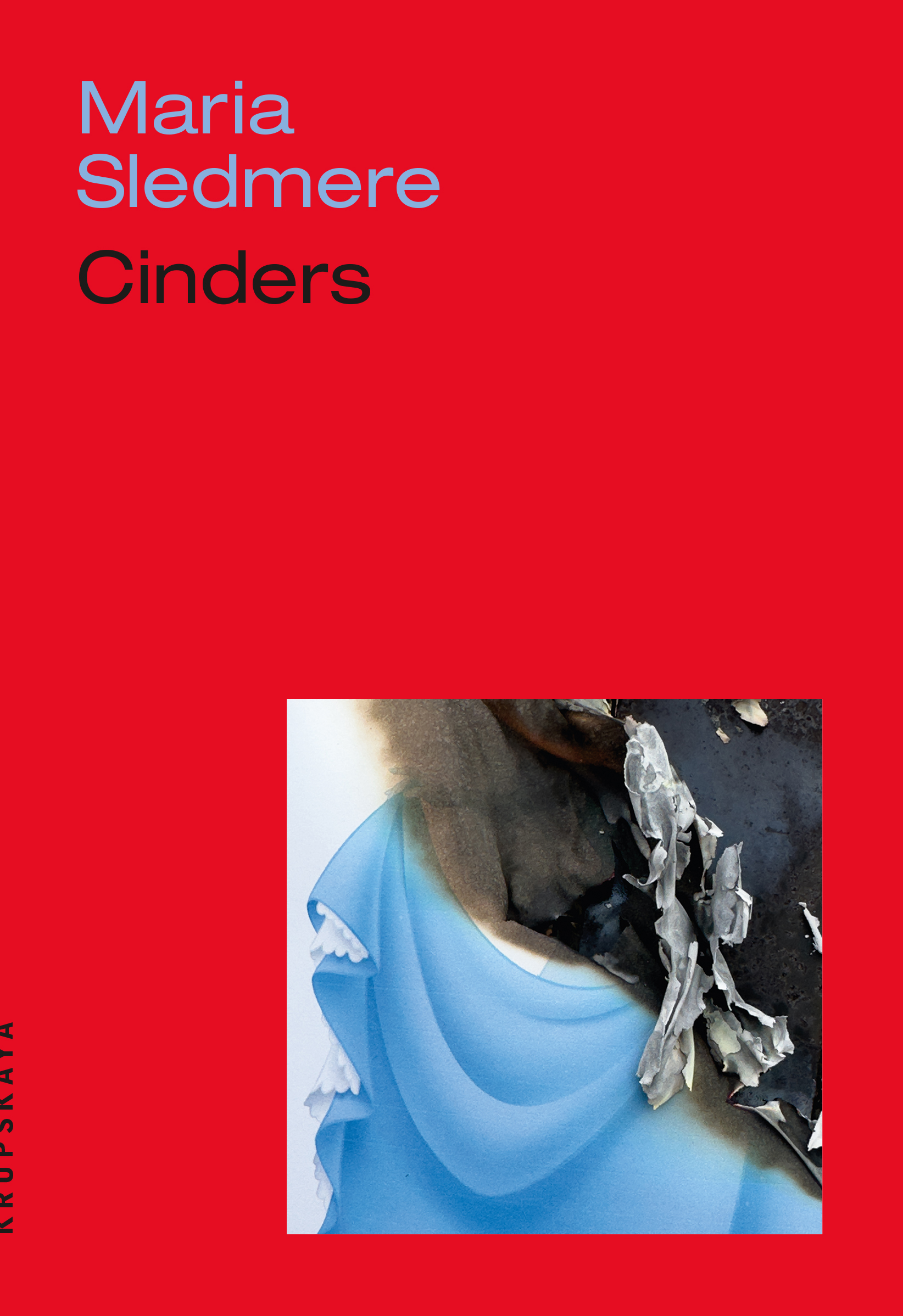
      I’ve been excited about this for a long time: my U.S. debut and new poetry collection, Cinders, is forthcoming with KRUPSKAYA Books!

      I started writing Cinders in 2019. In some ways, this feels like the most worked-through, shape-shifting and elemental thing I’ve written. It’s also a bit crazy, let loose, poet in residence at the wind farm energy.

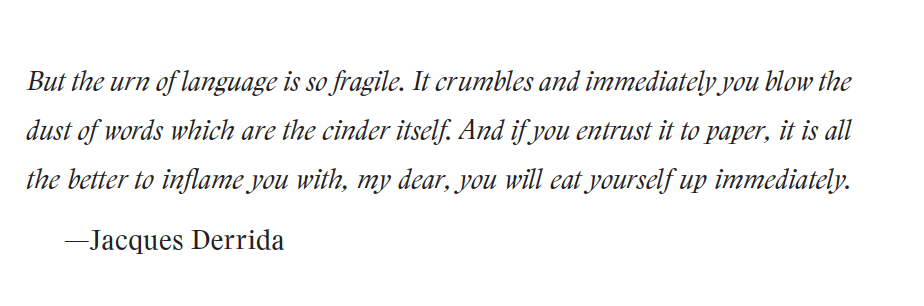
      Its main epigraphs are these:

      About the book

      Cinders is a perverse and hybrid reimagining of Jacques Derrida’s 1987 book of the same name and the rags-to-riches fairy tale, Cinderella, set against anthropocene mythoscapes of deep time, haunted leisure plazas and terraformed Mars.

      Cinders retells an old tale about lateness–how late is it, is it too late, what are the stakes of being too late if it is too late. This lateness, in Sledmere’s visionary lyric poems, pervades the structures and strictures of the pop dystopias and erotic utopias she studies: gender, class, geography, space–inner and outer. The very elements of Cinderella that were there all along as the wood burned to ash in the hearth.

      Jeff Clark of the amazing Crisis Studio did a really great job on the cover, which has an accidental nod to the drapery of Cixous’ Hyperdream (one of my favourite books in the world) and whose ash curls are from a real incident of burning the avatar of the tale herself.

      I am grateful to Sophie Collins, Colin Herd and Douglas Pattison for reading earlier drafts, and to Brandon Brown, Jocelyn Saidenberg and Stephanie Young for being such amazing, enthusiastic and thorough editors ❤

      Here are some nice things people have said about the book:

      Voilà! There she flies! Cinders! Sledmere’s ribboning red hot femme lyric avatar neither yet soot nor fire, always already hearthless, always already combustible, floating out on the thermals of volatile, flammable, scorching lyrics, trailing clouds of glorious derridean cinder-signals. Imagine lying with Plath’s red-haired Lady Lazarus and Celan’s ashen-haired Shulamith, moon-eyed sisters in anthropocene’s burned-out basement, knowing we are stardust, golden, indeed carbon, but with no way back to the garden and only high contempt for the billionaire boys’ silver spaceships in that yellow haze of the sun (‘this isn’t the journey’)—who do we call? Who ‘singing this tale of the comet’ is going to ‘come for you, little/ burning world’? Cinders! There she flies! Voilà! Poetry coming out of her like lava. Read it, sisters, and swoon. Now listen for that glass slipper to drop then splinter.
      — Jane Goldman

      Maria Sledmere sneaks up on you. In language that is deceptively intimate and often playful she limns a world of dark, sharp corners, where ecological catastrophe no longer looms but makes itself felt in every aspect of daily life. Intricate and expansive, never alighting on the expected, the poems in Cinders are both gems and bombs. A subtle stunner of a book.
      — Anahid Nersessian

      I’m planning to be in the Bay Area in May 2024 to launch Cinders with fellow KRUPSKAYA poets Jennifer Soong and Noah Ross at Small Press Traffic, but also look out for an online and Glasgow launch earlier on. The book’s publication date is 12th February 2024, just in time for Valentine’s. Please get in touch with the publisher if you would like to review, stock or whatever!

      Some poems in the book have been published already in places including trilobite and the Pilot Press anthology, Responses to Derek Jarman’s Blue (1993) (2022).

      Preorder here!

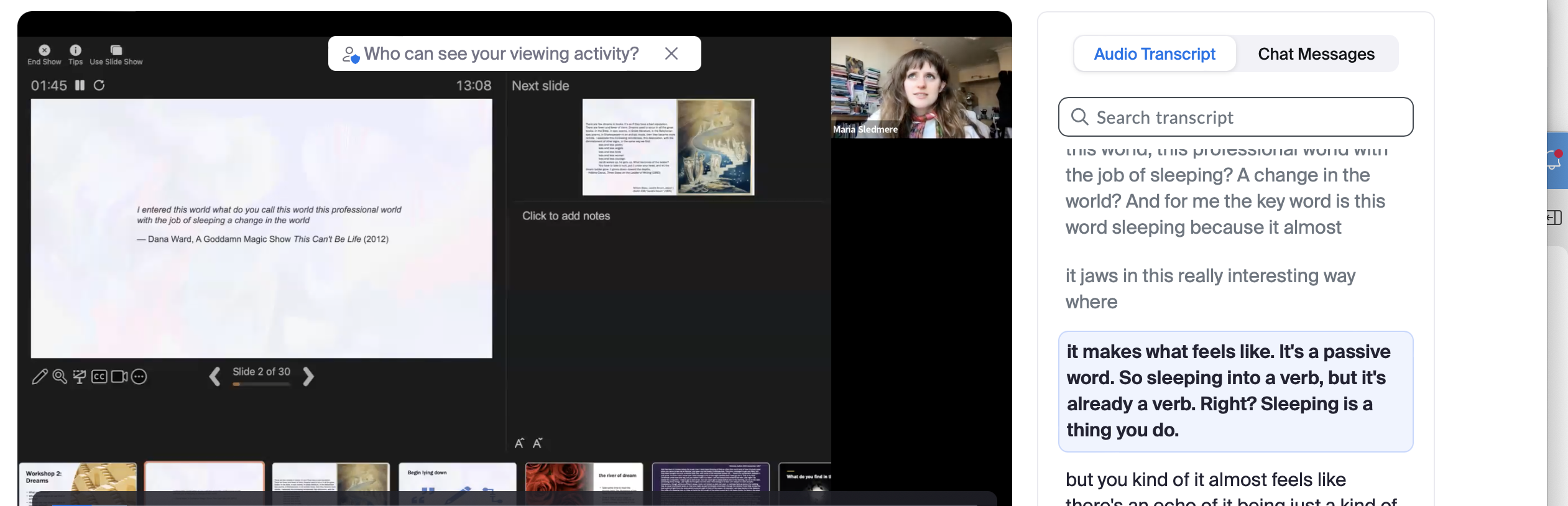
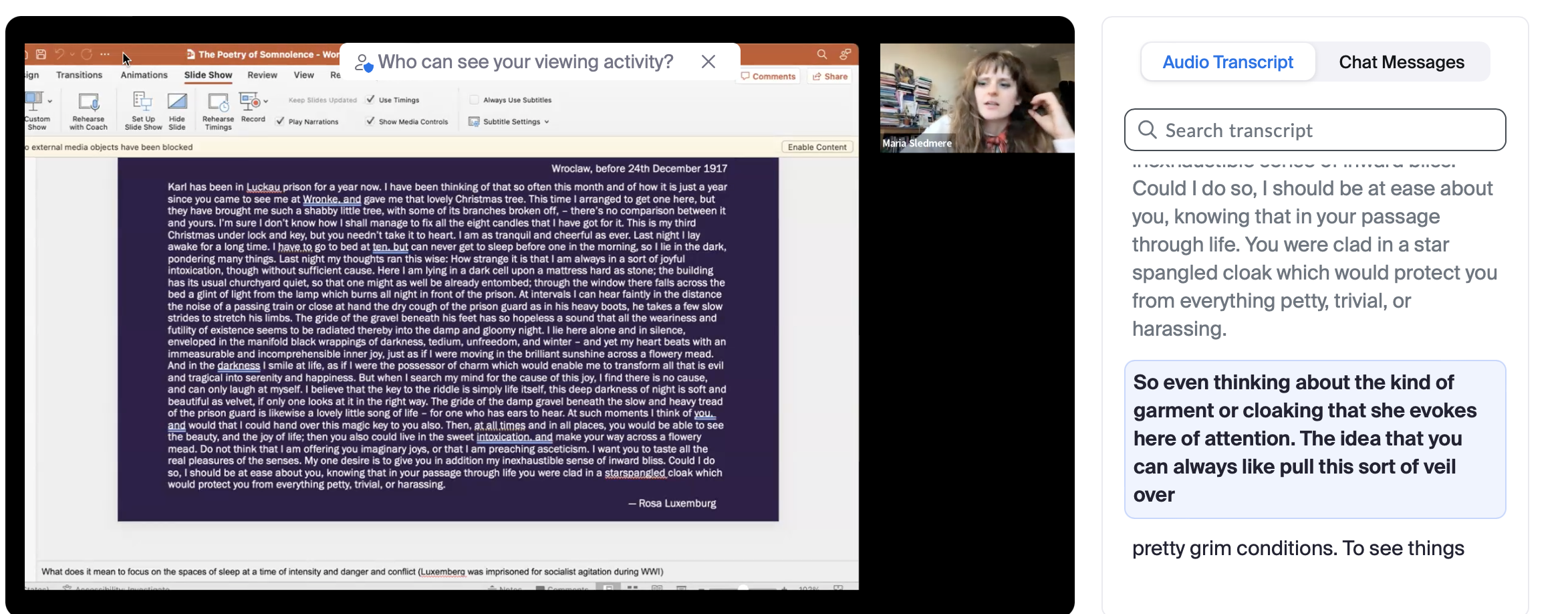
      Reflections on the poetry of somnolence

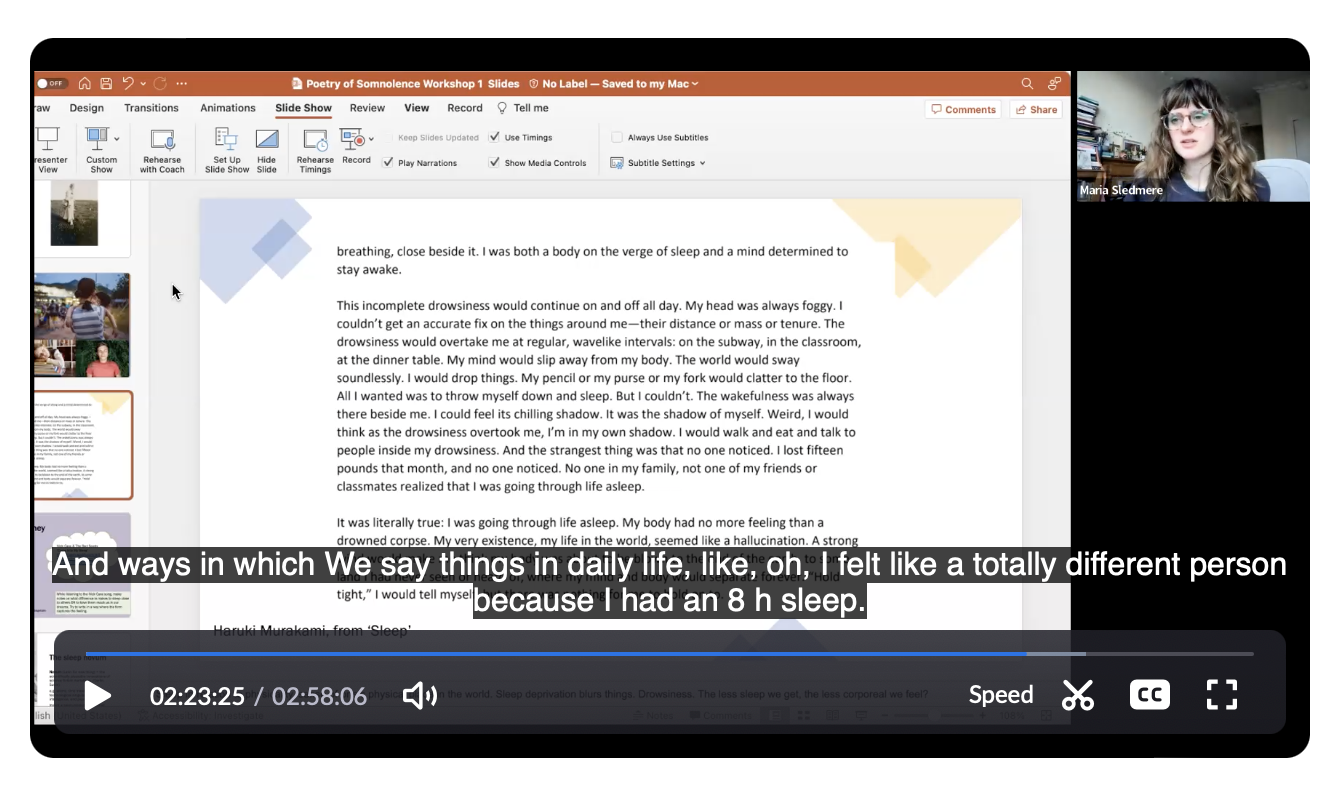
      I spent the weekend in Zoomland with a group of really brilliant practitioners musing on the affordances of sleep and dreaming in our writing. We took the opportunity to discuss chronotypes, insomnia, hypnagogic poetics, oceanic feeling, nocturnes, dwelling and dreamwork among other things. Everyone has a relationship to sleep and what I love about these workshop spaces is the way so much is unlocked by paying attention to the liminal moments in the day. I really enjoyed hearing about how modifications to one’s writing environment (turning the lights off, going outside, changing the light temperature on your writing device) an affect what we write. We thought about darkness as discovery. We considered the lullaby. Sleep as a transformative force, sleep as anti-capitalist, sleep as a process of (un)becoming, sleep as trip and trance. Sleep and caregiving, sleep and safety, sleep and homemaking, sleep and the more-than-human.

      Thanks to everyone who attended ❤

      More events and work on sleep & somnolence will be announced in the new year!

      For now, you can check out other Beyond Form Creative Writing opportunities here: https://www.beyondformcreativewriting.com