You’ve got a nerve to be embodied. Lana says it pains her how good the male vocals are on ‘Dealer’. Season of frivolous spending I call you from the floor of a mall, you spend £16.90 on coffee, I don’t know what prose is.
At some point I must have remembered the password to the room of amphibians, Analysis.
It’s not like the contact is there. A plate of sliced ham many decades ago, the puppy ate. A palate refined into podcasters who go out for cheeseburgers, murmuration of commas, choleric entropies. It’s a form of sleep paralysis. Horny letters to environmentalists.
Save me…as…
You lucid dream or you stop / shall it be blessed to touch the furnace a hard-light, the caterpillar blonde.
The door is locked. It needs a medicine. Rivers of cognac coagulate arterial: one is gold, one is white. Nightmares of Fancy prose. Aperitif or signet ring. Solid aura.
The barista gifts me free lemon cake “for someone that needs it” and it might be me or I half it with you? All canal walk I sipped the glow of that coffee their human kindness
The city a hologram out of Musk’s Eye™️
Sharing our name with the semblance of oatmeal, remembering for the business of hibiscus. It’s not as if I don’t want to say sky leaf, high staples, the charcoal nights of London. The bars are still apparently ours, a sensibility measured by flood vibe. Names of boats.
I can’t listen to music it’s all ships. The pillow faults of true music. Soundcloud was a planet. Salad Daze. Salad translates leaf array, a contour irrealism, swarm economics, morbid blonde. Wafer arrangements of transistor radio.
A feedback loop of the dark. The edifice of gelatine.
Time goes off like a triangle.
Photoelastic buoyancy; saline; bone; lime.
Nearby they are sleeping so I am the night elf
I miss tinsel I want so much tinsel I want Porphyria’s Lover erotica tinsel I want to be metaversed into the scintillant realm of tinsel a mass effect class tinsel I want blonde tinsel a gold physiology I want reddish the trad version tinsel ikr
Silvering with these destroyer lawyers
What was the original chipmunk music?
tinsellllllllllllllling total tinsel insensate a hard sell 🙂
I sue you!
Remember the xmas we listened to psychology podcasts as we hung gold baubles on the natural tree I wept in the eighties before sun lamps were invented
I’m walking home, stuck on a narrow pavement, hemmed in by parked cars. Two men are dawdling ahead of me, both of them huffing cigarettes. They’re dirty fags, definitely Marlboros, a stench that’ll take out your lungs like a morning bloom of toxic frost. I feel nauseous as the smoke blows back in my face and it’s a struggle to breathe; I’m striding fast to get ahead of them, not caring at this point whether it’s rude to push them aside. My heart-rate is up too much, the bodily reaction palpable.
I’m in a friend’s flat. It’s July and we’ve been awake all night and now it’s 4pm the following day, three of us watching videos, drinking rum with blackcurrant cordial in lieu of food. Somebody rolls every hour or so; two of us smoke out the window. It’s been raining for weeks but today the sky is blue and the daylight sparkling. A warm breeze comes through. I’m reminded of the night’s shimmery feeling, a glorious cocktail of chemicals and dropped sugar levels producing slow-release euphoria. The cigarettes are neatly rolled, thin and compact. They don’t take long to smoke, but the two of us—not being proper smokers—relish and linger the moment of supplementary respiration. They don’t taste of much at all, a very faint tobacco flavour that twirls down our throats, the thing we’ve been craving all night. We take turns to gaze at the street below, a couple of lush-leafed trees, passersby offering glimpses of the reality we’ve temporarily dropped out from. Everything has that vaguely pixellated feel of the virtual. Sideways glances at each other’s faces; at times like these you notice the colour of eyes, the shape of noses. We’re listening to dream pop, hip hop, lo-fi. We gossip to forget ourselves, spark grand discussions on topics ranging from astrology to engineering to ghosts. There’s a certain ambience we’ve made out of pure haze, a hilarity of mutual laughter meaning nothing in particular, resounding through abyssal chains of meaning. It’s one of the most blissful afternoons of my life. I go home, hours later, still tingling with nicotine. I lie on my sheets and let the scenes flicker by like beautiful lightning.
Like many people, my relationship to smoking is a little complicated. I’m a Gemini, my loathsome desire always cut into halves. I find myself disgusted by the dry sharp smell and residue taste, but somehow addicted to the presence of cigarettes in narrative, their signifying of time, their eking of transition between moments. It feels natural that such action should then manifest in real life: the disappearance outside after a talk or song or reading, buying yourself time to mull things over, return anew—snatch chance interactions with strangers. I know a friend who started smoking at university purely for the excuse to talk to girls outside nightclubs. I guess it worked well for him. The universal language of the tapped fag remaining a perpetual possibility, footsteps approaching the rosy garden of your smile and your smoke, your contemplative aura. Veils over nature. This is nothing but nothing; this is just the vapourisation of time and space. Smoke gets in your eyes and reality feels smoother. Less needs to be said; intrigue can be held. You add that plenitude of mystery in your walk, your dirty aroma of cyanide, carbon, tar and arsenic—an edge above the vaporous plumes of sweet-smelling e-cigs. With a fag in hand, there’s less impetus on you to talk. With a vape in hand, people want to know about your brand, juice, flavours.
A Smoker’s Playlist:
Mac DeMarco: Viceroy
The Doors: Soul Kitchen
Nick Drake: Been Smoking Too Long
Sharon Van Etten: A Crime
Simon & Garfunkel: America
Oasis: Cigarettes and Alcohol
Otis Redding: Cigarettes & Coffee
The White Stripes: Seven Nation Army
My Bloody Valentine: Cigarette In Your Bed
Tom Waits: Closing Time
Neil Young: Sugar Mountain
Smoking is an object-orientated approach to daily existence. A way of distilling the Bergsonian flow of time into its accumulative moments, paring apart the now from then in the spilling of ashes—slowing and building anticipation by the mere act of rolling. Appropriate that Bergson should use a rolling, snowballing metaphor for temporality. To roll a cigarette is to accumulate a fat tube of tobacco, to acquire something that smoulders, continues, then what? Flakes off as snow, delays. So you interrupt the flow, so you start again.
Denise Bonetti’s recent pamphlet, 20 Pack (2017), released via Sam Riviere’s If a Leaf Falls Press, explores the temporal and bodily effects of smoking. The title itself relates to a deck of cigarettes—twenty once being the glut of an addict’s indulgence, now the standard legal purchase—but of course you can’t help thinking of a deck of cards. Especially since the numbered poems are all out of order, starting with ‘20’, finishing at ‘1’; but by no means counting down in order in-between. I think of Pokemon cards, Tarot cards. We used to play at school and you’d always ask how many in your opponent’s deck, like “I’ve got a 20 deck, want a match?”. With Tarot, I don’t think we understood that only one person was supposed to have the cards in hand. We probably triggered some real bad luck, doing that. Bringing two realities, two predicted futures, into collision. Messing up the symbolic logic. I always flipped over the sun card, savouring the dry irony of Scottish weather and clinging to that vibrating possibility of future joy. We swapped velvet tablecloths for the scratchy asphalt of playgrounds. The older kids drifted on by the bike sheds, wielding cigarettes, watching us with scorn and suspicion.
Smoking has a lot of symbolic logic: ‘the faith in the liturgy the telling of a story / the pleasure of knowing what’s coming’. This is a whole poem from Bonetti’s collection: number ‘4’. A liturgy being a religious service but also a book. Cigarettes are made out of layered paper, scrolled possibility, something to become enslaved to. You just smoke your way through them, the way you might blaze through a novel, find yourself drifting on down a webpage. What thoughts roll round your mind in that moment, churning as soaked clothes in a launderette? You rinse them by the final intake, stubbing the line out and switching your mind like a refresh key. Take it off spin cycle and have a breather. Knowing what’s coming is that sweet anticipation, first cigarette of the morning, of the night or the shift. Remember what’s good for you. Physical relief disguised as imminent pleasure.
The poems of 20 Pack are quite wee poems, thin poems, poems with space inside them, milling and floating around the language. Punctuation is often erased to allow lingering where one pleases. These poems negotiate geometries of thought and situation, honing on imagistic visions which score upon memory: a seagull’s beak, swimming pool tiles, a gold leaf or ‘terrible sequin’, the sun and moon, ‘cyanic peas’. There’s the oscillations of desire, an almost mutual voyeurism that invites the reader within this intimacy, controlled as the cold celestials then warmed with a little wit. Each cigarette is tied to these ‘songs’, lamenting ‘the self- / replicating minutiae of days, / nights, encounters’; ‘An act of anachronism’. Every cigarette involves that mise-en-abyme of re-inhabiting each moment you once smoked in before, a concatenation of places and tastes starting to merge together with the first inhale. This is the seductive literariness of cigarettes. As Will Self characterises it, ‘it’s the way a smoking habit is constituted by innumerable such little incidents — or “scenes” — strung together along a lifeline, that makes the whole schmozzle so irresistible to the novelist’. Maybe also the poet. Easy to make necklacing narratives from the desire points instated by the gleam of a lit cig on a cool summer’s night. The worried observer or reader, clicking the beads together, watching with interest for events to slide into effect. The imminent possibility inherent within the duration of a smoke: what happens next? The loose stitches of a poem you pull apart for a better look, a glimpse of the future. Is all poetry a signal from tomorrow, that fragment of what comes next in the rolling tapestry of the present?
Simultaneous acts:
A tobacco impression between two movies,
Fingertips brushed in the exchange of a lighter,
Expendable tips,
The thick lisp of silver foil,
Dark cigar husk of Leonard Cohen’s voice,
Where we hid from the rain, making miniature glows.
In Ben Lerner’s 10:04 (2014), a novel set in New York, poised on the brink of various recent storms, streetlights provide a sort of talismanic portal into other dimensions. The text’s obsession with Back to the Future plays out the film’s time-travelling logic of multiple temporalities colliding, but it is light that figures this as fiction’s possibility. Embedded within 10:04 is a short story titled ‘The Golden Vanity’, in which the protagonist is struggling to write a novel, an echo of the narrative arc of Ben Lerner’s text. The protagonist pictures his protagonist standing at the same ‘gaslight’ beside which he stands in Ben’s (10:04’snarrator) fiction: ‘he imagined […] that the gaslight cut across worlds and not just years, that the author and the narrator, while they couldn’t face each other, could intuit each other’s presence by facing the same light’. The vicarious union of all these writerly characters, standing at the same gas lamp in different points of real and fictional time, enacts this sense of immanence contained in (re)iteration. The lamp embodies this externalised marker of being—resembling the narrative I that cuts across the novel’s page.
We might think of Virginia Woolf in A Room of One’s Own, describing the appearance of a shadow, a ‘straight dark bar, a shadow shaped something like the letter “I”’. It’s difficult not to think of the extra implications here: a straight dark bar is surely more than just a crudely drawn line on a page? Maybe also a heteronormative public space in which strangers meet under gloomy mood-lights, exchanging phone numbers and slurring words? There’s the association between the male voice and the act of smoking. How many times have you seen a male writer smoking onscreen, or in a novel? Is smoking an act of masculine dominance or, as Bonetti seems to suggest, a more fluid ‘act of negotiation’? Woolf writes: ‘One began dodging this way and that to catch a glimpse of the landscape behind it [the “I”]’. Like the emanating smoke of a cigarette, the literary I dominates context and setting with its insistent perspective, its rationalised display of determined personality. How can we see the fading moors, the elaborate trees, behind the I’s lament? What is it that recedes beyond the smoky planes of our everyday rhizomes, stories trailing over one another with a certain lust for narrative, precision, suspension—self-perpetuating molecules of thought? In poem no. ‘8’, Bonetti relays a ‘text from max: “i can’t stop picturing my first fag break splitting into a chain of identical fag breaks, each reiteration carrying a fainter trace of the initial reason”’. The pleasure of focus dwindles like a tiny dying seed, until all that’s left is this black, Saturnal kernel, reflecting outwards the rings of former moments.
Things people have spoken to me about in smoking situations:
Family problems,
Sex and relationships,
Hunger,
Literature,
Politics, Parties,
Mental illness,
Makeup,
The ethics of cheating,
Shared memories with deeper resonance beyond initial palpability.
Like some subtle, truth-telling elixir, cigarettes invite a space for confession. As Self argues, cigarettes are great for novelists. Not just because of their magic ability to garner stories from others, but because of their Proustian resonance. Gregor Hens, in his beautiful memoir essay Nicotine, describes the focus of smoking thus:
The chemical impulse initiates a phase of raised consciousness that makes way for a period of exhausted contentment. Immediately after the first drags an almost unshakable focus on what’s essential, on what’s cohesive and relatable sets in. I often have the impression that I can easily link together mental reactions to my environment that serendipitously arise from one and the same place in the cortical tissue during this phase. This results in associative and synaesthetic effects that help me to remember, along with the dreamlike logic that is the basis of my creativity.
The ebb and flow of a cigarette’s biochemical culmination prompts a certain rhythm of consciousness conducive to the rise and fall of creative impulse. Little flash-points of mental connection are made with each spark of a lighter; while joining the serotonin dots the nicotine rush soothes us into a mental state of dwelling, which allows those perceptions and expressions to take shape from the swirls of smoke. Consciousness lingers thirstily in the moment.
With an existentialist’s recalcitrant cool, Morvern Callar inhabits her eponymous novel by Alan Warner by describing the scenery around her, narrating her actions rather than inner feelings. Frequently she ‘use[s] the goldish lighter on a Silk Cut’—the phrase is repeated with little variation at least 30 times across the text. It’s a touchpoint of continuity in her turbulent world of suicide, secrets, solitude vs. claustrophobic community and most importantly the whirling raves of the 1990s in which you shed your identity. The rave scene itself ‘is just evolving on to the next thing like a disease that adapts’, as one of the ‘twitchy boys’ on her Spanish resort relates. Cigarettes are perhaps the little quotidian landmarks, the tasteful eccentricities that lend temporal solidity in a late-modern universe that warps and sprawls like some viral code, recalling the human ability to transmogrify base materials. Turn manufactured product to curls of paper, smouldering ash. Cruelly ironic, then, that they cause cancer—the terrible cells that twist, coagulate, balloon and elude.
Every cigarette recalls a former cigarette, the way you might look into the eyes of a lover and see the ghosts of all those who came before. That uncanny glimpse of deja vu that is human desire, the algorithmic infinitude of selfhood. Cue Laura Marling ‘Ghosts’ and sit weeping youthfully into your wine, or else think of it this way, as William Letford writes in his collection Dirt: ‘If you’re lucky you’ll find someone whose skin / is a canvas for the story of your life. / Write well. Take care of the heartbeat behind it’. You might never find a single soul whose skin provides the parchment for your ongoing sagas. Maybe you will. Maybe they smoke cigarettes and so you try to tell them to stop, thinking of their poor organs, struggling within that smoke-withered body. Maybe you’re single and lonely, writing as supplement for the love that’s trapped in your own ribcage like so much bright smoke waiting to be exhaled. There are many mouths you try out first. Poems to be extinguished in a crust of dust and lost extensions. Maybe you don’t think of it at all.
On average, romantic encounters triggered by a shared cigarette:
3/5
+ one arm wrestle,
a distant sunrise,
a song by Aphex Twin,
a bottle of gin,
a fag stubbed out drunk on the wrist.
We tend to think of cigarettes according to the logic of ‘first times’. Again that elusive search for origins, innocence. I remember doing a creative writing exercise long ago where we had to write, in pairs, each other’s first times. Others tackled drunkenness, kisses, flying, swimming. For whatever reason, the two of us (both nonsmokers) chose smoking. My partner recalled being at a festival, aged sixteen, being passed a rollup by her older sister. She remembered the smell of incense, coloured lights, the little choke in the crowd that signalled her broken smoker’s virginity. I slipped back into the dreary vistas of Ayr beachfront, sheltering from the sea wind with a couple of friends. This tall girl I looked up to in ways beyond the physical realm passed me what was probably a Lambert & Butler and I remembered being so pleased that I didn’t cough, but probably because I swallowed the smoke greedily and didn’t know how to inhale properly.
It took me a while to learn how to breathe altogether; when I was born I almost died. The first smoke feels like an initiation into identity and adulthood. It was like coming home from somewhere you never knew you were before. That little spark, a doorbell deep in the lungs. You purposefully harm yourself to establish a cause, a chain reaction. Realising the strange, acidic feeling flourishing in his stomach after smoking his first fag as a child, Hens suggests that ‘in this moment I perceived myself for the first time and that the inversion of perspective, this first stepping out from myself, shook me up and fascinated me at the same time’. It’s hard not to think of the bulimic’s first binge and purge, the instating of shame and pleasure whose release enacts this sweet dark part of the self, an identity at once secreted and secret. Feeling the little spluttering sparks or tingles within you, you realise there’s a thing in there to be nurtured or destroyed. As the bulimic’s purge renders gustatory consumption material, a thing beyond usual routine or forgotten habit of fuelling, the smoker daily encounters time in physical context, the actuality of habit, transition. From the perspective of his spliff-huffing protagonist in Leaving the Atocha Station (2011), Lerner puts it so eloquently:
the cigarette or spliff was an indispensable technology, a substitute for speech in social situations, a way to occupy the mouth and hands when alone, a deep breathing technique that rendered exhalation material, a way to measure and/or pass the time. […] The hardest part of quitting would be the loss of narrative function […] there would be no possible link between scenes, no way to circulate information or close distance […].
The cigarette is Jacques Derrida’s Rousseau-derived dangerous supplement, the elliptical essence of what is left absent but also implied. The three dots (…) or flakes of ash left on the skin from another’s cigarette. Are we adding to enrich or as extra—a thing from within or outside? Derrida describes the supplement as ‘maddening, because it is neither presence or absence’; ‘its place is assigned in the structure by the mark of an emptiness’. We find ourselves entangled; we smoke because we want to write, move, kiss, drink or eat but somehow in the moment can’t. Yet somehow those actions are imbued within the cigarette itself, the absent possibility making presence of that motion, the longest drag and the wistful exhale. Consciousness solidifies as embers and smoke: becomes thing; fully melds into the body even while remaining narratively somehow apart. The supplementary cigarette instates that split: even as smoking itself attempts a yielding, there is always a temporal logic of desirous cleaving. This is its process of transforming…the literal becomes figural—a frail, expendable ‘link between scenes’—the smoker dwindles in memory, stares into distance through a veil that is always there, then faintly dissipating…
The idea of melding with the body, melding bodies (O the erotics of skin-stuck ash), is compelling for smokers because there’s a sense that the cigarette becomes more than mere chemical extension. Like Derrida’s pharmakon, it’s both poison and cure: a release from the pain of nicotine deprivation, but also the poison that reinstates that dependence cycle within the blood. When smoking, you slip between worlds of the self, oscillate between freedom and need. All the old cigarette ads liked to tout smokers as self-ruling souls, lone wolves, Marlboro men who could conquer the world in the coolest solitude. The truth being really a crushing weakness: have you seen a smoker deprived of their vice? Tears and shivers abound, as if the body were really coming apart, the spirit melting. The cigarette becomes synecdochic mark for the smoker’s whole self. Think of Pulp’s ‘Anorexic Beauty’: ‘The girl / of my / nightmares / Brittle fingers / and thin cigarettes / so hard to tell apart’. Fingers and fags merge into one, when all that’s indulged is the un-substance of smoke.
I have certain friends who I could not imagine without their constant supply of paraphernalia; every interaction involves the punctuating rhythms of their trips outside, or desperate searches for lighters, filters, skins. I have seen them smoking far more times than I’ve seen them eating. The very nouns connote that sort of fleshly translucency; it’s a sense that these flakey tools really do mediate our experience of time, space and reality. There’s a horror in that, as well as a remarkable beauty. I have had many epiphanies, watching my friends smoke, the way they stylishly cross their knees or flip their hair out the way or cup their hands just so to protect that first and precious spark. There’s a sort of longing for that ease, that slinkiness; an ersatz naturalness of gesture which is itself a reiteration of every gesture that came before, the muscle memory of a million screenaging smokers always seeking that Marlon Brando original. The protagonist of Tom McCarthy’s Remainder (2005), lusting after the way Robert De Niro so effortlessly sparks up a fag, as if each motion was the freshest, the purest expression. Authentic. The compulsive abyss of the Droste effect in advertising, mentioned by the young Sally Draper in mid-century advertising drama Mad Men: ‘When I think about forever I get upset. Like the Land O’Lakes butter has that Indian girl, sitting holding a box, and it has a picture of her on it, holding a box, with a picture of her holding a box. Have you ever noticed that?’. To smoke is to wallow in that loop-work of fractals, feeling each replicated gesture slip past in the artful skeins of the next.
10:04’s protagonist, Ben, observes his lover Alena smoking a post-coital cigarette: ‘“Oh come on,” I said, referring to her cumulative, impossible cool, and she snorted a little when she laughed, then coughed smoke, becoming real’. There’s an uncanny sense of removal in that: the notion that in playing character, channeling gesture, Alena becomes real. Observing her smoke, Ben is able to achieve a more sensitive awareness of his material surroundings, his attuning to nonhuman objects. He also feels as though the smoking transmits a particle effect that draws his and Alena’s being closer together, as if those tiny motes of poison were causing a mingling of auras, a certain transcendental longing nonetheless grounded in the physical: ‘We chatted for the length of her cigarette […] most of my consciousness still overwhelmed by her physical proximity, every atom belonging to her as well belonged to me, all senses fused into a general supersensitivity, crushed glass sparkling in the asphalt below’. The little chimes of assonance betray that sense of mutual infusion, which can only ever be fictive possibility, the poetic conjuring of words themselves. Later, after feeling the disappointment of Alena’s ‘detachment’ towards him, Ben sends her a fragmentary, contextless text: ‘“The little shower of embers”’. While he regrets sending it, it speaks of our human need to talk desire in material metaphor, often enacting the trailing effects of synecdoche. Here is my (s)ext.: my breasts, my cunt, my limbs. Extensions or reifications, lost signals or elliptical read receipts betraying aporia…We offer a glimpse then withdraw our being. What remains is that transitory passion he cannot let go of, while she so easily finds it extinguished in the sweep of her day.
For Ben, ‘the little shower of embers’ lingers. It’s difficult not to think of the street-lights again, the punctuating markers of spatial trajectory across the grid of the city, twinkling in millioning appearance on 10:04’s book cover. I’m reminded of the street-light ‘Star Posts’ in early Sonic the Hedgehog games (we used to call them lollipops—appropriately enough, another supplement for oral fixation) which you had to leap through to save your place, so that if you lost a life you’d revert back to that position in the level. They’d make a satisfying twanging sorta noise when you crossed them, and sometimes if you had enough rings the Star Posts could open a portal into the ‘Special Stage’. Even the virtual contains its checkpoints of place, the long thin symbols of presence not unlike those Silk Cuts, the I, the anorexic fingers. A sense of these moments that flicker, the length of the cigarette marked as physical duration and spatial decay. A Deleuzian fold or cleave in time. In the new Twin Peaks, Diane is an entity stretched across dimensions. No surprise that she smokes like a chimney, and every time someone tells her to stop she yells fuck you! The implication is a laceration, quite literal. There’s a violence to that delicious rip, the cellophane pulled off the packet. Then there’s episode 8, where the universal smoker’s code—Gotta light?—acquires the bone-splitting currency of horror in the crackling mouth of the Woodsman.
Associative moments lost in time:
She gave up drinking and started smoking on the long flat dirty beaches;
People who burned bright & were extinguished young;
A neighbour whose house smelt so badly of stale fags we used to play in the garden instead;
His fingers shivering like leaves;
The reciprocity of this loose tobacco;
Taste of aniseed skins from Amsterdam, watching the film version of Remainder;
Broody Knausgaard in The Paris Review, admitting his continual addictions;
Smoking on the steps of my old flat saying everything will be okay—but what?
To smoke is perhaps to enact a kind of haunting, owing to the ghostly flavour of the former self performing the same action over. A poststructuralist elliptical supplement or sincere act of nostalgia. Masculine desire for luminous females, or the complicated politics of vice versa. A strange deja vu which mingles identity’s presence with absence. The fictive act of smoke and mirrors. In Safe Mode (2017), Sam Riviere’s ambient novel, the recurring character James recalls a phantom encounter, shrouded in imagined memory:
One summer at a garden party I danced with a girl in a green dress. I remembered her from high school, and built afterwards in my mind a certain mythology around the events of the evening…I discovered the next day that she had died a few months earlier. It seems I had been dancing with her sister. Almost any encounter can alter its configuration through the addition of detail or, more traditionally, a death.
In Safe Mode, problems may be troubleshooted as the brain or hard-drive enters a twilight zone of reduced consciousness, minimised process. The addition of detail: supplemented ornaments of thought, the drapery of memory or retrospective chain of events. What shatters through desire is the gape of that absence. A similar thing happens in 10:04, as Ben recalls his younger self falling in love with a girl he erroneously took to be his friends’ daughter: ‘She became a present absence, the phantom I measured the actual against while taking bong hits with my roommate; I thought I saw her in passing cars, disappearing around corners, walking down a jetway at the airport’. Always at the corner of his vision, she becomes an elliptical presence, diminished to the dotdotdot of memory attempting to make the leap. I think of binary code, the stabbed insistence of typewriter keys. In actuality, nobody else remembers who she is. Objects in the mirror are closer than they appear. What essence lies beyond or within that phantom appearance? What real need is channelled in the flimsy aesthetics of a lit cigarette, a girl in a memorable dress? We fashion narratives to make reality…what is this deep mode of operation; in what state of mind may we dispel rogue software, the signifying virus of niggling, unwitting desires? What jade-coloured jealousy of movement spins like an inception pin, stirring its quiet tornado of dreamy amnesia? How do we pick up our lost selves without cigarettes, what Self calls the usual rebirth of the ‘fag-wielding phoenix’?.
The mysterious ennui of Francoise Sagan’s chain-smoking heroines will always haunt me. Don Draper in the inaugural episode of Mad Men, ‘Smoke Gets in Your Eyes’, lingering over a Lucky Strike, will haunt me. Those moments of waiting for soulmates to finish cigarettes outside pubs will haunt me. Sitting by the sea on a picnic bench watching a friend smoke, talking of boys, will haunt me. The man who kept bugging us outside the 78 about ~The Truth~ will haunt me, even when I gave out a light to shut him up and tried to quote Keats—‘Beauty is truth, truth beauty’—losing his features to the veil of smoke as I myself drowned in chiasmus. Every teenage menthol enjoyed in clandestine fashion, on long walks up the Maybole crossroads, will haunt me. My clumsy inability to roll will haunt me. The cigarettes of stolen time behind the gym block at school will haunt me. The erotic proximity of those curled-up flakes, the crystal possibility of an ashtray haunts me. Frank O’Hara’s cheeky smoker’s insouciance haunts me. The way you stroll into newsagents and sheepishly ask for the cheapest fags will haunt me. Those dioramas of gore on each new packet will haunt me. The foggy spirals of facts and platitudes, health warnings and reassurances haunt me. The way you light up to kill time will haunt me. The dirty, morning-after coat of the tongue still haunts me. My own slow longing for breath will haunt me, I’m sure, in some other dimension where I start smoking and finally find the special addiction. For now, I choke behind strangers, stowing old packs in neglected handbags, writing as supplement for the first delicious drunken fag. Without that fixed, poetic, smouldering duration—Bonetti’s ‘comma between phrases’—I’m meandering through sentences, essaying in mist, waiting as ever for the next scene to begin.
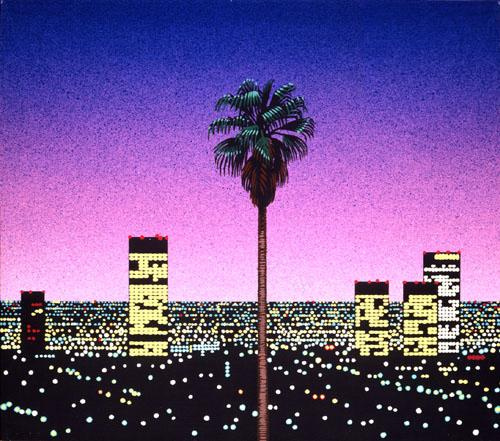
Lindsheaven Virtual Plaza – Daily Night Euphoria. Source.
The resonance is a tinny vintage, anachronistic; tinselled with eighties synths and a vocal sample that never quite begins. That baggy voice, normally soft as milk, becomes jagged, inhuman. Creepily crystallised. Your aunty’s favourite easy-listening is stripped of all coherence and synthesis; the tacky detritus of Steve Wright’s Sunday Lovesongs repackaged for an ersatz world of sulphurous sunsets and crumbling metropolises imploding like the plastic dust of an Arizonan dead mall. Back to the dark desert highway, purple-skied and dripped in molten neon. This isn’t what you’d enjoy on a leisurely car trip to the drive through…Or is it?
Listen to : : :
death’s dynamic shroud.wmv // I’m at the point in the level where the road narrows, curves, swirls upside down. Death is imminent. You can see the gloved fingers slipping a compact disc into the slot of a monster, borrowed straight from the architectures of Digimon. I’m thinking: Elizabeth Fraser’s sweetly haunting soprano (imagine being ghosted by the purest aural distillation of beauty); the chilled techno-ambience resurrected from the nineties. There’s heartbreak ahead. If you jump too far—and you will, won’t you—the space around you will glitch. There you’ll be, suspended in the space twinkles. An empty swimming pool. Climb into the cracks. Why is everything so gleaming, so white? I’m obsessed with getting back to matter. The music restores the filth, the glitch. There’s a vast acceleration of beautiful colour. The soprano grows warped, the orb-like contortions are glowing off kilter, off rhythm. The seven lumps of Galaxy chocolate I’ve just eaten melt sticky bits of sugar in my mouth, refuse to dissolve. They’ll coat my teeth like that.
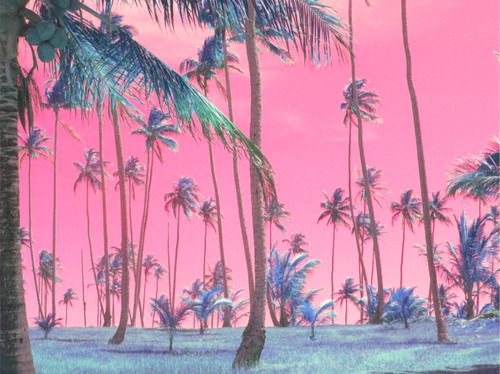
Vapourwave coats your teeth. God knows how or why you should define it. It’s like cheap candy, utterly sugary but filled with mysterious ingredients, mystic chemicals from another dimension. One minute I’m being instructed about the start of a sequence (it’s the eerie echoes of a sci-fi style video game)- – – loading loading loading – – – and then trap style beats come bouncing slowly in, delayed as if strained through some outpouring of weird gravity. There’s a purity to some of it, which feels more like an original composition; the ambient atmosphere of something along the lines of Aphex Twin’s Selected Ambient Works…There’s a sense of distortion, disorientation. Hyperreal landscapes lit in luminous pinks and purples. What’s that gleam, is it rain? Tokyo on a postcard, dipped in cross-processing chemicals, in violet acid. Then you’ve got a vague array of p a r a d i s e lighting up the screen. Palms and sand and cerulean sea.
As soon as you get attached to a sample, you’re away. Rarely does the beat resolve. You’re like, totally always stuck on the pre-beat. To the point that human expression becomes a technological fault, a beep, a burp. Sometimes it sounds like waves are being pulsed through your brain, blurred in a malfunction of some tacky machinery cooked up for a pulp movie of the nineties. Do scanners really look like that? Coated in rhinestones, bathed in pink. Some of it’s dreamier. Arpeggios of bell-scented keyboards (what do bells smell like? Not musty old church bells, but the sonorous chimes of noughties computers). Arpeggios climbing and climbing, dissolving, rising. A pop melody shining through. I’m in a rainforest of futurist skyscrapers, cloud-surrounded, everything drenched in pastel-hued pixels. It’s so serene.
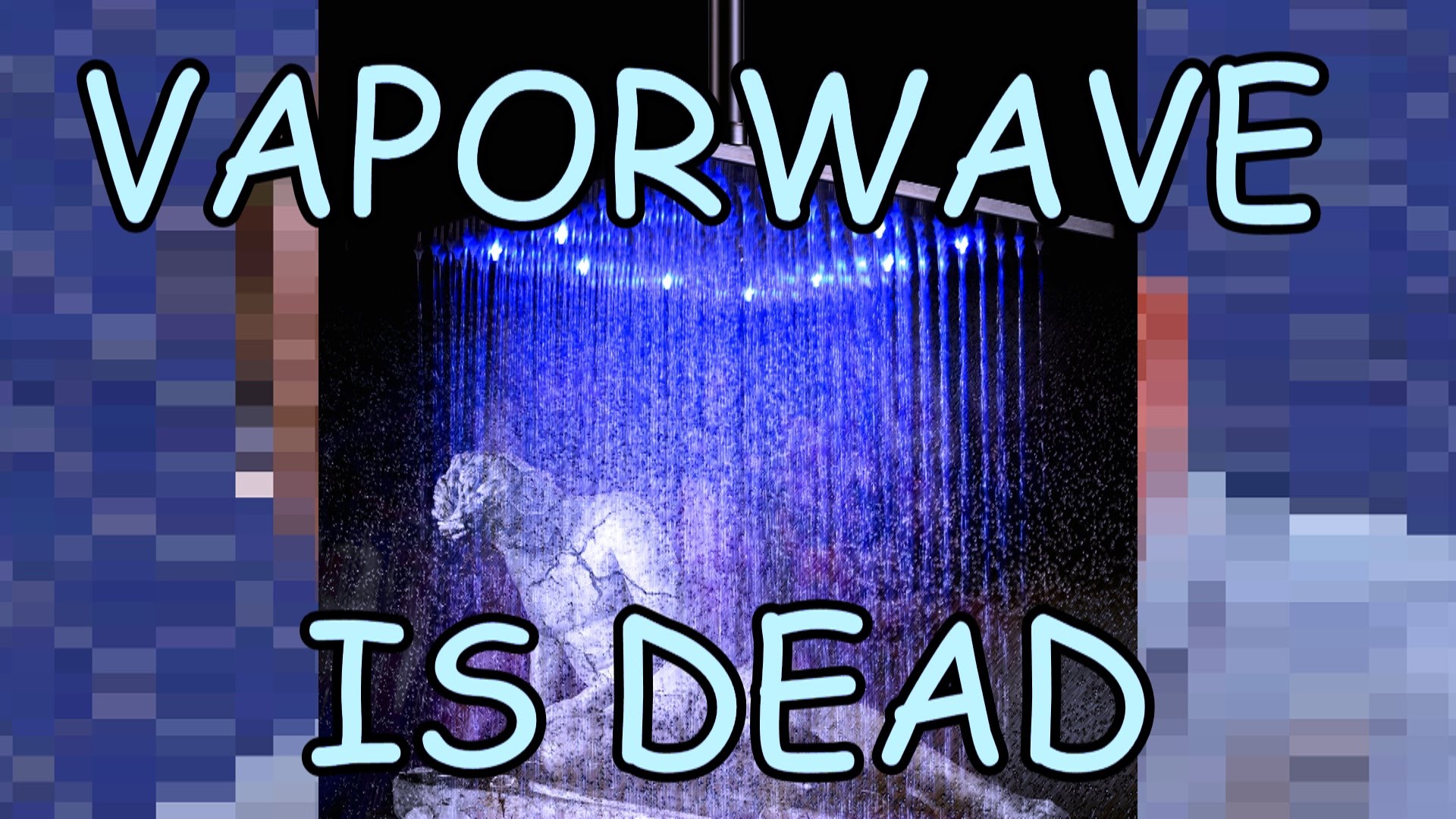
Vapourwave. What a joke, an internet meme. Didn’t it die a couple of years ago?
I’m so confused. What is this monstrosity that’s eked itself into my life like a viral code luxuriating in my brain? At once disdainfully ironic, crass, tacky as hell; but also painfully sincere, nostalgic, full of a misplaced longing. The metamodern paradox of postmodern irony and modernist authenticity cooking up an endless loop of misplaced longing. I find myself thirsty for shopping malls from the seventies, for grotesque cups of Diet Pepsi, for the glossy pop of the eighties and the apocalyptic reveries of the nineties. I’m drifting through a city stripped of its glitz and left with patches of bright matte colour, refusing to reflect the glass through which dreams have appeared and got lost. I remember polishing a CD with the back of my sleeve, watching the lines of rainbows beam. Slotting it into a computer that hummed and whirred at my touch. I remember when technology felt somehow homely.
That comforting little Windows XP flourish, how friendly it was compared to the blasé boom of Apple’s triumphant C chord. Glitch, glitch, glitch. I pick the pixels out with my fingertips. The eerie keyed chords of MACINTOSH PLUS’ 地理 fill me with a sinister sense of urgency. It’s an entropic catastrophe of dissonance.
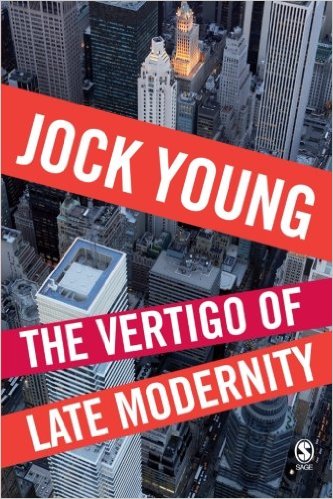
At the heart of vapourwave is a tension between the sweet and disturbing, between satisfyingly vacuous muzak and dissonant, deliberate glitching. This is related to its deterritorialising impulse, by which I mean (borrowing from Deleuze and Guattari lingo), the way it extracts and recontextualises some element of a thing, then placing it elsewhere in a different environment. Vapourwave is a sort of bulimic, abject, rhizomatic discourse. It gorges on the symbols of late capitalism (the glossy muzak and soft rock of the eighties, international brands like Nike or Microsoft, the aesthetics of corporate advertising and so on) and then expels them in a gross reinterpretation that seems to purge them of their original, seamless facade. It might be useful here to mention that sociologist/criminologist Jock Young (2007) once described late modernity as a ‘bulimic society’, where we are all (internationally) included in the dreamlike semiotics of the rich through the opulence and availability of global branding, advertising and popular culture, but increasingly we are structurally excluded from the means which would allow us to achieve such dizzying heights ourselves. This social anomie is jarringly rendered in vapourwave’s shameless embrace of corporate culture; at once poking fun at it but also monumentalising it in an ambiguous way. It’s by no means a didactic movement, but as Grafton Tanner tends to argue in his excellent book Babbling Corpse: Vapourwave and the Commodification of Ghosts (2016), it’s symptomatic of its times. The very poetics of vapourwave reflect the uneasy experience of being unable to escape the system, the uncanny effects of our perpetual cultural nostalgia—the celebration and denigration of late capitalist modernity and all its forms of post (post (post) post).
Outside of their usual contexts, corporate and commercial visuals (the vapourwave a e s t h e t i c) seem absurd, funny, strange, alienating. It hollows out the imagined ‘core’ of the brand and replaces it with a sort of free-floating lack of functionality, a disembodied eeriness. Chuck a logo in with a pastel-hued painting of palms and corny dolphins lifted from a SNES game and there you have it. Old Apple logos might be hovering over a pixellated ocean, waiting to plunge inexorably. Not only the aesthetics, but also the music itself, creates this sense of fragmented capitalism. Tanner talks briefly about the relevance of Derrida’s idea of hauntology to understanding the politics of vapourwave and this seems to me very astute. It’s the idea that the future is irrevocably haunted by the past; that culture and politics are also spooked with spectres from the past—from communism (Derrida’s book is called Spectres of Marx) to old technologies. It’s the idea that things are always-already obsolete, that there’s a sense of being itself as displaced and never quite fully present. It’s an ontology of difference, deferral, doubling, of objects which become ‘a little mad, weird, unsettled, “out of joint”’ (Derrida 1994). Derrida’s gloss on Marx’s analysis of the commodity-table gives us a sense on the ghostliness of consumer objects:
For example — and here is where the table comes on stage — the wood remains wooden when it is made into a table: it is then “an ordinary, sensuous thing [ein ordindäres, sinnliches Ding]”. It is quite different when it becomes a commodity, when the curtain goes up on the market and the table plays actor and character at the same time, when the commodity-table, says Marx, comes on stage (auftritt), begins to walk around and to put itself forward as a market value. Coup de theatre: the ordinary, sensuous thing is transfigured (verwandelt sich), it becomes someone, it assumes a figure. This woody and headstrong denseness is metamorphosed into a supernatural thing, a sensuous non-sensuous thing, sensuous but non-sensuous, sensuously supersensible (verwandelt er sich in ein sinnlich übersinnliches Ding). The ghostly schema now appears indispensable. The commodity is a “thing” without phenomenon, a thing in flight that surpasses the senses (it is invisible, intangible, inaudible, and odourless); but this transcendence is not altogether spiritual, it retains that bodiless body which we have recognised as making the difference between spectre and spirit. What surpasses the senses still passes before us in the silhouette of the sensuous body that it nevertheless lacks or that remains inaccessible to us.
(Derrida 1994)
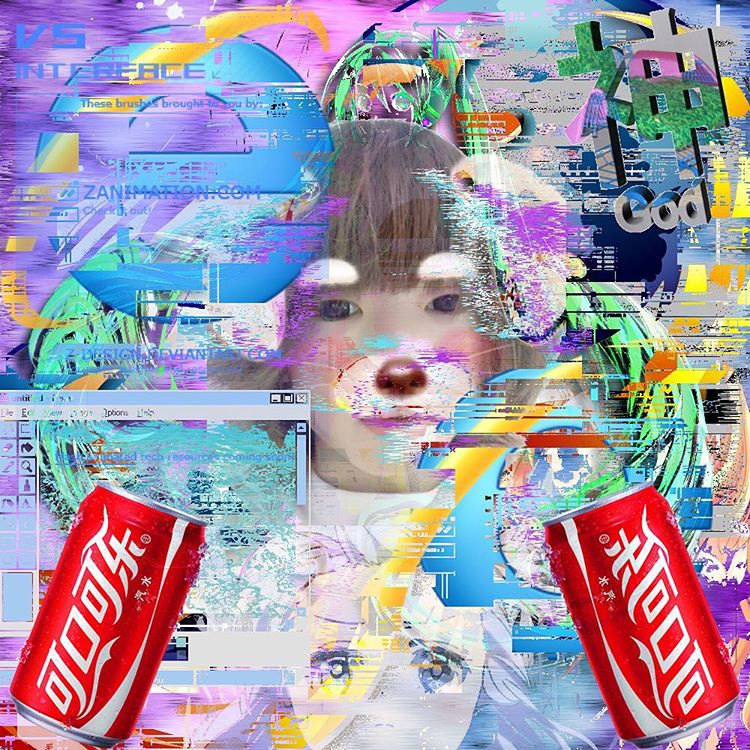
Vapourwave, of course, exploits this ‘ghostly schema’ of consumer objects. ‘Woody and headstrong denseness’, the sheer materiality of the thing is ordinarily supplanted by its mystical, transcendent value as a commodified good or brand. When we think of Nike trainers, rarely do we care for their actual material structure; usually it is the symbolic resonance of the brand that captures us. In Vapourwave, materiality comes back, vicious and strange. Fredric Jameson laments the way that postmodernism presents us with a meaningless concatenation of cultural nostalgia, often without context—BuzzFeed’s noughties nostalgia lists perhaps being a case in point. Vapourwave takes this ‘out of context’ randomness and runs with it. Art objects, textures, corporate iconography and screen-saturated colours combine in a collage of irony and contrasts. The mishmash quality of the vapourwave aesthetic lends it to easy manipulation and re-creation. This is the DIY ethic of the movement, its impulse towards constant theft, the cut and paste fun of sampling, the wilful shredding of distortion which creates a contemporary rendering of William Burroughs’ literary cut-up method or the random-making ‘recipes’ of Dada poetry, as described by Tristan Tzara.
Vapourwave Collage (note the hashtags on the link). Source.
Now, the effects of this mixed-bag of internet treats aren’t just weird and humorous, but weird also in an unsettling way. The samples become points of focus in a manner that strips away the normal cultural values of the original song; the easy soft-rock of the eighties becomes haunted with lo-fi feedback and interruption, compression and echoes. It sounds like it’s being heard through a cave or the underwater atrium of an abandoned mall, after the apocalypse. One of vapourwave’s most prominent releases to this day remains Macintosh Plus’ Floral Shoppe (2011) and on this record the production warps its soul music with a surrealist synth-driven dreamscape, in which R&B beats become slow and trippy and human voices are dehumanised into drawls and robotic calls. Often a sample starts but never resolves its line, constantly stumbling over itself. Tempos are spliced and no song follows conventional structure, but instead runs on repetitions, overlaps, interruptions; completely jarring changes in rhythm and key with no transition. Funk and soul from the eighties are no longer smooth and satisfying radio filler, but are turned inside out, their inherent weirdness exposed. Some of the highlights include ‘It’s Your Move’ by Diana Ross and ‘You Need a Hero’ by Pages. The effect of listening to this album is sort of like pushing a shopping cart round a supermarket and gazing around in wonder at the saturated pastels, the pointless products, the detritus of cluttered consumer madness. Glitches, twinkles, the beats of unsteady feet. Random tannoy announcements like a call from some parallel universe, the underground, the flickers of the internet ether.
Tanner’s Babbling Corpse usefully makes a connection between the dehumanisation of human voices in vapourwave music and contemporary philosophical movements such as speculative realism and object-orientated ontology. Both movements share the fundamental rejection of correlationism (the dominant, anthropocentric idea in Western philosophy that views reality only in relation to and projection from the human perspective). Instead, they turn to the world experience of the nonhuman, the sentient and foreign perspective of matter and objects. They expose the contrived nature of our distinction between self and world, showing how we are world, entangled in a way that is inextricable and disturbing (Timothy Morton, for instance, points to the crustaceans that live in our eyelashes or the bacteria in our gut as examples of how we are the environment, rather than self-complete and separate beings). Vapourwave in some way manages to evoke this weird world of objects, at a level only barely accessible to humans. Its use of glitches and looped samples disrupts the ordering of people and things. As Tanner puts it,
Glitches interrupt our expectations while deceiving and annoying us. They undermine our notion of what the machine is supposed to do for us, not without us. In this way, our electronic machines take on lives of their own and appear capable of functioning perfectly well without humans – a complete transcendence into other-worldly sentience.
(2016: 11)
We might consider this in relation to Martin Heidegger’s (2008) idea that we only notice a tool as a thing when it stops working. A broken hammer suddenly becomes a strange entity in its own right, rather than just one chain link in the process of a means to an end. Chuck Persons Eccojams Vol. 1, for starters. The very name: Eccojams. It implies the jams are a product of this Other: the ecco, ecology, echo…The title derives from an old Sega Megadrive game called Ecco the Dolphin, an action adventure game which featured dreamy music and a very minimalist gameplay narrative. You made Ecco sing to attract and interact with other objects and cetaceans; you could evoke echolocation in order to unfold a map of your oceanic surroundings; you could call to special crystals (glyphs) which in various ways controlled Ecco’s access to different levels. There is a beautiful otherworldliness to this game, and not just because Ecco ends up at the City of Atlantis. It’s created its own mythology, and the emphasis on song (like The Legend of Zelda’s ocarina melodies, which initiate effects in the game) opens up the possibilities for a nonhuman conscious or logic. Music, perhaps more than language, has effects on nonhuman consciousness. At a certain pitch, it can shatter a glass, or cause buildings to rumble with bass. It opens up its own logic of cause and effect.
Hauntology, in a sense, is about being stuck on the loop of the end of history. Technology constantly dislocates our awareness of time and space, so that linearity is replaced with instancy, repetition and reiteration, the constant recycling of former styles and events. Repetition is uncanny partly because, as Freud argues in ‘The Uncanny’, it’s the structure of the unconscious. When we notice repetition, we notice how our whole psyches are built on the compulsion to repeat even that which is most traumatic to us. It also violates our sense of identity and experience as singular and unique (an idea that liberal democracy and consumer capitalism likes to perpetuate). Identical twins are uncanny for this reason, as is deja vu. We feel that the normal order of time and space has been distorted (this is of course made explicit in films like Donnie Darko, which deal with parallel universe theorems). Repetition is also uncanny because it suggests that things we thought were unique to a moment, imbued with their apparent transience, are actually lingering and potentially eternal. It’s unsettling to have the buried constantly disinterred and broken out into the open present. Tom McCarthy’s Remainder (2005) is a novel which explores the logic of repetition in relation to a trauma narrative in which the protagonist becomes obsessed with re-enacting events to the point of absurdity and violent conclusion. It’s that overlap of the real, where dreamlike remembrance meets actual performed repetition, that is the orgasmic satisfaction of the psyche.
Listening to vapourwave enacts this perfectly. We might start to recognise the songs from which these samples were drawn, but our recognition is distorted along with the samples themselves. The past floats uncannily into the future. Eccojams Vol. 1 drops its tinkling beats on a loop and the vocals from eighties ballads are stripped of their velvet and become mournful, minor, distorted. Inhuman, odd. There’s a sense in which our contemporary experience of reality in the face of apocalypse and pathological nostalgia is both dark and sweet. Morton’s branch of object-orientated ontology, dark ecology, perfectly captures this experience (in fact, in Dark Ecology (2016) he describes the process of dealing with this ‘grief’ as sharing the structure of a ‘dark ecological chocolate’). Vapourwave is at times incredibly saccharine, mapping itself through the cheerfully smooth loops of Muzak; but it is also jarring, dissonant, deeply unsettling. It takes dirty club techno, the complex tempos of intelligent dance music, and puts them through the cheap production of the GarageBand blender. Vocals echo like a broken tannoy machine. Vapourwave, as both visual and musical aesthetic, fundamentally opens an aural space in which past, present and future become a haunting echo chamber of one another. No longer is this the mere surface play of postmodern collage, but instead it’s the material manifestation of a specific cultural hauntology. As Tanner puts it, hauntology ‘is unlike Jameson’s pastiche in that it complicates the past (specifically, the past’s image of the future) in order to call attention to capitalism’s destructive nature as a subjugating force that only fools others into thinking it came to eradicate “history”’ (2016: 35-36). Capitalism is hollowed out, its signature brands become lost echoes in a vaguely recognisable, a hypnotically attractive yet alarming vision of our near-present future; blended with the figures of mall culture, the colours of early aughts internet webspaces and the abyssal possibilities of a Tumblr scroll.
I’m interested in how vapourwave re-enacts a different form of consciousness and how this might be ecological, even though the movement’s only obvious engagement with Nature as Such is through the proliferation of palms and potted plants that drift incongruously as consumer goods through some of its artwork. To get at its ecological sweetness, it’s like cracking open a crystal to see its lattice parameters (what a beautiful phrase), the places where the material cleaves (its lines of weakness), its cubic structure. The interplay between structure and embedded weakness is what motivates vapourwave; it contains its own failure, the undeveloped samples, the way a tiny snatch of a song is unfolded into a tranquil sequence of soporific, nonsensical sound. This is not music with a coherent logic. You look for lines and trends and vague traces of structure, but a song will become something more fluid and fragmented. Vapourwave’s material metaphors cannot be coherent; it’s at once free-floating, vaporous, seeping, gelatinous, oozing, splitting, cracking, choking, pulsing, dissolving. Hard matter, soft matter, chemical, vapour, waves and glitches and tiny explosions.
Sometimes, the structure is completely frustrating. On Person’s Eccojams Vol. 1, for example, the slowed-down, reverb-heavy sample from Gerry Rafferty’s ‘Baker Street’ repeats endlessly and never resolves itself into the next line: ‘another year and then we’ll be happy / just one more year and then we’ll be happy’. The twinkle signifies the glimpse of a transition and there’s a blip of the ‘b’ which should resolve into ‘but you’re crying, you’re crying now’ and yet here never does. Instead the song becomes an endless loop of implied futurity, the future conditional, ‘we’ll be happy’ that doesn’t get to complete itself but instead hangs. We’re taken out of time and left in this limbo. Here, the repetition isn’t soothing, it’s unsettling—mesmerising in a disturbing way. We question our longing for the song to resolve and before we have a chance it’s skipped to the next track. So we go back, search out the original version. Is it satisfying? Listening to Raferty’s original now feels weird in a way it didn’t before. It’s like this lost artefact from the past, spliced across the future ether rendered by Person’s eerie and hypnagogic album. While ‘Baker Street’ implies a specific place, now it’s thoroughly displaced, an effect of the internet’s rhizomatic possibilities.
As Morton puts it, ‘in order to have environmental awareness, one must be aware of space as more than just a vacuum. One must start taking note of, taking care of, one’s world’ (2002: 54). Ambient poetics disturb our assumed distinction between inside/outside, self/other; they show how we are entangled in a shared space of coexistence (Morton 2002: 54). Ambient music, in its sensuousness, its borrowing from the world—for example, by using samples of music concrète and field recordings from both nature and urban spaces—embeds us inside an environment in a way that is at once comforting and disturbing. It literally surrounds our senses. Brian Eno famously sets out a manifesto for ambient music by describing ambience as ‘an atmosphere, or a surrounding influence, a tint’, and ‘whereas conventional background music [i.e. Muzak] is produced by stripping away all sense of doubt and uncertainty […] from the music, Ambient Music retains these qualities. […] Ambient Music is intended to induce calm and a space to think’. As Morton puts it, ambient music as figured by Eno deconstructs the ‘opposition between foreground and background, or more precisely, between figure and ground’. In this sense, ‘ambience could be shown to resist the reification of space in capitalism’, ‘at once fill[ing] and overspill[ing] the ideological frame intended for it by the social structure in which it emerged’ (Morton 2001).
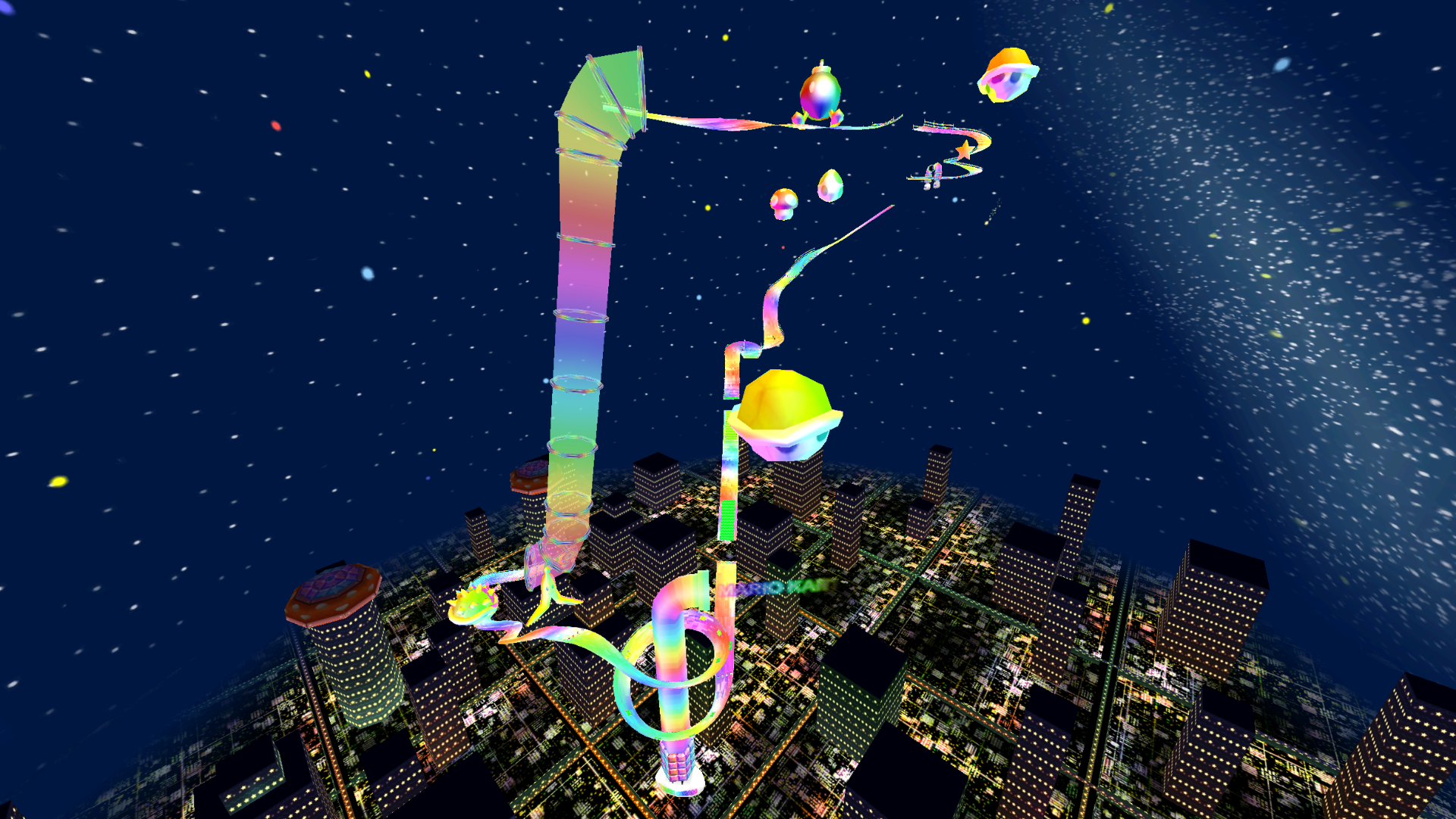
Think of it this way: could you get away with playing vapourwave in a mall or a supermarket or diner? Sure, it would ‘fill’ the space in one sense, but also exceed it, rendering all our cultural and material associations with this space uncanny and distorted. It would become a sci-fi space, a space displaced into the future. We would be inhabiting a doubled world, a doubled temporality. I tried playing Floral Shoppe in the restaurant where I work once (obviously when there were no customers) and the effect was actually very comforting. I felt like I wasn’t trapped in the familiar twenty-something existential limbo and instead inhabiting a plane of dreamlike contemplation, like the Rainbow Road level on MarioKart: Double Dash. I close my eyes and the scratched wooden floor spills out into a highway of colour; the tables I’m bumping against are bright yellow stars and fragments of unknown matter. I’m back in the supermarket, trolleys wheeling away from me and products falling off the shelf. I open my eyes and there’s the mirror and a reflection of someone that might be me, wearing a uniform, the chairs and tables flashing around me like holograms. I’m not exactly sure where that association sprung from (it’s been a long time since I’ve turned on the old GameCube), but I guess that’s the free associative impact of the music itself.
Like Jean-Jacques Rousseau’s Reveries of the Solitary Walker (1782), vapourwave is about an experience of travel and movement without necessarily describing that movement itself. Crucially, the emphasis is on slowing down, on dwelling in a moment; a moment which is looped, repeated, pondered over, exhausted, reflected on. ‘I undertook to subject my life to a severe examination that would order it for the rest of my days in such a way as I wished to find it at the time of my death’ (Rousseau 2011: 24). Vapourwave subjects the e v e r y t h i n g of capitalist late modernity to such self-reflexive inner scrutiny. This scrutiny enacts a slowing down of perception, a sense of looking around and absorbing one’s place in the environment. Through an uncanny distortion, doubling back and becoming the environment. Vapourwave allows us to adopt both a blasé and a highly perceptive attitude to the ad-saturated world in which we exist; the metropolis of the internet becoming some great labyrinth in which we linger at every turn, mesmerised by the neon palms swaying in time to the untimely music, to cans of diet coke and the universal resonance of that bold tick logo. Everything surrounds and coagulates, connects.
This aesthetic dwelling is crucial for ecology because it forces a recognition of the world which we are and in which we live, a recognition that notices patterns of interconnectedness and coexistence. For Gregory Bateson (2016), aesthetics means ‘responsiveness to the pattern which connects. The pattern which connects is a meta-pattern’; both cities and their parts form part of this pattern, of the patterned aesthetic of vapourwave. The metropolis, the mall, the fountain plaza, the computer screen, the window of a building, the burnished, pixellated sunset. All are the environs of sound and vision, the movement between figure and ground, the deconstruction of synecdoche. The part and the whole are constantly supplementing each other (the song, the sample; the symbolism, the surface aesthetic). It’s a bewildering, shape-shifting experience. It forces us to take notice of our world. There’s something about vapourwave which always suggests to me a sort of endless highway, where the vehicles move as if through some viscous substance that drags the experience of time and space. Our perception becomes blurred and starry, with blips of unconsciousness and moments of epiphanic reverie. Things around us fade or glow. The radio rumbles in the darkest cavity of our chest. Am I even breathing? I don’t feel human. Is this freedom?
Alongside this dwelling is a certain playfulness of a way unique to vapourwave. James Ferraro’s Far Side Virtual (2011) might be the classic here. It blends together the inane and cornily flourishing samples from Muzak with automated audio speech stolen from corporate contexts and sound effects from everyday tech life—the message-send swoop, a mouse click, laptop crashing sounds and start-up tunes. The result is something that might reflect Jean-Francois Lyotard’s famous definition of postmodernism as ‘eclecticism’, the ‘degree zero of contemporary general culture [where] one listens to reggae, watches Westerns, eats MacDonald’s for lunch and local cuisine for dinner, wears Paris perfume in Tokyo and retro clothing in Hong Kong; knowledge is a matter for TV games’ (2004: 76). This eclecticism is made playfully manifest in Ferraro’s lively, atmospheric and at times downright trippy record, where twinkles of commercially-drenched, techy synths give way to stuttering keyboards, ringtone effects and twirls of familiar message noises which become maddeningly synced with finger clicks and conversations between robotic voices. A CONUNDRUM article argues that ‘since vapourwave functions namely as commentary, it loops, pitch-shifts and “screws” the utopia of the virtual plaza, creating a harsh, grating sound in away that brings each muzak sample’s faults to the forefront of the track’. This is certainly true of Ferraro, but I’d also suggest that vapourwave is more than mere commentary; Ferraro especially revels in the silliness of corporate culture (check out ‘Pixarnia and the Future of Norman Rockwell’, with its drink slurping sound effects and jingly, kids tv-worthy melody), at the same time as revealing its peculiar utopian unreality, a world of shimmering sound and holograms. There’s a self-consciously affective and pleasurable aspect to the music. Sometimes it sounds like the demonstration music on an art channel, to the point where I’m expecting some beautiful, sellotaped creation to materialise with every musical flourish.
On the other hand, there’s the total weirdness of ‘Palm Trees, Wi-Fi and Dream Sushi’, which takes us through a scintillatingly bizarre encounter with a ‘touchscreen waiter’ who explains the ordering process at a sushi restaurant—apparently in Times Square, with Gordon Ramsay as chef—to the backdrop of exuberant synths and glitchy effects which sound like a Windows 95 laptop gone haywire, or merely said customer making her selections from the menu software. The result is to render a future where restaurants and coffeehouses are devoid of human interaction, becoming impersonal encounters with creepily enthusiastic machine waiters (creepy not just because they’d put me out of a job). The contrast between this manic happiness, this constant focus on choice, with the maddening music is to create a deep sense of unease, to reveal the artifice of such utopian tech constructions. Do we really have a choice? Is life being boiled down to a series of computer menus? Is the future bound to the unsettling intonations of such robotic encounters? I can’t help but escape into the absurdity of the music and try to forget this hauntological disaster is always-already constantly happening…
The comparatively meditative ‘Bags’ weaves its entrancing ambience from an early Windows startup theme, dipping into sonorous caverns of sparkling synths and lifting for air bubbles and irregular, incongruous finger clicks. I am reminded here of a beautiful essay by Steven Connor on the magic of objects, specifically here bags: ‘because they are in essence such fleshly or bodily things, bags enact as nothing else does our sense of the relation between inside and outside. We are creatures who find it easy and pleasurable to imagine living on the inside of another body’. There’s an amniotic vibe to Ferarro’s ‘Bags’; the swaying, dreamy pace that makes us feel as though we are inside those palms, or encased within a glossy plastic number, bouncing away against some glamorous knee. Just as humans have a sort of supplementary, life-giving association with bags, we also have this relationship with the plazas of capitalism and the affective world they render. Ferarro has said that he conceived of Far Side Virtual as a series of ringtones, a musical form which inherently suggests consumer transience, tackiness, kitsch, the whims of passing fashions (not least because the polyphonic presets change with each phone upgrade). He’s also said that he loves the idea of the album being ‘performed b a Philharmonic Orchestra […] Imagining an orchestra given X-Box controllers instead of mallets, iPhones instead of violins, ring tones instead of Tubular bells, Starbucks cups instead of cymbals. All streamed online, viewable on a megascreen in Times Square’. That’s what’s special about vapourwave: its commitment to the endurance of art and the a e s t h e t i c alongside an ambiguous relationship with the ephemerality of corporate kitsch. The artistic rearrangement of these samples, alongside their visual presentation and marketing as alt music through sites like Bandcamp, completely reterritorialises their original framework of meaning.
There’s a sense in which this music—with its self-conscious materiality, the recognisably tacky mattering of its samples, its embrace of the ambient disruption of foreground and background—is inherently committed to some kind of hauntological ecological project, the kind advocated by Tim Morton’s dark ecological poetics. As Ferarro himself says of his album, it’s a ‘rubbery plastic symphony for global warming, dedicated to the Great Pacific Garbage Patch’. Vapourwave recycles culture, proliferates both beauty and trash, endlessly parodies itself and its references. It renders explicitly what Marc Augé calls the ‘non-places’ of supermodernity: the anonymous malls, airports, offices and stations where cultures blend and collide and become foreign places of blank existence, of non-place, of disembodied temporality and physical and social experience. Places emptied out of cultural specificity. Places where one might eat Japanese sushi in a New York airport restaurant, concocted by a holographic rendition of a grumpy English chef and served by a robot developed and programmed by a Chinese tech company. Vapourwave is melancholy and strangely displaced. The frequent use of anonymity by many of its prominent artists (Xavier, for example, is responsible for more than just Macintosh Plus), alongside the Eastern characters for song titles, creates again a dehumanised, uncanny and culturally displaced understanding of identity. It weaves an almost Orientalist mystery through its art, so that we can’t quite geographically place the origins and players of this musical movement. It’s all about dissemination, reappropriation, the instancy of recycled production; but it’s also about slowing down to notice the flaws inherent in our everyday, consumer lives. The heavily sampled, rhizomatic nature of vapourwave forces you to become a more active consumer of both music and other forms of material pleasure, from picking your morning coffee to choosing your desktop screensaver. Perhaps it’s this recognition that gives vapourwave the vague trace of disruptive impulse; the way it strips away the uneasy pleasures and pink mist of the late capitalist plaza and replaces it with a mystique that haunts us back from the future. Objects and humans withdraw from our grasp and we are left with the surface detritus of crushed coke cans, defunct MacBooks, coffee cups and robot voices stuck on repeat, cleaning the floor of the mall to a vicious gleam that threatens to bounce back like a screen and remind us that we haven’t left the room at all – we’re still on the internet, chasing our dreams.
Freud, Sigmund, 2003. The Uncanny, trans. by David McLintock, (London: Penguin).
Heidegger, Martin, 2008. Being and Time, trans. by John Macquarrie and Edward Robinson, (New York: Harper Perennial).
Jameson, Fredric, 1991. Postmodernism: Or, the Cultural Logic of Late Capitalism (Durham: Duke University Press).
Lyotard, Jean-Francois, 2004. Postmodern Condition: A Report on Knowledge, trans. by Geoff Bennington and Brian Massumi,(Manchester: Manchester University Press).



 mariaology