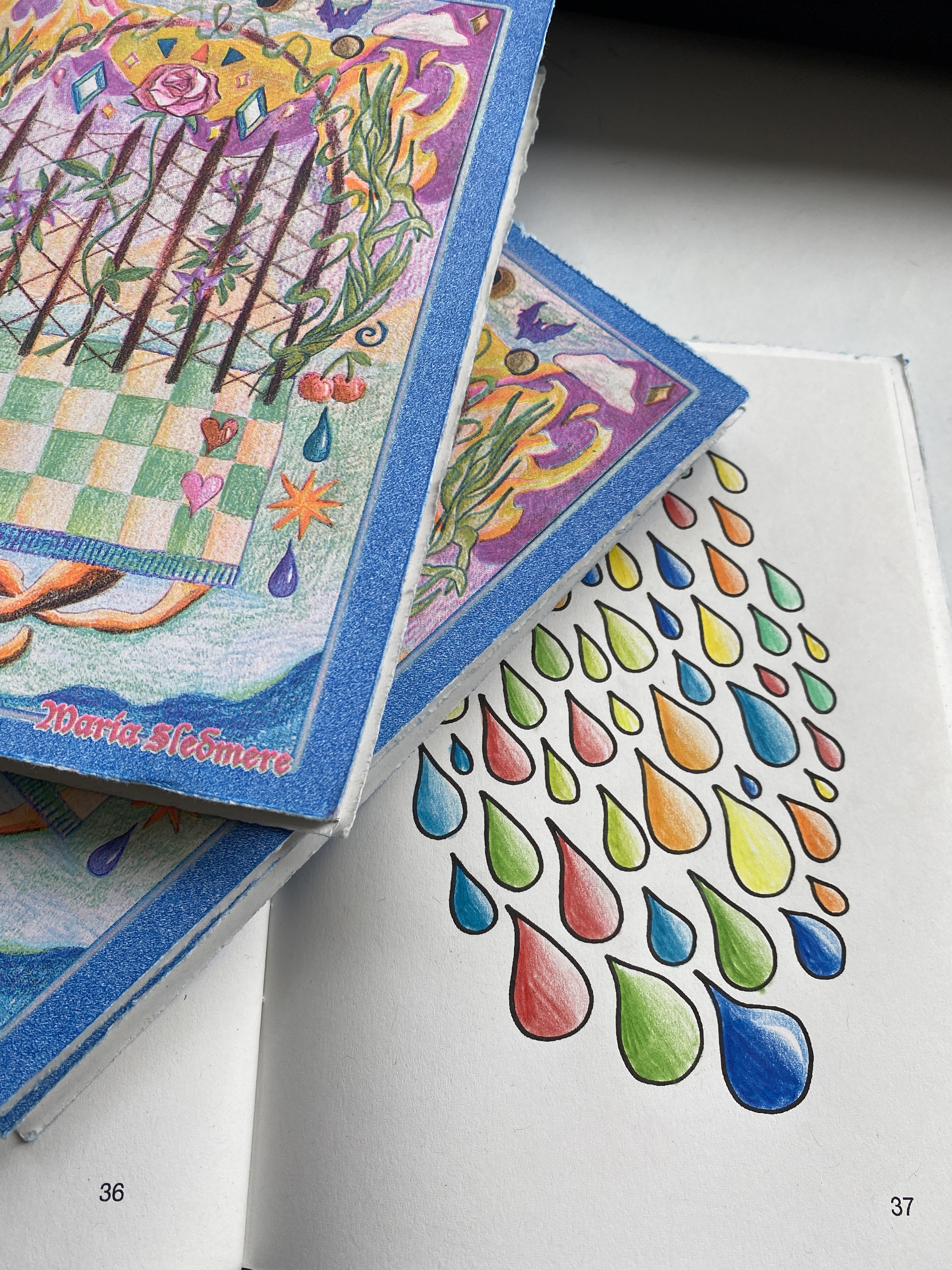
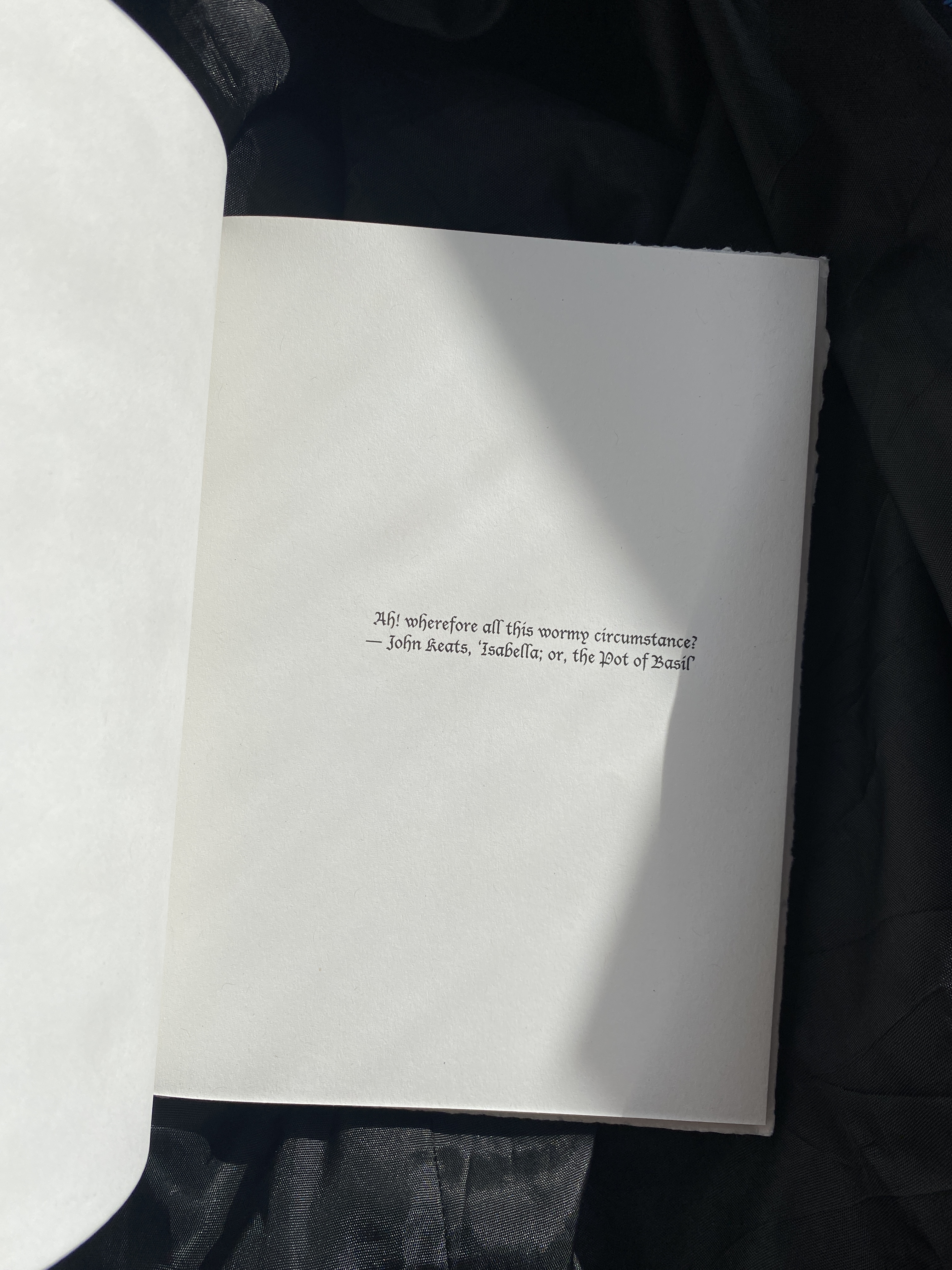
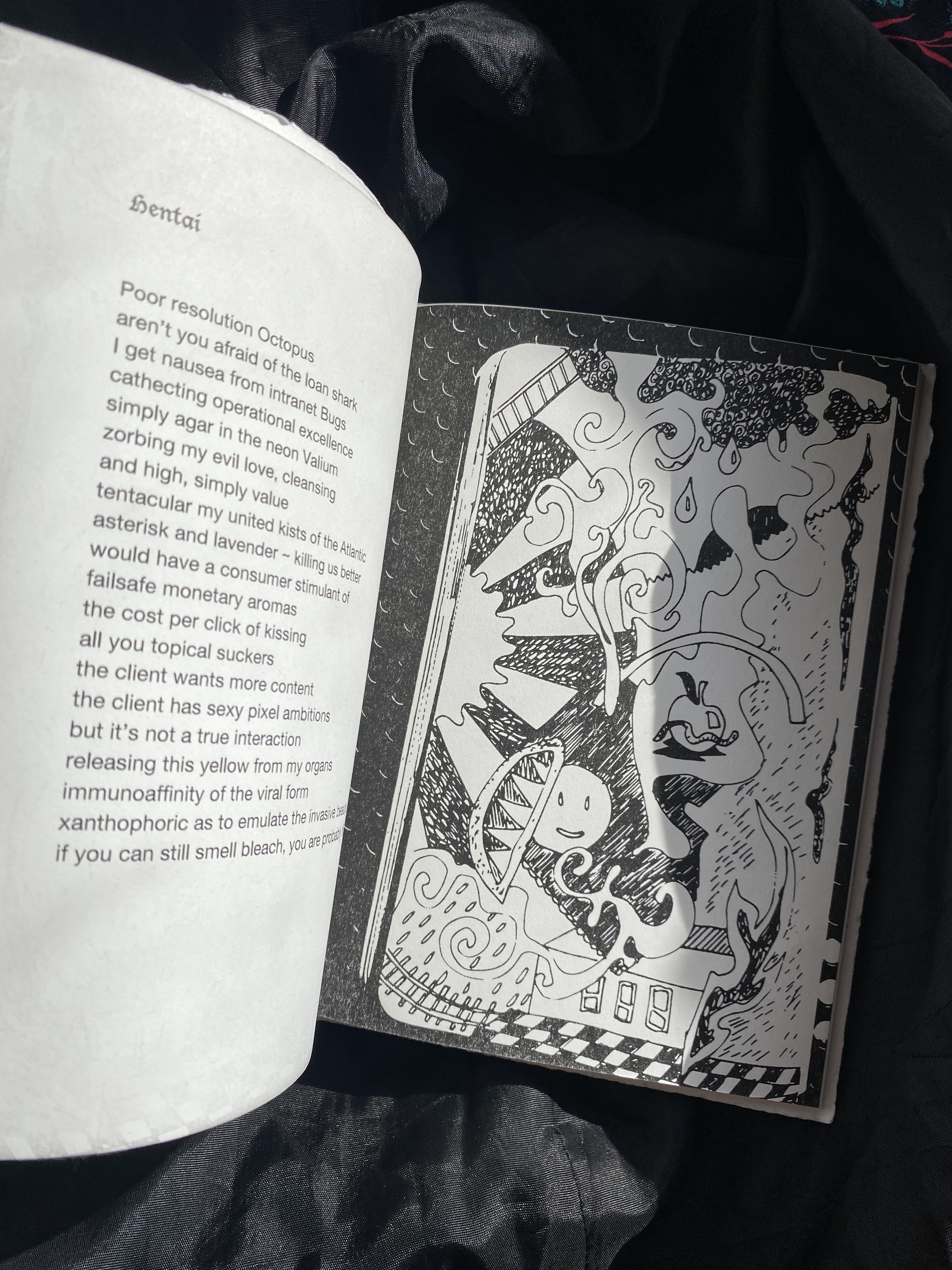
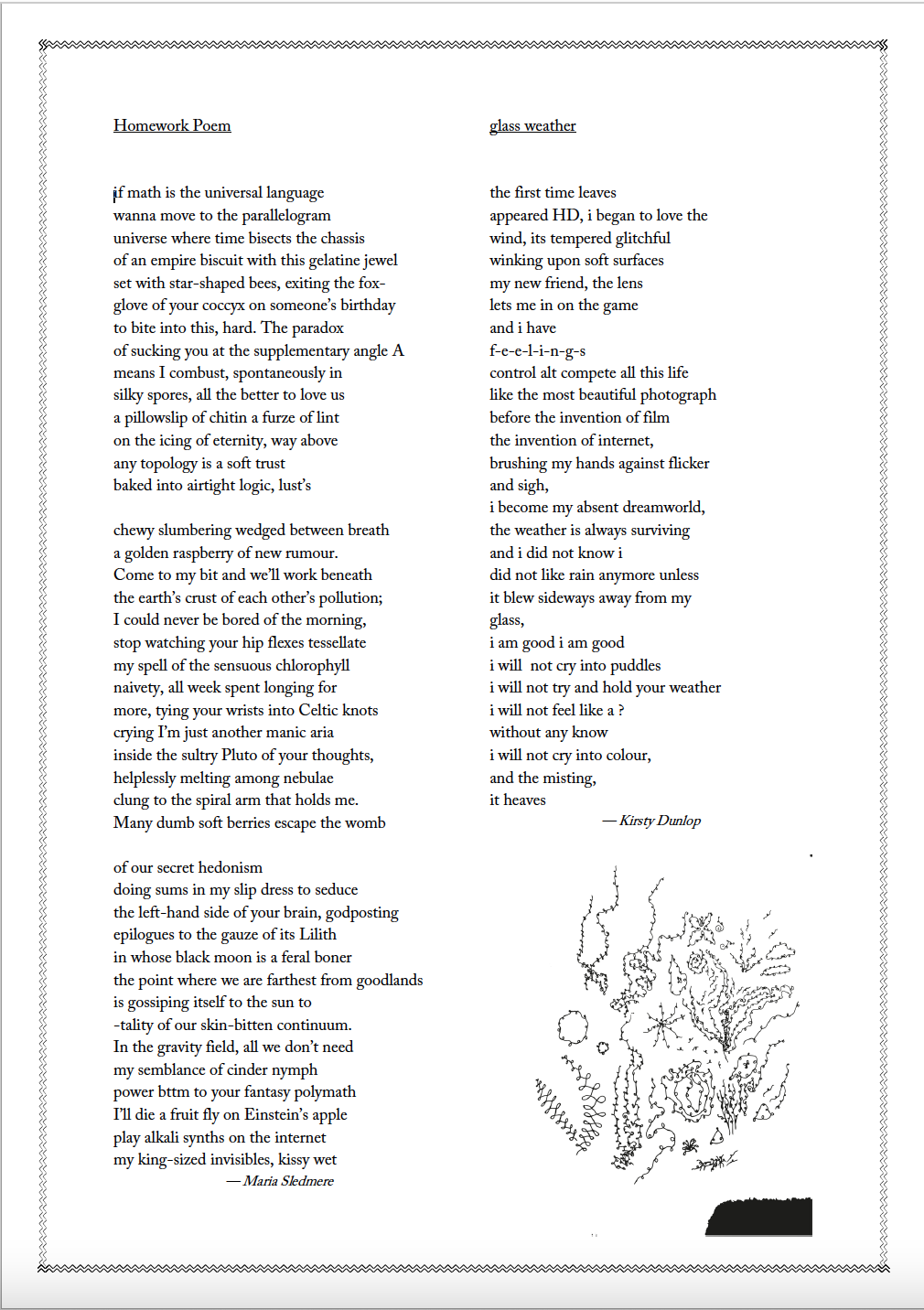
A new pamphlet written in the ardent chaos of this spring, commissioned and published by Owen Fortunato Brakspear of slub press.
🥀
In the night, there is a garden. It is night, which overfloweth. Strange vines begin girdling the old lamp posts and the wrought iron fences, intertwining with ivy, with passion flower, and the nodding hellebore. This irenic incandescence overcomes the cinerescent, and the wee small hours become you in the hypnagogic glow of the only childhood left to you. Dreams of That which is still possible… there you stand, so much smaller now, beneath the Cherry Nightshade……..
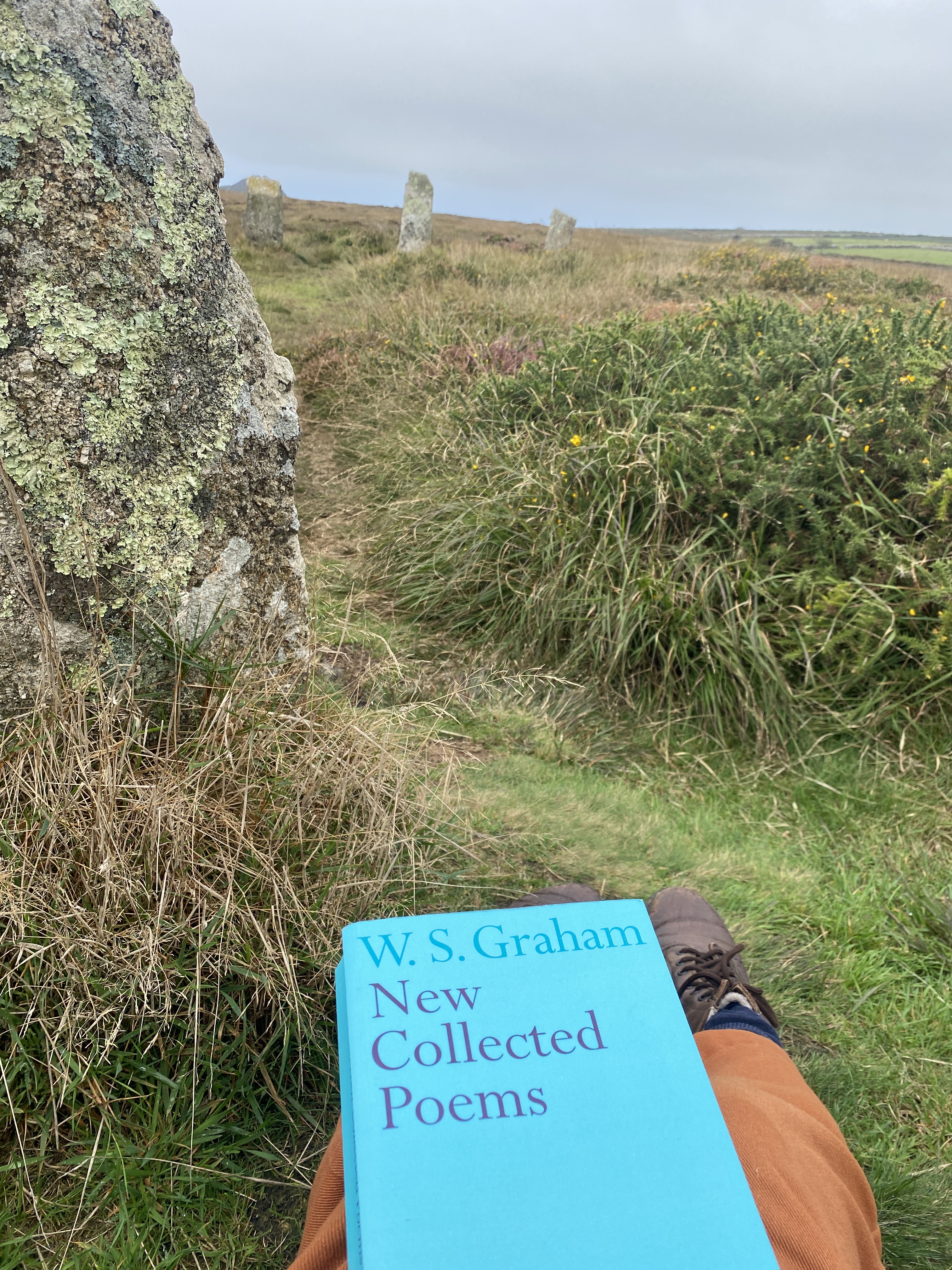
I’m on the twelve-hour CrossCountry from Penzance to Edinburgh. Penzance is the most westerly town in Cornwall and being this close to the edge of something calms me. I always sleep better by the sea. On my way here, on the Great Western Railway, a woman gifted me a glass sculpture with a rainbow inside it, as thanks for helping with her bags at Truro. ‘It’s for stirring your drinks’. For the past week, I’ve been writer in residence at The Grammarsow: a project which brings Scottish poets to Cornwall in the footsteps of WS Graham, who was born in Greenock but spent much of his life down here, making a home of Madron, of Zennor, of the moors. To say this has been a magical week is to say it changed me. I first came across Graham when the poet Dom Hale sent me a voice note of his elegy, ‘Dear Bryan Wynter’, out of the blue; I immediately went out and bought another bright blue, the Faber New Collected Poems. There was something about that foxglove on the wall and the hum of some memory in childhood, watching the bees.
Graham grew up in Greenock, on the Inverclyde estuary. A town where I used to teach writing workshops at the Inverclyde CHCP, taking weekly, then fortnightly trains with our chitty from Glasgow. That time in my life is a blur of shift work, seasonal overhaul, hopeless crushes. I’d get there early to look at the lurid flowers in Morrisons with Kirsty, my co-tutor, or visit the docks alone. Sometimes, I brought my little heartaches to the docks because the air felt smelted, or salt-rinsed, excoriating. The nature of these workshops was that people would share their life stories of such intensity we’d bear them home. I remember one woman writing a story about the moon, ‘we share the same moon’: the one thing connecting her, unconditionally, to her estranged daughter. Many people with stories of recovering from addiction through returning to childhood pursuits: the fishing taught by their fathers, the harbour walks, the musical grammar of language. Graham was trained as an engineer and spent some time on fishing boats, but dedicated most of his life full-time to poetry. The more I learn about this, the more I pine for the shabby romance of that clarity of pursuit. Not as a sacrifice but a great generosity from him, like a penniless rock star.
I’m sure it took a toll on his friends. Graham sent many a letter pleading neighbours and pen pals for the loan of a pound or a pair of boots, once thanking the artist Bryan Wynter for a pair of second-hand trousers. His letters are documents of a life lived in gleaning, bracing the elements, enjoying his wife Nessie’s lentil soup and of course, drinking. On a ‘bleak Spring day’ in 1978, by way of a quiet apology, he pleads with Don Brown, ‘I was flippant in the drink when you came with your news […]. Please let me still be your best friend’. He was often full of fire, a real zeal, taking poetry so seriously but life a strange lark, ‘speak[ing] out of a hole in my leg’. He wrote to his contemporaries — artists such as Ben Nicholson and Peter Lanyon, Edwin Morgan, along with family and friends — with bags of personality, a man self-fashioning in the long blue sea of ‘I miss yous’. As he wrote to Roger Hilton:
We are each, in our own respective ways, blessed or cursed with certain ingredients to help us for good or bad on our ways which we think are our ways. What’s buzzin couzzin? Love thou me? When the idea of the flood had abated a hare pussed in the shaking bell-flowers and prayed to the rainbow through the spider’s web. I have my real fire on. I am on.
The real fire may have been a woodburner, sure, but it’s something lit within him. The letter as a turning on, turning towards: we see this spirit of openness and address in the poems. The real commitment to Lyric. I love the hare that shakes in the flowers with its rainbow religion. I love the flush of arousal from walking uphill at speed. I saw many a spiderweb and two hares chasing each other on dawn of Thursday. On the train home texting many friends as if to have the rush of being held again, ‘Love thou me?’, could I be so vulnerable. A foxglove shook in the wind. The line as a tremble is lesser felt in the steady verse. Clearly, Graham wasn’t afraid of sincerity, though he always took pains to remind his addressees of his roots. ‘No harder man than me will you possibly encounter’, he assures Hilton; elsewhere, after the death of Wynter, he writes to his Canadian friend Robin Skelton of the coming funeral: ‘Give me a hug across the sea. […] I am not really sentimental. I am as hard as Greenock shipbuilding nails’. In a way, the infrastructure of space inflects the language as its face. I’m reminded of a quote by Wendy Mulford which Fred Carter shared at the recent ASLE-uki conference in Newcastle, where she talks about ‘attempting to work at the language-face’. I wear the face of the land, Graham seems to say, and the build of it. At West Penwith, we face the end of the land, literally Land’s End to our west. It is sometimes a silver gelatine, other times a bright blue, a fog grey thicker than thought. A granite-hard land that nonetheless sparkles. I recall a rock on the beaches of Culzean, in South Ayrshire, we’d come across as kids. Mum called it a ‘moonrock’ or a ‘wishrock’. It was a perfectly huge dinosaur egg of white granite. I find this particular rock showing up in my dreams, even now; as if having touched it, I become complicit in a deep time that doesn’t so much store the past as bear its promise. What could hatch from within a rock like that? What could move it, or hold it?
Graham had the idea of poetry’s ‘constructed space’, what I’d call a lyric architecture for reassembling something sensuous in memory or emergence. That this space isn’t just designed (as in my idea of architecture) but constructed points to that emphasis on building. What kinds of muscle, time, effort of spirit and will go into this? The poet Oli Hazzard writes that one of the effects of Graham’s poetry is ‘that I feel like it allows me—or, creates a space in which it becomes possible—to see or to hear myself’. Graham’s poem ‘The Constructed Space’ opens with the line ‘Meanwhile surely there must be something to say’. I always hear it in the lovely vowels of his Inverclyde accent, assuring. Like he’s sitting with you in the poetry bar, two pints between yous, and the poem gives this permission to talk or make space to listen. I think of Denise Riley’s ‘say something back’. My own need always to blurt, interrupt, muse out loud what mince is in my head. It continues:
[…] at least happy
In a sense here between us whoever We are.
As I write this, light dances on the opposite wall of my tenement flat and it’s prettier than anything given to me by the window. Sometimes my love says I am harsh when they need delicacy, and so I soften the heather of my voice to listen. It’s true that I was happy while reading that poem, a happiness or lightness in the brain as precarious as the light is. Changeable and easily blown further west to let in what fog, or dimness. I don’t mind my brain when I’m in Graham’s poems. By which I mean, it’s no longer a drag to be conscious or sad; things move again, their metaphors in process. There’s a lightness to quietude, its intimate premise, that holds me. Nothing extreme is promised here, ‘whoever / We are’: lyric address sent through ether to find that ‘you’, held in the future’s new ‘us’. It’s better than a page refresh, reading the poem to think something Bergsonian of the self’s duration. I’m more snowball than the first maria who read this. It’s a kind of exhale, in a sense, like Kele Okereke singing ‘So Here We Are’ from an album named suitably Silent Alarm. Imagining my loves at the same time, out in Stirlingshire lying tripping by the loch, their eyes skyward, the high or low. I cherish that wish you were here / so here we are. I can look out from inside the constructed space of the poem. Wheeeeeeeeesht, you. You’ll find constructed spaces everywhere in Cornwall. The lashing blue skyscapes of Peter Lanyon, the abstract panoramas of Ben Nicholson, the ambient plenitude of Aphex Twin (especially ‘Aisatsana’ and most things from Drukqs). I want ambient or abstract art to give me the clouds in my head back to myself, with the light of it. Colours, gestures, fractals, lines.
~
I’ve spent the past week schlepping around the moors and lanes, reading Sydney Graham’s poems and letters, cooking veg on my wee stove and eating simple marmite and butter sandwiches. I have this grandparent on my mum’s side who shared his name, who died of cancer before I was born. Sydney was the name Graham tended to go by, signing letters. It’s not that I’m looking for literary fathers but I stumble into their charismatic arms all the same. Is it guidance I look for, or perspective? I love the rolling enthusiasm, pedantry and chiding of his letters, as well as their cheekiness and charm. His dedication to writing and reading, his swaggering or boastful tendencies after an especially successful performance (coupled with an irresistible gentleness and warmth). His big sweet expressions ‘THE MILK OF HUMAN KINDNESS IS CONDENSED – TTBB)’, ‘IMPOSSIBLE TALK’. TTBB is the slogan of Grammarsow and a familiar exhortation in Grahamworld, meaning Try To Be Better (the title of an excellent anthology of Graham-inspired poems, edited by Sam Buchan-Watts and Lavinia Singer). I summon my voices, I try to be; used to be; want us to be.
There’s a quietude I love about the work, which suits the land and mind. After a summer of working three paid jobs, and two voluntary, I was ready for a gearshift into something relaxed and focused. I’d had enough of my own ‘impossible talk’. Being here was like being given permission to play and explore. Quickly I realised my time didn’t need to be ‘dedicated’. I lived by the cruising whim of the big sky, its scrolling clouds and moodswings. Saw the moon at two o’clock in the afternoon. I watched dragonflies dart between the lanes, listened to my neighbourly ravens at night. Watched big jenny long-legs make flickery silhouettes on the walls. Slept peacefully with spiders above me and the ravens being craven. I wanted all these things in my poemspace, and the poems themselves were initially scarce, then they began a familiar elongation that was comforting, with the swerves of a bus but also the tread of a walk. Some poems wanting to hide themselves between logs where I might later try and find them.
~
A grammarsow is the Cornish name for a woodlouse, or what we’d call in Scots a slater. I remember growing up and having this internal argument about language: was I to go with what my English mum said, or everyone at school? Aye or nay, yes or no. At some point I realised it wasn’t a question of scarcity and elimination, but abundance. The words became barnacle-stuck from all over the sloshes of life, swears and all, and I cherished their stubbornness. Even those gnarly, uncommon words and spicy portmanteau like ‘haneck’, ‘gadsafuck’, ‘blootered’ and ‘glaikit’. And yous: the juicy, plural form of you. Addressing the crowd, the swarm or many. A woodlouse is a terrestrial crustacean drawn to damp environments. I grew up with woodlice crawling out from under cracked kitchen tiles, unearthing raves of them hidden under rotten logs, finding them in tins of old paintbrushes or sometimes a bag of flour or sugar. I always liked the way their little legs seemed translucent, a little alien, and was especially seduced by their darling tendency to curl up into a ball, for protection, like Derrida’s idea of the poem as hedgehog.
Across the English language, there are many amazing names for the humble woodlouse, not limited to:
armadillo bug
billy button
carpet shrimp
charlie pig
cheeselog
chisel pig
doodlebug
hardback
hobby horse
hog-louse
jomit
menace
pea bug
pennysow
pill bug
roly-poly
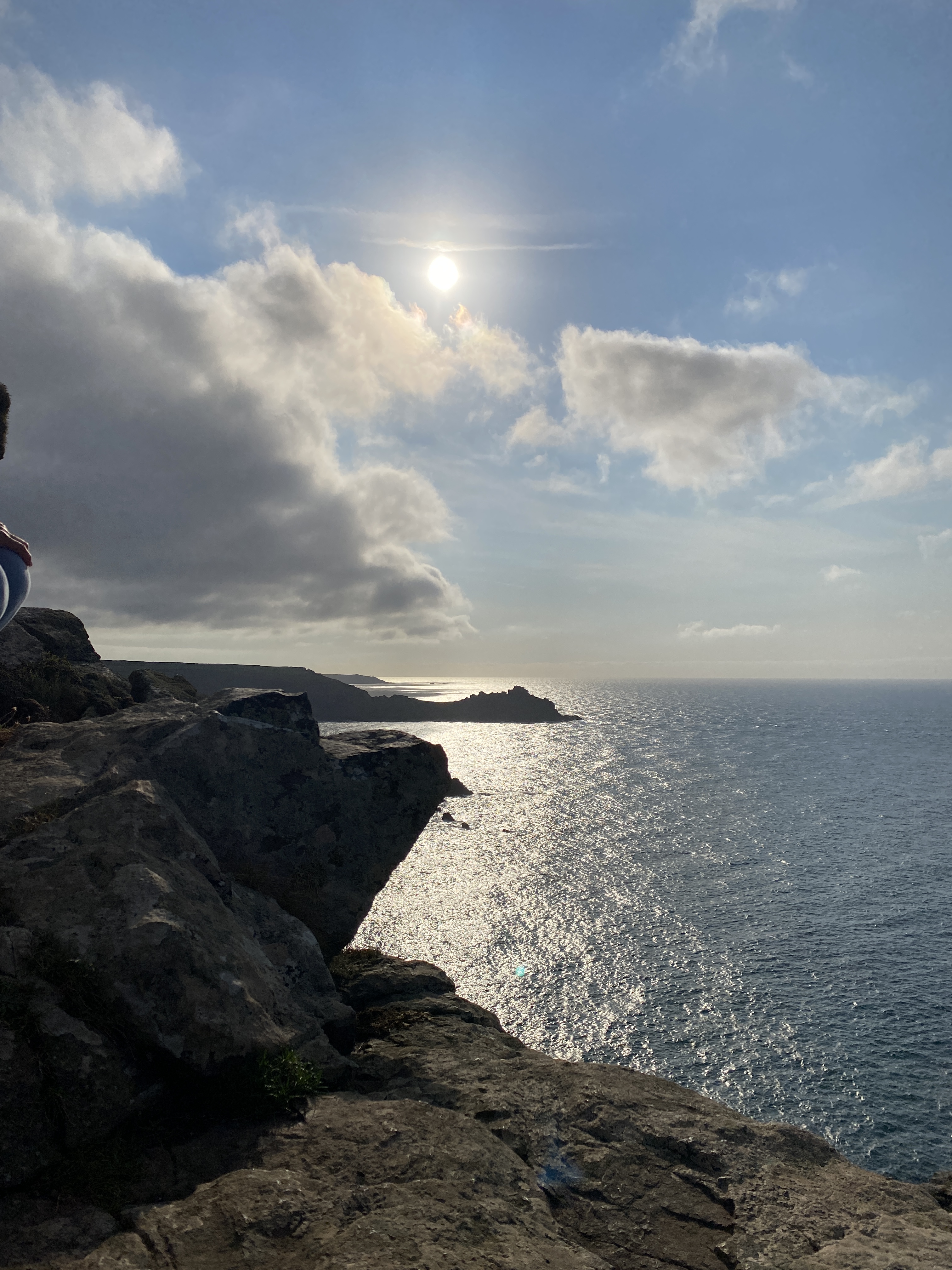
What is this penchant for lists I share with Graham? I want abundance from something other than products. I’m dumbly monolingual and lists are one of the few ways I can accumulate nuances of meaning. My attention-disordered brain collects lists as procrastination for the Thing itself, what is it I should be doing, always on the tip of some other event horizon bleeding through the last and first, so nothing is really finished. I like that in West Penwith, to look at the Atlantic you don’t see any islands, so there doesn’t have to be an end. You have the illusion that there can always be more time. The sea as this list of limitless light, colour shift, unbearable senses of depth. You are here.
~
The grammarsow crops up in Graham’s letters. In a missive to Robin Skelton, he muses:
And what are we now? Maybe better to have been an engine-driver in the steam-age. A sportsman a shaman a drummer a dancer rainmaker farmer smith dyer cooper charcoal-burner politician dog bunsen-burner minister assassin thug bird-watcher poet’s-wife queer painter alcoholic ologist solger sailer candlestick-maker composer madrigalist explorer invalid cowboy kittiwake graamersow slater flea sea-star angel dope dunce dunnick dotteral dafty prophesor genius monster slob starter sea-king prince earl the end.
Again the ‘steam-age’ of other infrastructures interfacing language. Better to have been a wave engineer in the renewable(s) era. I find myself somewhere between the ‘ologist’ and the ‘angel dope’, strung out on critique, measure and the promise of sensuous oblivion. Not sure if the dope is connected to the dunce or angel, but I’ll claim it spiritually as something good: an enhanced performance. As in, those are dope lines I’m reading. Do you want some? ‘And what are we now?’ not who, but what. A question I want always to ask — it’s almost Deleuzian — with someone in my arms or the sea swishing up to waist height, a sea-star clung to the hollows behind my knees. What’s possible when shame is gone. I love tenderly Graham’s list of possible existences and wonder how many I might retrain as (O genius monster), keeping in mind Bernadette Mayer’s old quip that all poets should really be carpenters. I love the raggedness of letters, which is why I love blogs (letters to the idea of being read). Who are they for? We’re so lucky to have these old ones, bound for us, evidence to the material conditions for our wild imaginaries.
~
In Cornwall, I love falling asleep. I love falling for new poems, stumbling a little on the rugged paths, falling for the air and water, for a little more mermaid’s ale or Bell’s, a blackcurrant kombucha or 100g of coconut mushrooms. In his essay for Poetry Foundation, ‘This Horizontal Position’, Oli Hazzard writes about a time Graham ‘went for a walk on Zennor Hill in Cornwall and fell into a bramble bush’. This falling was a repeat pattern: in 1950 he drunkenly fell off a roof and complained of his three-month hospital stay, ‘I hate this horizontal position’. In my DFA thesis I wrote extensively about lying down as a beginning for writing, the horizontal as a form of refusal when it comes to the upright requirements of an assertive ‘I’. It’s no secret that I prefer poetry in the mode of dreamtime, but that’s not to say I’m also a rambler. It’s a poetry of breath and of steps (of vigour!) I enjoy in Graham. Zigzagging and winding down well-trodden moor paths, stumbling upon bridleways that lead around the hills from holy shrines.
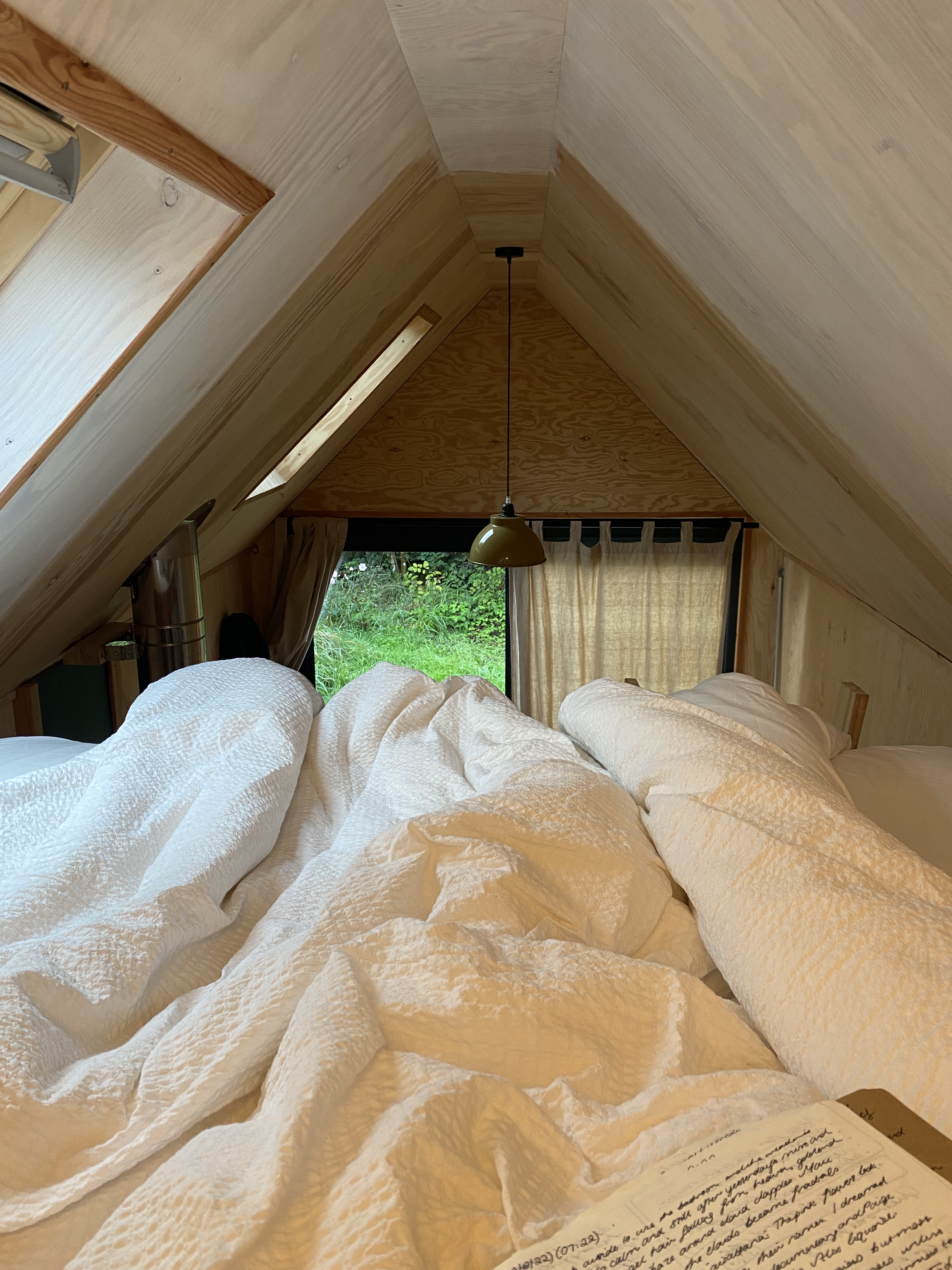
I was the lucky poet to first bless a new writer’s cabin that my host, Rebecca, built on some land near the Ding Dong Mine. From the garden, you can see right out over Mount Bay. The skies are huge here. I’ll say that a lot. I saw a seal down by one of the zawns on the north coast, felt the fear of losing the moon in you, let my lips chap on the telepathy of remote secrets. I try to be better, regardless. My poems become languorous obscurities. All of the land has hidden depths.
~
There was a summer before secondary school when we were gifted an unlimited pass to Historic Scotland, meaning our holidays involved camping across Dumfries and Galloway, the Trossachs, the Highlands, in search of abbeys, monasteries, castles and holy sites in various states of decay. I was turned off by leaflets documenting the actual details of history, emerging sleepy-eyed from the car where I’d been navigating the turgid sentences of fantasy novels or playing platform games like Super Mario. There’s a particular form of carsickness that produces electrolytic effects conducive to imaginative ventures. What I mean to say is, instead of vomiting I overlaid the real world with the promise of portals to elsewhere. In Penwith, I walk off my city sickness and sit by the standing stones, quoits and old ruins of industry. What do I imagine but a ‘news of no time’, still to come? Zennor Hill is both poem and place. The more I’m here, the more a sort of aura thickens.
Swap Zoom for the view from Zennor
On my last morning, I wake to sunrise over the sea. Dew shimmers the rosehips. The air is earthsweet as ever and I don’t know how I’ll go home. Travelling is an experience of dislocation: here, I find home again in language, its caught habits, Graham’s words sluicing Clydewards. There’s a poise to his poetry, steadfastly composed as ‘verse’ and often by iambic measure. Making perfect prosody with the chug of the train. I was pleased to roll into Glasgow having bumped into my friend Kenny, the whisky god of the Hebrides, attuned to the flight-pulse of conversing again. Hungry, ‘putting this statement into this empty soup tin’ to say cheerio as Sydney would, lighting up poetry to finish it, the best thing of all, a warm scaffold to hold up how we missed each other. A quiet disintegration of cloud. What are we now?
With thanks to Andrew Fentham, David Devanny and Rebecca Althaus for kindness and hospitality. Long live The Grammarsow!
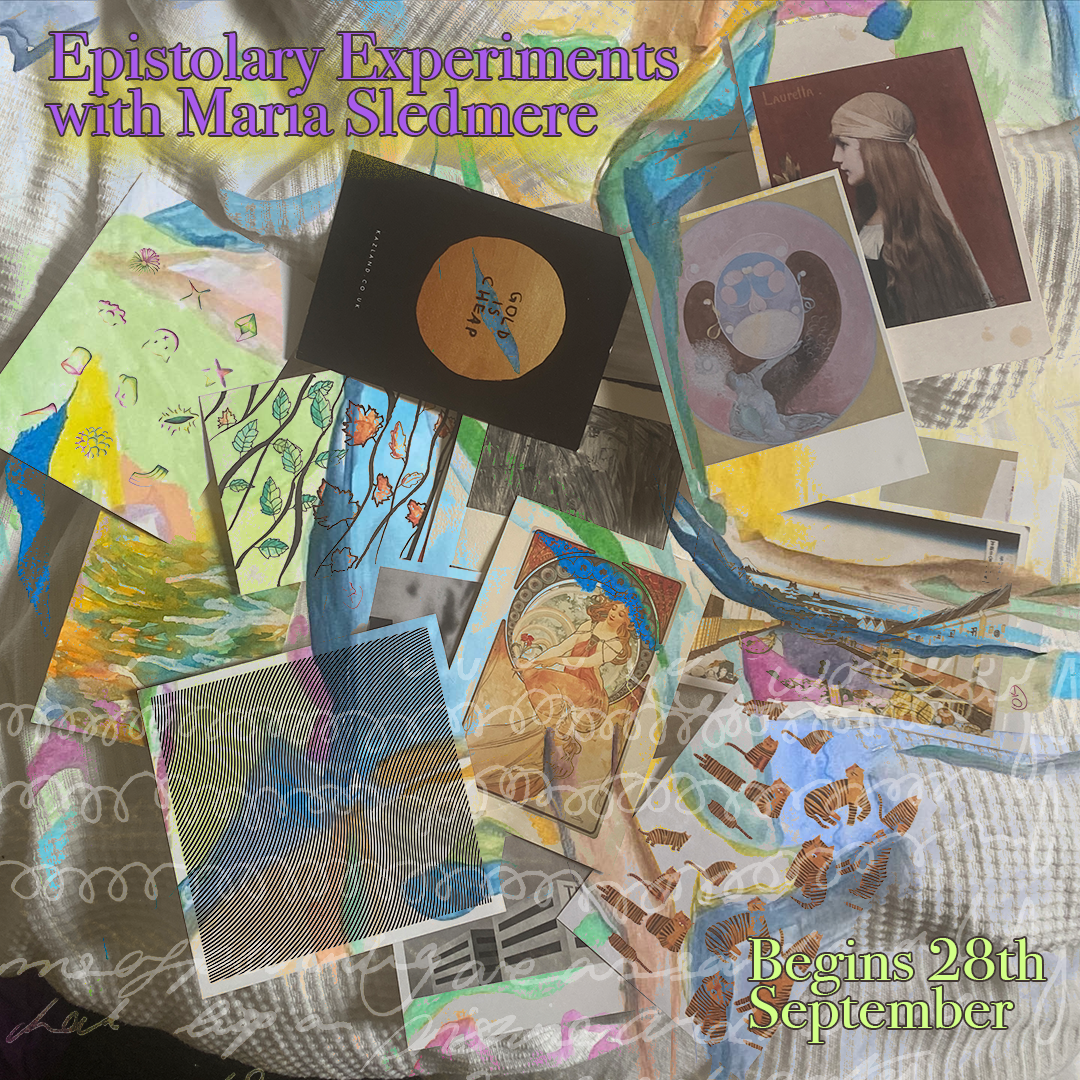
Thrilled to announce I’ll be working with Beyond Form Creative Writing again this autumn to offer two new workshops. The first, Epistolary Experiments, begins on 28th September and is a monthly, four-part series designed to explore the arts of letter writing and correspondence across different forms. We’ll be thinking about how the work of address, posting, description and all its intimacy and triangulation can tell a story, evoke fantasy scenarios or perform an expansive, relational lyric. The second, Pop Matters: Our Songs, is a one-off workshop on 23rd November and offers a warm and upbeat ‘studio’ for musing on the relationship between creative practice and pop music. How do we write through and towards pop with all our devotion or ambient dwelling in its neon glow? Both workshops will involve a mix of reading other work, discussion and structured individual writing activities. There will never be any pressure to share work, although you will have access to the workshop threads on Experimental Creatives Collective, a closed forum space where further discussion and sharing can take place if anyone wishes.
For both workshops, there is both a full price and two concession rates.
Epistolary Experiments
4 Sessions Starting Wednesday September 28th
6-8:00pm (GMT) via Zoom
‘I write you a letter to make eyes at a reader I don’t know from Adam’ (Kay Gabriel). From Samuel Richardson’s Pamela (1740) to Sean Bonney’s incendiary Letters Against the Firmament (2015), letter-writing or ‘the epistolary’ has inflected all kinds of writing, including novels, poetry and manifestos. Taking cue from Kay Gabriel’s ‘The Purloined Lyric’, we’ll explore the possibilities of letters, address and communication in all kinds of writing, practice and performance. While the literary letter has an established tradition, we’ll look at contemporary artists/authors who shake up the form of correspondence and in turn reframe desire, play, identity, sex, intimacy, domesticity and the political.
In this four-part, monthly series, we’ll look at several key areas: the love letter, the political letter, the fantasy letter and the postcard. A letter can triangulate writer, addressee and reader in endlessly generative ways, not to mention the origami of folds between art, life and writing, and this series is designed for creatives of all kinds to think about the epistolary genre in their own practice. Whether you want to incorporate the letter form directly into your work as source material/form, or simply use it as an extra tool in your research, reflection and development process, this series offers a generative starting point. Workshops will combine reading and reflection with individual writing activities, with some opportunities for collaboration including optional pairing of participants as ‘pen-pals’ for the duration of the course.
Open to all skill levels and writers and creatives of all mediums. You can sign up for all or just some of the weeks!
♡
Session 1 September 28th: The Love Letter
An iconic motif in the history of film and literature, the love letter conveys acts of noticing, clandestine reflections, confessions, embarrassment and desire. The love letter might be a plot device, a poetic ode, a pop song, a frank or coded material expression. The love letter tells a story, obscures a truth, embodies connection; it might concern romantic, platonic or comradely love. Sometimes a love letter goes beyond the intended beloved and forges all sorts of new energies and worlds. We’ll write into all these intimacies and frictions.
Key writers include John Keats, Jane Campion, Kay Gabriel, Jo Barchi, Diana Hamilton, Frank Ocean
Session 2 October 26th: The Political Letter
By reading unsent letters, letters to everyone, letters to no one, we’ll consider how the art of writing letters is a radically social form. Playing with the art of address and description, this workshop explores how the letter form can explode and disseminate ideas of presence, identity, desire and political (im)possibility.
Key writers include Bernadette Mayer, Fred Moten and Sean Bonney
Session 3 November 30th: The Fantasy Letter
Sometimes we write to someone who might never read our letters. We write to fictional characters, other writers or artists — some of them lost to time. These epistles might take the form of fan letters, speculative letters, epistolary letters or fantasy missives — defying the limits of time, space, the living and dead. In this workshop we’ll engage with such letters to consider voice, the intimate arts of reading, communication between forms, the body and queer temporalities.
Key writers include Dodie Bellamy, Vahni (Anthony Ezekiel) Capildeo, Jack Spicer
Session 4 December 14th: The Postcard
‘A giving which gives only its gift, but in the giving holds itself back and withdraws, such a giving we call sending’ (Derrida, The Post Card). What does it mean to send, or be sent? This final workshop takes the pithy form of the postcard as a figure for the literary possibilities of posting. What temporality does a postcard hold? What happens in the relationship between word and image, expression and constraint, public and private? Could we write postcards to the past or future, to the more-than-human? Can thinking postcard help us rethink other kinds of ‘posting’ and (un)delivery in our daily and writerly lives?
Key writers include: Postcards from the Anthropocene project, Jacques Derrida, Kiraṇ Kumār
Building on the success of the 2020 Pop Matters series, this workshop offers a warm and upbeat ‘studio’ for musing on the relationship between creative practice and pop music. We’ll focus mostly on pop music and love/devotion, making space for writing which borrows from the form of pop music or writes to specific pop artists. We’ll consider how pop can offer the emotional and structural inspiration for other kinds of creative output, the role of pop in everyday life/life-writing and the mythologies we give to pop icons in writing. Designed for anyone who wants to flirt with a bit of pop in their practice, this workshop will feature music, free association, reading and stimulating activities for writing.
Key writers include: Kevin Killian, Dana Ward, Anne Boyer, Ian Macartney
In Glitch Feminism (2020), Legacy Russell hones in on the sudden error of the glitch as ‘a form of refusal’. As our social, intimate and professional lives become increasingly directed by the commercial algorithms of everyday media platforms, how can poetry intervene in the cognitive minefield of Web 2.0? Playing with text-mixing, collage and procedural forms, we’ll consider ways of glitching between interfaces of browsing/writing in virtual space and print, with time for questions and discussion.
Through cookies, advertisements and terms and conditions, digital capitalism constantly demands that we affirm the ‘yes’ of its systems. In this workshop, poetry will offer something alternative. We’ll break through the junk space of virtual realms and create innovative works within and beyond them, while exploring the world of SPAM Press. Asking what it means to be post-internet, to write from error, to envision the poem as an interactive environment. Let’s glitch!
This event will include: group discussions, reading out loud, reading alone, writing, sharing work that has been created in the workshop.
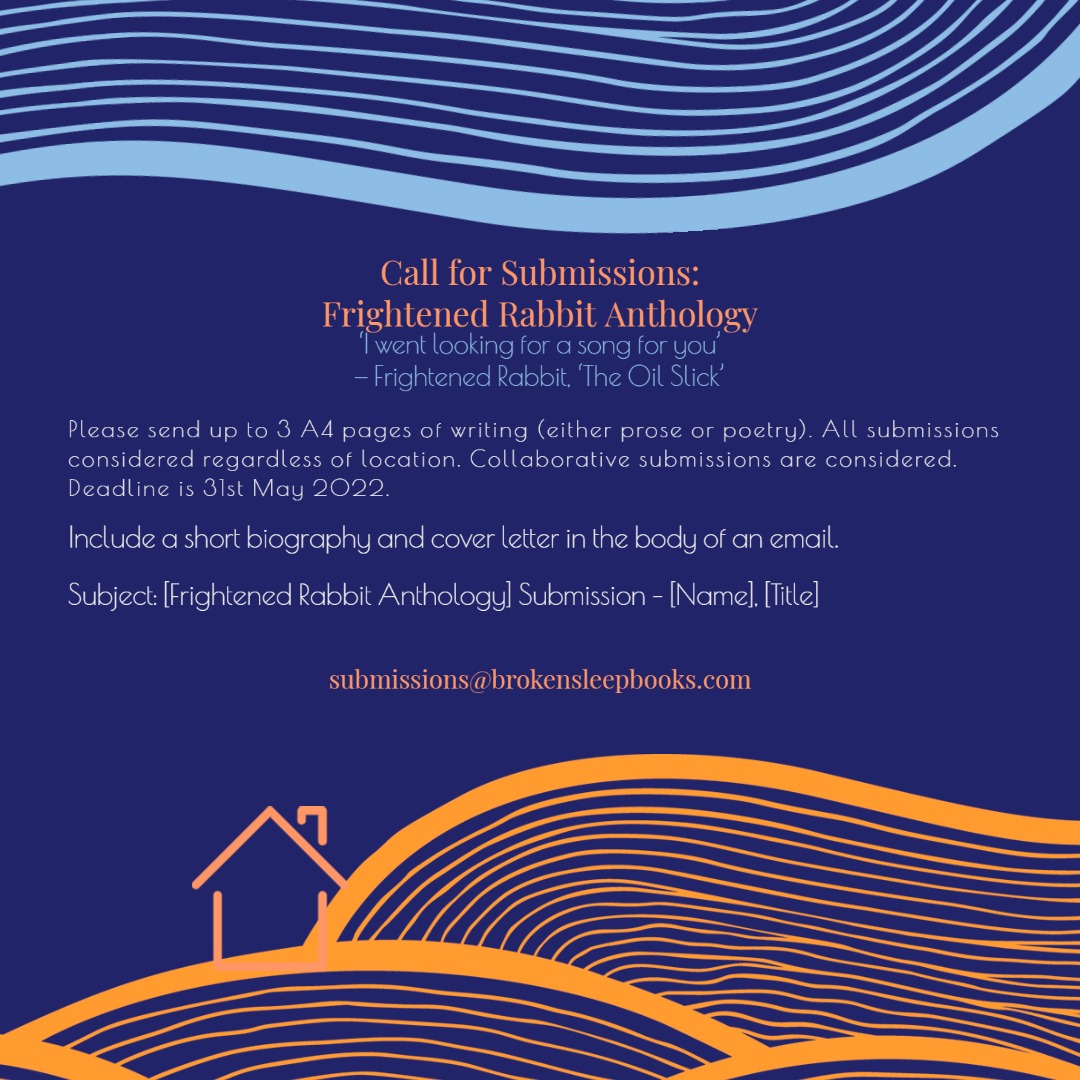
Pleased to announce I’ll be working with Aaron Kent in editing an anthology of poetry and prose in response to Frightened Rabbit. I’m anticipating this as a really special project, and a chance to make something collaborative in celebration of the work of a band that touched the lives of so many. I love music! The pandemic knocked some of that out of me for a while, but it sounds good again. Music! I want to write about it all the time. Send us your best odes, ekphrasis, reflections, fiction, mini essays, lyrics etc.
~
I went looking for a song for you — Frightened Rabbit, ‘The Oil Slick’
Edited by Maria Sledmere & Aaron Kent
From the release of their debut album, Sing the Greys (2006), Frightened Rabbit were a phenomenal presence in the lives of many. To be at a Frabbit show, to read the liner notes, to belt the words back at your friends was to feel if not release then solidarity in suffering. To catch love from the greys and live in colour. The band’s inimitable singer Scott Hutchison (also a talented illustrator) penned lyrics that captured the weight and heat of adolescence and its wreck, of joyous chaos and loneliness, of growing into a person, falling in and out of love. Frabbit helped many of us nurture a voice in the woodpile of the dark, and to embrace what happens when it sparks.
This anthology is a celebration of Frightened Rabbit’s work in both music and community. Their songs inspired many of us to pick up a pen and write, or share our stories and inner lives with others. We are looking for work that engages with the themes of the Frabbit discography: work that takes its cue from a quoted line, a song, a title, a particular performance. Work that processes the memories filtered through music, that delves into the landscapes, emotional topographies and rich imaginaries of the Frabbit world. Work that shows us how the band’s immense legacy continues through our words, and makes tiny changes.
As Tom Johnson, founder of the magazine GoldFlakePaint writes in a heartfelt tribute to Scott, not long after his passing: ‘The songs are right there anyway; they will always be there’. This is an invitation to carry on the songs. Send us your poems, send us your words.
Walking to the supermarket today cost wild amounts of strength and energy, for which I am grateful to have spent now that I can eat nauseating Roquefort cheese in the hope of coaxing my numbed-out tastebuds to attention (so far semi-successful) with lathering of French mustard on wholewheat bagel. Semi permasick seemingly from something in the walls in me. MOULD. Watching the Easterheads peruse giant boxes with undersized, foil-wrapped eggs inside reminds me of a lecturer I had many years ago whose primary exam advice was to study always with such an egg by your side, because curved chocolate is ‘superior’. Trying to summon childhood memories of Easter and all I get is something hardboiled and glum, rainbow-painted free-rangers being rolled down the smashed-up concrete of Minnoch Crescent estate. What were you supposed to do next? Retrieve the egg. I forget. I roll over. I have to sleep on my side or something in my organs hurts; but I believe cats have healing powers and if a cat wants to sleep right on my chest, sure, I’ll sleep on my back and wake up better.
So I’ve been enjoying The Blindboy Podcast and recently the episode where he talks about the internet before it became, well, everything. The total bombardment. Blindboy has charming tales of what cultural scarcity was like before you could just shazam the shit out of any sonic phenomenon, google every micro-thought that comes into your head or find your brain rewired around the big-ass anxiety MMORPG that is Twitter. I’m geriatric millennial enough to remember this and especially tapes. I had a thing about tapes. I wrote about this already, way back in 2014, my thing for tapes. That was kind of before the indie tape revival (is it still going on?). Seriality in writing is irresistible to me. The backwards and forwardsness of it. Krapp’s spoolish jouissance. Bernadette Mayer’s tape recordings in Piece of Cake, Memory and Midwinter Day. The glossolalic Mr Tuttle in Don DeLillo’s The Body Artist.
Recently, editor, writer and absolute king [<3] in the poetry community, Aaron Kent, published a pocket-sized pamphlet called The Rise Of… (Broken Sleep Books, 2022). The back page features the familiar anatomy of tape reels encased in clear plastic. There’s a kind of Side One/Side Two vibe: a long essay-poem, ‘The Rise Of…’, which documents the process of coming to know what happened in the wake of a sexual assault; and a poem ‘Inkmist’ dedicated to ‘CRASAC group therapy; for saving me‘. This is a breathtaking work that doesn’t so much ‘confront’ its difficult subject as enter into a kind of ‘momentum’ capable of thawing the petrification of trauma. Of central concern to the speaker is the notion of hallucination, of letter-writing, of ‘difficulty’ itself. I opened it gently from the envelope as I once would a cassette from its casing, read the whole thing in one go and found myself at this point upside down on the sofa, blood rushed to my head, kind of too stunned to even cry. The fluidity and force of Kent’s words are such that all kinds of dormant synapses in my own brain began to take flight again. This is poetry which dials up exposure not exactly to ‘tell a story’ but to disclose the whole affect-storm of a writing that could approximate a traumatised consciousness — one that is at once deeply singular, embodied but also permeable within language itself. A writing that soaks up the residues of thinking’s trillions. It’s hypnagogic, syncopated, a rush; full of swerves, stops, broken clauses, syntactic mania. Forget punctuation. This is a book about the secret. About a wild undersong of constant, yet fluctuating pain. ‘I’m like a sponge i’m always shedding and if i don’t deal with it the pain won’t go away’. Anhedonia, itching, ‘something so simple and powerful’ about a scream. ‘There must be a word for losing melody’. In a blurb for the book, Day Mattar describes this not so much as ‘a stream of consciousness’ but ‘a flood’. There’s something mesmerising and unstoppable here. ‘I am the rapture!’ Buy this book.
When I was in London I also picked up Emily Berry’s new collection, Unexhausted Time (Faber, 2022), a book I’d hotly anticipated owing to Berry’s excellent previous titles Dear Boy (2013) and Stranger, Baby (2017) but also because the book cover perfectly matched the magenta of fred’s new iets frans tracksuit. I read this last weekend in a few turbulent, food coma type nights, marvelling at how my brain could just pick up a special Berry ellipsis, steal it for a dream and then awake to another suspension in the poem. This is a book full of ghosts and twisted souls, a kind of carefulness around utterance itself; spellbinding in the sense of a spine for holding together our weathering lives. A book bound by some kind of spell. You have the sense of a secret, and a holding back:
All statements purporting to be act are true. Nothing goes away… You carry it with you, if not on your back, or in your arms, then somewhere behind your eye… So be careful… See the ghost scratching at the door frame for the note that will free her. The past is parked next to me like a dirty van with messages fingered in the grime…
(Emily Berry, Unexhausted Time)
These lines summon us but also disintegrate on the page as dust. I imagine the automatic typing of a super-intelligence gleaned from our messages. It feels intimate, uncanny. Where is this person speaking from? I want to take their advice seriously. There’s a lowkey lockdown hauntology, the house turned inside out by a kind of social toxicity. Anything natural is also sort of monstrous: ‘It always seemed to me a kind of madness, / the gardens all in flower year after year’. It’s sort of obscene to me that the blossoms are all out and I feel about as disconnected from them as if they existed purely as pixels. Is this disintegration of the senses a prefiguration to ageing? How do you stay involved with the big delicious ‘madness’ of the sensory world? The hyper-pitch of birdsong made audible by the lockdown of spring 2020 was lush, but also spooky. As if to be always in the dawn song of 5am, alone with the birdly chimeras — too piercing to surely be real? I miss it. The feeling of being wholly alive in waves. Write something to the ghost?
It always comes back. And there are new messages…
(Berry)
The digital eeriness of felt presence. New messages. Poems in their seasonal palimpsests. I want that unexhausted time, a time we haven’t yet strung out, a time to be rechilded. A time for birds.
Dearest, Happy pink moon!!!!!!!!!!!!!!!!!!
Lastly, the new Ludd Gangarrived. Mark Francis Johnson:
Those birds of passage present as fists.
I think we fauns may learn more from those birds than
half-hours by the sea teach us.
In the summer the woodcutter wanted to fell my home
and I let him.
(from The Faun Book)
You go stumbling, burned your pineal gland, phone mum. I keep the doors open in my dreams in case a deer walks in. ‘With my eye’, says Jesse Darling in the same issue, ‘I wanted to go / there, to the end of that road. With my whole body I wanted to go / there’.
Let the cold, curved chocolate fit the lip of my tongue, from the fridge.
Want also to melt.
Earlier I wrote something of our weathering lives. It’s the most beautiful and encompassing thing you can say to someone, becoming the spooky sweet hail in flux with sunbursts and mugs full of snow, a rainbow.
Something like an offering, snowballs of silver foil. Blossoms and more blossoms.
Again, from Ludd Gang (the last poem), Gloria Dawson writing for Callie Gardner:
hey, you were my weather sometimes arriving at my door
Pleased to announce that I’m joining the Beyond Form team as a tutor and mentor, and about to begin my first course: Writing the Everyday. If you’re interested in poetry, hybrid forms and journaling, in how we attend to everyday life in writing and think critically about time, work, ritual and habit, capitalism, technology, sickness and health, rest and dreams, then this course is for you!
Official descriptor:
This seven-week course takes everyday life as an abundant field of study. Following the rhythms of work, leisure, the body, technology, desire and play, we’ll explore various approaches to writing the daily. What forms of ‘extreme attention’ (CAConrad) can writing access, and to what effect? How do we break, queer, slow or sabotage time? What kind of writing could hold, shrink or expand the day? We’ll read a range of contemporary experiments in the quotidian and engage with journaling, poetry and hybrid writing.
Open to writers of all backgrounds and practice. This course is for anyone interested in exploring everyday life in their writing, reflecting critically on the poetics and politics of daily writing and encountering literary issues of time, intimacy, objects, environment and the body. Extracts from all texts will be supplied on a shared Google Drive and linked through Experimental Creatives Collective.
Here’s a breakdown of the course structure:
Week 1 February 24th: Today
Exploring ‘today’ as a unit of experience in writing, rhythms of repetition, return. What do we mean by an aesthetics of ‘everydayness’? How does literature encounter everyday life — its things, feelings, tempos, bodies and motions — in form and content?
Week 2 March 3rd: Work
In what ways can we explore the rhythms and demands of work, and make space for play and dream? In what ways is writing a form of work? How can our writing critique the conditions of labour which variously structure our daily lives? What kinds of interval, escape and resistance might it offer?
Week 3 March 10th: Ritual Attention
How can we practice forms of attention that estrange us from the familiarities of daily and domestic life? What forms of collage and screenshot experiments help us make sense of the chaos of daily life under late capitalism?
Week 4* Tuesday March 14th: Consumerism and Desire
What are the political and poetic potentials of our everyday desires? How can we think beyond the desires of capitalism? What is the significance of gender and sexuality within daily life, and how is this negotiated through consumption?
*please note this class will take place on Tuesday 14th March not Thursday
Week 5 March 24th: Technology and the Post-Internet
What is the relationship between writing and technology in our daily lives? How does experimental writing explore, and intervene in, the forms, genres and platforms of Web 2.0 — from social media to texting and digital objects/systems? What are the everyday politics and poetics of the internet and its various temporalities of labour, desire, data, communication and self-presentation?
Week 6 March 31st: Sick Time
How can writing explore personal and societal experiences with sickness, from chronic illness to pandemics? How does illness alter our sense of time, space, work and embodiment; how does it change our sense of the ‘day’?
Week 7 April 7th: Rest and Dreams
What forms of rest and relaxation can writing offer? What is the relationship between writing and dreaming, and how can dreaming help us imagine better worlds, or access hidden portals in writing? What are the politics of rest and how might we pursue it through creative practice?
Week 8 April 14th: Optional Open Mic
Registration
Prices are on a sliding scale and you can choose to enrol on the full course or to attend individual workshops. Most of the workshops are focused on individual writing, with room for open discussion at the end of sessions. You will not be expected to share work or give feedback on others’ work, although there may be occasion for this informally throughout the course, and through the Experimental Creatives Collective workspace which you will gain access to upon registration. There will be an optional open mic, held online, at the end of the course.
If you want further feedback on your work, I am available for one-to-one mentorship through the Beyond Form mentorship scheme.
All classes will take place on Zoom. How-to videos for using Zoom can be found here.
If you have further questions about registration, accessibility and Beyond Form more generally, please email Tawnya Selene Renelle at info@beyondformcreativewriting.com.
For more information and to register, head over to the course page here.
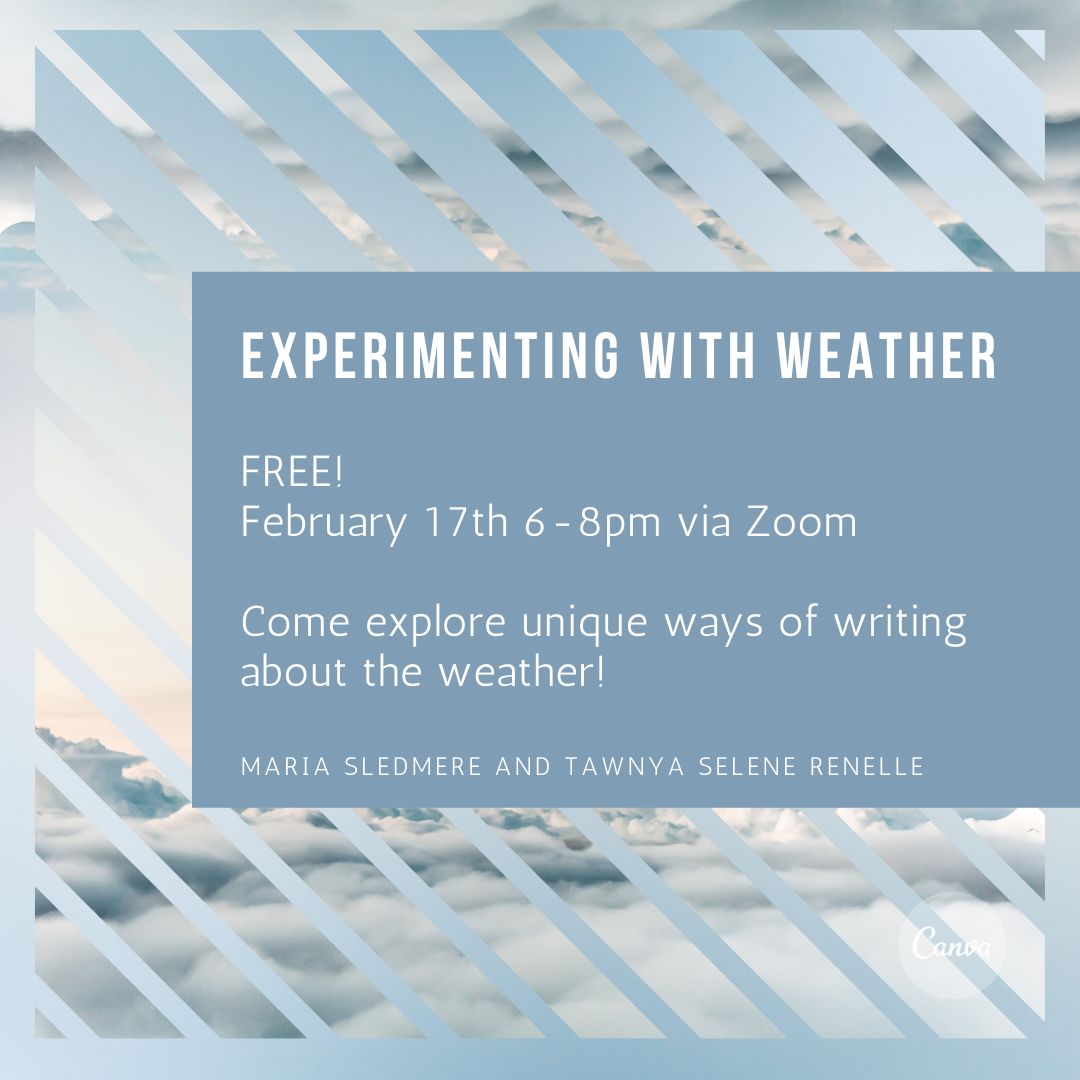
Experimenting with Weather A workshop with me and Tawnya Selene Renelle
(Online and free)
Thursday February 17th
6-8:00pm (GMT) via Zoom
Join us for this free workshop. Maria Sledmere will be our guest as she gets you ready for her new course Writing the Everyday which will begin on February 24th.
We will be deep diving into all the ways we can experiment with weather and thinking about the ways that weather can shape both the content and structure of our writing. We will be thinking about the influence of weather and how something simple might be woven into experimental writing.
Suited to all genres, skill levels, and artists of any medium.
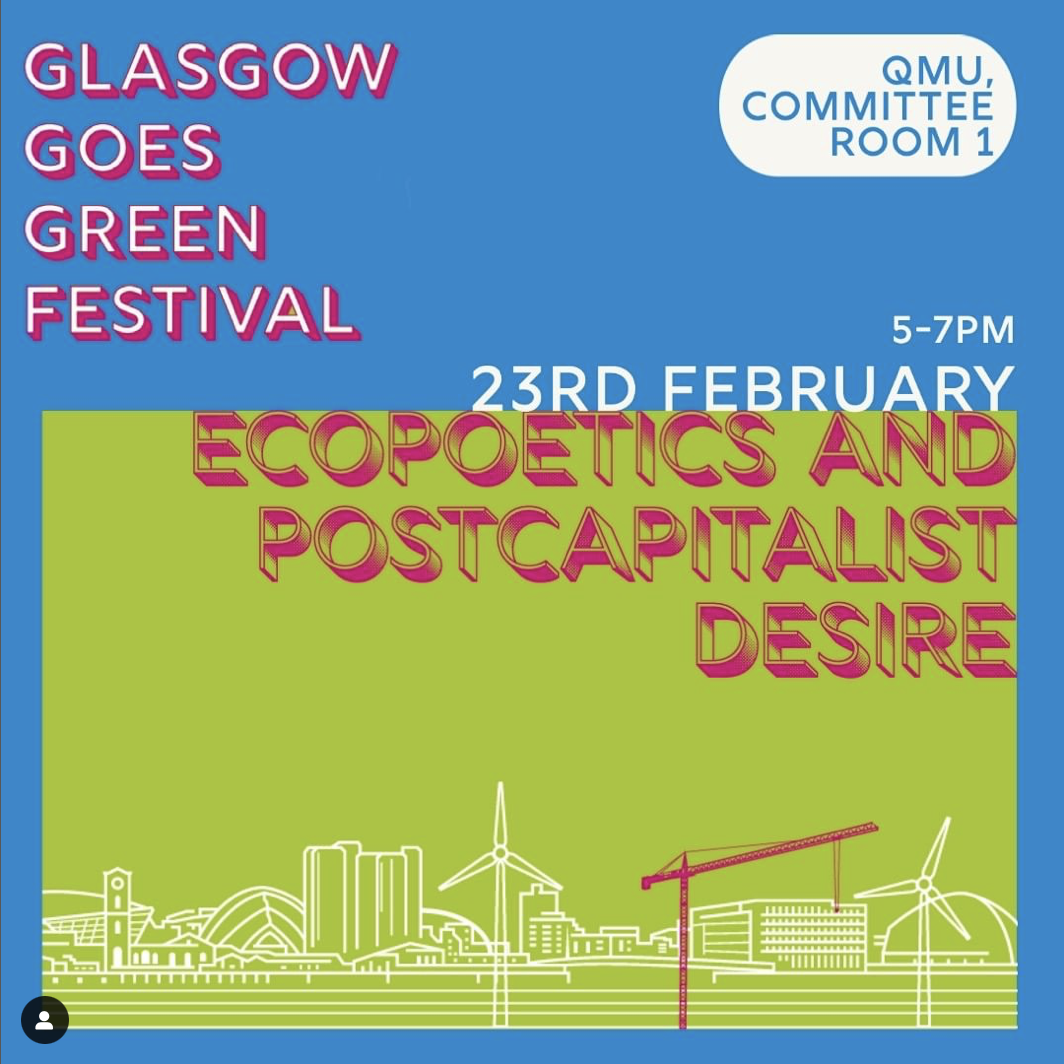
Ecopoetics and Postcapitalist Desire As part of Glasgow Goes Green Festival (QMU, University of Glasgow)
(in-person, 5pm on 23rd February)
In his 2012 essay, ‘Post-Capitalist Desire’ Mark Fisher recalls protestors at the Occupy London Stock Exchange critiqued in the press for having iPhones and buying Starbucks coffee. In many mainstream framings of environmental activism, to be ecological is to be solemnly ‘pure’ and somehow entirely free of the taint of consumerism’s impulse. How do questions of energy, desire and expression come into artistic and activist responses to the climate crisis? Can we complicate the binary of ascetism and pleasure when it comes to ecology? This workshop asks: what does it mean to be ecological in and beyond capitalist society? Looking at various works of contemporary poetry, we will locate ecological thought within complex expressions of excess, hedonism and despair; works which intersect ecology with queer joy and critiques of racialised capital; works which negotiate ecological politics and ethics within everyday life and its games of recognition.
After a short introduction to ecopoetics, we’ll read some poems (distributed as pdf handouts), explore writing activities and have discussion.
Open to anyone interested in reading and writing poetry.
Location: this workshop will take place in Committee Room 1 of the QMU. Enter through the front door of the building and take the stairs or the lift ahead to the third floor. A member of staff will be present to direct you to the workshop.
Please bring your own preferred writing materials.






 mariaology