Institute for Advanced Studies in the Humanities, 2 Hope Park Square Edinburgh EH8 9NW
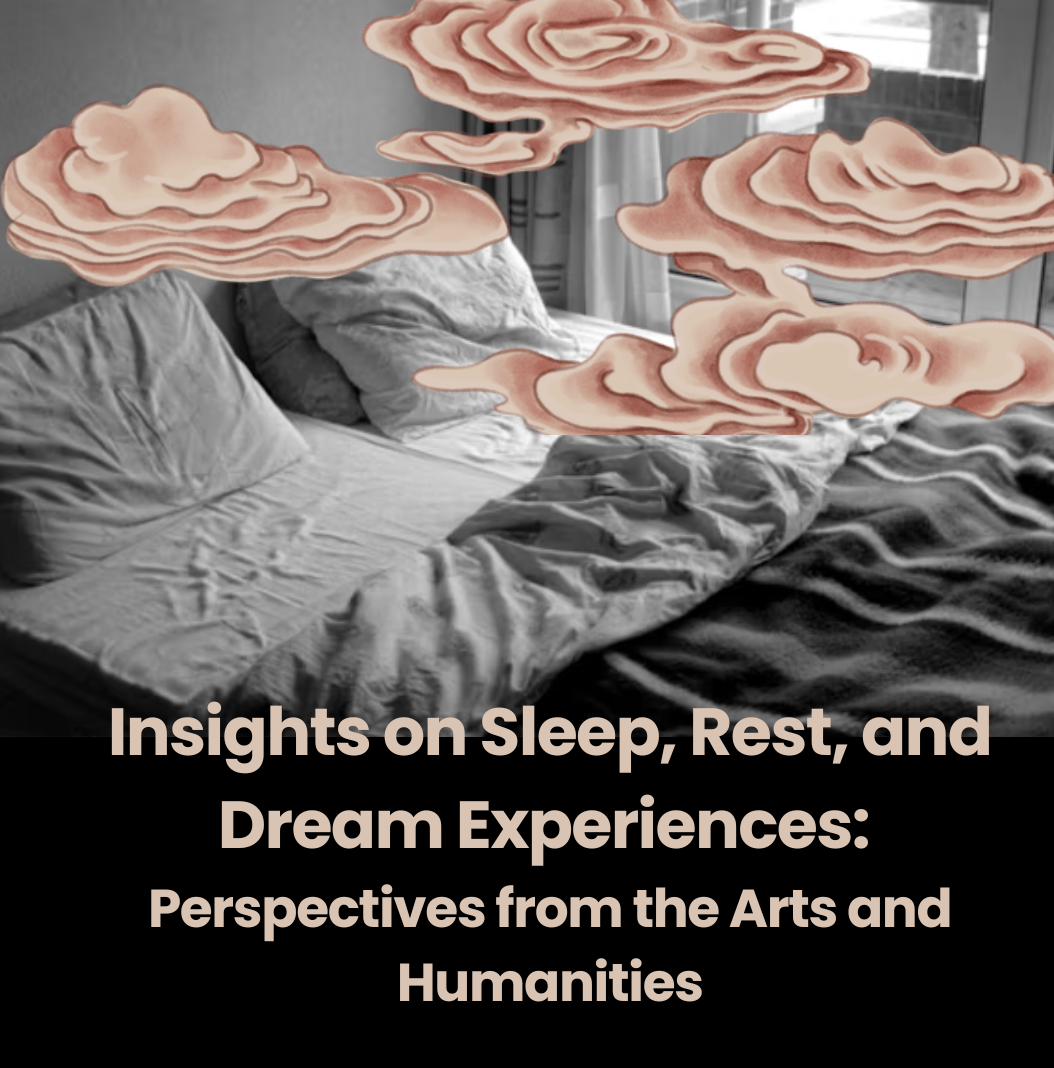
Broadly, our societal response towards sleep and rest is one of downgrading and devaluation. In our current capitalist society, sleep and rest are conceptualised as a time of passivity and inaction, and thus, as a period in which we are not producing or accomplishing. We tend to be jealous of those who can go about their days with fewer hours of sleep than ours, or praise those who can maximise their schedules, crammed with an endless series of activities and tasks. However, lack of sleep and rest time can lead to poorer health, both physical and mental. A good night of sleep can be one of our most restorative activities, and despite this fact, it tends to be neglected. Similarly, sleep and resting states allow for the occurrence of experiences that, if carefully attended, can provide us with a tool for self-exploration, such as dreaming and daydreaming.
The workshop intends to explore how these and related issues to our relationship to sleep and rest can be approached from the methods and perspectives of different disciplines within the arts and humanities. To that end, the workshop will consist of short presentations, panel discussions, and collaborative sessions for active participation. The workshop will be hosted both in-person and online.
DrMaria Sledmere(English & Creative Writing, University of Strathclyde)
Preliminary schedule:
11-11.25: Introduction and reflective activities:In this initial session, participants will be encouraged to share and write down their thoughts about their relationship to sleep and rest.
11.30-13: “Topics on dreaming, sleep experiences and transitory states” (Dr. Alcaraz-Sánchez, Dr. Bernini and Dr. Cowan). Short talks followed by a Q&A.
· Dr Marco Bernini (Durham University): “Dreams and Heightened Narrowed Immersivity: Combining Saturation, Permeability, Presentationality and Presence”.Are dreams (narrative) worlds? What similarities and differences are in play between our waking consciousness of the perceptual world and dream consciousness as quasi-perception? This paper posits that dreams exhibit a unique experiential mode called ‘Heightened Narrowed Immersivity’ (HNI)—a state characterized by intense presentational immediacy and severely restricted informational context. Combining frameworks and concepts from narrative theory and cognitive science while looking at dream reports, literature, lyrics, and movies, the paper shows how dreams and their artistic mediations reveal unstable ontological environments—low saturation in time, causality, identity, and space—while maintaining a high degree of immersive presence.
· Dr Robert Cowan (University of Glasgow). “Exotic and Ordinary Dreaming”.In this talk I consider two kinds of ‘exotic’ dreams. First, those that occur during episodes of REM sleep behaviour disorder where subjects allegedly ‘act out’ their dreams. Second, lucid dreams wherein subjects are apparently aware that they are dreaming while dreaming. My question: what do these exotic cases tell us about the nature of ordinary dreaming? My answer: very little and certainly less than others have thought.
· Dr Adriana Alcaraz Sánchez (University of Glasgow). Hacking the sleeping mind: the exploitation of the dreamspace.In dream research, the term ‘dream engineering’ has been adopted to describe techniques that manipulate, record and affect our dreams. Within the research context, dream engineering has become a useful tool for exploring the nature of dreaming as well as its potential for enhancing our waking lives. Yet, a couple of examples taken from outside scientific research might make us worry about the extent dream engineering practices should be conducted, especially when those are applied widely to the general public. Here, I consider some of the ethical implications of those practices outside the research realm, some of which put into question the value we attribute to sleep and dreaming.
13-14: Lunch Break:Vegetarian and Vegan catering for all participants
14-15: Panel discussion: Working title “The need for rest”(Dr Reeder, Dr Jones, and Dr Callard and Dr Sledmere): Our panellists will give a flash/provocation followed by a chaired discussion with questions from the audience.
15-15.15: Short break:Tea and coffee for all participants
15.15-17.00: Creative session.In this facilitated session, we will explore the role of dreaming/liminal states for creative purposes.
· Poetry reading and discussion by Dr Sledmere and Dr Hazzard.
· Haiku writing and Deep Listening activities
17.00-17.30: Discussion back to the rest of the workshop/final thoughts
From 17.30: Wine reception at IASH (Open to all participants)
This event is organised byAdriana Alcaraz-Sánchez(Postdoctoral Fellow in Philosophy, IASH, University of Edinburgh), Maria Sledmere (Artist and Lecturer in English & Creative Writing, University of Strathclyde) and Kevin Leomo (Artist and Community and Engagement Manager, University of Glasgow).
Accessibility: This event will take place at IASH, 2 Hope Park Square, Edinburgh, EH8 9NW. Please see a map here: https://www.iash.ed.ac.uk/location
The Seminar Room is on the first floor, and unfortunately IASH does not have a lift. If you have mobility issues and would like to discuss access, please contact iash@ed.ac.uk as soon as possible. Next to the Seminar Room, there are a couple of rooms that can be freely used in between the sessions/break time. If you require a quieter space at any point during the duration of the workshop, do reach out to the lead organiser (contact below) or let any of the organisers know on the day of the event. There’s also access to a microwave/small kitchen space if you require it.
Note to online participants: All sessions will be streamed, and online participants will be able to ask questions. However, note that due to the engaging nature of some of the sessions (i.e. creative session), we will not be able to provide tailored support or feedback to online participants. The sessions (including the talks) will not be recorded.
Note to in-person participants: Unfortunately, we are unable to cover travel and/or accommodation expenses for participants. Catering (including lunch and refreshments) will be provided to all.
Contact: For any questions or enquiries regarding the event, please get in touch with the lead organiser Adriana at Adriana.alcaraz.sa@gmail.com
The event is supported by the Susan Manning Workshop Fund from the Institute for Advanced Studies in the Humanities (IASH) and is jointly hosted by IASH and Project Somnolence.
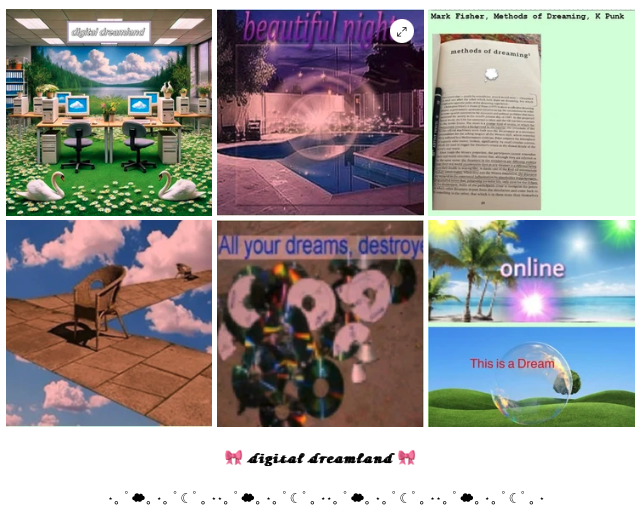
SPAM Plaza is reopening submissions for Digital Dreamland.
Ever had déjà vu, not knowing if something happened IRL, online or in your dreams? As screentime and sleep time increasingly clock similar hours of the day, we’re turning our attention to the acute relationship between dreams and the internet.
We invite critical work inspired by, but not limited to, any of the following topics:
☁︎ sleep procrastination and social media
☁︎ cloud hoarding
☁︎ the return of the (digital) repressed
☁︎ the memetic unconscious
☁︎ distraction as dream economy
☁︎ ghosting (and the metaphysics of digital presence)
☁︎ sleep texting
☁︎ hyperreal environments & nonspaces as dreamscapes
☁︎ online dream journaling communities
☁︎ targeted ads as unconscious desires
☁︎ chaos edits as dream realism
☁︎ artificial intelligence and dreaming
☁︎ interactive & lucid dreaming
☁︎ digitally-induced parasomnias
☁︎ dream imaginaries and political im/possibility
☁︎ neural net neurosis
☁︎ image spam and cyber garbage as psychic discharge
☁︎ oceanic feeling online
☁︎ dreams in augmented and virtual realities
☁︎ video game realities and dream framing
☁︎ online shopping and astral projection
☁︎ cognitive timelapse and digital intimacies
☁︎ corecore and collaging the cultural unconscious
☁︎ dream scanning as the next cyber frontier
☁︎ avatars, dreams and shadow selves
☁︎ (rip) twitter dream sharing
☁︎ movie and/or fictional representations of dreams and the internet
☁︎ typographic parapraxis (poetics of the typo as freudian slip)
For more inspiration, read the inaugural editorial for this series written by Maisie Florence Post. We always love to see work which engages these themes specifically in relation to poetry, but are open to work that touches on any aspect of texts, media and internet culture.
Submission guidelines:
We will be open for submissions between 15th January and 12th March 2025.
All submissions should be sent to spamzine.editors@gmail.com with subject line SUBMISSION: DIGITAL DREAMLAND.
Please add a brief note to your email explaining how your work fits into our theme.
We aim to respond to all submissions within four weeks and some people will hear back before the submission window closes as we will be publishing pieces on a rolling basis throughout 2025.
This is an open call for critical work. While we appreciate the line between creative and critical can be fluid, we are looking for work that fits overall a more critical angle.
Unfortunately neither the editors or contributors of this series will receive remuneration. Copyright remains with the author.
We don’t have capacity to give feedback on unsuccessful submissions and the editors’ decision remains final.
Please send submissions that are previously unpublished.
You can submit up to TWO pieces in any of the following categories:
Flash essays – 400-1000 words
Full essays – 1000-2500 words
Theory fictions – up to 2000 words
Verse essays – up to 100 lines (we have very limited formatting options however, so please get in touch if you’re not sure your work will be suitable)
Visual essays (photography, memes, illustrations etc – max limit of 15 images)
Audio or video essays (with text transcript provided – you must already have the link hosted elsewhere rather than send it as a file – we need to be able to embed it via a link)
ʚɞ
You can read the SPAM Plaza archive for free to get a feel for the stuff we like to publish.
Che Go Eun, a hole in a boat and a deep hole (2024)
Dear pain,
That’s how the light gets in. Fractal emanations of screaming the dark is a luxury the dark the dark. I listen to the radio and a mother talks of her autistic child preferring the dark — thriving in it, coming to life.
We soft-light to protect the unsaid stories.
Our bodies twist in the dark and we make an inconsistent work of pain-pleasure. The mattress gives out: pools of blood, ink, sweat, coffee, sex. I feel better when the sun comes up and when the sun goes down, wine-dark. It’s what’s in-between that’s the problem.
I keep thinking about Fred Moten’s luminous correspondence, ostensibly between Andrea Geyer and Margaret Kelly:
My friend, I have discovered in the antagonism between my work and dead letter that the project returns as an amazing field and air of correspondence, a transgenerational lotion of breathing, a revue of breath, a general bouquet in the grace of your asking in friendship since the day we met, and our braiding and breathing of a correspondence that we are now and have been working together in the atmosphere of our comrades, that we literally breathe them as a kind of braiding, an insistence of revolt as garment, a tapestry for the touched wall of a spaceship we noticed on the way to school, that off dimensionality of the cloud from our perspective, which I want to say is real not graphed, which I want to say is both a function of, and still untainted by the terrible business of, the Dutch masters, so that it’s impossible to tell the top from the side, though there was some kind of emanation or emendation that we all saw as a smooth flatness, like a table the cloud prepared of its own accord, a spread platform for spreading our metastatic air, our beautiful, is ourreal.
To make a pain of you, stop being a pain, I’d form a cartography of the nerves so rich you’d never know I’d outmatched the major scale. A map does not function in service of security. Anyone who has seen me read (and attempt to follow) a map knows this.
What is so gorgeous about the Moten quote above is its ph(r)asal longing: an ongoingness open to improvisation and constant sentence desuetude. Language like you don’t even need it, breathing all the same beyond what’s essential. Take this key. Braiding and breathing a coital somnolence of the body, twice rung out in language / only us leaving voice notes for what clicks pearls together, minor, deep in the distance.
Emollient longing of writing between pith and pronoun, what is prepared by the passing between. Our breath, clouds; mattering.
‘•.¸♡ ♡¸.•’
I saw the spaceship too. Didn’t you?
Intimacy, I told someone recently, feels like the opposite to what capitalism wants of us. Intimacy is worldsharing, ourreal, a grammar of humours, kisses and shibboleths. You know my pain and I know yours. We make a joke of it. What escapes serious talk but our serious dreams. So when we’re all in the gallery, we switch to our senses to make language-sense of ourreal, cellular vibe spread. It’s a room replete with the sonic ecology that is feeling all my fucking feelings (Clémentine Coupau): aka hook me up to ‘electronic components, dimensions variable’. The little paper lantern is a miniature version of my own IKEA lampshade. The problem with my IKEA lampshade is that I had to tear it a bit to change the lightbulb. I have a torn lantern. Magic hands. That’s how the light gets in. Paper = skin. Creamy light.
Che Go Eun 최 고 은, a hole in a boat and a deep hole (2024)
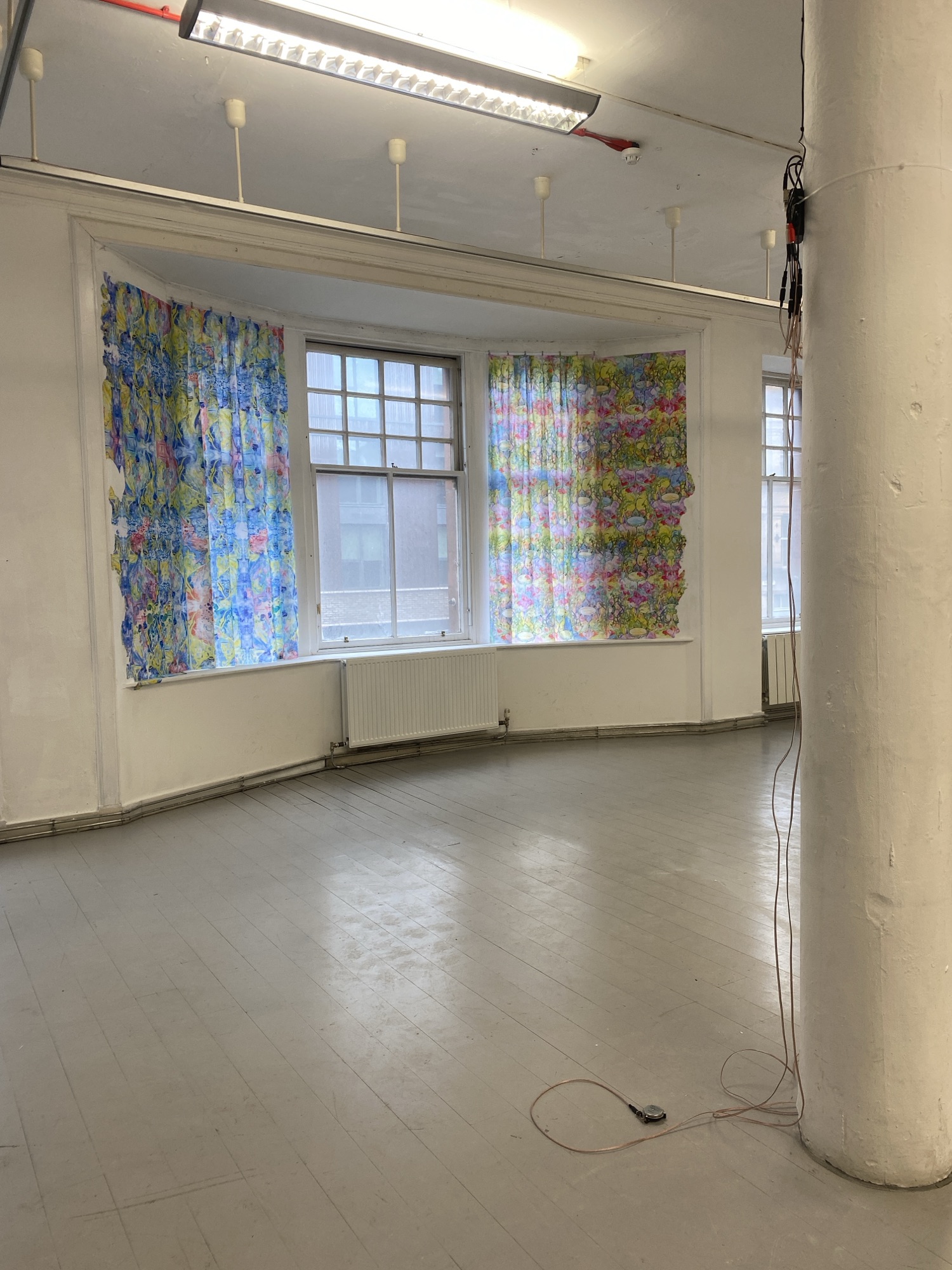
Aside from lanterns, the other homeware alluded to are curtains. Che Go Eun’s a hole in a boat and a deep hole is composed in collaboration with artificial intelligence. The artist inserted diary notes into an AI image generator which ‘transformed [their] intimate reflections and resulted in images’. Watercolour drawings were then made in response to those results, with the artist ‘reappropriating’ their ‘own feelings back from the AI’. This tension between creativity, data and predictive imaging results in a fascinating, speculative assemblage of arabesque, thorn and psychedelic colour. The nod to William Morris/Arts & Crafts reminds us of the collaborative handicraft that has gone into the piece’s imaginary and manifestation. Diary phrases such as ‘art nouveau’, ‘harder I am sinking’, ‘throw all my stress into the hole’ are woven into the fabric of these drapes which suggest both privacy and opening, light and shade. The work is gauzy. There’s a real street, a construction site behind it. Trongate: name as lozenge. What Moten says in the same letter-poem as quoted above, ‘a gauze of reckoning’. Threads, braids: stress, tension. I want to wrap the code-baroque of the fabric around my body like I’m a silkworm going in reverse, all the way back to its gross and sultry, larval conception. I keep hearing that the internet is just the unconscious. I see a bag of squishie candies in a vending machine and think: ugh, silkworms.
‘•.¸♡ ♡¸.•’
Back IRL, it’s raining with the pelting dreich that only a Glaschu April delivers, and I arrive at Trongate 103 having walked through Dennistoun listening to Elliott Smith. I’m not feeling morose; I’m just in touch with my feelings. As if they were tangible: animatronics, statuettes, pets. I’m still on a medication that holds such whimpering demands at just enough distance to be considered somehow ornamental — torrents no more. Once I would torrent my day in their favour. Let someone seed me. Now, I might choose to pick them up, put them back down, or smash them into oblivion. Let my soul have the architecture of a bleeding gate.
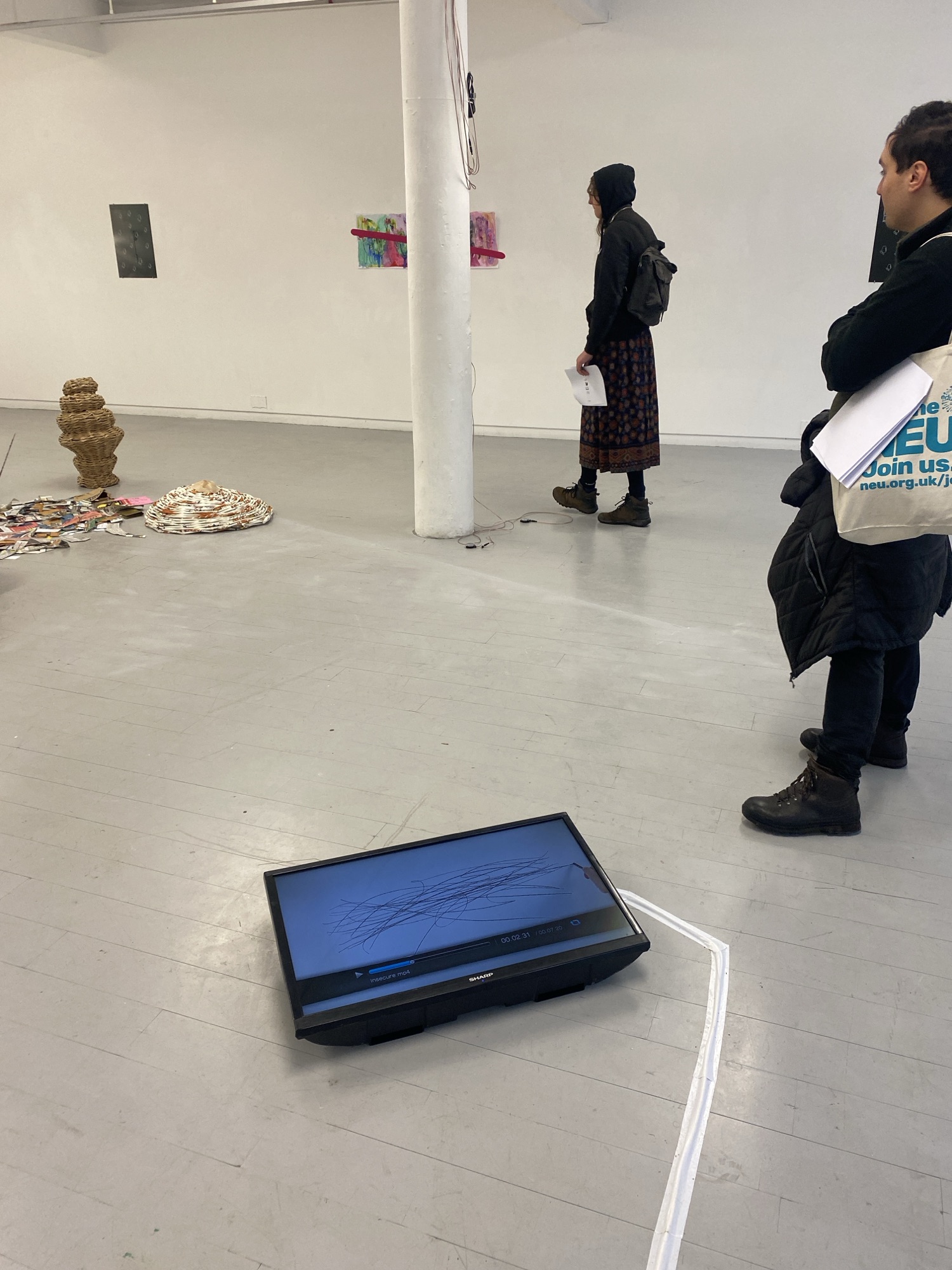
As I enter the exhibition, the invigilator says something about one of the objects we’re allowed to touch. I forget immediately what they say because I am greedy for colour and form, not meaning. So the whole time I am looking at the exhibits wondering: which of you may be touched? A finger trace of the curtains, time slider on video screen, glass surface of framing, kinesiology tape cut into bows and ribbons.
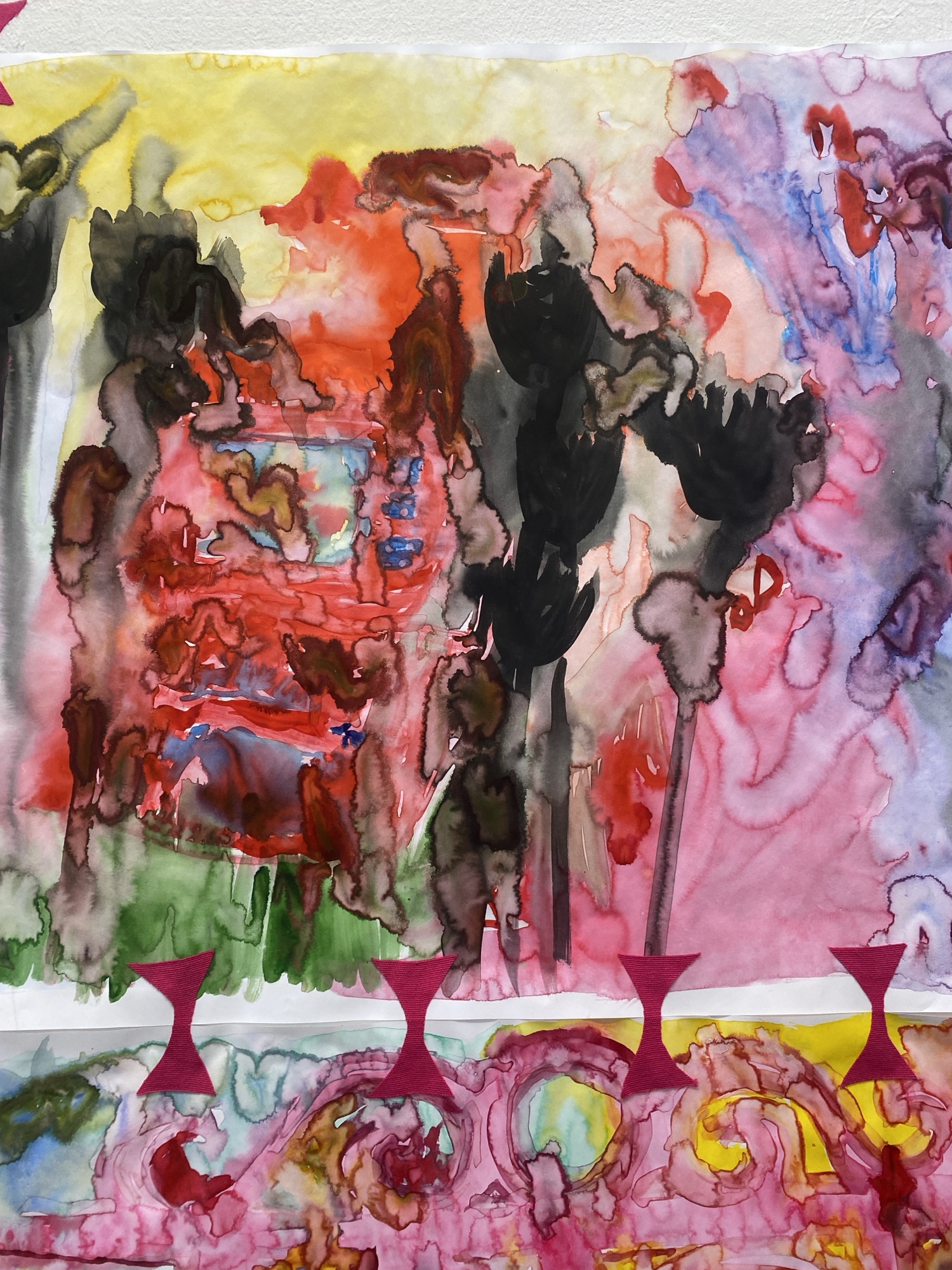
Daisy Lafarge, Gate Theory of Pain (III) (2024)
Touch is not in itself untainted. I am in love with Lafarge’s black tulips; their painful, precious tendrils.
‘•.¸♡ ♡¸.•’
Some people gave me advice on how to do better: thirsty in the flowerbed for some aphids fed upon 200 ladybugs to eat/moult more often than not they would die as fast as any plant blocked sunlight to pay (dustfall / bonnie / smitten ) should the wind ever blow you a raven
‘•.¸♡ ♡¸.•’
Mau and I try to diagnose the Mandelbrot set-seemingness of Lafarge’s watercolour fractals. The sequence ‘remains bounded in absolute value’. This is a beautiful phrase I find on Wikipedia. ‘It is one of the best-known examples of mathematical visualisation, mathematical beauty’. I could watch the little fractal gif forever like giving birth to myself over and over as a starfish with 7000 eyes & infinite narcissism. As it stands, that boundedness is a gate: pink, the colour of doll-flesh. I think of tentacles, elliptical phone calls, inflammation. We agree that almost all the art in the room is art that could be done on the phone. It’s not just about doodlecore but the intimate, desultory gesture of the line itself, and what’s on either side of it.
Not to get kinda kinky but the other day we were explaining ‘lucky pierre’ in the pub (because of Frank O’Hara the poet we all love and love most of all to discuss in the pub). In his ‘Personism: A Manifesto’, O’Hara talks about the poem in supplementary relation to people. Intimacy again. Sure, he wrote it while ‘in love with […] a blond’, which makes it all the more true and golden:
I went back to work and wrote a poem for this person. While I was writing it I was realising that if I wanted to I could use the telephone instead of writing the poem, and so Personism was born. It’s a very exciting movement which will undoubtedly have lots of adherents. It puts the poem squarely between the poet and the person, Lucky Pierre style, and the poem is correspondingly gratified. The poem is at last between two persons instead of two pages.
As Moten’s poem from The Service Porch is framed between two persons, so the epistolary heat is folded into Personism. It’s not letters but speech itself that gets electric. So what Mau and I mean by ‘this is art that could be done on the telephone’ is perhaps something about how the work takes place in correspondence between two or more bodies. Lafarge describes her paintings ‘as a means of pure distraction’, made during ‘episodes of severe chronic pain’, ‘remote NHS chronic pain sessions’ and ‘in phone queues and conversation with Adult Disability Payment (Social Security Scotland)’. The trembling of watercolour is an apt form for the bleeding edges that connect the power imbalance of someone trying to get support and the person with the power to connect them to it. It’s the art of turning away, seeking psychic space, without letting total go of the line.
How often do we find ourselves at the gate, with no end of wanting to both know and not-know what’s beyond it?
Wrought/not I.
‘•.¸♡ ♡¸.•’
I love gates. I love especially baroque ones with curlicues. I grew up with a broken gate which soon got removed. What did we have to keep in, or shut out? It was black and gold and the paint flaked off very beautifully. You might describe it as ‘tawdry’. I probably have false memories about this gate. Sometimes the screech of its opening hinges my dreams. Lafarge’s gate might be a homophonic pun on ‘gait’ (and so referencing the debilitating effects of chronic pain on one’s ability to walk freely). The painting, titled Gate Theory of Pain (III), no doubt references Ronald Melzack and Patrick Wall’s 1965 paper on ‘The Gate Theory of Pain’. In the words of Lorne M. Mendell:
The [Gate Theory of Pain] dealt explicitly with the apparent conflict in the 1960s between the paucity of sensory neurons that responded selectively to intense stimuli and the well-established finding that stimulation of the small fibres in peripheral nerves is required for the stimulus to be described as painful. It incorporated recently discovered mechanisms of presynaptic control of synaptic transmission from large and small sensory afferents which was suggested to “gate” incoming information depending on the balance between these inputs.
The Gate Theory concerns sensory fibres, transmission cells and their respective levels of activity. The idea is that painless sensations can supplant and so quell sensations that are painful. The process involves a blocking (a closed gate) of input to transmission cells. When the gate is left open, the sensory input gets through to transmission cells and produces pain. An example of the therapeutic application of this theory is transcutaneous electrical nerve stimulation (TENS), massage, acupuncture, vibration and mindfulness-based pain management (MBPM). While gazing at Lafarge’s vivid watercolours, one senses that pain is not suspended in the art of painting so much as calibrated, channelled, short-circuited. We keep commenting on the bleeding edge.
Aniara Omann, Resting on an icy couch (mother, grandmother, grandfather, big brother, older sister, little sister) (2020-2024)
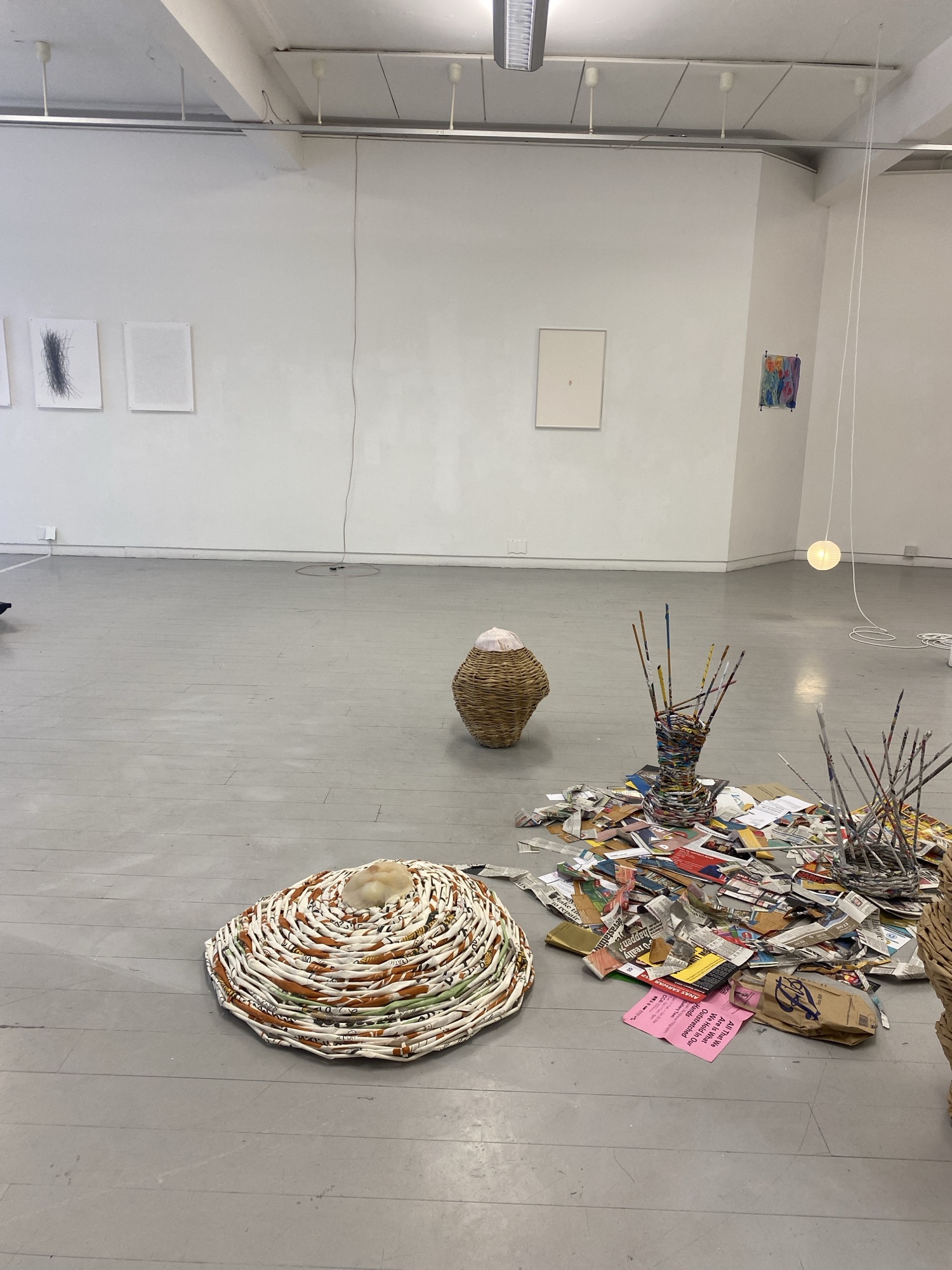
Elsewhere in the exhibition, ideas of feedback loop, intimacy, daily life and relationality are also manifest. Feronia Wennborg and Simon Weins’ soft tissue plays with sound transduction to install a ‘lo-fi sound system that lives at the periphery of perception’. This installation of contact-based sound production manifests the pair’s ‘long-distance collaboration’ in felt space. Aniara Omann’s haunting paper baskets, plugged by family faces, makes a ragged philosophy of grief and panic. The raggedness betrays a struggle for focus which is played out through the woundful (I meant to say wonderful, but this works better) arrangement of loose paper, woven baskets, the sense of things cut, twisted, recycled. Omann describes wearing the clothes of their sister, who died: ‘If anyone complimented me on a garment I had inherited from her, I would say it was a gift from a family member’. In that sense, we could think about the paper baskets as fragile amphora for an archival underworld. The baskets are not perfect, machine-made. They retain the expressive and painful grace of their making. They are a flammable structure, woven from newspaper clippings, election flyers, prescription papers, envelopes, bills. What is it to find a way of wearing something? Wrap your troubles in dreams. Shuffle for sources. The difference is a question of agencies; and yet either way the gesture remains. The gift: it has to be infinite.
Elísabet Brynhildardótti, The Lines- Hesitant line, Obediant line, Indecisive line, Decisive line (2023)
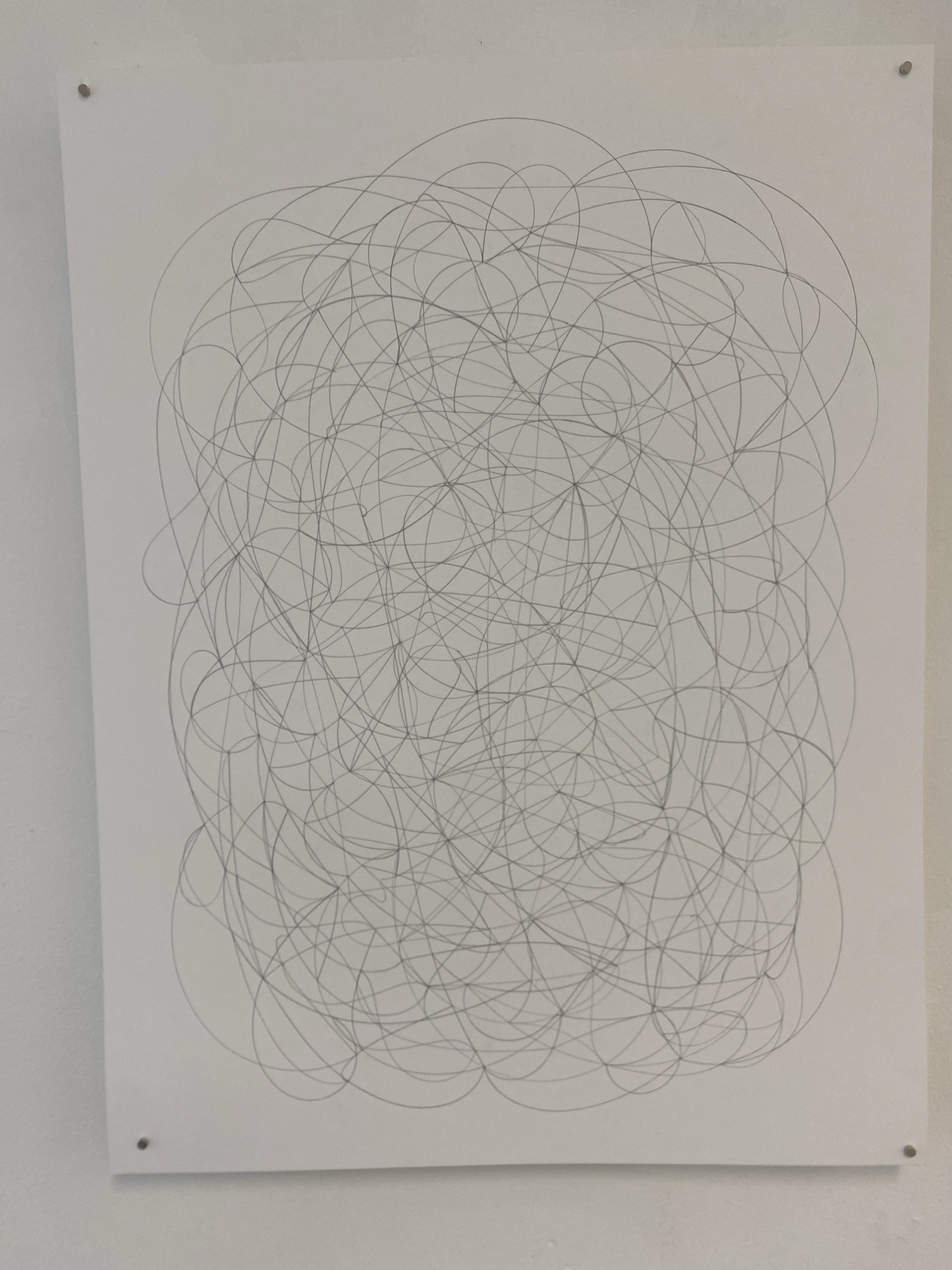
When someone says ‘hold the line’. Please hold the line. Please hold the handrail and take care on the stairs. Will you please hold? What’s at the end of that hold? I have been trying to get a medical appointment for weeks. They keep putting me on hold, hanging up. I phone up a doctor’s surgery which is based in a shopping mall at precisely 08:30, when the lines open, and immediately the lines (the queue) are full. How do I envision those lines? Swirling and spiralling around the postcode lottery of where we live, tangled and fizzing with people trying to find words for the pain they’re in. I think of my mum in lockdown, endlessly on the phone 500 miles away from the fact of trying to get prescriptions and medical treatment for my nan. It’s pretty mild for me, my current need to be on the line: among other things, fucked-up hearing, tinnitus, crackling I hear like static between the two sides of my skull. Sometimes a pleasurable hum in the morning, like ultrasound waves in the skeins of my pillow. On hold to the doctor’s office, you become a line. The hidden labour of the chronically ill is this beholden quality, the line with its insecurities. It’s getting thinner. There is no guarantee that the line will lead to something: its pulsing, throbbing insistence on being anything but spirogram music. The irony of disconnect. Give me a point; an appointment; a person at the other end.
Who would pick up the line would do so, of course, in the dead of night. In Stigmata: Escaping Texts, Helene Cixous writes:
It is the dead of night. I sense I am going to write. You, whom I accompany, you sense you are going to draw. Your night is waiting.
The figure which announces itself, which is going to make its appearance, the poet-of-drawings doesn’t see it. The model only appears to be outside. In truth it is invisible, but present, it lives inside the poet-of-drawings. You who pray with the pen, you feel it, hear it, dictate. Even if there is a landscape, a person, there outside—no, it’s from inside the body that the drawing-of-the-poet rises to the light of day. […] The drawing is without a stop.
Hélène Cixous, Stigmata: Escaping Texts, trans. by y Catherine A.F. MacGillivray (1998)
What I see in iNsEcurE (whose inconsistent casing recalls the long identifiers of medical-grade pharmaceuticals, the vowel-like howling insistence, the trembling name) are poets-of-drawings. The asemic work of line, layer and bleed is an avid supplement for writing itself. Who can write while in pain? Who’s afraid of the dark? Who’s afraid of the blank? It is in the night of writing, unnannounced. What is that invisible presence but pain itself? There is no ‘outside’ to pain, once you’re inside it. And yet the gate theory does imply a certain threshold. Relief bucks at the gate. Still, we draw from the well of it moving inside us. You can’t stop it. The appearance of the outside is only gauzy separation.
‘•.¸♡ ♡¸.•’
When I thought I had endometriosis and lived in the hormone torture of latent, duplicate pubescence, resulting from the long-durée of various quiet disorders, I wrote spiky little poems for a pamphlet called Cherry Nightshade. I didn’t yet know about the gate theory of pain but I saw all the poems in a dream_garden festering behind a gate. Well, more like a trellis. Ground cherries contain solanine and solanidine alkaloids: toxins which are lethal, and all the more lethal for their immaturity. Tart cherries have soporific qualities. I wanted sleep to envelop me in perfect velvet. My speaker was a jumping nerve, a shitty little internet silkworm.
What did I get from staring so long at the gate? I fell asleep on the line and the vine grew around me.
I love this exhibition for what it teaches us about art between bodies, how light interacts with feeling-colour, Moten’s ourreal in its total ambience, the drilling outside is part of that thrum in your skull, the way I love to look at my friends as they look at art, tulip mania, mourning vessels, the exquisite difference between red and pink, the meaning of panic touch, pain as the body’s great epistolary effort, fragility, attention’s relationship to healing, what it means to be gratified (if at all). I am grateful for the sharing of insecurity at the heart of the works, and for what they offer by way of being with pain. A bearing, a cloud platform, an intricacy. Standing at the gate.
‘•.¸♡ ♡¸.•’
Further notes:
medical filigree
acid yellowing
mau touches a sound magnet
‘insecurity fuels consumerism’
light source
biofeedback
neon bandage
organelle ballet
tesselate attentions
the puzzle pieces do not technically touch
go into the hole
golden shovel
’emoji repertoire’
give me a viable body
‘cast latex, apple seeds, sawdust’
‘I am still earning less than living wage through my art practice’
Becoming a line was catastrophic, but it was, still more unexpectedly (if that’s possible) prodigious. All of myself had to pass through that line. And through its horrible joltings. Metaphysics taken over by mechanics. Forced through the same path, my thoughts, and the vibration.
Henri Michaus, Miserable Miracle (2002) – quoted by Elísabet Brynhildardótti in the exhibition handout
iNsEcurE is open at Glasgow Project Room, Trongate 103, First Floor G51 5HD between 29th March-7th April. It is organised by Aniara Omann and supported by Creative Scotland and Hope Scott Trust.
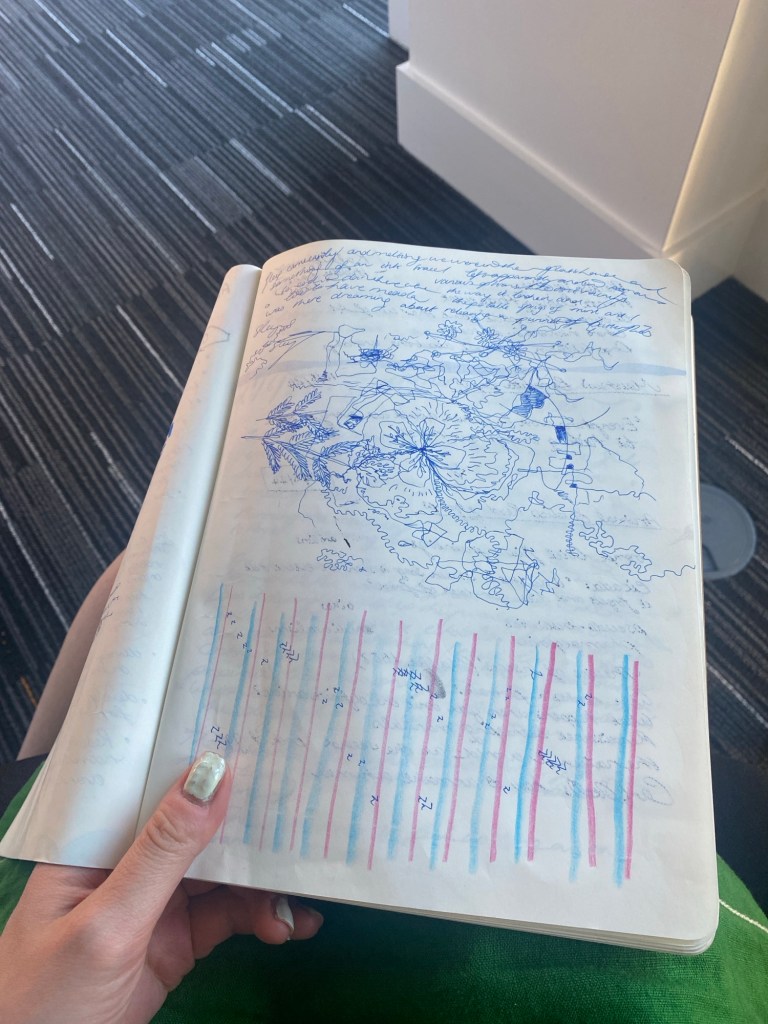
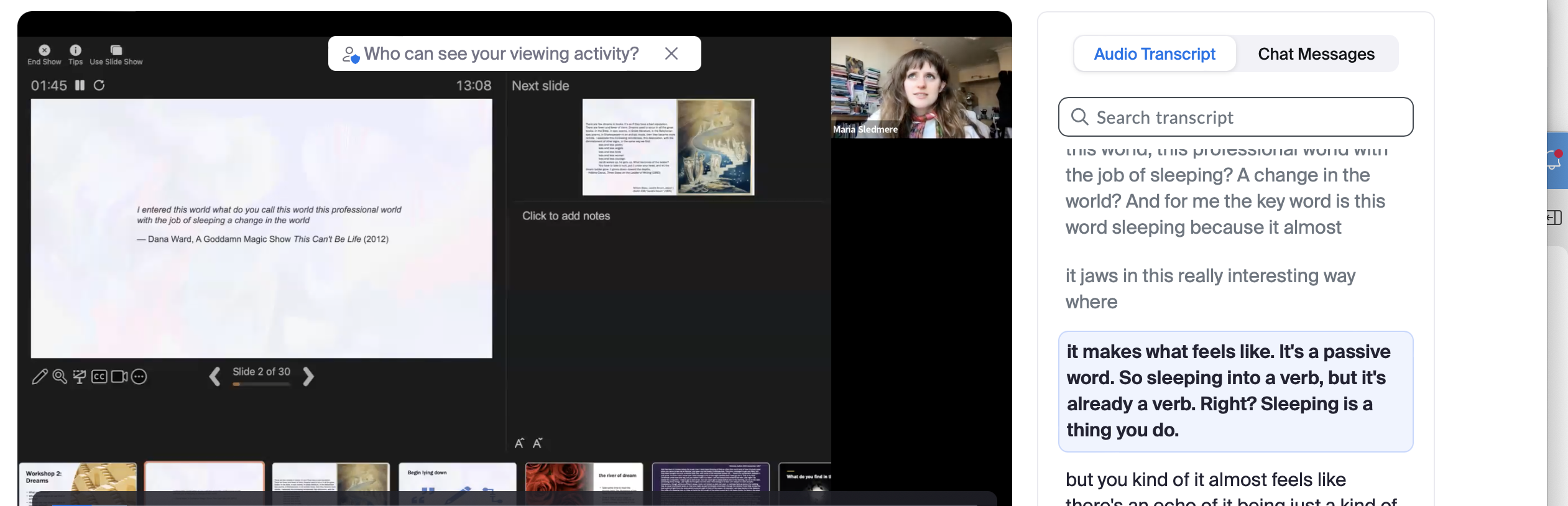
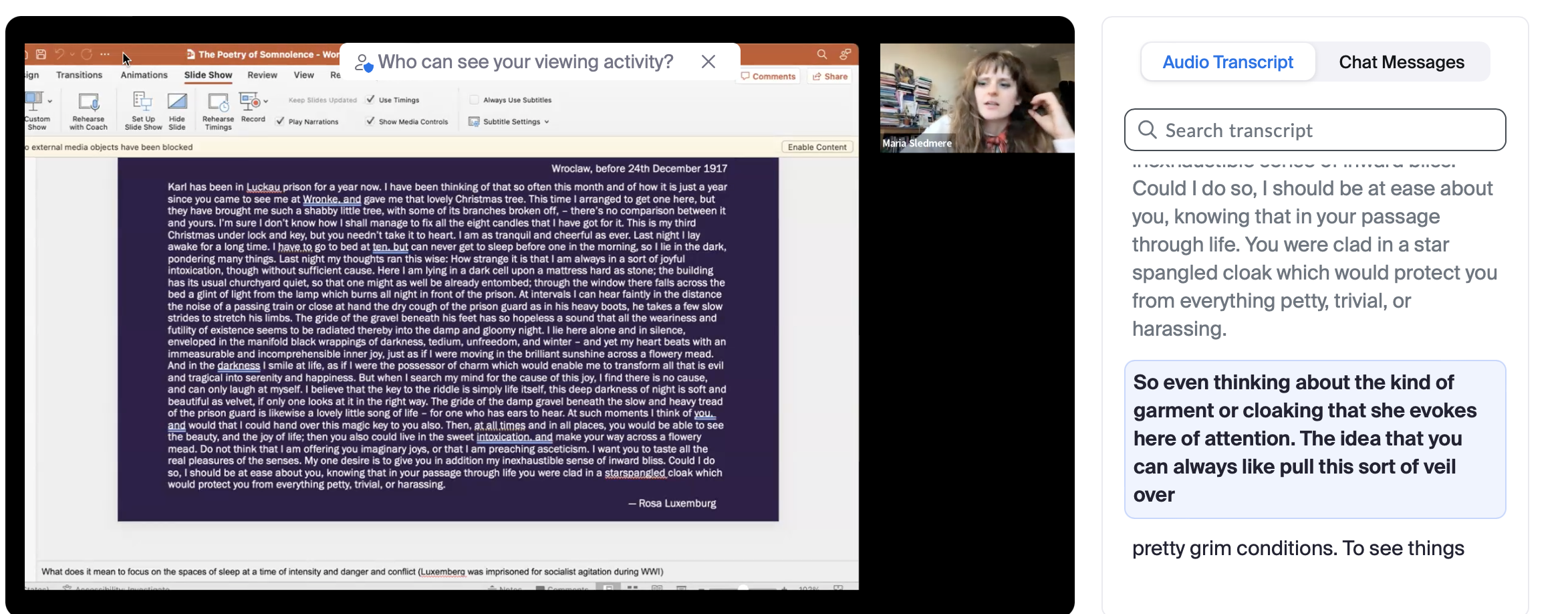
I spent the weekend in Zoomland with a group of really brilliant practitioners musing on the affordances of sleep and dreaming in our writing. We took the opportunity to discuss chronotypes, insomnia, hypnagogic poetics, oceanic feeling, nocturnes, dwelling and dreamwork among other things. Everyone has a relationship to sleep and what I love about these workshop spaces is the way so much is unlocked by paying attention to the liminal moments in the day. I really enjoyed hearing about how modifications to one’s writing environment (turning the lights off, going outside, changing the light temperature on your writing device) an affect what we write. We thought about darkness as discovery. We considered the lullaby. Sleep as a transformative force, sleep as anti-capitalist, sleep as a process of (un)becoming, sleep as trip and trance. Sleep and caregiving, sleep and safety, sleep and homemaking, sleep and the more-than-human.
Thanks to everyone who attended ❤
More events and work on sleep & somnolence will be announced in the new year!
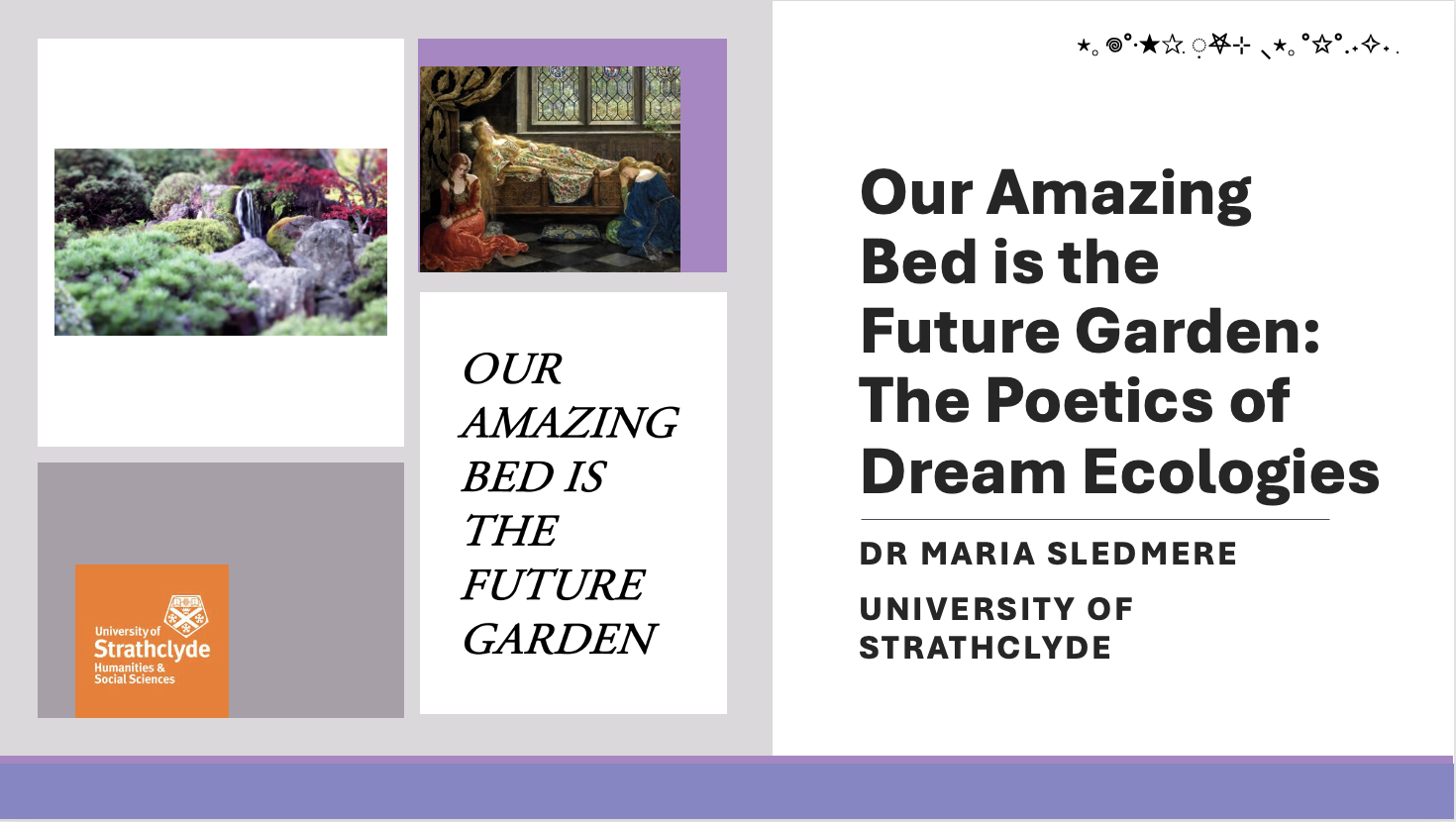
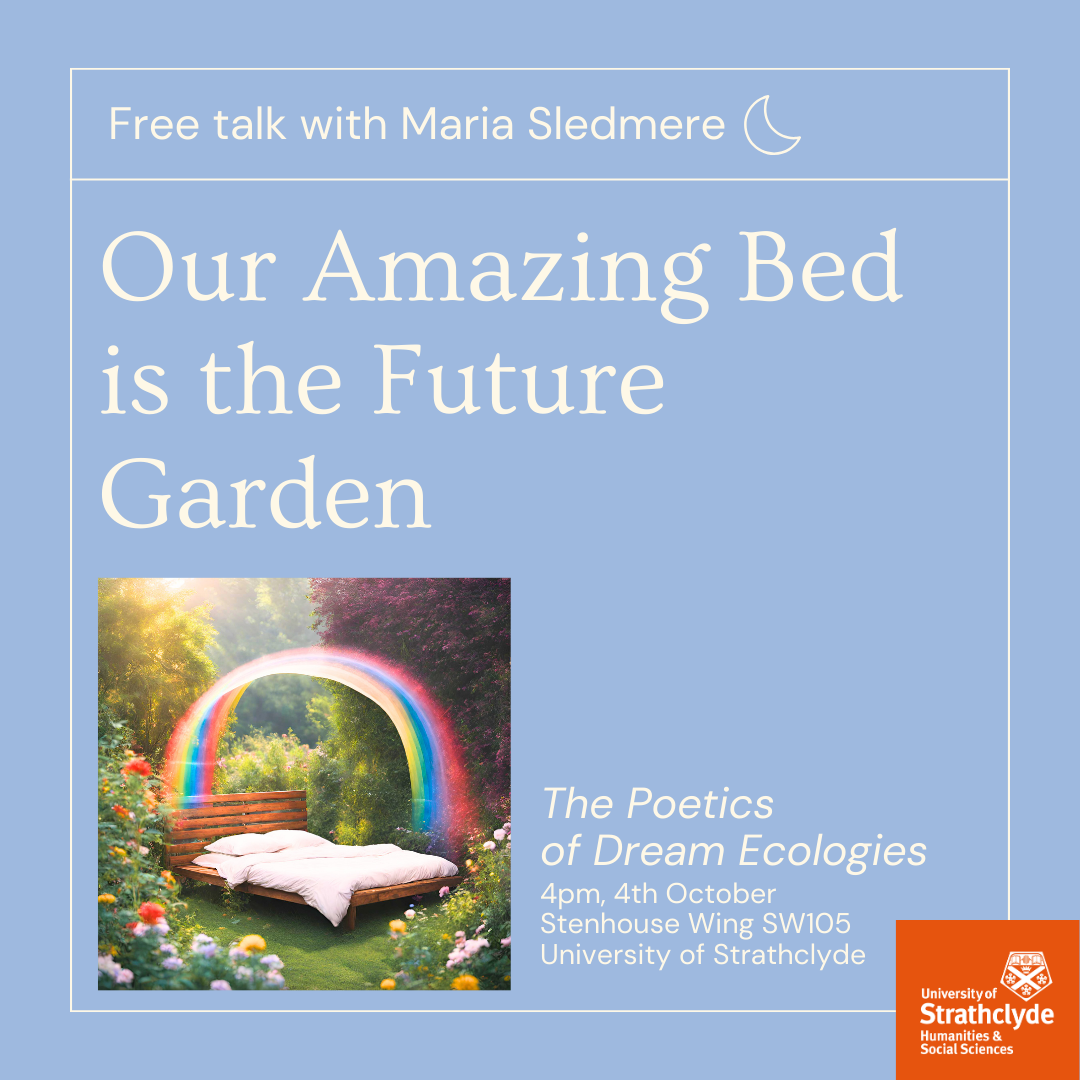
This performance lecture takes flight from the shape of a question: what is the relationship between poetic language, sleep and dream in the anthropocene? Combining poetry, journaling and critical inquiry towards the ecologies of sleep, I will consider how dreams may be the site of impossibility, drift and low-carbon pleasure in a time of ’24/7′ where, in the words of Jonathan Crary, our ability to ‘daydream’ is blocked by a constant barrage of the internet’s attention economy, the demands of late capitalist labour and ongoing crisis. Taking this as a serious political disempowerment, I look to writers whose work alters the ‘operating speed’ of daily life to make room for dreaming otherwise. Exploring the formal interventions of writers within feminist, New York and Language schools, I focus on how these works tend the unruly future garden through daily reclamations of dreamtime. If many of us are at surge capacity, how might poetry attune to various kinds of ‘slow violence’ (Crary) which often go hidden in mainstream narratives of extinction and climate crisis? How might poets borrow from the logic, content and impulse of dream to offer alternative visions of coexistence, commoning, time and compassion for other species?
Recorded at the University of Strathclyde’s Department of Humanities Seminar Series, hosted by Charles Pigott and Hannah Proctor, 4th October 2023.
My research currently centres on sleep as a nexus for thinking about energy transition, low carbon pleasure and chronodiversity (the way our circadian rhythms differ).
Tomorrow I’m giving a talk titled Our Amazing Bed Is the Future Garden: The Poetics of Dream Ecologies. It emerges from a chapter in my DFA thesis which will form part of a book forthcoming with NoUP Press next year. If you would like a Zoom link please drop me an email at maria.sledmere[at]strath.ac.uk.
This autumn I’ve got three upcoming workshops, two of them with the brilliant experimental composer Kevin Leomo.
Civil Twilight: Carving Dreamtime – workshop with Kevin Leomo and Maria Sledmere 14th October at 5:30pm, Civic House, Glasgow
Get your brain sticky in the pumpkin meat of the circadian and join Kevin Leomo and Maria Sledmere in carving dreamtime as an expression of creativity and low carbon pleasure. As the nights draw in and the clocks go back, we’ll be thinking about how darkness affects mood and slumber. Civil twilight is the brightest of the three twilight phases, where stars and planets might be seen in the sky as the sun dips just below the horizon. By attending to the ‘nocturne’ as a form in poetry and music, we’ll dwell in the possibilities of liminal experience for cultivating ecological imaginaries. Please bring: Preferred writing materials, If you have one, a reusable coffee cup, headphones and phone. Tickets are offered on a slide scale: £15 / £10 / £5. Part of Civic Harvest at Civic House – an Autumn themed day of family friendly activities, workshops and market stalls with lunch from Parveen’s and seasonal cocktails at Civic House Bar! Tickets
😴
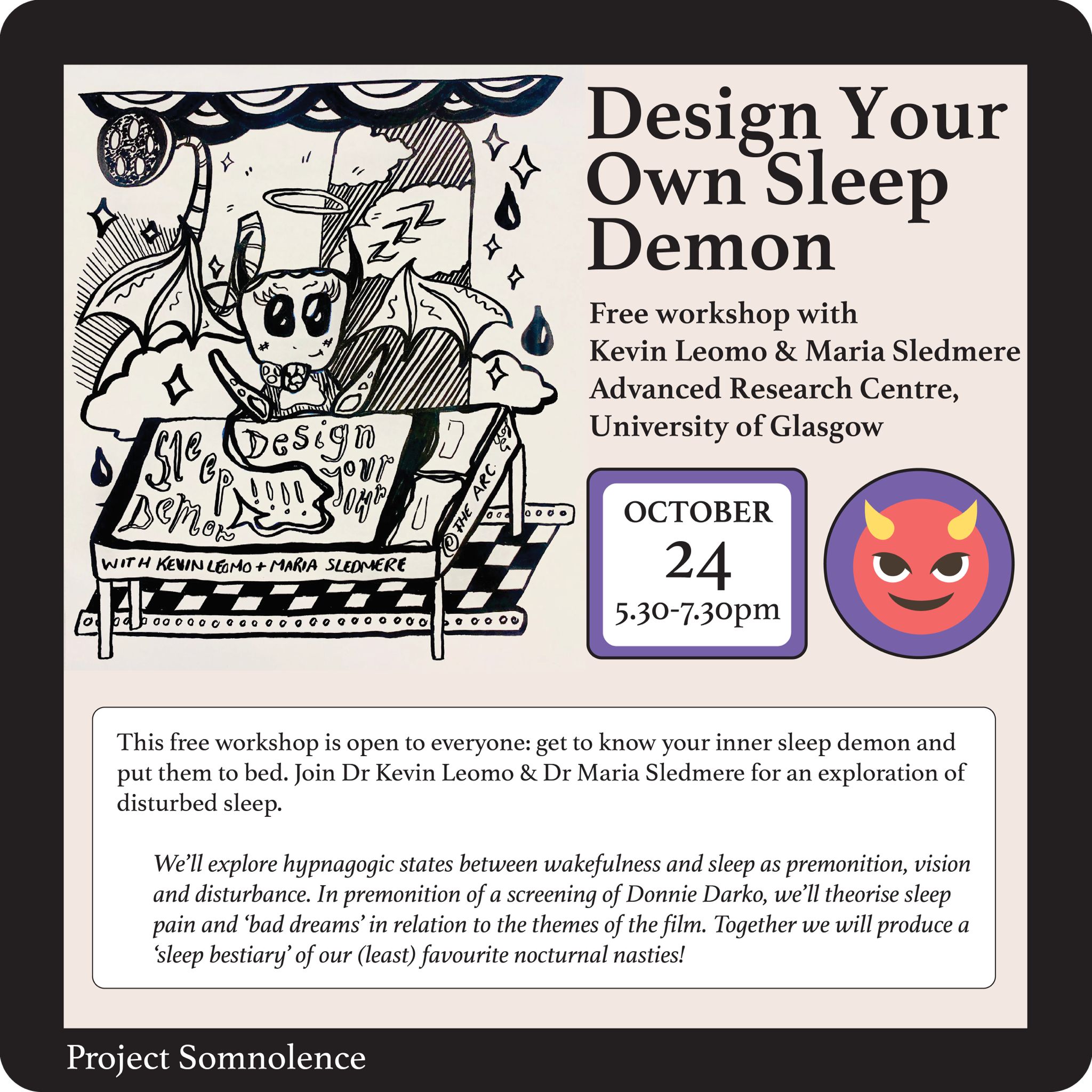
Design your own sleep demon – workshop with Kevin Leomo and Maria Sledmere 24th October at 5:30pm, Advanced Research Centre, University of Glasgow While sleep is a source of rest and recovery, many of us wrestle with disturbed sleep. If you’ve ever had nightmares or found yourself sleepwalking, you’ve encountered oneirodynia. The word comes from the Greek oneiros, meaning ‘dream’ and odyne, meaning pain. Sleep disturbance may be caused by a number of factors: from stress to stimulants, environment, illness and temperature. The eponymous protagonist of Donnie Darko is often found sleepwalking or experiencing some kind of nocturnal anguish. In this workshop, which serves as a primer for the film’s upcoming CinemARC debut, we’ll explore hypnagogic states between wakefulness and sleep as premonition, vision and disturbance. Together we will produce a ‘sleep bestiary’ of our (least) favourite nocturnal nasties, and present our findings before the screening on Friday.
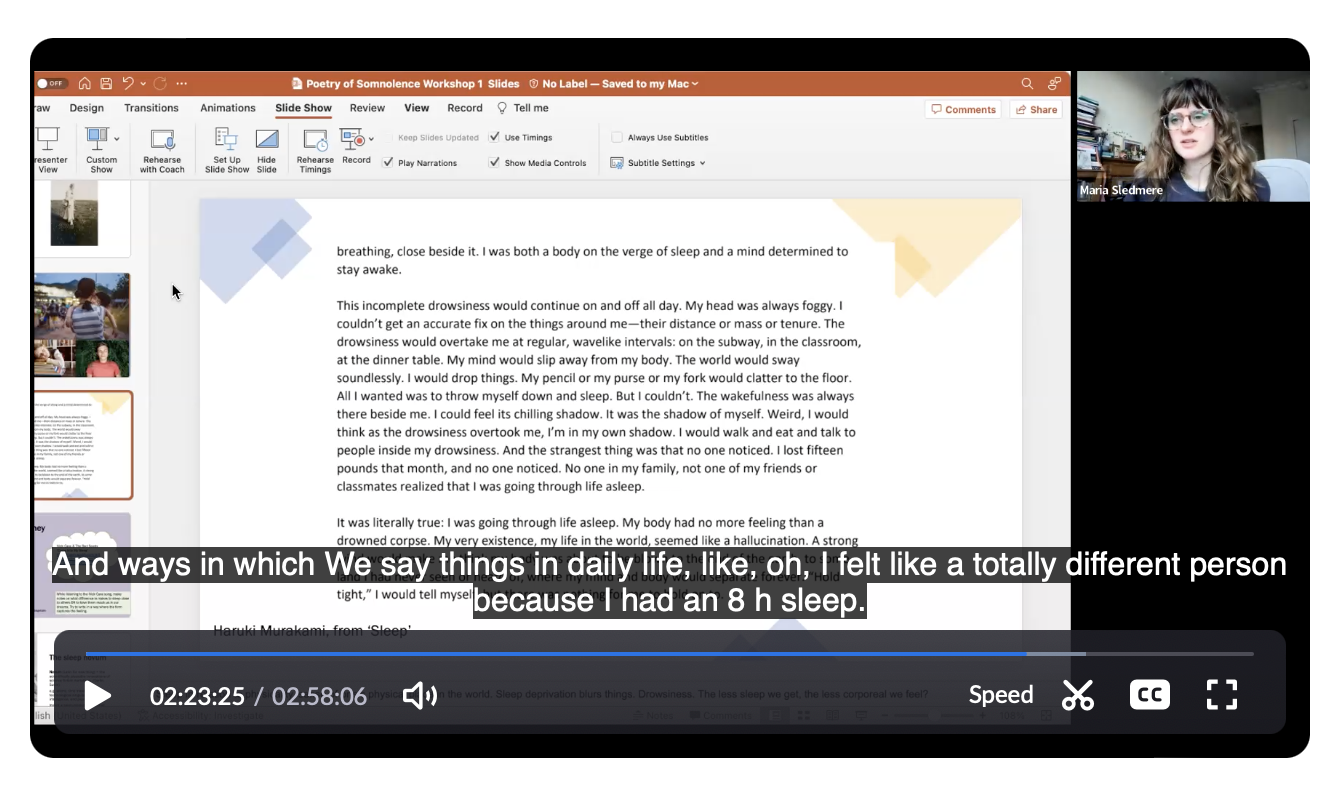
The Poetry of Somnolence – weekend double workshop with Maria Sledmere and Beyond Form Creative Writing 11th and 12th November at 1-4pm (GMT), Zoom
This 2 part series of afternoon workshops prioritise the relationship between writing and sleep. Exploring cross-genre writing, visual and sonic art, we will look at how daily writing practice can recentre our circadian rhythms. From hypnagogic poetics to dream writing, nocturnal missives, dawn songs and notes on twilight, we’ll consider experimental approaches to writing somnolence. All creatives welcome.
Workshop format will combine reading, writing, listening, optional discussion and two nap breaks.
Announcing a 2-part weekend workshop ‘The Poetry of Somnolence’ with Beyond Form Creative Writing.
Take this workshop to explore the radical, rhythmic & world-traversing poetics of sleep, whatever your creative practice!
Saturday and Sunday November 11th and 12th
1-4pm (GMT) via Zoom
😴
This 2 part series of afternoon workshops prioritise the relationship between writing and sleep. Exploring cross-genre writing, visual and sonic art, we will look at how daily writing practice can recentre our circadian rhythms. From hypnagogic poetics to dream writing, nocturnal missives, dawn songs and notes on twilight, we’ll consider experimental approaches to writing somnolence. All creatives welcome.
Workshop format will combine reading, writing, listening, optional discussion and two nap breaks. Reading will be provided in digital format (pdf or weblinks) ahead of the session.
It’s been a fair while since I posted. Struggling through Covid, another supercold (emerald phlegm forever), more transitions, finishing my thesis, April snow, more streaming of the body and ache, but here we are. It’s good to get words down. I can’t smell or taste anything at all right now (coffee is just…neutral earthiness, sweet potatoes are…mush of the orange variety, bread is…send help) — so the vicarious pleasure of language is all the more heightened. Sometimes it’s a barrier: why read about anything when your senses don’t respond? I’m drawn to the elliptical which doesn’t hold me for too long. I want to be let go or dissolve a bit. Like eking my reading through a fine mesh of muslin, a semi-permeable membrane of comprehension. Or pull it over my head, this paragraph, the whole fabric of the thing. I was gonna write about a month’s worth of reading: mostly while walking west to east along the polluted, outer commuter belt of the city; on trains between Glasgow, Inverness, London, Leeds; in frail, unwaking mornings; at the park, in that golden week, sitting in the grass with salad from Juicy and daffodils. Instead I wrote about sleep.
*
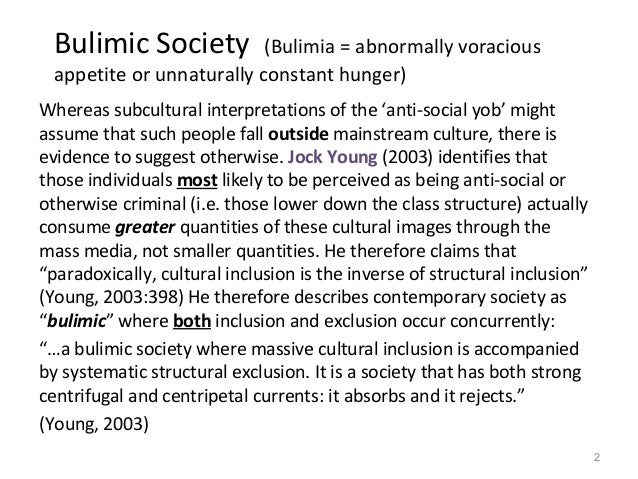
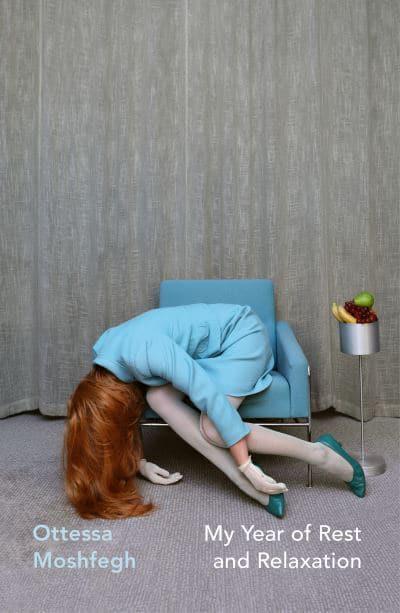
Finally I got round to reading Ottessa Moshfegh’s My Year of Rest and Relaxation (2018), a book I wanted to read especially because a trusted friend described the ending to me as ‘disappointing’. I love to glut myself on disappointment. For some reason the novel produced a similar effect on me as Tom McCarthy’s Remainder (2005), in that the pleasure was all in the premise. I would love to exist endlessly in the loop that is prolonged sleep or the reconstruction of a highly specific sensory memory. I want these novels to just go on and on like that. Of course, there has to be escalation, as per the rules of plot or ~human nature~. Is it true we can’t circle the mobius loop forever? That after a while the pleasure is desensitised, and we need to dialup on the extremity? McCarthy’s novel sort of preserves that perfect figure of eight in its set-piece ending, and you’re left with the image adrift to loop back on the primal, inciting moment of falling debris and trauma. I found the Moshfegh ending ‘cheap’ in that it seemed to cash in its bulimic character for a kind of tragedy whose fate was to fall. Bulimia, I can say, is generally an experience of permanent insolvency in the body, resulting in a loop time of binge and purge. You pay the debts of fasting by devouring; you pay the debts of eating by purging and fasting. Rinse, brush teeth, ouch, repeat. The sociologist Jock Young talks of ‘bulimic society’ as one where the poorest and most marginalised are often the most culturally enmeshed in the desperate iconography and desire economy of consumerism. The most excluded populations, according to this view, absorb images of what is apparently available under the veil of late-capitalism; but simultaneously they are rejected from accessing this culture themselves due to material inequality and class difference. As Young puts it: ‘a bulimic society where massive cultural inclusion is accompanied by systematic structural exclusion. It is a society that has both strong centrifugal and centripetal currents: it absorbs and it rejects’. But does capitalism spit us out or do we boak back? This is why I am scared to go on TikTok, like fear of lifestyle saturation to the point of nauseating breakdown.
Often powerpoint slides defining bulimia for this sociological context mention an ‘abnormally voracious appetite or unnaturally constant hunger’. In Moshfegh’s novel, the character Reva (an insurance broker) is constantly eating or constantly fasting; something our protagonist describes with pity or nonchalance. Reva is tragic because she wants too much what the protagonist effortlessly has by birth: beauty, thinness, style, money. Thinness is kind of the ur-sign for WASP privilege in the aftermath of the heroin chic fin de siècle. Reva is jealous of the protagonist’s weight loss, steals her pills. Both women are after control (or its relinquishing) in a world in freefall.
This is a period novel: set in the early 2000s, New York in the lead up to 9/11. It’s full of that inertia following the boom of the 1990s. The desire to just sleep in the unit of a single year is like a microcosm for not just an end of history, as per Fukuyama, but a refusal of history altogether as this thing that keeps growling, accumulating, disrupting sleep. I kind of buy into Reva’s bulimia as something about the consequence of being voraciously invested in a world that wants to expel you, sure. The sky’s big whitey’s the limit around Manhattan. Chewing on this feels productive. The violence of the novel is primarily in the gallery where the narrator starts out working. The gallery’s prized artist, a young man called Ping Xi, has these ‘dog pieces’: a ‘taxidermied […] variety of pure breeds’, which are rumoured to make their way into the artist’s exhibition via premature slaughter and industrial freezing. The work apparently ‘marked the end of the sacred in art’. The narrator is kind of offhand disgusted but eventually comes to identify with the young animals in the freezer, waiting to be thawed into art. Writing can be a bit like self-cannibalism; the denial of which leaves you stoked for a snack.
There are several kinds of hunger in the novel: primarily for sleep and food, but also for meaning, intimacy, loyalty. Love is a strange relation that moves uneasily between two girlfriends whose friendship is based on a premise of inequality and co-dependency. The hungers are sated by devouring emptiness. Sleep, junk food, fleeting talks. That bit in Melancholia where Justine screws her face up deliciously and says the meatloaf tastes like ashes. When I realised the same of my dinner, I didn’t even react.
We look more peaceful when sleeping. It’s worth lauding, like Lana singingPretty when I cryyyyyyyyyy………….
O, and the concept of the sad nap:
There was no work to do, nothing I had to counteract or compensate for because there was nothing at all, period. And yet I was aware of the nothingness. I was awake in the sleep somehow. I felt good. Almost happy.
But coming out of that sleep was excruciating. My entire life flashed before my eyes in the worst way possible, my mind refilling itself with all my lame memories, every little thing that had brought me to where I was.
(Moshfegh, My Year of Rest and Relaxation)
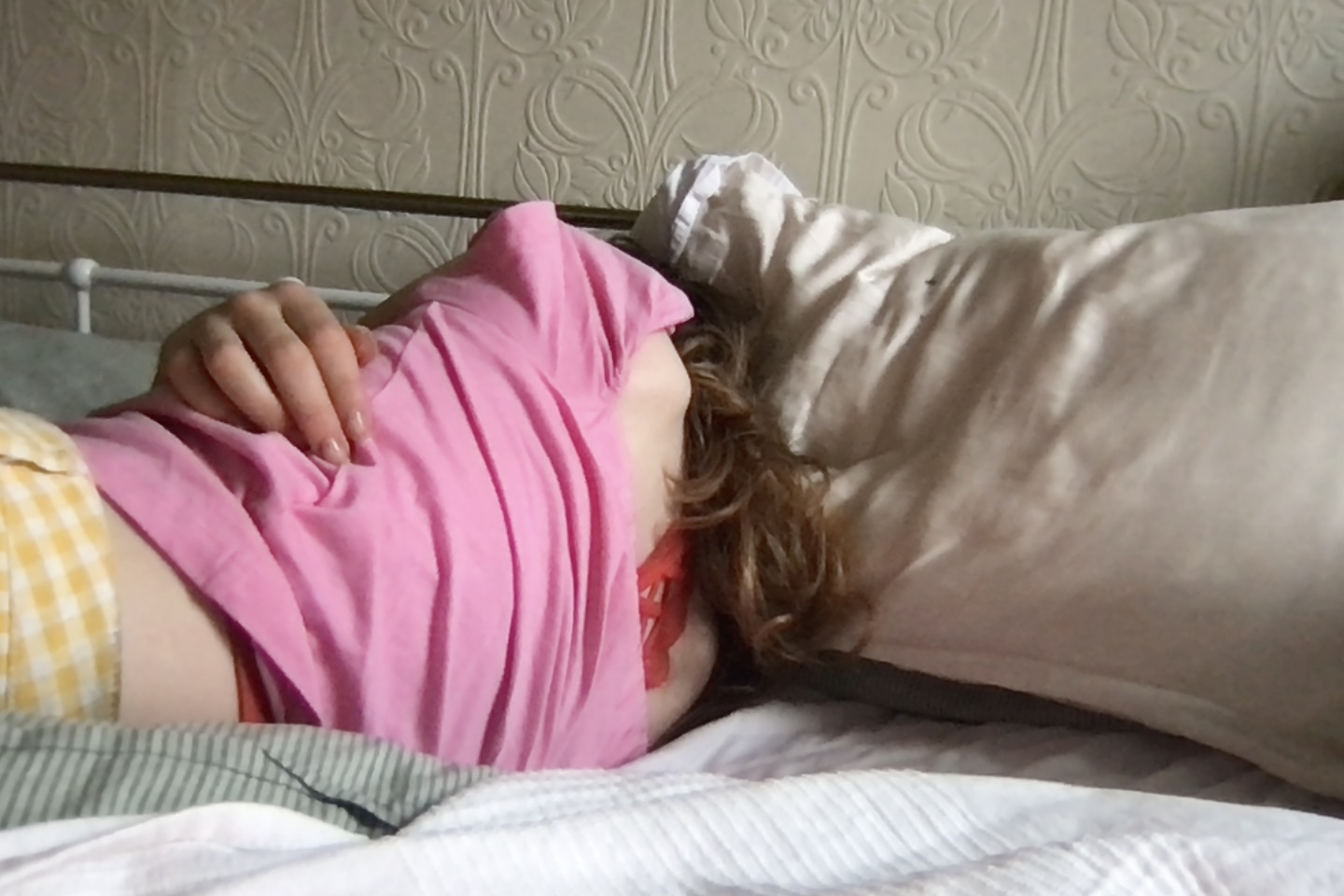
The brutal awakening cashes in on the extra expenditure of napping. I’ve written in a poem somewhere, ‘I wish I could sleep forever’. It’s different from wanting to die. It’s more like, wanting to feel aware of the nothingness and calm in its premise. Nobody needs anything from you and you can’t give anything back. It’s restful or at least prolongs the promise of rest. Stay awake super late to relish the idea that you could go to bed. I don’t remember the last time I woke up feeling energised by sleep. </3 I remember listening to an interview with the editor of Dazed where he talks about sleep being his great reset. I remember thinking wow sick cool. Whatever mental health thing he’s going through, sleep will heal it. Sleep can otherwise be a kind of emulsion of depression. You’re in the weight of it spreading right through you. I carry sleep along even when I don’t ‘have’ it.
I want you mostly in the morning when my soul is weak from dreaming (Weyes Blood, ‘Seven Words’)
I used to wake up extra early before school to steal back from sleep. I felt sleep would eat me alive. I used that time to browse the internet, write, read. Eat shitty muesli. Puke.
I’d sleep in class. Teachers would bring it up at parent’s night. I just couldn’t understand why everyone else wasn’t regularly passing out over their schoolbooks.
The perma-arousal of bulimia is a counternarrative to the inorganic sleep cycles pursued by the novel’s main character. I got a similar vibe from watching Cheryl Dunn’s Moments Like This Never Last, a documentary snapshot of the pre- and post-9/11 world of New York’s underground, showcasing Dash Snow’s graffiti and outsider art. Dash is always cheating sleep to go tag, paint, take pictures. There’s a ton of cocaine and consequence. 9/11 had toppled right through all of that leaving a wound. You know by the law of entropy that it can’t be sustained, this life, writing on the walls and all that. Maybe tagging is also about a kind of hunger-purge. Colour’s aerosol vom marking time, presence, ideas. It’s permanent, but then someone can just go clean it up; the ultimate fuck you.
Whose space does this belong to? Remainder is a novel about gentrification, the white guy’s obsessive reorganising of London spaces as precursor for the gentrification of Brixton. A novel of the zombie flaneur, fuelled on flat whites, iPad swipes and vape juice, as Omer Fast’s 2016 movie adaptation brings into focus. Moshfegh’s novel is set around the same time, but her protagonist is decidedly not a flaneur, even if she carries that vibe of the waking dead. She barely leaves her apartment to get coffees from the local bodega, and when she does venture further it has all the amnesiac disaster of a night on the NY tiles with Meg Superstar Princess, furs and all. I find this zombie existence an irresistible metaphor for the numbing effect of late-capitalism: we are overstimulated and aroused to the point of just turning off. It’s banal to say that, sure. What’s great about the Meg Superstar Princess blog girl revival is the way the writing itself is charged with like, full off-kilter zaniness. The opposite of zombie. It’s like barhopping around A Thousand Plateaus — cheap wine in one hand, vintage Android in the other —to the tune of Charli XCX and it’s absolute chaos: ‘spitting e pillz out my mouth, trying to live normal, disco n apz’. You get smashed. You’re alive! I’ll have it in writing because I can’t really have it elsewhere rn, the same way I sleep but I can’t really sleep. Apps (f)or naps?
For all this tangent on (post)pandemic hedonism (let’s say post to mean, posting and not to signal some wholescale shift in era), it’s weird how history just hits you in the face at the end of Moshfegh’s novel. Falling debris, bits of glass. Words:
On September 11, I went out and bought a new TV/VCR at Best Buy so I could record the news coverage of the planes crashing into the Twin Towers. […] I watched the videotape over and over to soothe myself that day. And I continue to watch it, usually on a lonely afternoon, or any other time I doubt that life is worth living, or when I need courage, or when I am bored.
(Moshfegh, My Year of Rest and Relaxation)
Earlier in the novel, she’s frustrated when someone replaces her VCR player with a DVD player, even though she doesn’t have any DVDs. She kind of hates the concept of the DVD. She likes the process of rewind. Video tapes, with their seriality, make you confront duration; whereas DVDs allow easy random access to specific scenes. The over and overness of Moshfegh’s careful, clean, lethargic prose is at once soothing and disturbing. When the pandemic first hit, I couldn’t stream anything because the thought of having all that content at my fingertips seemed appalling. Like accessing a trillion orderly dreams of someone else at the very moment I couldn’t even touch another person. Maybe video tapes would’ve been different. The residue of wave matter at the edge. The analogue sense of fossilised images, decaying in visible time.
In a poem called ‘Along the Strand’, Eileen Myles is like,
The times of the day, the ones with names, they are the stripes of sex unlike romance who dreamlike is a continuous walker
I love the rhythmanalysis of daily life here. VHS stripes in descending order of luminance: white, yellow, cyan, green, magenta, red, blue and black. How the speaker clings to named moments of the day as like khora: receptacles unseen for adhesive feelings. ‘Vigorous twilight’, ‘noon’ you slip into, ‘Morning’ as ‘something / I could stay with’. The times of day are lovers. If romance is continuous walking, there’s not a lot of romance in My Year of Rest and Relaxation. So after reading the novel I’m sorta stuck on wanting the romance of sleep again. Exhalations as stripes of sex. Like when you have a new partner and after a few weeks of breathless sleeplessness suddenly the first thing you realise is how well you’re sleeping, like being beside them all night just fixed your life. And so to be in love you know noon tastes different, and twilight has a lilac halo. And you’re sharing this shiny sticky static in the air like asterisks, so much more to say.
*
Sleep. After a long walk, I remember circling South Norwood Lake and humming Elliott Smith’s ‘Twilight’, because of the time. You asked me to sing it. I had a low voice, a high voice. I was just waking up; the air was all lavender, leaves in fall.










 mariaology